
Morocco desert tours: Culture, and insider tips
- Morocco desert tours often fall short of expectations due to misleading claims about facilities and exclusivity.
- Travelers should verify vehicle comfort, guide arrangements, camp amenities, and privacy details in writing before booking to ensure a genuine high-end experience.
- Choosing the right region and planning a well-paced itinerary maximize comfort, authenticity, and cultural immersion during the journey.
There is a persistent myth floating around travel forums and glossy brochures: book a Morocco desert tour, and a flawless, five-star experience automatically awaits you. The reality is more nuanced. Even premium-priced camps in the Sahara can surprise guests with cold showers, shared bathroom facilities, or a minivan instead of a private SUV. This guide cuts through the marketing noise to show you exactly what genuine means in Morocco’s desert, which region suits your travel style, how to plan an itinerary that won’t exhaust you, and the smart questions you should ask before you hand over a single dirham.
Table of Contents
- What define Morocco desert tour tours?
- Comparing Morocco’s desert regions: Merzouga, Erg Chigaga, and Zagora
- Planning your itinerary: Optimal durations and essential logistics
- Bespeaking your desert experience: Genuine cultural immersion and service quality
- The uncomfortable truth about Morocco desert tours
- Experience and authenticity with Morocco Tours
- Frequently asked questions
Key Takeaways
| Point | Details |
|---|---|
| Variable | Morocco desert tours can differ dramatically; always verify driver quality and camp amenities before booking. |
| Region choice matters | Picking Merzouga, Erg Chigaga, or Zagora fundamentally shapes your camp experience, remoteness, and available services. |
| An itinerary impacts comfort | Short, optimized Morocco desert tours can feel rushed—allow five days or more for genuine relaxation and immersion. |
| Ask for specifics | Savvy travelers demand detailed amenity lists, service flexibility, and evidence-backed promises before committing. |
What define Morocco desert tours?
With misconceptions revealed, let’s unpack what high-end actually means for desert travelers.
When tour operators label a trip, they are drawing on a wide spectrum of standards. An experience in Paris means something very specific. In the Moroccan Sahara, it can mean almost anything. You might arrive at a beautifully photographed camp and discover that “private bathroom” means a separate toilet tent shared among four guests or that hot water is available for exactly 30 minutes each evening. These are not hypothetical problems. They are the kind of real-world surprises that surface in detailed traveler reviews, again and again.
The core areas that can mislead you:
- Vehicle comfort: A true tour should include a modern, air-conditioned 4×4 or SUV. Many tours list “comfortable transport” but deliver older minivans without reliable air conditioning, particularly on long desert drives.
- Driver vs. dedicated guide: Some operators bundle the roles of driver and guide into one person. A genuinely bespoke experience separates these roles, giving you a knowledgeable guide while a professional driver focuses on navigation and vehicle management.
- Camp amenities: Private tent bathrooms, hot water availability, functional flush toilets, and reliable electricity are not guaranteed even at higher price points.
- Group size and privacy: A “small group” tour might still have 8 to 12 people sharing camp facilities. “True” means you control your group composition.
As one thorough traveler review notes, tour logistics vary significantly even within premium products, with comfort factors like air-conditioned vehicles and dedicated guides making the biggest difference in satisfaction. The same review cautions that some camps can still feel gimmicky or constrained by sand, water, and shower limitations compared to expectations set by marketing images.
“The gap between a camp’s photographs and its day-to-day reality can be surprisingly wide. The most important word in any booking conversation is ‘confirm,’ not ‘assume.’”
Pro Tip: Before booking, request a written amenity checklist from your operator, covering hot water hours, toilet type, tent size, electricity access, and whether your tent has an ensuite or shared bathroom. A reputable operator will provide this without hesitation. If they resist, treat that as a warning sign.
Your pre-booking checklist:
- Is the vehicle a private, air-conditioned 4×4 or SUV?
- Is there a dedicated guide separate from the driver?
- Does each tent have a private or ensuite bathroom?
- Is hot water available at all hours or only at set times?
- Is the camp exclusively for your group or shared with other parties?
- Are there any facilities that are unavailable during peak or off-season periods?
These are not paranoid questions. They are exactly the kind of tour booking tips that separate a great desert experience from a disappointing one. Smart travelers ask them upfront.
Comparing Morocco’s desert regions: Merzouga, Erg Chigaga, and Zagora
Understanding the meaning of luxury, we now turn to choosing the right desert region for your bespoke experience.
Morocco offers three primary desert destinations for travelers, each with a very different character. Choosing between them is not simply a matter of preference. It materially shapes your camp type, your drive time, your level of remoteness, and the kind of experience you can realistically expect. As one traveler who drove 1,200 km across Morocco in three days discovered, the desert region you select completely changes what the Sahara actually teaches you and how grueling or sublime the journey feels.
The three regions at a glance
| Region | Distance from Marrakech | Remoteness level | Typical camp style | Best for |
|---|---|---|---|---|
| Merzouga (Erg Chebbi) | ~560 km (approx. 9 hours) | Moderate | Boutique and glamping tents with good amenities | First-time travelers |
| Erg Chigaga | ~650 km (approx. 10-11 hours) | High | Exclusive private camps, fewer guests | Travelers seeking true seclusion |
| Zagora | ~360 km (approx. 5-6 hours) | Low to moderate | Comfortable and accessible camps | Shorter trips, families |
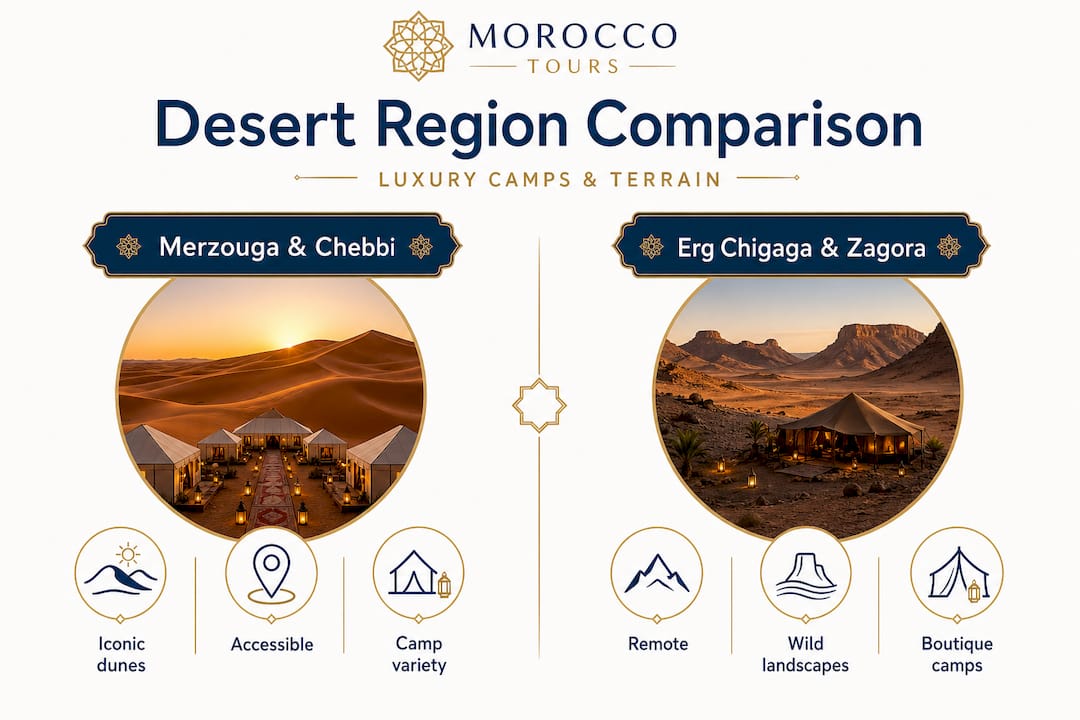
Merzouga and Erg Chebbi sit in southeastern Morocco and feature the iconic golden dunes most travelers picture when they think of the Sahara. The dunes of Erg Chebbi reach up to 150 meters in height, and the area has developed a solid infrastructure and boutique camps. Accessibility is relatively straightforward, meaning operators can deliver consistent amenities and service. The trade-off is that Merzouga attracts more visitors, so true seclusion requires selecting a camp that is positioned away from the main tourist cluster.
Erg Chigaga, in the Draa Valley region near M’hamid, is Morocco’s most remote major dune system. Reaching it requires a serious 4×4 journey through dirt tracks. There are no paved roads leading directly to the dunes. That remoteness translates into a more exclusive experience: fewer camps, fewer guests, and a genuine sense of being deep in the Sahara. Operators who work in Erg Chigaga tend to cater to a smaller, more discerning clientele. Expect higher prices and fewer amenity compromises, but plan your itinerary carefully because the logistics are demanding.
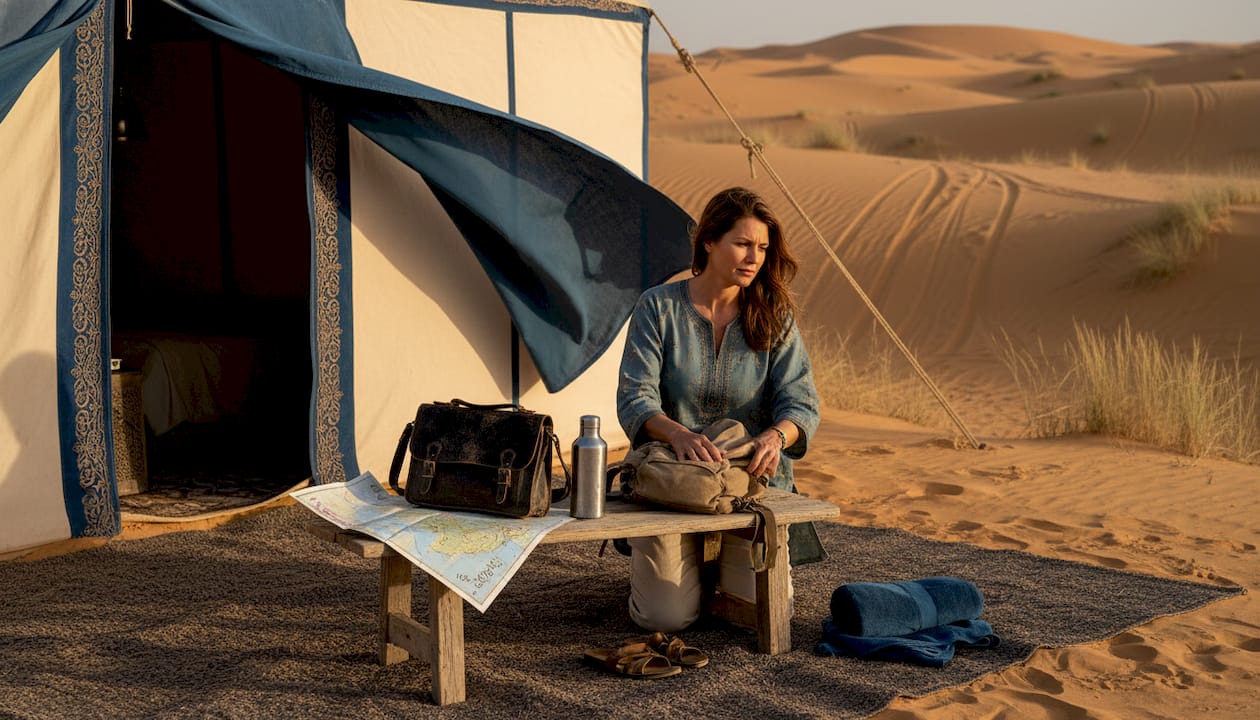
Zagora offers a middle path. It sits closer to Marrakech than either Merzouga or Erg Chigaga, making it an option for travelers with tighter schedules. The landscape is more varied, blending rocky desert terrain with sandy areas and oases. The dunes here are less dramatic than Erg Chebbi, but the cultural richness of the Draa Valley more than compensates. Camps in Zagora tend to be well-appointed and accessible, though the desert immersion is less intense than in the southeast.
Key considerations by region:
- Merzouga suits travelers wanting the classic Sahara dune experience with reliable infrastructure
- Erg Chigaga suits those who want genuine remoteness, exclusivity, and a once-in-a-lifetime feel
- Zagora suits travelers on shorter timelines or those who want to pair desert with oasis and valley scenery
Comparing desert region differences before booking prevents the most common disappointment: paying for one type of experience and arriving at another. Your operator should be able to explain these distinctions clearly and match you with the region that genuinely fits your expectations. Also, reviewing desert itinerary ideas for each region helps you visualize the full arc of the journey, not just the destination.
Planning your itinerary: Optimal durations and essential logistics
Once you know which region matches your style, it is critical to plan an itinerary that delivers both adventure and relaxation.
One of the most common itinerary mistakes desert travelers make is underestimating drive times. Morocco is a large country. The roads between Marrakech and the Sahara are scenic and winding, passing through the Atlas Mountains, the Todra Gorge (a dramatic limestone canyon in the High Atlas), and the Dades Valley. These stretches are genuinely beautiful, but they also take time. A traveler who tries to rush to the desert and back in two or three days will spend more time in a vehicle than in the experience itself.
A detailed six-day tour review makes the case clearly: attempting to visit the Sahara from Marrakech in fewer than five days risks turning the journey into an exhausting slog. The recommendation is at least five days for a comfortable, immersive experience, and six days if you want breathing room for stops, side trips, and genuine rest.
Recommended itinerary durations by experience type:
| Tour duration | Experience level | Regions covered | Recommended for |
|---|---|---|---|
| 3 days | Basic | Zagora only | Not recommended for travelers |
| 5 days | Comfortable | Merzouga or Zagora with stops | Minimum for genuine desert immersion |
| 6 days | Optimal | Merzouga with Atlas and valley stops | Most travelers |
| 8+ days | Immersive | Merzouga and Erg Chigaga combined | Deep Sahara enthusiasts |
How to build a logical five- to six-day desert itinerary:
- Day one: Depart Marrakech, cross the High Atlas via the Tizi n’Tichka Pass, visit Ait Benhaddou (a UNESCO World Heritage ksar, or fortified village), and overnight in Ouarzazate.
- Day two: Drive through the Dades Valley and the Todra Gorge, stopping for walks and photography; overnight in the Dades Valley.
- Day three: Arrive at Merzouga in the afternoon, take a camel ride at sunset to the camp, and spend the night in the Sahara.
- Day four: Sunrise in the dunes, morning activities (quad biking, sandboarding, or visiting a Berber nomad family), late departure toward the Ziz Valley.
- Day five: Return journey via a different route, passing through Erfoud and the Tafilalt palmeraie (Morocco’s largest palm grove), and overnight near Midelt or Ifrane.
- Day six: Return to Marrakech via the cedar forests of the Middle Atlas.
Pro Tip: Ask your operator specifically whether the return route differs from the outbound route. Travelers should experience two distinct landscapes, not retrace the same road. A good operator builds this variation in as a standard.
Essential logistics questions before you commit:
- What is the exact vehicle model, and how old is it?
- Will the same driver accompany you for the entire trip?
- What is the guide-to-guest ratio?
- Are all overnight accommodations confirmed in advance, or are they subject to availability?
- What happens if a road is blocked by weather or construction?
Reviewing unique experiences in advance helps you identify the signature moments worth building into your itinerary, whether that is a private dinner in the dunes, a night of traditional Gnawa music, or a private guided visit to a remote oasis village.
Bespeaking your desert experience: Genuine cultural immersion and service quality
With your itinerary shaped, the next step is curating a desert tour that blends authenticity and high-end service.
The word “bespoke” is as overused in travel marketing as “luxury.” A truly bespoke Morocco desert tour is not defined by thread counts or Instagram-worthy tent designs. It is defined by the depth and quality of cultural access you receive and by the operator’s willingness to customize every detail to your preferences.
What genuine cultural immersion looks like in practice:
- A private Berber guide who speaks your language and can explain desert ecology, tribal history, and local traditions in detail
- A visit to a nomadic family’s camp, not a staged performance but a genuine introduction facilitated through the guide’s personal connections
- Traditional Berber cuisine prepared by a camp cook who sources local ingredients, not a buffet of generic tagines
- An oasis walk that explains the traditional khettara irrigation system (ancient underground water channels that have sustained desert communities for centuries)
- A private stargazing session with a guide who knows the constellations visible in the Sahara and can connect them to Berber navigational traditions
“The difference between a commercial tour and a bespoke one is not price. It is access. The best operators open doors that no amount of solo planning can replicate.”
However, as practical reviewers have noted, even camp marketing may not guarantee sealed hot showers or reliable water. High-end travelers should request concrete facility details: whether the private bathroom is genuinely ensuite within the tent, what the hot water policy is, where the camp is located relative to the dunes, and whether water is rationed during stays. Asking these questions is not pessimistic. It is how you protect a significant investment.
There is also the question of what “private” actually means. As reviewed by experienced desert travelers, many small-group desert tours still feel commercial and budget-like despite being marketed as luxury. A small bus or shared minivan with a group of strangers is not a private experience, regardless of the camp’s marketing photographs. Before booking, confirm whether “private” means a vehicle and guide exclusively for your group, guaranteed premium tent allocation, and the flexibility to adjust the schedule as you go.
Smart questions to separate bespoke from commercial:
- Can I visit a nomadic family as part of the itinerary?
- Is the camp shared with other tour groups or exclusively for my party?
- Can the itinerary be adjusted on the day if I want to spend more time somewhere?
- Who prepares the food, and can dietary preferences be accommodated?
- Is there a cultural program (music, storytelling, stargazing) that is private to my group?
Exploring desert camel ride options in advance also helps you understand what premium camel trek experiences look like compared to the basic alternatives most operators offer. And if oasis visits are important to you, reviewing authentic oasis experiences will show you the difference between a brief photo stop and a genuinely immersive afternoon in a living desert ecosystem.
The culture of the Moroccan Sahara is extraordinarily rich. The Amazigh (Berber) people have inhabited these landscapes for thousands of years, developing deep knowledge of desert navigation, herbal medicine, water management, and oral history. A bespoke tour should give you real access to that knowledge through guides who are genuinely connected to these communities, not reciting scripted talking points for tourists.
The uncomfortable truth about desert tours
Here is what years of curating Moroccan desert experiences have taught us: there is not a fixed standard in the Sahara. It is a negotiated reality between what an operator promises, what the desert environment actually permits, and what a traveler expects based on their past travel experiences.
Most travelers who feel let down by a desert tour were not deceived in bad faith. They were simply working from different assumptions than their operator. When you have stayed in five-star hotels in Dubai, “camping” sounds like a seamless extension of that world. In practice, you are in a remote desert environment where water is scarce, electricity runs on generators, and sand finds its way into places you would prefer it did not. That reality is not a failure. It is the nature of the place.
The travelers who have the best experiences are those who understand this distinction. They embrace the raw environment while insisting on the specific comforts that matter most to them: a private bathroom, a reliable guide, excellent food, and a well-maintained vehicle. They do not expect the Sahara to behave like a Parisian hotel.
The smartest approach we consistently recommend is to prepare a personal comfort priority list before you speak to any operator. Rank the amenities that are non-negotiable for you. Then, when reviewing operators, ask directly whether each item on your list is guaranteed in writing. A transparent operator will confirm, clarify, or suggest alternatives. An operator who deflects these questions or answers vaguely is telling you something important about how they will handle problems once you are already in the desert.
We also believe that the most honest measure of a desert tour is not the tent design or the camp website. It is the operator’s responsiveness and transparency during the booking process. How quickly do they answer your questions? Do they proactively share logistical details or wait until you ask? Do they have a protocol for handling problems? These behaviors predict your in-desert experience far more accurately than any photograph.
Finally, read reviews carefully and skeptically. Look for reviews from travelers whose expectations and travel style resemble yours. A solo backpacker’s definition of “amazing desert camp” is very different from yours. Filter for travelers, and filter for the specific region and camp type you are considering. The tour booking tips that actually protect your investment are always rooted in specific, verifiable details, not general enthusiasm.
Experience authenticity with Morocco Tours
You have learned what separates genuine from marketing language, which desert region fits your travel style, how to plan a meaningful itinerary, and the exact questions that protect your investment. Now, the next step is finding an operator who delivers on all of it without compromise.
At Morocco Tours, we specialize in private, fully customized desert experiences designed for discerning international travelers. Every detail of your journey, from the vehicle and guide to the camp amenities and cultural program, is confirmed in writing before you travel. Our signature Morocco tour brings together the most compelling desert landscapes, authentic Berber cultural access, and premium logistics into a single, seamlessly managed journey. If you are ready to experience the Sahara the way it deserves to be experienced, we are ready to design it with you.
Frequently asked questions
How can I ensure my desert camp in Morocco has hot water and private bathrooms?
Ask your operator for photographic proof and a written description of the facilities, and clarify whether hot water is available throughout your stay rather than only at set hours.
What is the minimum recommended duration for a desert tour starting from Marrakech?
Plan at least five days for a comfortable, immersive trip; shorter itineraries risk becoming exhausting because drive times to the Sahara and back consume a disproportionate share of a brief trip.
Which desert region, Merzouga, Erg Chigaga, or Zagora, is best for tours?
Each region offers distinct camp types and experiences; Merzouga (Erg Chebbi) is most accessible, Erg Chigaga is more remote and exclusive, and Zagora offers comfort with closer desert proximity to Marrakech.
How do I avoid commercial or non-authentic desert tour experiences?
Confirm that “private” means an exclusive vehicle and guide for your group only, and ask about guaranteed camp upgrades and specific cultural immersion activities before you pay.