
Morocco Jewish Tours: Discover Heritage
- Morocco Jewish Tours’ history reflects a vibrant, resilient community that has maintained active sites and traditions despite emigration.
- Jewish heritage tours offer deep, personalized experiences through meaningful community interactions and well-curated itineraries.
Morocco holds a secret that most travelers completely miss. The country’s Jewish history is not a relic locked away in dusty archives or half-forgotten ruins. It lives in active synagogues, in the warm conversations of community elders, in the aromatic corridors of ancient mellahs, and in the careful work of preservationists who are shaping these sites for future generations. A well-designed Jewish heritage tour in Morocco gives you direct access to all of it, both the celebrated landmarks and the quietly remarkable encounters that most visitors never experience.
Table of Contents
- Understanding Morocco’s Jewish heritage today
- What to expect from a Morocco Jewish tour
- Key sites and experiences: Not just the classics
- How to navigate nuances: Politics, storytelling, and respectful travel
- Our take: What most travelers get wrong about Jewish heritage in Morocco
- Ready to experience Morocco’s Jewish heritage?
- Frequently asked questions
Key Takeaways
| Point | Details |
|---|---|
| Living heritage | Morocco’s Jewish culture remains active, offering meaningful encounters for travelers. |
| Tailored tours | Jewish heritage journeys can be highly customized for authentic, upscale experiences. |
| Understand narrative nuance | Site interpretations sometimes have political undertones, so ask tour providers about their approach. |
| Beyond famous sites | The most memorable moments often come from smaller communities and personal interactions. |
| Tour responsibly | Respectful behavior and choosing thoughtful interpretations ensure positive engagement with Morocco’s Jewish heritage. |
Understanding Morocco’s Jewish heritage today
Morocco’s Jewish story stretches back more than 2,000 years, making it one of the oldest continuous Jewish presences in the world. Long before the Arab conquest of North Africa, Jewish communities had already established roots throughout what is now Morocco. The medieval period brought waves of Sephardic Jews expelled from Spain in 1492, many of whom settled in cities like Fes, Meknes, and Casablanca. These arrivals enriched Moroccan Jewish culture enormously, contributing to religious scholarship, trade networks, and a distinctive blend of Sephardic and North African traditions.
Over the following centuries, the Jewish community grew to well over 250,000 people at its peak in the mid-20th century, representing a vibrant and economically significant segment of Moroccan society. Then came the mid-century migrations. The establishment of Israel in 1948, followed by periods of regional tension and evolving social dynamics, prompted a large-scale emigration. By the 1970s and 1980s, the community had dramatically reduced in size.
Morocco’s Jewish population is currently estimated at around 2,000, with a much larger diaspora overseas, particularly in Israel, France, and Canada.
That number sounds small. But what remains is genuinely active. Synagogues hold regular services. Jewish cemeteries receive ongoing care and visits. Community centers in Casablanca and a few other cities remain functioning social hubs. King Mohammed VI has publicly championed the restoration of Jewish heritage sites as a national priority, framing Moroccan Jewish history as an inseparable thread in the broader national identity.
This modern revival context is critical when you start thinking about travel in Morocco centered on Jewish heritage. The sites you visit are not stage sets. Many are leaving places of worship and memory. That distinction shapes every meaningful itinerary.
| Era | Estimated Jewish population | Key centers |
|---|---|---|
| 15th century (post-Iberian expulsion) | 50,000+ | Fes, Meknes, Marrakech |
| Mid-20th century peak | 250,000+ | Casablanca, Rabat, Fes |
| Early 21st century | ~5,000 | Casablanca, Marrakech |
| Present day (2026) | ~2,000 | Casablanca (primary) |
Understanding this timeline helps you ask smarter questions of any tour provider. Are they focusing exclusively on medieval history? Are they connecting you with present-day community members? Are they treating the entire era between 1948 and today as simply “decline,” or are they showing you the resilience and continuity that actually characterizes this story?
Key facts worth knowing before you book:
- Morocco’s Jewish community predates Islam in the region by centuries
- The mellah (Jewish quarter) system was established in Fes in the 15th century
- Morocco is one of very few Arab-majority countries where Jewish culture receives active official state support
- Multiple restoration projects are funded jointly by the Moroccan government and diaspora organizations
What to expect from a Morocco Jewish tour
With this background, it’s essential to know what you’ll actually see and do on a Jewish tour of Morocco and how to get the most out of every moment.
A thoughtfully designed Morocco Jewish heritage itinerary typically spans seven to twelve days, combining major imperial cities with smaller towns and moments of genuine community access. Your days will rarely feel like a checklist. Instead, mornings might begin with a guided walk through a mellah, the historic Jewish quarter found in several major Moroccan cities, followed by a visit to a restored synagogue and a conversation with a local historian or community leader.
Lunch might be at a restaurant that practices or acknowledges traditional Moroccan Jewish cuisine. Evenings can involve cultural performances, private dinners, or simply quiet time in a beautifully designed riad that reflects the layered cultural history of the city around you.
Group tour vs. private bespoke experience:
| Feature | Standard group tour | Private tour |
|---|---|---|
| Group size | 10 to 25 travelers | 1 to 8 travelers |
| Itinerary flexibility | Fixed schedule | Fully customizable |
| Community access | General site visits | Potential private meetings |
| Accommodation | Mixed-category hotels | Curated riads and hotels |
| Guide specialization | General heritage guide | Specialist in Jewish history |
| Pacing | Fast, scheduled | Relaxed, interest-driven |
| Kosher dining options | Limited or incidental | Researched and arranged |
The difference is significant for Jewish heritage travelers specifically. Private tours allow you to slow down at sites that matter most to you personally. If your family has roots in Fes or Mogador (now Essaouira), a bespoke operator can structure extra time in those locations and even assist with genealogical research.
One critical point to raise with any operator relates to interpretive framing. Heritage site programming at Jewish sites in Morocco may be politically contested, with some restoration projects connected to political agendas rather than purely cultural preservation. Asking your guide how they approach this complexity is not just smart; it is respectful to the communities involved.
Pro Tip: Before booking, ask your tour provider directly: “Who funds the restoration of the sites we’ll visit, and how does your guide team address contested narratives?” A confident, nuanced answer signals a thoughtful operator. Hesitation or deflection signals the opposite.
Questions to ask your tour provider before booking:
- Do your guides have specific academic or community-based training in Moroccan Jewish history?
- Will we have opportunities to meet members of the living Jewish community?
- How do you handle sites that may carry politically sensitive interpretations?
- Are kosher dining options researched in advance, and how are they sourced?
- Can the itinerary be adjusted to accommodate personal family history research?
- How do you ensure that community members benefit from our visit, not just the tourism economy?
- What is your policy on photography at active religious and communal sites?
Explore Morocco itineraries that go beyond the standard tourist circuit to understand how these questions can shape a genuinely richer journey.
Key sites and experiences: Not just the classics
Understanding what’s possible lets you focus on experiences that move beyond guidebooks for a truly memorable, personal journey.
Major city highlights
Casablanca’s Beth-El Synagogue is one of the most striking active synagogues in Africa. Built in the early 20th century, the building is stunning in its architecture, and the fact that it remains a functioning house of worship makes a visit feel genuinely meaningful rather than purely historical. The city also hosts the Moroccan Jewish Museum, the only Jewish museum in an Arab country, which holds thousands of artifacts documenting community life, religious practice, and art across the centuries.
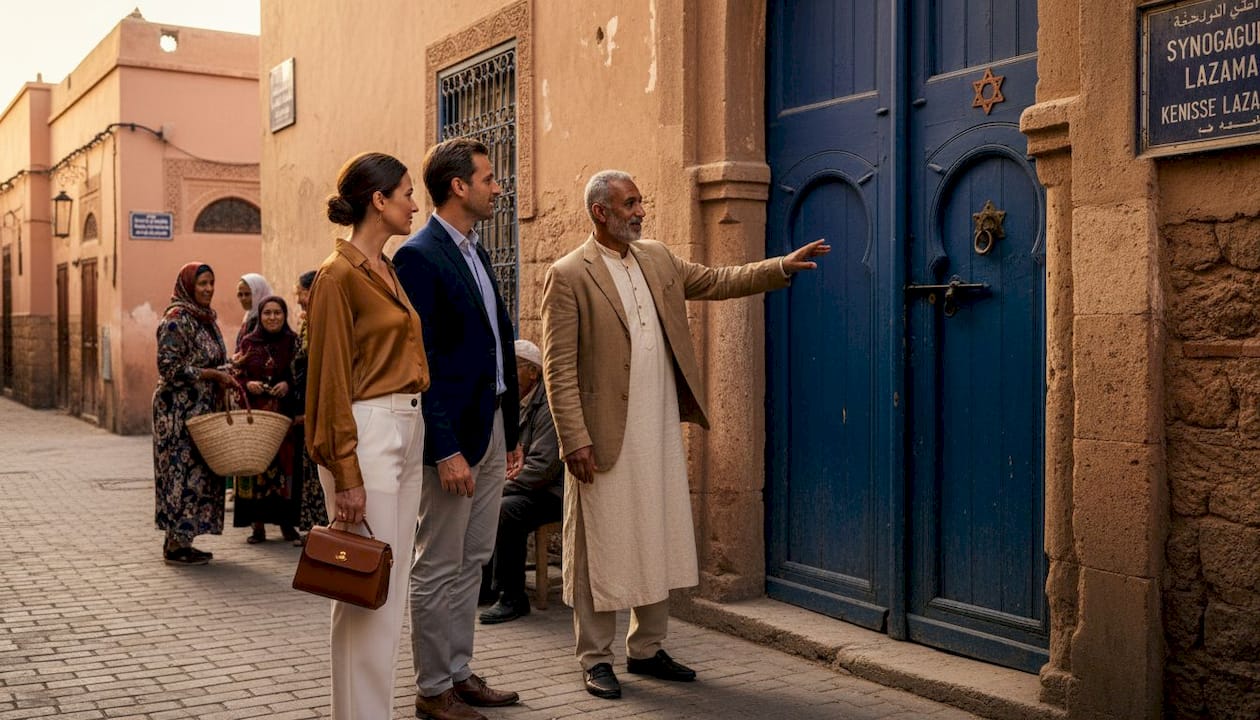
In Marrakech, the mellah dates back to the 16th century and contains the Lazama Synagogue, still used for services during major Jewish holidays. Walking through the mellah’s narrow lanes, you notice how closely Jewish and Muslim communities lived together, with shared walls, shared markets, and a daily life that was far more interwoven than popular histories sometimes acknowledge.
Fes holds what is considered one of the oldest Jewish cemeteries in the world, the Ibn Danan Synagogue (now beautifully restored), and a mellah that is larger and more historically layered than the one in Marrakech. A specialist guide in Fes can walk you through the neighborhood block by block, connecting architectural details to specific historical moments in ways that are genuinely absorbing.
Lesser-known gems worth the detour
Essaouira, once known as Mogador, was a major center of Jewish merchant life for centuries. The community there developed a distinct identity connected to the Atlantic trade routes. Today, Essaouira hosts the Diwan Gnaoua and World Music Festival, where Moroccan Jewish musical traditions are sometimes performed alongside other North African roots music.
Sefrou, a small city south of Fes, was historically nicknamed “Little Jerusalem” because of the large proportion of Jewish residents. The annual cherry festival there is deeply tied to Jewish cultural tradition. It is exactly the kind of place that a mass-market tour skips entirely.
Debdou, a remote town near the Algerian border, was almost entirely Jewish for centuries and contains the remains of multiple synagogues and a remarkable cemetery. Getting there requires planning and a knowledgeable local guide, but the experience of standing in a place of such concentrated, largely unvisited history is unlike anything in the major cities.
Cultural and personal engagement opportunities
- Cooking workshops focused on Moroccan Jewish recipes, such as dafina (the slow-cooked Shabbat stew) and makouda (potato cakes)
- Visits to artisan workshops where Jewish families historically dominated specific crafts like silversmithing and embroidery
- Interfaith dialogue sessions organized by civil society groups
- Performances of Andalusian classical music, which has deep roots in both Moroccan Jewish and Muslim cultural traditions
Heritage travel experiences in Morocco often reflect not just cultural preservation but also political narratives, which makes choosing your guide and operator all the more important. The most unique Morocco experiences balance iconic sites with genuine off-the-beaten-path encounters that create lasting personal meaning.
Pro Tip: Look specifically for itineraries that include scheduled meetings with current community leaders or educators. With only around 2,000 Jewish community members remaining in Morocco, these encounters are rare, intimate, and often the single most memorable part of any trip.
How to navigate nuances: Politics, storytelling, and respectful travel
To fully appreciate Morocco’s Jewish legacy, travelers need more than just logistics. They need strategies for engaging respectfully and insightfully with the past and present.
This is where many well-intentioned tours still fall short. The politics surrounding Jewish heritage restoration in Morocco are real and deserve your attention. Several international organizations have been involved in funding and directing site restorations, and their involvement is not always neutral. Political framing by international heritage actors can affect how heritage sites and the narratives around them are presented, sometimes prioritizing particular modern political agendas over historical accuracy or community voices.
This does not mean you should avoid restored sites. It means you should ask your guide what the restoration context is, who was involved, and whether local Jewish community members had a meaningful say in the interpretive choices. A skilled, independent guide will know this history and engage with it honestly.
A note on storytelling: The most truthful version of Morocco’s Jewish history is plural. It includes Moroccan Jewish voices, scholarly perspectives, community memories, and yes, the sometimes uncomfortable realities of why communities emigrated. Tours that present a single, smoothed-over narrative are doing travelers a disservice.
Do’s and don’ts for respectful heritage travel:
- Do dress modestly when entering synagogues and cemeteries. Shoulders and knees covered; head covering often expected for men
- Do ask your guide whether the site is actively used before assuming it is purely a museum
- Do ask permission before photographing individuals, especially elderly community members
- Do learn a few basic Hebrew or Judeo-Moroccan phrases if you have the time. The gesture is remembered warmly
- Don’t treat community members as living exhibits or press them for opinions on regional politics
- Don’t assume that Moroccan Jews share a single political perspective on Israel, Morocco’s normalization diplomacy, or their own history
- Don’t leave cemeteries without replacing any stones you may have moved and following your guide’s instructions on protocol
- Don’t book with operators who cannot clearly explain their relationship with the communities they visit
These principles apply equally well to the broader landscape of the ultimate guide to Morocco travel. The highest-end experiences in Morocco, including Jewish heritage tours, are defined not just by the quality of accommodation but by the depth of community relationships and the integrity of the storytelling.
Our take: What most travelers get wrong about Jewish heritage in Morocco
The single biggest mistake we see even seasoned travelers make is approaching Morocco’s Jewish heritage as a checklist. See the synagogue. Photograph the mellah. Check the museum. Move on to the next city.
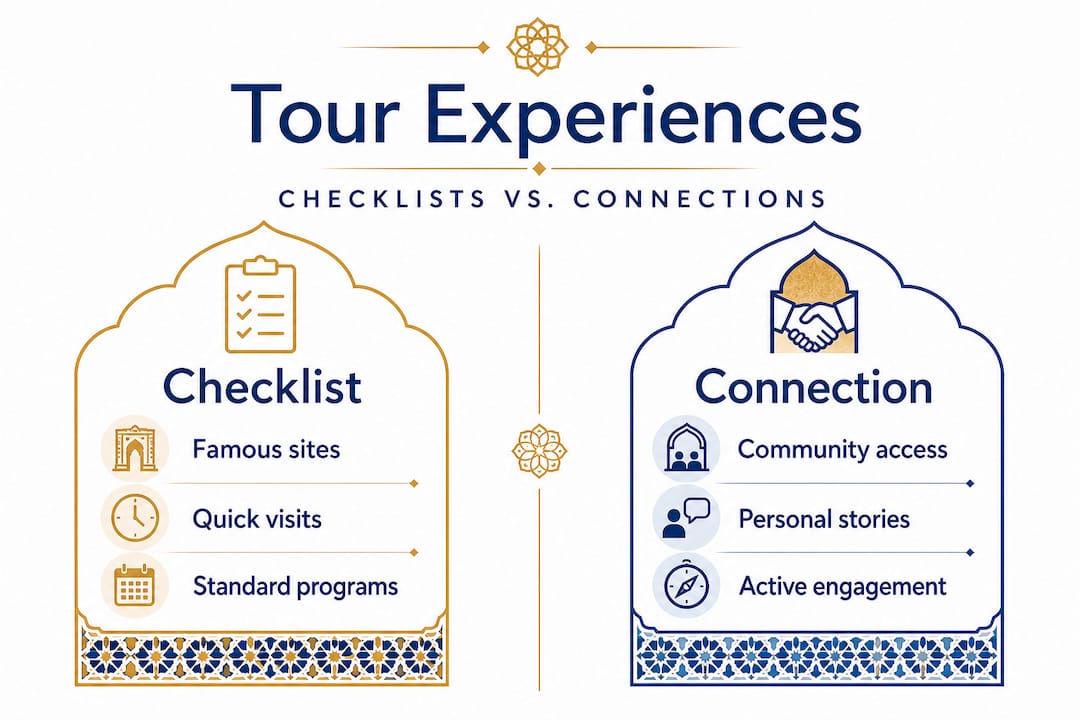
It is understandable. Many heritage tours are literally designed this way, moving efficiently from famous site to famous site and measuring success by the number of locations covered. But this approach systematically misses what makes Morocco’s Jewish story extraordinary. It is not primarily a story of stone and architecture. It is a story of lived continuity, of relationships, and of a community that survived; adapted; emigrated; and, in some small but vital way, persisted.
The moments that our clients most often describe as transformative are rarely the famous sites. They are the afternoons spent in conversation with a Casablanca community elder who remembers the city when the Jewish population was thirty times larger. They are the chance discovery of a tiny synagogue in a southern town that nobody talks about in travel writing. They are at a meal in a private home where the host explains why their family’s recipe for a specific Shabbat dish differs from the “standard” version and what that difference reveals about migration history.
These moments require deep-dive Jewish heritage tours built on genuine community relationships, not just logistical efficiency. They require guides who know families and scholars, not just buildings. And they require travelers who come ready to listen rather than simply to observe.
There is also a real question of footprint. Travelers have genuine purchasing power, and how that power flows through a heritage tourism ecosystem matters. Tours that engage local Jewish-community-affiliated guides, that source kosher meals through community-connected restaurants, and that direct a portion of their fees toward community cultural programs are doing something qualitatively different from tours that simply use heritage sites as scenic backdrops.
The real tour is access to authentic storytelling and living communities, not just five-star hotels. That is not a criticism of beautiful accommodation. Comfort matters, and a well-rested traveler absorbs more than an exhausted one. But if you are spending significantly on a Morocco Jewish tour and the primary justification is the cost of the hotels, you are leaving the most valuable part of the experience on the table.
Ready to experience Morocco’s Jewish heritage?
If this guide has sparked something in you, a curiosity about your roots, a genuine desire to understand one of the world’s most layered Jewish histories, or simply an appetite for travel that goes deeper than the surface, then the next step is finding the right people to travel with.
At MoroccoTours.co, our Morocco Jewish tour itinerary options are built specifically for travelers who want both the iconic sites and the extraordinary personal encounters that most tours never reach. We work with specialist guides who have deep community relationships across Casablanca, Fes, Marrakech, Essaouira, and beyond. We arrange kosher dining, private meetings with community leaders, and itineraries that flex around your specific family history or personal interests. Whether you want to combine heritage visits with an authentic oasis experience in the Sahara or keep the entire journey focused on Jewish sites and culture, our travel packages are customized to what matters most to you.
Frequently asked questions
How large is the Jewish community in Morocco today?
Morocco’s Jewish community is estimated at around 2,000 people, with a much larger diaspora spread across Israel, France, Canada, and Spain.
Are Morocco’s Jewish sites still in use by local communities?
Yes, synagogues and cemeteries remain active in major cities, particularly Casablanca, where the community is most concentrated, and in Marrakech during Jewish holidays.
Should travelers be aware of political framing at Jewish heritage sites in Morocco?
Absolutely. Some restoration and programming projects may involve contested political narratives, so asking your guide or operator directly about interpretive choices is a smart and respectful practice.
Can Morocco Jewish tours be personalized for family history or specific interests?
Yes, reputable tour operators can accommodate individual genealogical research, customized routing to towns of family origin, and itineraries that focus on specific periods of Moroccan Jewish history.
What is the best way to ensure respectful engagement when visiting Jewish sites?
Follow local customs, dress modestly, ask your guide before photographing individuals, and choose operators who actively involve and compensate local Jewish community members in the tour experience.