
Moroccan Riad: Your Guide to Authentic Stays
- A Moroccan riad is a traditional inward-facing home centered around a courtyard, offering authentic cultural immersion.
- Moroccan riads feature craftsmanship like Zellige tiles and Tadelakt plaster, with personalized hospitality that surpasses standard hotels.
- Choosing the right riad depends on size, style, and location, with planning arrival logistics crucial due to maze-like medinas.
A Moroccan riad is a traditional Moroccan home built around a central courtyard, offering travelers a lodging experience that no international hotel chain can replicate. The word “riad” derives from the Arabic ryad, meaning garden. These inward-facing houses were originally private family residences in the ancient medinas of Marrakech, Fez, and Essaouira. Today, hundreds have been converted into boutique guesthouses that place guests at the center of Moroccan domestic life. If you want to understand Morocco beyond its souks and desert dunes, sleeping inside a riad is where that understanding begins.
What architectural and design features define a Moroccan riad?
A riad’s architecture is its identity. The entire structure turns away from the street and faces inward toward a central courtyard, which traditionally holds a fountain, a small pool, or a garden of orange trees and roses. This design was not accidental. It gave families privacy from the dense urban fabric of the medina while creating a natural cooling system through evaporation and shade. The result is a space that feels 10 to 15 degrees cooler than the streets outside, even in July.
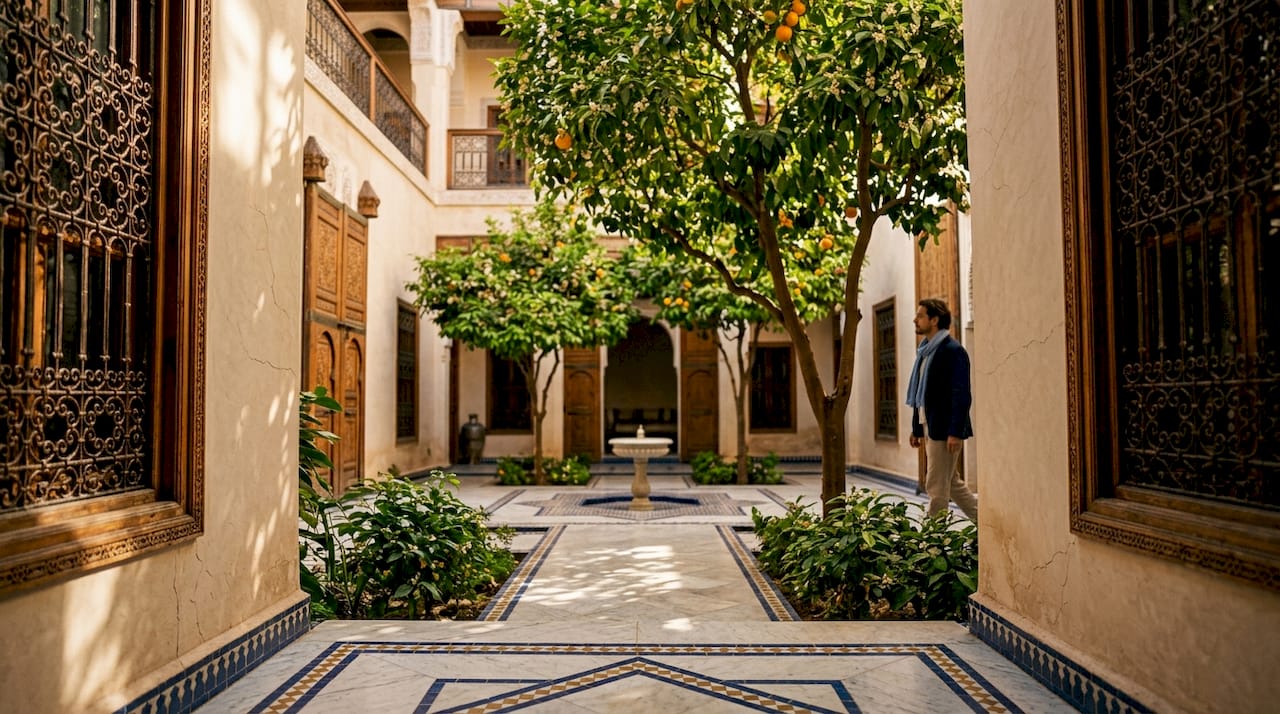
The craftsmanship inside a riad tells the story of Moroccan artisan traditions that stretch back centuries. Traditional riads feature Zellige tilework, Tadelakt plaster, and carved cedar wood throughout their interiors. Zellige is a form of geometric mosaic made from individually hand-cut terracotta tiles glazed in vivid colors. Tadelakt is a waterproof lime plaster polished with river stones and treated with black soap, giving walls a smooth, luminous finish. Carved cedar wood appears in doorways, ceilings, and decorative screens called moucharabieh, which filter light into rooms without sacrificing privacy.
Key architectural features you will encounter in most riads include:
- Central courtyard: The social and spiritual heart of the house, often with a central fountain or plunge pool
- Horseshoe arches: Repeated throughout doorways and galleries surrounding the courtyard
- Rooftop terrace: Called a terrace, offering panoramic views of the medina and, in Marrakech, the Atlas Mountains
- Natural light design: Rooms receive light primarily from the courtyard, not the street, creating a cave-like calm
- Hammam: A traditional steam bath, often built into the lower level of the property
The rooftop terrace deserves special mention. In the best riads in Marrakech, the terrace functions as an outdoor living room where breakfast is served at sunrise and mint tea appears at dusk. The contrast between the silence up there and the noise of the medina below is one of the most memorable sensory experiences Morocco offers.
Pro Tip: When reviewing riad photos online, look for images of the courtyard taken from above. A well-proportioned central courtyard with original Zellige floors is the clearest sign of an authentically restored property rather than a modern imitation.
How does staying in a riad differ from hotels in Morocco?
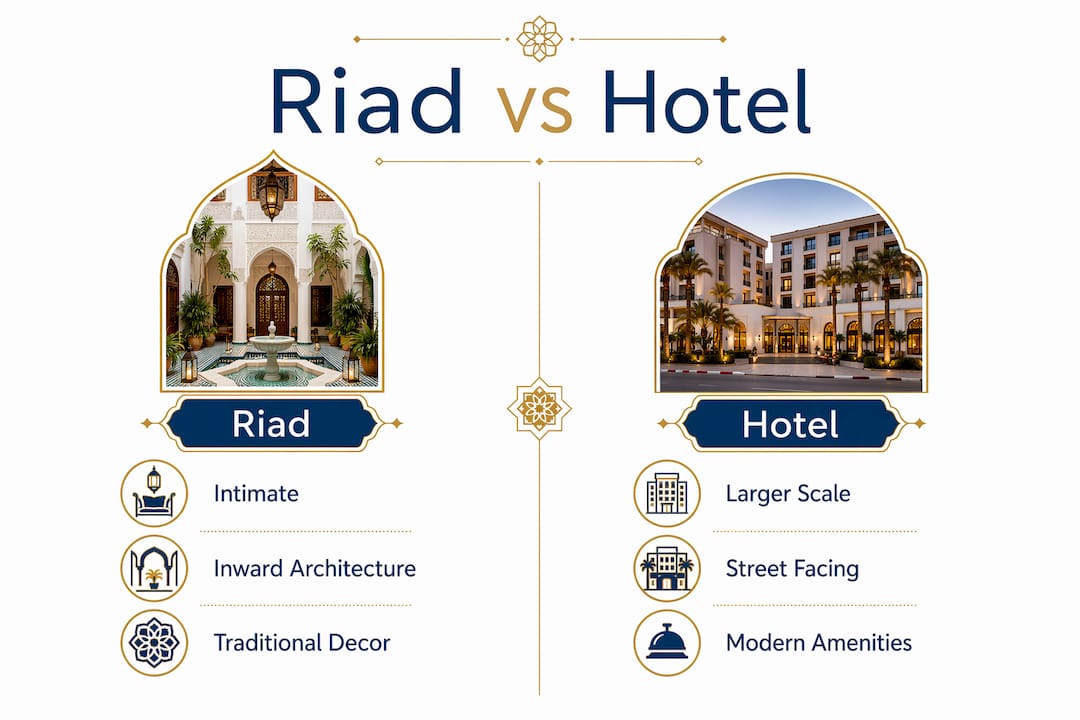
The difference between a riad and a standard hotel is not about thread count or room size. It is about the nature of the relationship between guest and host. Riad staff act as hosts offering highly personalized service that routinely exceeds what travelers receive at traditional hotels. You are not a room number. You are a guest in someone’s home, and the entire staff of four to eight people knows your name, your breakfast preference, and your plans for the day.
Here is how the riad experience differs from a standard hotel stay, point by point:
- Room count: Most authentic riads have between 4 and 14 rooms. Luxury riads limit rooms to 10 to 14 to preserve privacy and ensure attentive care. A 200-room hotel cannot offer the same ratio of staff attention.
- Dining: There is no restaurant menu. Meals are traditionally home-cooked using local market ingredients and served in the courtyard or on the rooftop. Expect slow-cooked tagines, couscous on Fridays, and pastilla if you ask in advance.
- Location: Riads sit inside the medina, not beside it. You wake up to the call to prayer from a nearby mosque, smell fresh bread from the bakery two alleys over, and step directly into the living city.
- Ambiance: The medina outside is loud, colorful, and relentless. Inside the riad, the courtyard absorbs sound, and the thick earthen walls create near-total silence. This contrast is the defining feature of the Moroccan riad experience.
- Flexibility: Riads adapt to you. Staff will arrange a private hammam session at midnight, source a specific ingredient for a dietary restriction, or organize a cooking class in the kitchen. Hotels process requests. Riads solve problems.
The evolution of luxury in Moroccan riads now centers on intimacy over scale. The most sought-after properties in 2026 are not the ones with the largest pools. They are the ones where the owner still greets you at the door.
Pro Tip: If you are traveling as a couple or a small group of four, consider booking a riad exclusively. Many properties rent the entire house for the same price as two or three rooms at a five-star hotel, giving you a private courtyard, rooftop, and dedicated staff.
What should you expect during arrival and your daily stay?
Arriving at a riad for the first time is the moment most travelers underestimate. The medinas of Marrakech, Fez, and Essaouira are built on medieval street plans with no grid logic, no street signs in most alleys, and no reliable GPS signal under the dense building canopy. GPS navigation frequently fails inside medinas, making pre-booked transfers with staff guidance the only reliable arrival method. This is not an inconvenience. It is the first act of the riad experience.
Here is what a typical arrival and daily stay looks like:
- Airport transfer: In Marrakech, transfers from Menara Airport take approximately 15 minutes by car to the medina gate. A riad staff member or driver will meet you at arrivals and escort you through the alleys on foot to the front door.
- Welcome ritual: Almost every riad greets arriving guests with Moroccan mint tea and a small plate of chebakia or dates. This is not a formality. It is a genuine hospitality gesture rooted in Moroccan culture.
- Daily rhythm: Mornings typically begin with breakfast on the rooftop or in the courtyard. Eggs, msemen flatbread, honey, argan oil, and fresh orange juice are standard. The riad staff will brief you on the day’s options.
- On-site services: Most riads offer in-house hammam treatments, massage, and can arrange guided medina tours, cooking classes, and day trips to the Atlas Mountains or Ourika Valley.
- Dining: Advance notice helps riads accommodate dietary restrictions since meals are prepared fresh from market ingredients. Vegetarian, vegan, and gluten-free requests are handled easily with 24 hours’ notice.
- Seasonal pricing: Boutique riads start under £100 per night during off-peak periods, while the same property can cost two to three times more during peak season from October through April. Book early for the high season.
The daily rhythm of a riad stay is slower than a hotel. That is the point. You are not being processed through a system. You are being welcomed into a place.
How to choose the right riad for your Morocco visit
Choosing a riad requires more precision than booking a hotel because the category spans an enormous range. A property calling itself a riad could be a 500-year-old family house with six rooms and a resident cat or a modern resort with 40 rooms, a spa, and a rooftop bar. A fundamental distinction exists between large modern spa-equipped riads and small historic houses. Knowing which type you want before you search saves significant frustration.
Use this comparison to match your priorities to the right type of property:
| Factor | Boutique historic riad | Resort-style riad |
|---|---|---|
| Room count | 4 to 10 rooms | 15 to 40+ rooms |
| Authenticity | Original architecture, artisan finishes | Modern renovations, some original features |
| Service style | Personal, host-like, family atmosphere | Professional, hotel-standard |
| Dining | Home-cooked, no menu, communal | Restaurant-style, menu-driven |
| Price range | Budget to mid-range off-peak | Mid-range to luxury year-round |
| Best for | Cultural immersion, couples, solo travelers | Families, groups, comfort-first travelers |
Beyond property type, location within the medina matters significantly. In Marrakech, riads near Jemaa el-Fnaa place you within a five-minute walk of the city’s central square, its food stalls, and its storytellers. Properties deeper in the medina near the Bab Doukkala or Mouassine neighborhoods offer quieter surroundings and a more residential feel. For travelers visiting Fez, the Fez medina is the largest car-free urban area in the world, so proximity to Bab Bou Jeloud or the tanneries determines your entire daily logistics.
Additional factors worth verifying before booking:
- Staff-to-guest ratio: A riad with six rooms and four staff members delivers a fundamentally different experience than one with 12 rooms and two staff.
- Rooftop access: Confirm whether the rooftop is private to your room or shared. In smaller riads, it is usually shared and becomes a social space.
- Pool or plunge pool: Not all riads have one. If swimming matters to you, confirm the pool size. Many “pools” in riads are decorative plunge pools, not swimming pools.
- Hammam: Determine whether the hammam is private or shared and whether treatments require advance booking.
- Reviews for authenticity: When reading Marrakech riad reviews on platforms like Booking.com or TripAdvisor, filter for mentions of the courtyard, staff names, and food quality. These details separate genuine riads from hotel-style imitations.
Key takeaways
A Moroccan riad delivers an authentic, intimate lodging experience that no standard hotel can match, defined by inward-facing architecture, personalized hospitality, and direct immersion in medina life.
| Point | Details |
|---|---|
| Architecture defines the experience | Zellige tilework, Tadelakt plaster, and central courtyards are the markers of an authentic riad. |
| Riads prioritize intimacy over scale | Properties with 4 to 14 rooms deliver the personal service that makes the riad format distinct. |
| Arrival requires planning | Pre-book transfers with Riad staff since GPS fails inside medinas and alleys are unmarked. |
| Pricing varies sharply by season | Off-peak rates can start under £100 per night; high season from October to April costs significantly more. |
| Match property type to your priorities | Boutique historic riads suit cultural immersion; resort-style riads suit comfort-first travelers. |
Why the riad experience stays with you long after you leave Morocco
I have arranged stays across dozens of Moroccan properties for Moroccotours clients, from budget guesthouses in the Fez medina to private luxury riads in Marrakech’s Mouassine neighborhood. The single most consistent piece of feedback I receive is not about the food, the hammam, or the rooftop view. It is about the moment guests walk through the unmarked wooden door in a narrow alley and find themselves standing in a sunlit courtyard with a fountain at its center and total silence around them. That transition from chaos to calm is something no hotel lobby can engineer.
What surprises most first-time riad guests is how quickly the property starts to feel like their own home. By the second morning, the staff knows how you take your coffee. By the third, they are suggesting the specific souk stall where you should buy saffron because the owner is their cousin and the quality is genuine. This is personalized hospitality operating at a level that large-scale hospitality simply cannot replicate.
My honest advice: resist the urge to treat the riad as a base camp for sightseeing. The riad itself is a destination. Spend a morning in the courtyard doing nothing. Eat every meal on-site at least once. Ask the cook to show you how they make harira. The travelers who get the most from a riad stay are the ones who slow down enough to let the place reveal itself. Balancing riad tranquility with medina energy is the real skill, and it takes about 48 hours to find the rhythm.
One practical note I always share with clients: do not book a riad based on photos of the bedroom. Book it based on photos of the courtyard and the rooftop. The bedroom is where you sleep. The courtyard and terrace are where you actually live during your stay.
— Moroccotours.co
Plan your Moroccan riad stay with Moroccotours.co
Moroccotours specializes in placing travelers inside the riads that match their specific priorities, whether that means a six-room historic house in the Fez medina or a private luxury property in Marrakech with a rooftop pool and a dedicated hammam. Every Morocco luxury travel package includes pre-arranged airport transfers, staff introductions, and curated daily itineraries so you arrive knowing exactly what to expect. For travelers who want to combine riad stays with broader exploration, the 9-day Morocco food tour pairs traditional Moroccan accommodation with culinary experiences across multiple cities. Contact Moroccotours to build an itinerary around the riad experience you actually want.
FAQ
What does “riad” mean in Morocco?
The word “riad” comes from the Arabic “ryad,” meaning “garden.” It refers to a traditional Moroccan house built around a central courtyard that typically features a fountain, garden, or pool at its center.
Are riads only in Marrakech?
Riads exist throughout Morocco’s historic medinas, including Fez, Essaouira, Meknes, and Chefchaouen. The best riads in Marrakech receive the most international attention, but Fez contains some of the oldest and most architecturally significant examples.
How do I find a riad inside the medina?
Pre-booking a transfer with Riad staff is the most reliable method since GPS navigation fails frequently inside medinas. Staff will meet you at the medina gate or your arrival point and escort you directly to the property.
What is the difference between a budget and a luxury riad in Morocco?
Budget riads in Morocco typically offer fewer amenities, shared hammam access, and simpler furnishings, while luxury riads in Morocco feature private hammams, plunge pools, premium Zellige finishes, and higher staff-to-guest ratios. Both categories offer the authentic courtyard architecture that defines the riad format.
Is staying in a riad safe for solo travelers?
Riads are among the safest lodging options in Morocco for solo travelers. Their inward-facing design, locked street doors, and small staff teams create a secure, private environment. Staff familiarity with the medina also means you have reliable local guidance throughout your stay.