
Agadir Travel Guide: Plan Your Perfect Trip
- Agadir is Morocco’s most modern city, rebuilt after a 1960 earthquake, featuring a 9-kilometer beach and rich Amazigh culture.
- Visitors can enjoy world-class beaches, regional day trips, and a relaxed environment ideal for first-time travelers looking for safety and accessibility.
- The city offers a mild climate, diverse attractions, and practical transportation options, making it a versatile base for exploring southern Morocco.
Most people picture Agadir as a sun-soaked resort strip with little else going on. That picture is incomplete. Agadir is Morocco’s most modern city, rebuilt from scratch after a catastrophic 1960 earthquake, and the result is a beach destination unlike anything else in North Africa. It combines a 9-kilometer golden beach with a safe, walkable urban layout, a rich Amazigh cultural scene, and day trips that will take your breath away. This guide covers everything you need to plan a smart, satisfying trip to Agadir.
Table of Contents
- Key takeaways
- Agadir at a glance: city, climate, and character
- Things to do in Agadir that go beyond the beach
- Day trips that make Agadir worth the flight
- Practical Agadir vacation tips for a smooth trip
- My honest take on what Agadir really is
- Plan your Agadir trip with Moroccotours
- FAQ
Key takeaways
| Point | Details |
|---|---|
| Best travel months | Visit March through May or September through October for ideal weather and fewer crowds. |
| Beach and city combo | Agadir’s beach spans 9 kilometers with amenities, but the city’s cultural sites and markets reward exploration too. |
| Day trip potential | Taghazout, Paradise Valley, and Taroudant are all within 90 minutes and dramatically expand your experience. |
| Transport know-how | Always insist on the meter in petit taxis, and use the new Amalway TRAMBUS for affordable city travel. |
| Budget flexibility | Daily costs range from around $40 for budget travelers to $140 for a more comfortable, amenity-rich stay. |
Agadir at a glance: city, climate, and character
Agadir sits on Morocco’s Atlantic coast, roughly 500 kilometers south of Casablanca, with the Anti-Atlas Mountains rising dramatically to its east. That geography alone sets it apart. You get ocean breezes, mountain backdrops, and a climate that stays mild year-round. The city’s modern layout is a direct product of tragedy. On February 29, 1960, a 5.7-magnitude earthquake leveled most of the old city in just 15 seconds, killing roughly 15,000 people. What rose in its place was a planned, wide-avenue city with low-rise buildings, palm-lined boulevards, and a resort-style infrastructure rarely seen in Morocco.
That history matters for your trip planning because Agadir does not have the labyrinthine medina alleys of Fez or Marrakech. There is no ancient walled city to get lost in. Instead, you get wide, easy-to-walk streets, clear signage, modern hotels, and a relaxed, family-friendly energy. For some travelers, that is a downside. For many, especially families and first-timers in Morocco, it is exactly what makes Agadir the right entry point.
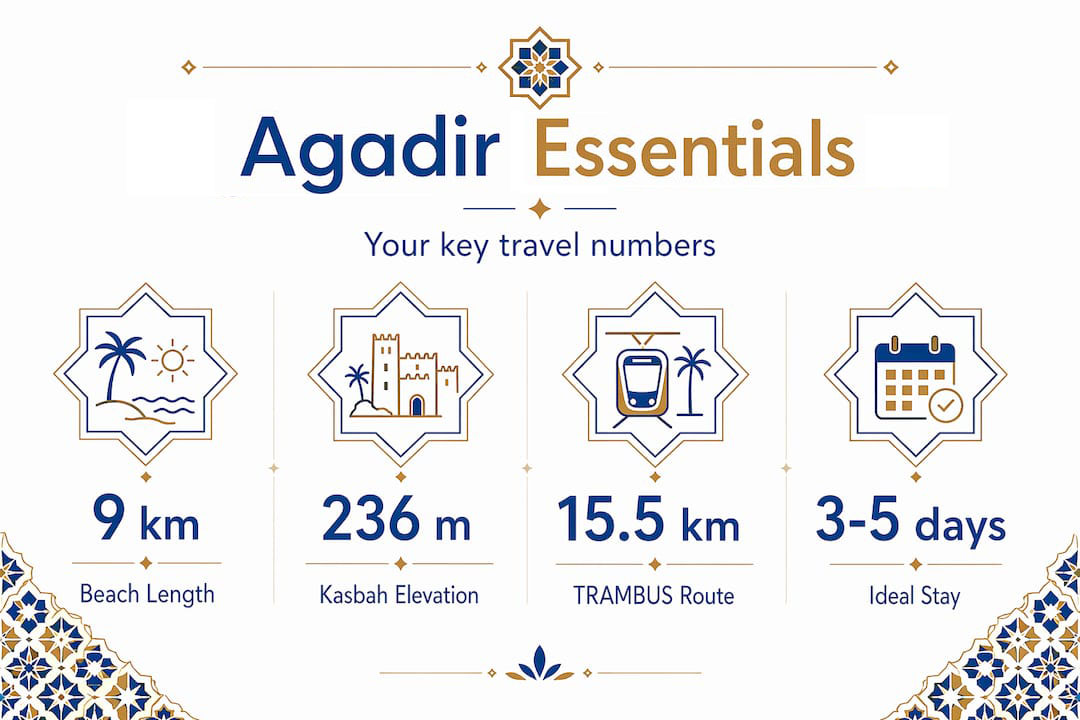
The climate deserves special attention. Agadir records over 300 days of sunshine annually, and even winter temperatures rarely dip below 15°C (59°F). The Atlantic keeps summers from getting brutal, topping out around 28°C (82°F) in August. Spring and fall are the sweet spots, with warm days, cool evenings, and hotels that are not fully booked. The city is also one of Morocco’s safest for tourists, with a visible security presence and a tourism infrastructure that handles international visitors with ease.
Here is what makes Agadir especially practical as a base:
- Ocean and mountains nearby. You can surf in the morning and hike in the afternoon.
- International airport access. Al Massira Airport connects to European hubs directly.
- Liberal alcohol policy. Unlike many Moroccan cities, alcohol is freely available at hotels and beach clubs.
- Family-friendly facilities. Promenades, beach clubs, and parks are all well maintained.
Pro Tip: Book accommodations in the Founty or Hay Mohammadi districts to stay close to the beach while still having easy access to the market and marina without paying top-dollar for an oceanfront room.
Things to do in Agadir that go beyond the beach
Agadir’s beach is the headline act, but if that is all you see, you have left a lot on the table. Here is a structured breakdown of the city’s best experiences.
The beach itself
The beach is genuinely world-class. Fine golden sand, calm Atlantic waves, and a 9-kilometer stretch give you room to find your own space even in peak season. Beach clubs dot the promenade with sunbeds, cafés, and watersports rentals. You can rent jet skis, try paddleboarding, or sign up for a beginner surf lesson at the northern end near Anza. Camel rides along the shore at sunrise or sunset are a classic Agadir experience that is worth doing at least once.
Oufella Kasbah ruins
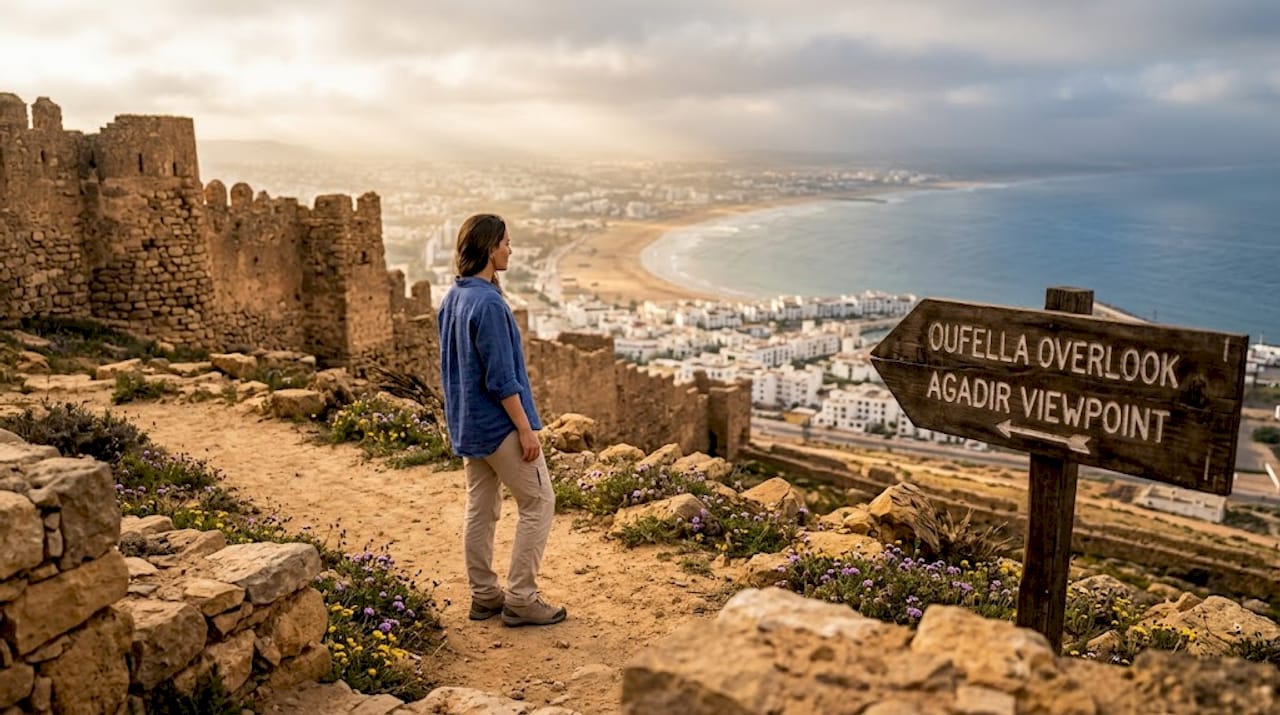
Perched 236 meters above the city on a hill north of the beach, the Kasbah of Oufella is what remains of Agadir’s pre-earthquake settlement. You can drive up, but the cable car rises 148 meters across a 1.8-kilometer journey and delivers panoramic views of the coastline that are simply stunning. The ruins themselves are sparse, but the inscribed wall bearing the words “God, Country, King” in Arabic is historically significant. Go at sunset for the best light.
Souk El Had and local markets
Souk El Had is one of the largest covered markets in Morocco. It operates every day (despite the name meaning “Sunday market”) and sells everything from fresh produce and spices to leather goods, ceramics, and Amazigh silver jewelry. This is where you shop for genuine Argan oil at fair prices. Vendors are generally less aggressive than in Marrakech, making it a more comfortable introduction to Moroccan market culture.
Agadir Marina and waterfront dining
The Marina is a polished mix of sailboats, seafood restaurants, and café terraces that feels distinctly European. It is the best place in the city for a long dinner with grilled fish caught that morning. The fish market adjacent to the port sells the day’s catch directly, and several restaurants will cook what you buy.
Musée du Patrimoine Amazigh
This small but well-curated museum focuses on the Amazigh (Berber) heritage of the Souss region. Jewelry, textiles, carpets, and tools tell the story of the indigenous culture that predates Arab settlement in Morocco. Admission is inexpensive, and the exhibits are translated into French and English.
Here is a quick comparison of Agadir’s top attractions by type and time needed:
| Attraction | Type | Time needed | Best for |
|---|---|---|---|
| Agadir Beach | Outdoor relaxation | Half day to full day | Families, sun seekers |
| Oufella Kasbah | History and views | 2 to 3 hours | History buffs, photographers |
| Souk El Had | Shopping and culture | 1 to 2 hours | Shoppers, food lovers |
| Agadir Marina | Dining and leisure | 2 to 3 hours | Couples, food lovers |
| Musée du Patrimoine Amazigh | Culture and history | 1 hour | Culture-focused travelers |
Top five things to do ranked by overall experience value:
- Watch the sunset from Oufella Kasbah with a cable car ride up.
- Spend a full morning exploring Souk El Had and sampling street food.
- Book a surfing lesson at Anza or Taghazout through a certified surf school.
- Have a long seafood dinner at the Marina, ordering whatever is freshest.
- Visit the Musée du Patrimoine Amazigh to ground yourself in local culture before exploring further.
Day trips that make Agadir worth the flight
The city earns extra points as a base for regional exploration. Several outstanding destinations sit within a two-hour radius, and each one is dramatically different from the last.
- Taghazout Village. Just 19 kilometers north of Agadir, Taghazout has transformed from a quiet fishing village into a surf and digital nomad hotspot with boutique guesthouses, surf schools, and yoga retreats. The fishing boats still come in each morning. That contrast between the old and the new makes it one of the most interesting villages on Morocco’s Atlantic coast. You can take a shared taxi from Agadir’s northern bus station for a few dirhams.
- Paradise Valley. About 60 kilometers inland from Agadir lies a series of natural pools carved into gorge rock surrounded by palm trees and oleander. It sounds like a cliché, and then you see it. Hiking between pools, swimming in clear mountain water, and eating a tagine at a clifftop café is one of the most memorable half-days you can spend in southern Morocco. Rent a car or book a guided tour, as public transport does not reach the valley directly.
- Taroudant. Often called “the grandmother of Marrakech,” Taroudant sits 80 kilometers east of Agadir inside well-preserved ancient walls. Its souks are uncrowded, its pace is slow, and its food market near Place Assarag is one of the most authentic in the south. This is the day trip for travelers who want traditional Moroccan medina without the tourist pressure of Marrakech.
- Essaouira. This UNESCO-listed coastal city is roughly 175 kilometers north and makes for a full-day excursion. Its blue-and-white medina, wind-sculpted beaches, and excellent grilled sardines on the harbor make it one of Morocco’s most rewarding stops. You can explore Morocco’s coastal towns through Moroccotours if you want a curated itinerary that connects Agadir and Essaouira with a private guide.
- Legzira Beach. This remote beach near Sidi Ifni is a 4-hour scenic drive south of Agadir and shelters some of Morocco’s most photogenic rock arches. The isolation is part of the appeal. Bring food, water, and a 4×4 for high-tide access to the beach’s most dramatic sections. Spring is the best season for this trip.
Pro Tip: Combine Taghazout and Paradise Valley in one day. Spend the morning surfing or walking the village, then drive inland to Paradise Valley for the afternoon. You will be back in Agadir in time for dinner.
Practical Agadir vacation tips for a smooth trip
Getting the logistics right makes everything else better. Here is what actually matters.
Getting there and getting around
Al Massira Airport (AGA) sits about 25 kilometers from the city center. Taxis from the airport to the hotel district cost around 200 to 250 Moroccan dirhams (roughly $20 to $25) if you agree on a price before getting in. Many hotels also arrange airport transfers.
Inside the city, two taxi types handle most local travel. Orange petit taxis cover the city itself and take up to three passengers. White grand taxis handle routes outside city limits and are usually shared with other passengers going the same direction. The most important rule: always insist the driver turns on the meter in a petit taxi. Many will try to quote a fixed price that is significantly higher than what the meter would show. If a driver refuses, find another cab.
Agadir’s new Amalway TRAMBUS launched as a bus rapid transit system running 15.5 kilometers across 35 stations, from the port to the Tikiouine District. It operates on dedicated lanes and is designed to carry up to 60,000 passengers daily. For budget travelers, this is the most affordable way to move across the city.
Renting a car is worth it if you plan on doing day trips independently. Parking in Agadir is generally free and easy, though watch out for unofficial attendants who expect a small tip.
Budget and timing
| Budget level | Daily spend (USD) | Accommodation type | Food style |
|---|---|---|---|
| Budget | $40 to $60 | Hostels, guesthouses | Street food, local restaurants |
| Mid-range | $70 to $100 | 3 to 4 star hotels | Mix of local and tourist restaurants |
| Luxury | $120 to $140+ | 5 star resorts | Hotel restaurants, Marina dining |
The ideal trip length is 3 to 5 days for the city itself, though a week works better if you want to do multiple day trips. March through May and September through October are the sweet spots for weather and value. July and August are peak seasons with higher prices and more crowds, though the beach clubs are at their liveliest.
Cultural etiquette worth knowing
Agadir is more relaxed than other Moroccan cities when it comes to dress and behavior, but respecting local customs still matters. On the beach, swimwear is standard and accepted. In the market or the museum, covering your shoulders and knees shows basic respect that locals genuinely appreciate. Solo female travelers generally find Agadir very manageable, with a level of infrastructure and security that sets it apart from busier medina cities. Keep your wits about you in the souk, as pickpocketing does occur in crowded market areas.
My honest take on what Agadir really is
I have spent time in most of Morocco’s major cities, and Agadir consistently surprises me. Not because it is the most dramatic, but because it is the most misunderstood.
Travel writers often dismiss Agadir as Morocco Lite. Too modern. Not “authentic” enough. In my experience, that criticism misses the point entirely. Agadir is deliberately designed as a resort city, rebuilt with tourism in mind after 1960, and it excels at exactly that. The beach is maintained. The streets are clean. The taxi system, frustrating as the meter negotiation can be, is functional. For a first-time visitor to Morocco who is nervous about diving straight into Fez or Marrakech, Agadir is genuinely the right starting point.
What I find more interesting is the tension I see in Taghazout. When I first visited, it was a cluster of painted walls and surf boards leaning against fishing huts. Now it has boutique hotels, Wi-Fi everywhere, and a smoothie bar. The village has evolved into a curated hotspot for digital nomads and upscale surfers, and the fishing boats still come in at dawn. That coexistence is fragile, and visiting now, before it tips further into pure tourism, is worth doing.
My practical recommendation: spend two or three days in Agadir itself, then use it as a base for one full day in Taghazout and one in Taroudant. That combination gives you the beach, the modern city, the surf village, and a traditional Moroccan medina experience all within a single trip. You leave understanding Morocco’s range in a way that a Marrakech-only trip rarely delivers.
The Amazigh heritage angle also tends to get overlooked. The Musée du Patrimoine Amazigh and the silver jewelry in Souk El Had connect you to a culture that is genuinely distinct from Arab Moroccan identity. That layer is what makes Agadir more than just a beach resort once you start paying attention.
— Moroccotours.co
Plan your Agadir trip with Moroccotours
If this guide has you ready to book, Moroccotours.co makes the planning side straightforward. The team specializes in customized Morocco itineraries that go well beyond a standard hotel-and-beach package. Whether you want a luxury Morocco tour that combines Agadir’s coastline with imperial cities and Sahara desert nights, or you are looking at the Morocco Signature Tour for a curated 10-day experience, private guides and premium transportation are included throughout. Families will find the 15-day family vacation especially well-structured for mixing beach time in Agadir with cultural depth elsewhere. Every itinerary is tailored to your group, your pace, and what you actually want from Morocco.
FAQ
What is Agadir best known for?
Agadir is best known for its long Atlantic beach, modern resort infrastructure, and mild sunny climate. It is Morocco’s most developed beach destination, rebuilt after the devastating 1960 earthquake with wide avenues and a welcoming tourist environment.
When is the best time to visit Agadir?
The best months to visit Agadir are March through May and September through October, when the weather is warm, the crowds are thinner, and hotel prices are more reasonable. Summer is lively but crowded; winter is mild and very affordable.
Is Agadir safe for solo travelers?
Yes. Agadir is considered one of Morocco’s safest cities for tourists, with a strong security presence and well-developed tourism facilities. Solo female travelers in particular find it significantly more comfortable than Morocco’s busier medina cities.
How do I get from Agadir to Taghazout?
Taghazout sits about 19 kilometers north of Agadir and is easily reached by shared grand taxi from Agadir’s northern transport hub or by renting a car. The drive takes roughly 25 minutes and costs very little by shared taxi.
What should I eat in Agadir?
Agadir local cuisine centers on fresh Atlantic seafood, Amazigh-style tagines with local olives and preserved lemons, and Souss-region argan oil used in both cooking and the traditional almond-argan spread called amlou. The fish market near the port and the Marina restaurants are the best places to eat well without overspending.