
Chefchaouen Morocco: Your Travel Guide
TL;DR:
- Chefchaouen, Morocco, is renowned for its historic blue medina, rooted in Jewish cultural symbolism from the 1930s.
- Visiting during shoulder seasons offers the best weather and fewer crowds, with access solely by road from Tangier and Fes.
- Spending at least two days allows travelers to explore beyond the blue streets and enjoy nearby natural sites like Akchour Waterfalls.
Few places in the world stop you cold the moment you turn a corner. Chefchaouen, Morocco, does exactly that. The blue-painted medina tucked into the Rif Mountains has a way of making even seasoned travelers reach for their cameras before they’ve said a word. But if you treat it as a quick photo stop, you’ll leave with pictures and miss everything else. This guide covers the full picture: the history behind those famous walls, the best ways to get there, what to do when crowds thin out, and how to turn a rushed day trip into a genuinely memorable stay.
Table of Contents
- Key Takeaways
- The real history of Chefchaouen, Morocco
- When to visit Chefchaouen for weather, crowds, and culture
- How to get to Chefchaouen from Tangier and Fes
- Things to do in Chefchaouen beyond the blue streets
- Practical tips for staying in Chefchaouen
- My honest take on visiting Chefchaouen
- Plan your Chefchaouen trip with Moroccotours
- FAQ
Key Takeaways
| Point | Details |
|---|---|
| Rich historical roots | Chefchaouen was founded in 1471, and its blue painting tradition carries deep Jewish cultural and spiritual symbolism. |
| Timing matters enormously | Visit before 9 AM or after 7 PM to explore the blue streets without day-tripper crowds. |
| Road access only | There is no airport or train station; buses from Tangier and Fes are the most reliable options. |
| Two days is the minimum | One day gets you the medina photos; two days gets you the waterfalls, the sunset hike, and the real city. |
| Go beyond the blue streets | Akchour Waterfalls, the Kasbah museum, and the Spanish Mosque are just as rewarding as any alley shot. |
The real history of Chefchaouen, Morocco
Most first-time visitors arrive expecting a photogenic blue village and leave realizing it’s something considerably more layered. Chefchaouen was founded in 1471 by Moulay Ali Ben Rachid, a Moorish leader who built the settlement as a military stronghold to resist Portuguese expansion along the Moroccan coast. The city sits at an elevation of 564 to 600 meters in the Rif Mountains, which shaped both its geography and its isolation over the centuries.
The blue color that defines the medina today has a more recent and more complex origin than most postcards suggest. In the 1930s, Jewish refugees fleeing persecution settled in Chefchaouen and began painting the buildings blue, a color carrying deep spiritual weight in Jewish tradition. Blue symbolized the sky, heaven, and divinity. The practice spread, the color stayed, and locals eventually made it their own.
Beyond the spiritual symbolism, residents also cite practical explanations:
- Mosquito repellence: The indigo compounds historically used in the paint were believed to deter mosquitoes.
- Cooling effect: Lighter blue tones reflect sunlight, keeping interior spaces cooler during summer months.
- Community identity: Over generations, the act of repainting became a collective ritual of civic pride.
Today the city has a population of about 46,168, a small-town scale that contributes heavily to its unhurried feel. Walking the medina here doesn’t carry the sensory overload of Fes or Marrakech. That’s not an accident. It’s a product of its history.
Pro Tip: Ask your riad owner about the neighborhood’s history before wandering. Many can point you toward streets where the blue is deepest and the alley compositions are less photographed than the famous tourist corners.
When to visit Chefchaouen for weather, crowds, and culture
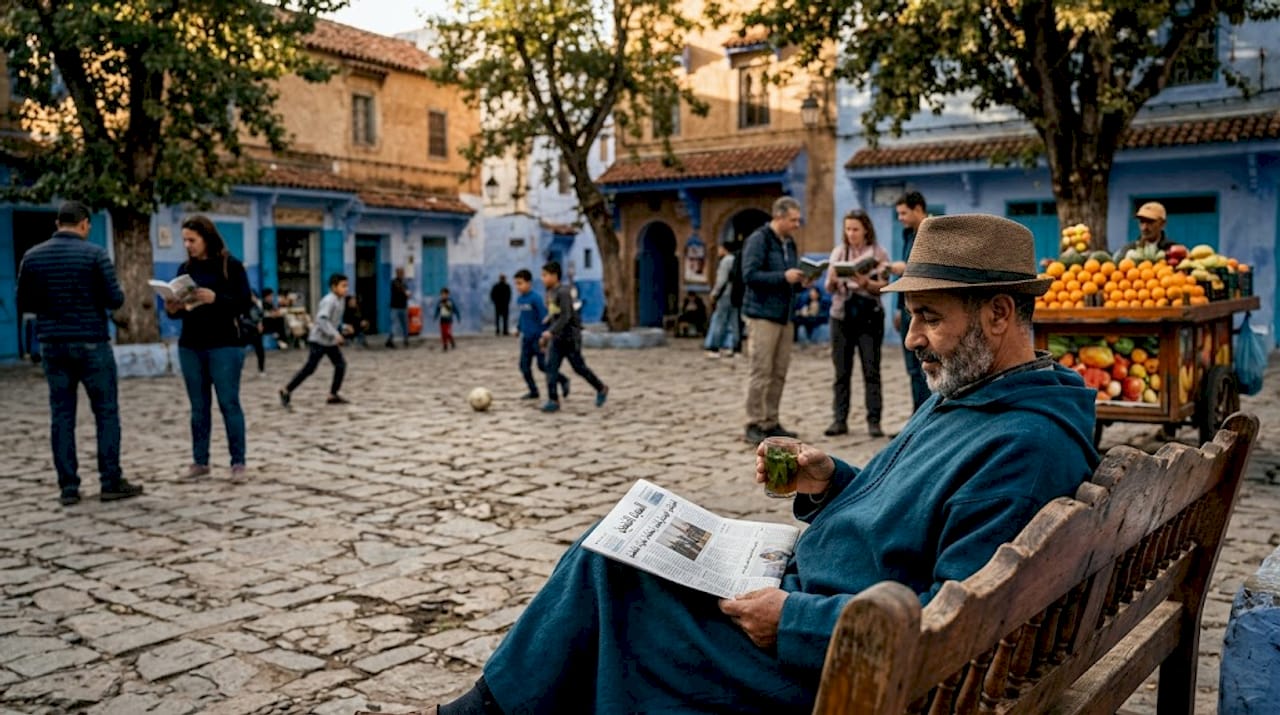
Getting the timing right in Chefchaouen is genuinely one of the more consequential travel decisions you’ll make. The city sits at altitude and has its own microclimate. Summers feel cooler here than in Marrakech or Fes, but spring and fall offer the most comfortable conditions for walking the steep medina streets and hiking nearby trails.
The best shoulder seasons run from April through May and then from late September through October, with temperatures holding in the 18 to 25°C range. These windows offer manageable crowds, reliable sunshine, and the kind of soft light that makes the blue walls glow.
| Season | Weather | Crowds | Best For |
|---|---|---|---|
| Spring (Apr–May) | 18–25°C, occasional rain | Moderate | Photography, hiking, general visits |
| Summer (Jun–Aug) | 25–35°C, dry | High (peak season) | Swimming in rivers near Akchour |
| Fall (Sep–Oct) | 18–24°C, settled | Low to moderate | Budget travel, hiking, cultural experiences |
| Winter (Nov–Mar) | 5–15°C, possible snow | Very low | Solitude seekers, budget travelers |
| Ramadan | Variable | Low | Cultural immersion, authentic local life |
A few additional considerations worth knowing before you book:
- Photography: Spring morning light is exceptional. The blue walls catch the golden hour beautifully, and rain-washed streets after a spring shower become mirror-like.
- Hiking: Fall is the sweet spot. Trails around the Spanish Mosque and toward Akchour are cooler and less dusty than in summer.
- Ramadan falls in late February into March. Many restaurants open late, and the medina is quiet significantly during the day. For anyone interested in authentic Moroccan culture, this is actually a compelling time to visit.
- Budget travel: Winter delivers the lowest guesthouse rates and near-empty streets, though some smaller cafes and shops reduce their hours.
Pro Tip: If you plan to visit during summer, book your riad at least six weeks in advance. The combination of domestic Moroccan tourists and international visitors fills quality accommodations fast from June onward.
How to get to Chefchaouen from Tangier and Fes
This is where many travel plans trip up. Chefchaouen has no airport and no train station, which means every visitor arrives by road. That’s not a problem once you know the options. It is a problem if you assume you can wing it.
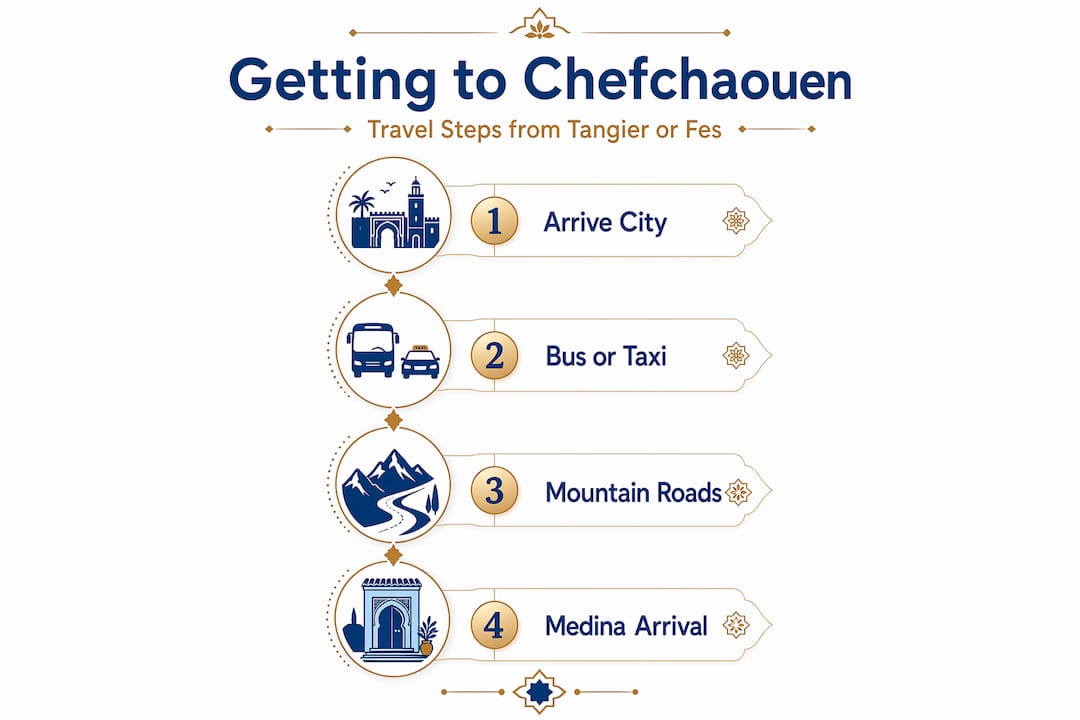
| Route | Method | Duration | Approximate Cost |
|---|---|---|---|
| Tangier to Chefchaouen | CTM bus | 2.5–3 hours | 60–80 MAD |
| Fes to Chefchaouen | CTM bus | 4 hours | ~75 MAD |
| Tangier to Chefchaouen | Shared grand taxi | 2–2.5 hours | 80–100 MAD per seat |
| Tangier to Chefchaouen | Private taxi | 2–2.5 hours | 500–700 MAD total |
| Local bus (cheaper option) | Non-CTM | 3–4 hours | 40–60 MAD |
A few things that the table doesn’t capture:
- The Tangier port transfer problem: If you’re arriving by ferry, the port is not close to the main bus station. Budget for a taxi transfer or arrange a pickup in advance. Travelers who don’t account for this miss their buses.
- CTM advance booking: CTM is Morocco’s most reliable intercity bus company. Book at least a day or two ahead during peak season. Their app and website work smoothly.
- Grand taxi negotiation: Shared grand taxis fill one seat at a time from the taxi stand. If you want to leave immediately rather than waiting, you can pay for the remaining seats. Private taxis are negotiated beforehand. Agree on the price before you get in.
Pro Tip: If you’re coming from Tangier and arrive by ship, tell your ferry company or hotel in advance. Some Tangier hotels offer transfer packages to the bus station that save you the chaotic negotiation outside the port gates.
For travelers who want the northern circuit covered without logistics stress, Moroccotours offers a structured 9-day northern Morocco tour connecting Chefchaouen, Fes, and Tangier with private transport included throughout.
Things to do in Chefchaouen beyond the blue streets
The Chefchaouen blue streets are the reason most people come. But they’re not the reason most people remember the place the way they do. Here are the experiences worth building your itinerary around.
- Wander Sidi Bouchouka Street, El Asri Alley, and El Haouta Square. These are the three most photogenic corners of the medina, and each has a distinct quality. Sidi Bouchouka is famous for its flower pots and layered blue geometry. El Asri Alley goes deeper into the residential fabric. El Haouta Square offers the kind of café-lined space where you can sit for an hour and watch the city function. The best time to visit all three is before 9 AM, when day-tripper crowds haven’t arrived yet.
- Visit the Kasbah and its ethnographic museum. Entry costs 70 MAD for foreigners and opens daily from 9 AM to 6 PM. Inside you’ll find a restored fortress, Andalusian-style gardens, and a small but genuinely interesting museum with regional costumes, weapons, and historical photographs of the city. Climb the tower for panoramic views over the medina rooftops.
- Hike to the Spanish Mosque at sunset. This is the most rewarding single activity in the city for views. The hike is a 15- to 20-minute steady uphill walk, but you need to leave at least an hour before sunset to claim a good vantage point. The mosque itself is closed to non-Muslims, but the hilltop position gives you an unobstructed view of the medina, the valley, and the surrounding mountains going orange in the fading light.
- Shop local artisan goods in the medina souks. Chefchaouen specializes in woven wool products, including blankets, djellabas, and baskets in the city’s signature blue and white palette. Prices are more honest here than in Marrakech, and the hard-sell pressure is considerably lower. Ras El Ma is also worth a visit: a natural spring at the edge of the medina where locals do laundry and children play.
- Day trip to Akchour Waterfalls. The Akchour Waterfalls and God’s Bridge sit about 45 minutes from Chefchaouen by shared taxi (25 to 30 MAD) or a private taxi for roughly 300 MAD round trip. Plan at least six hours for the excursion. God’s Bridge is a natural rock arch above a river and the lighter of the two hikes. The Grand Cascade is longer and more physically demanding but spectacular. Leave by 8:30 AM to make the most of daylight and cooler temperatures.
Pro Tip: Bring water shoes for Akchour. The trail crosses the river multiple times, and most people end up wading regardless of the season. Sandals work in a pinch, but dedicated water shoes make the experience significantly more comfortable.
For photography lovers, MoroccoTours also offers a dedicated Morocco photography tour that structures your days around the best light in locations like Chefchaouen, the Sahara, and the imperial cities.
Practical tips for staying in Chefchaouen
Choosing where to stay shapes your entire experience. The medina is the obvious choice, and staying inside it means you can be at the best spots before the crowds arrive. Most riads and guesthouses here are small, atmospheric, and genuinely run by local families rather than corporate operators.
- Stay inside the medina: The inconvenience of carrying your bag through narrow alleys is worth it. You’ll hear the call to prayer from the Uta El-Hammam mosque, smell the bread being baked by neighbors, and be steps away from everything.
- Avoid photo-spot scams: Some locals in the most famous alleyways charge tourists for photographing them or their cats and doorways. Be polite, be aware, and don’t feel obligated. Move on without engaging if approached aggressively.
- Cannabis culture: The Rif Mountains region is one of the largest cannabis-producing areas in the world. You will be approached with offers. Possession is illegal in Morocco regardless of local production, and tourists are not immune to enforcement. Politely declining is the right move.
- Dress modestly: This is a conservative mountain city. Shoulders and knees covered go a long way toward respectful interactions with residents who live here year-round and aren’t performing for tourism.
- Safety: Chefchaouen is one of the safer cities in Morocco for solo travelers, including women. The scale of the medina means it’s easy to orient yourself, and the community feel discourages the kind of harassment common in larger cities.
Pro Tip: Book a riad on or just off Plaza Uta El-Hammam, the main square. You get the convenience of the central medina while being steps from cafés, the Kasbah, and the mosque. Avoid the very cheapest options around the bus station outside the medina walls, which trade proximity for atmosphere.
My honest take on visiting Chefchaouen
I’ve seen Chefchaouen on a rushed day trip from Tangier, and I’ve seen it across two unhurried nights. They are not the same experience. They barely feel like the same city.
The day-trip version is genuinely fine if that’s all you have. You’ll get your photos, eat a tagine, and walk the main squares. But you’ll share every one of those moments with a rotating crowd of fellow day-trippers, and you’ll leave not entirely sure what made the place special beyond the color of the walls.
Spending at least two full days changes what you notice. The medina in the early morning, before 8 AM, belongs to the people who live there. Old men drinking mint tea on doorsteps. Bakers pulling bread. Cats in every shaded corner. That’s when the architecture stops being a backdrop and starts being a lived-in place.
What I find most underrated about Chefchaouen is what it does to your pace. After Marrakech or Fes, where the contrast with larger Moroccan cities can feel overwhelming, this city restores something. The streets are quiet enough to hear yourself think. The scale is human.
My advice is concrete: arrive the evening before you want to explore, eat dinner in the square, and be up by 7 AM the next day. Save the Akchour excursion for day two, with an early departure. Don’t cram both into a single day. And don’t let the blue streets be the only thing you look at. The people living behind those walls are the actual story.
— Moroccotours
Plan your Chefchaouen trip with Moroccotours.co
If Chefchaouen has moved to the top of your list, the next question is usually how to connect it with the rest of Morocco without burning days on logistics. At Moroccotours, that’s exactly what we specialize in. Our Morocco tour packages are built around private transport, expert local guides, and itineraries that treat the north of Morocco as more than a detour.
Our Northern Morocco Tour is designed specifically for travelers who want to see Chefchaouen, Fes, and Tangier without the hassle of figuring out bus schedules or negotiating for taxis. For those who want to extend further south, our Morocco Desert Tour combines the imperial cities with the Sahara for a complete Moroccan experience. Every package is customizable, and our team handles accommodation, guides, and transport from arrival to departure.
FAQ
What is Chefchaouen, Morocco, known for?
Chefchaouen is famous for its blue-painted medina, a tradition rooted in Jewish cultural heritage dating from the 1930s. Beyond the blue streets, it’s known for its mountain setting, local wool artisans, and proximity to natural sites like the Akchour Waterfalls.
How long should you spend in Chefchaouen?
Local guides recommend at least two full days: the first for exploring the medina and the Kasbah and the second for a day excursion to Akchour Waterfalls or God’s Bridge.
What is the best time of year to visit Chefchaouen?
The shoulder seasons of April through May and late September through October offer the best combination of mild weather, manageable crowds, and ideal conditions for both hiking and photography.
Is Chefchaouen safe for solo travelers?
Yes. Chefchaouen is considered one of Morocco’s safer cities for solo travel, including for women, due to its small scale, community feel, and lower intensity compared to larger Moroccan cities.
How do you get to Chefchaouen from Tangier?
The most common route is a CTM bus from Tangier, taking 2.5 to 3 hours and costing 60 to 80 MAD. Shared grand taxis are a faster alternative and cost slightly more per seat.