
Fez, Morocco: the ultimate traveler’s guide
- Fez is a historic Moroccan city known for its medieval urban layout and cultural significance, not the red hat it shares a name with.
- Understanding the city’s history reveals its origins as a hub of Islamic scholarship, architecture, and multicultural influence.
When most people search for “fez,” they are looking for one of two things: a flat-topped red hat with a tassel or one of the world’s most extraordinary medieval cities. If you are here for the city, you are in exactly the right place. Fez can mean both the Moroccan city and the brimless cylindrical hat, which creates real confusion for travelers trying to plan a cultural journey. This guide cuts through that ambiguity and focuses on what makes Fez, Morocco, a destination unlike anything else on earth and how to experience it the way it deserves.
Table of Contents
- Discovering fezzes: understanding the iconic hat versus the city
- Fez medina: a living medieval masterpiece and UNESCO World Heritage Site
- The historical roots of Fez: from Idris I to multicultural capital
- Experiencing Fez today: cultural excursions, cuisine, and unique local activities
- Why typical Fez tours miss the mark and how to truly experience its essence
- Plan your journey to Fez with Morocco Tours
- Frequently asked questions
Key Takeaways
| Point | Details |
|---|---|
| Clarify ‘fez’ meaning | The term ‘fez’ can refer to the Moroccan city or a traditional hat, so clear distinction is essential for travelers. |
| Historic medina | The Fez el-Bali medina is the world’s largest car-free medieval city and a UNESCO World Heritage Site. |
| Cultural depth | Fez’s rich history and multicultural heritage make it a unique hub for cultural travel. |
| Experiences | Personalized tours, artisan workshops, and culinary journeys offer immersive experiences. |
| Choose expert guides | Engaging local experts ensures authentic, meaningful, and comfortable travel in Fez. |
Discovering fezzes: understanding the iconic hat versus the city
Let’s get the famous hat out of the way first, because understanding it actually enriches your time in the city. The fez is a brimless, flat-topped cylinder, typically red felt with a tassel, and it has become one of the most recognized symbols of the Islamic world. But its story is more complicated than its image suggests.
The hat’s Byzantine and Ottoman origins place it firmly in Mediterranean history, not Moroccan. Sultan Mahmud II of the Ottoman Empire promoted it in the early 19th century as part of a modernization campaign intended to replace turbans with more uniform headgear across his empire. The hat got its name from the city of Fez because the city was historically a major source of the crimson dye used to color it. That’s the connection. One dye. Not a shared cultural identity.
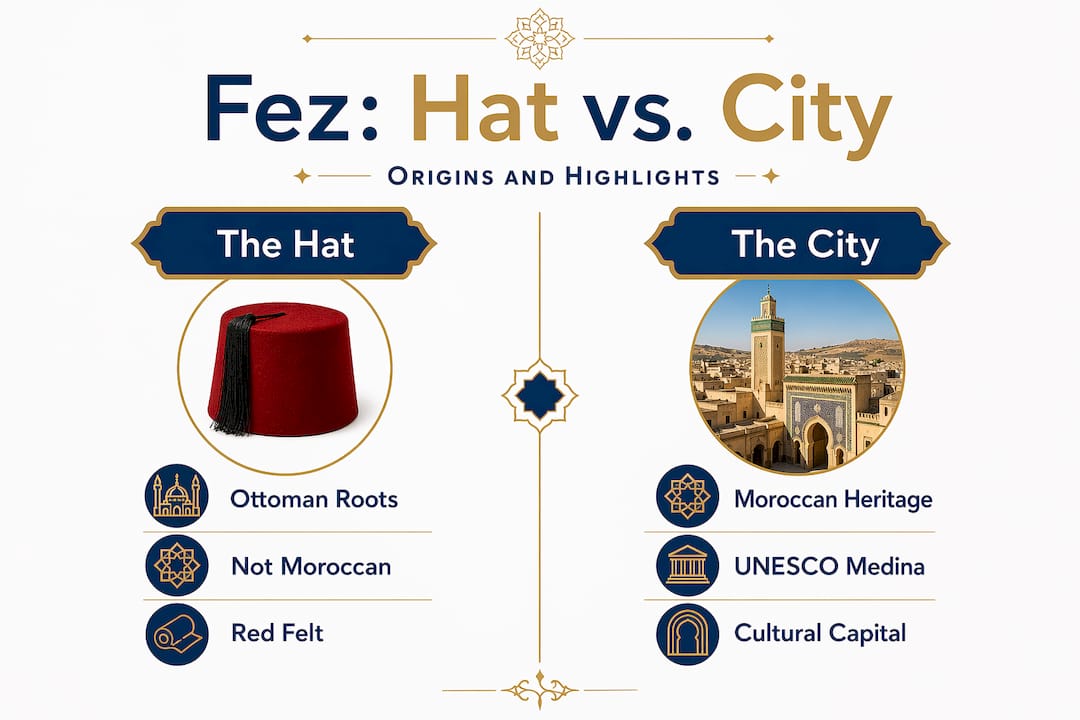
This matters for travelers because it illustrates something important about Fez itself: the city is a source, a place where things originate and radiate outward into the world. Understanding that history gives you a sharper lens for everything you will see there.
Here is a quick breakdown of the key distinctions:
- The fez hat: brimless, red felt, cylindrical, Ottoman in origin, named after the city for its dye supply
- The city of Fez: a living medieval city in northern Morocco, founded in the 8th century, home to the world’s oldest university
- Cultural significance of the hat: largely symbolic today, associated with nostalgia and cultural identity in former Ottoman territories
- Cultural heritage of the city: an active, breathing UNESCO World Heritage Site with 12 centuries of continuous urban life
If you are planning to buy a fez hat as a souvenir during your visit, the medina’s souks (traditional markets) absolutely sell them. But the city itself is the real object of desire. When you start looking into tours in Morocco, Fez almost always anchors the itinerary for good reason.
Fez medina: a living medieval masterpiece and UNESCO World Heritage Site
Nothing quite prepares you for Fez el-Bali. You walk through a gate in the old city wall and step into a city that has operated continuously since the 9th century, without cars, without traffic lights, and without a grid street plan of any kind.
Fez el-Bali earned UNESCO World Heritage status in 1981, recognized for its outstanding universal value as a medieval Islamic cityscape. Spanning 300 hectares with over 9,000 lanes and alleyways, it is the largest car-free medieval urban center on the planet. That is not a marketing claim. It is a structural reality: the streets are simply too narrow for vehicles, which is exactly why the city feels so alive.
| Feature | Details |
|---|---|
| Area | 300 hectares |
| Alleyways | Over 9,000 |
| UNESCO inscription | 1981 |
| City founded | 789 CE |
| Primary transport | Walking donkeys and handcarts |
| Key landmark | University of al-Qarawiyyin (founded 859 CE) |
Medieval Islamic urban planning was not random. It was layered and intentional, placing mosques at the center of neighborhoods, with markets radiating outward, and residential zones wrapping around both. That logic still holds in Fez today. You can see it in the way a single lane can shift from a spice souk to a carpenter’s workshop to a neighborhood mosque courtyard within fifty meters.
What makes the medina extraordinary for heritage travelers is that it is not a museum. People live here. Children go to school here. Artisans inherit their workshops from their parents and grandparents. You are not observing a recreation of medieval life. You are walking through it.
Pro Tip: Hire a licensed local guide for your first full day in the medina and resist the urge to follow a map. The medina’s layout rewards being led, not navigated. Save independent exploration for day two, when you already have a mental map of the main quarters.
A unique experience itinerary built around Fez will typically include at least two full days in the medina, which is the right minimum. One day barely scratches the surface.
Key architectural highlights to prioritize:
- Bou Inania Madrasa: a 14th-century theological school with extraordinary carved plasterwork and cedarwood
- Al-Attarine Madrasa: adjacent to the al-Qarawiyyin mosque, with mosaic tilework that defies explanation
- Chouara Tannery: the oldest functioning leather tannery in the world, best viewed from the surrounding terraces of leather goods shops
- Bab Bou Jeloud: the ornate blue gate marking the main western entrance to the medina
The historical roots of Fez: from Idris I to multicultural capital
Fez did not grow by accident. It was built with purpose, expanded through ambition, and shaped by waves of immigrants who each left a permanent mark on its architecture, food, and intellectual character.
The founding of Fez in 789 CE is attributed to Idris I, who selected the site for strategic reasons: access to the Fez River for water, natural defenses in the surrounding hills, and proximity to trade routes connecting the Mediterranean coast to sub-Saharan Africa. His son, Idris II, expanded the settlement significantly in the early 9th century, and his decision to welcome two large waves of refugees changed the city’s character permanently.
Here is the sequence of events that made Fez what it is:
- 789 CE: Idris I founds the city on the east bank of the Fez River, establishing the original settlement
- 809 CE: Idris II establishes a larger settlement on the west bank and begins attracting skilled immigrants
- 818 CE: Approximately 8,000 families expelled from Córdoba, Spain settle in Fez, forming the Andalusian quarter and bringing Spanish-Islamic architectural traditions
- 824 CE: Families from Kairouan, Tunisia (then one of the Arab world’s great intellectual cities), settle across the river, forming the Qarawiyyin quarter
- 859 CE: The University of al-Qarawiyyin is founded, becoming the world’s oldest continuously operating university
- 12th to 14th centuries: The Marinid dynasty transforms Fez into a showcase of Islamic architecture and scholarship
The Andalusian and Kairouan immigrants were not refugees in the modern sense of displaced and dispossessed people. They were educated, skilled urban dwellers who brought construction techniques, agricultural knowledge, musical traditions, and culinary practices. The couscous you eat in Fez today carries traces of that North African and Tunisian influence. The carved wood ceilings in the riads (traditional courtyard houses) reflect Andalusian woodworking traditions.
Building a Morocco itinerary that includes Fez without spending time understanding this founding history is like visiting Rome without knowing anything about the Republic. The buildings make more sense when you know who built them and why.
Experiencing Fez today: cultural excursions, cuisine, and unique local activities
Knowing Fez’s history is one thing. Living it for a few days is another category of experience entirely. The question most travelers ask is, “How do I go deeper than the standard tour without feeling like I am intruding on people’s daily lives?” The answer is expert local guides and carefully curated access.
The best cultural experiences in Fez combine structured knowledge with unscripted moments. Here is what that actually looks like in practice:
- Private medina tours: A licensed guide who has spent years in the medina does not just identify buildings. They know which master craftsman makes the finest zellige (geometric mosaic tilework), which family runs the best hole-in-the-wall restaurant, and which hours the al-Qarawiyyin library is accessible to visitors
- Tannery visits with context: The Chouara Tannery looks spectacular from above, but the real experience is understanding what you are seeing. Hides are soaked in pigeon dung to soften them, then hand-dyed using saffron for yellow, poppy for red, and indigo for blue. A knowledgeable host turns a visual spectacle into a story about centuries of unchanged craft
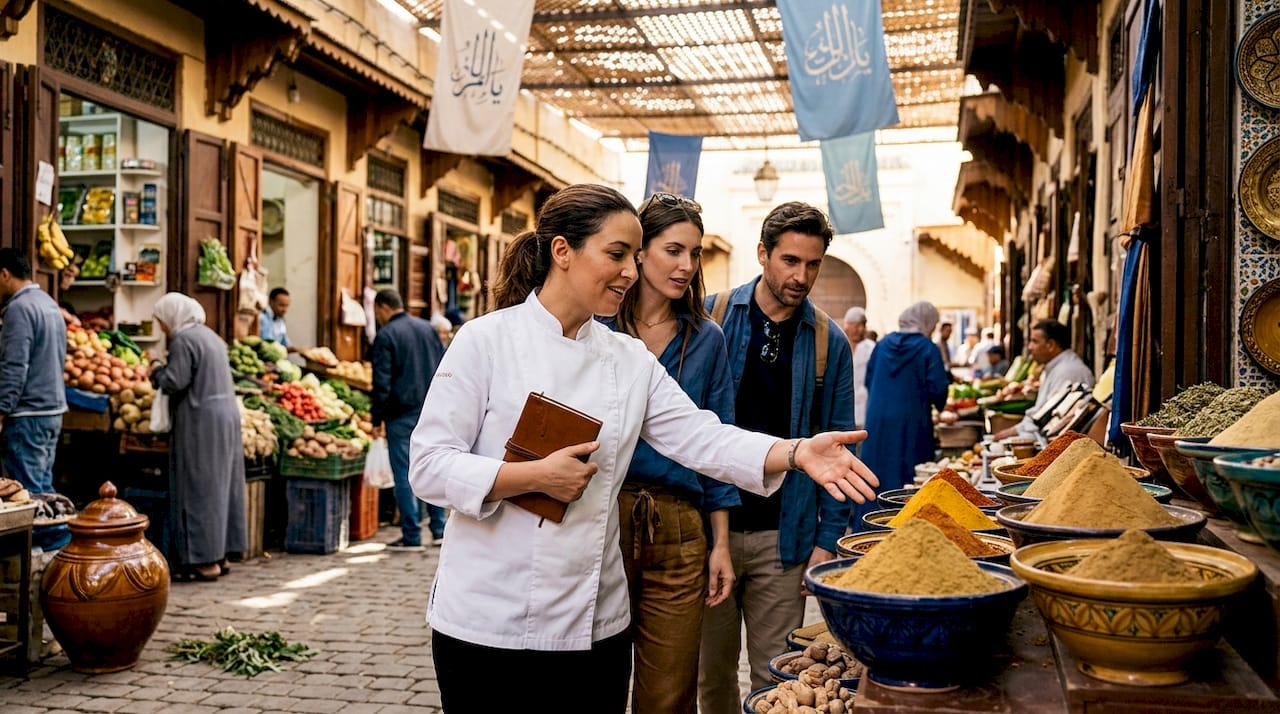
- Cooking classes with local chefs: Moroccan gastronomy in Fez is distinct from Marrakech’s food culture. Fez is considered by many Moroccan chefs to be the country’s culinary capital, with dishes like pastilla (a savory-sweet pie of pigeon, eggs, and almonds wrapped in thin pastry) representing a sophistication you simply cannot find elsewhere
- Riad stays chosen for heritage, not just comfort: The best riads in Fez are not just beautiful hotels. They are restored historic homes where the owner can tell you about the family that built the house and the trades that once operated in its courtyard
A serious Moroccan food tour through Fez will take you beyond the restaurant and into the souk at dawn, following a chef as they select ingredients. That kind of access requires relationships and local knowledge that only a specialist operator can provide.
Pro Tip: Book your riad for at least three nights. Two nights in Fez is consistently the most common regret among first-time visitors. The city takes time to reveal itself, and your third day is always the best one.
For travelers who want to extend their cultural immersion beyond the city, exclusive tours in Morocco can combine Fez with the Sahara, Chefchaouen, or the imperial cities of Meknes and Marrakech in a single, logistically smooth journey.
Why typical Fez tours miss the mark and how to truly experience its essence
After years of curating travel experiences in Morocco, one pattern stands out consistently: the travelers who leave Fez most transformed are never the ones who followed a group tour with a numbered itinerary and a set lunch at a tourist restaurant. They are the ones who slowed down, got slightly lost, and let the city come to them.
The conventional tour approach to Fez has a specific flaw: it prioritizes coverage over depth. You see the tannery. You walk through the souks. You photograph the blue gate. You spend forty minutes in a carpet shop. You leave having checked boxes. That is not nothing, but it is not Fez.
“Because ‘fez’ is ambiguous, experts recommend clear cultural framing to prevent irrelevant or superficial travel experiences.” Traveling with that principle in mind means actively choosing depth over breadth at every decision point.
Here is what actually goes wrong on typical tours and what to do instead:
Common pitfalls:
- Rushing through the medina in half a day when it deserves at least two full days
- Visiting artisan workshops attached to tourist shops rather than independent craftspeople
- Eating at restaurants catering to visitors instead of neighborhood spots recommended by your guide
- Skipping the Jewish quarter (Mellah) because it is less photographed, despite its enormous historical significance
- Treating the medina as a backdrop for photos rather than a functioning community
What works:
- Hiring a guide who lives in the medina, not just one who works there
- Asking your guide to introduce you to craftspeople by name, not just show you their work
- Scheduling a morning at the souk before tourist hours begin, around 7 to 8 AM
- Choosing a riad located inside the medina rather than adjacent to it
- Building in unscheduled time every day, because the best moments in Fez are unplanned
The fez hat’s story offers a useful metaphor here. For generations, people assumed the hat was Moroccan because it was named after a Moroccan city. The name created a false impression of the origin. Similarly, the name “heritage tour” creates a false impression that showing up and seeing old buildings constitutes genuine cultural exchange. It does not.
Real cultural immersion in Fez requires guided tours in Morocco built around relationships, context, and intentional pacing. The city rewards travelers who come prepared to understand it, not just photograph it.
Plan your journey to Fez with Morocco Tours
Fez is a city that gives back in proportion to the quality of your preparation and the expertise of your guides. At Morocco Tours, we design private, personalized itineraries that place you inside the living culture of Fez, not just in front of it. Every detail, from your riad selection to your guided medina walks to your private cooking experiences, is built around what you actually want from this city.
Our Fez packages connect naturally to broader Morocco desert tours and multi-city journeys, so you can move from the medina’s medieval lanes to the Sahara’s silence within a single, professionally managed trip. Explore our Morocco itinerary options to find a starting point that fits your travel dates, interests, and preferred pace. Every itinerary we offer is adjustable, because no two travelers experience Fez the same way.
Why travelers choose us for Fez:
- Private licensed guides with deep medina knowledge
- Carefully selected heritage riads with personal service
- Exclusive access to artisan workshops and culinary experiences
- Seamless logistics from arrival to departure
- Fully customizable itineraries built around your priorities
Frequently asked questions
What is the difference between “Fez” and “Fes”?
Fez (also spelled Fes) is a city in northern Morocco and one of the country’s four imperial cities. A fez is a traditional brimless red hat with a tassel, originating in the Ottoman Empire. Travelers searching for cultural experiences in Morocco almost always mean the city.
Why is Fez’s medina a UNESCO World Heritage Site?
The medina’s UNESCO designation in 1981 recognized it as the most complete, authentically functioning medieval Islamic city in the world. Its traditional urban layout, architecture, and social organization have remained largely intact since the 9th century.
What are some must-do experiences in Fez?
Private guided tours of the medina, exclusive visits to artisan workshops such as traditional craft spaces, and high-end culinary journeys including cooking classes focused on Fassi cuisine are consistently the most memorable experiences for travelers.
Is the fez hat originally from Morocco?
No. The fez hat has Byzantine and Ottoman origins and was standardized across the Ottoman Empire in the early 19th century. It takes its name from the city of Fez because the city supplied the crimson dye used to color it, not because Moroccan culture invented or traditionally wore it.