
Morocco guided tours: culture, and real adventure
- Morocco guided tours are fully customizable, focusing on personalized itineraries, accommodations, and experiences.
- They prioritize authentic cultural immersion, private access, expert guides, and slow-paced travel to foster genuine connections and memorable moments.
- Travelers who leave room for spontaneity and local encounters find the deepest, most rewarding experiences in Morocco.
Most travelers assume guided tours mean shuffling through crowded sites with a flag-waving leader and a fixed script. Morocco, though, breaks every one of those assumptions. When you invest in a guided experience, you step into a country of staggering contrasts: ancient medinas beside modern art galleries, Saharan silence beside bustling spice markets, snow-capped Atlas peaks beside Atlantic surf. The question is not whether Morocco is worth visiting. It is whether you will experience it at surface level or at a depth that stays with you for decades.
Table of Contents
- What defines a guided tour in Morocco?
- Must-see highlights and unique experiences
- Customization for families and couples
- Gastronomy, hospitality, and cultural immersion
- What most travelers miss about Morocco guided tours
- Explore curated Morocco guided tours
- Frequently asked questions
Key Takeaways
| Point | Details |
|---|---|
| Personalized | Morocco guided tours can be fully tailored to your interests and preferences for a truly personalized experience. |
| Unique experiences | Signature guided tours unlock exclusive access to Morocco’s hidden gems, cultural sites, and local encounters. |
| Family and couple focus | Tours are expertly designed with safety, amenities, and experiences ideal for families and romantic travelers. |
| Culinary immersion | Food tours and local cuisine are a highlight of premium guided tour itineraries. |
| Expert guidance | Experienced local guides provide deep cultural insight and seamless logistics for stress-free travel. |
What defines a Morocco guided tour?
Now that we have reframed what a guided tour can offer, let us zoom into the elements that set Morocco tours apart from anything you might have booked before.
The single biggest difference is the itinerary itself. A Morocco tour is built around you, not around a bus schedule. That means your guide knows your interests before you land. If you love architecture, mornings are spent inside intricately tiled madrasas and walled kasbahs rather than outside looking at them through a chain-link fence. If you are a food-obsessed traveler, a private chef might join your group for an evening in a Fes riad. This level of specificity is only possible because tour designers spend time learning what you actually want.
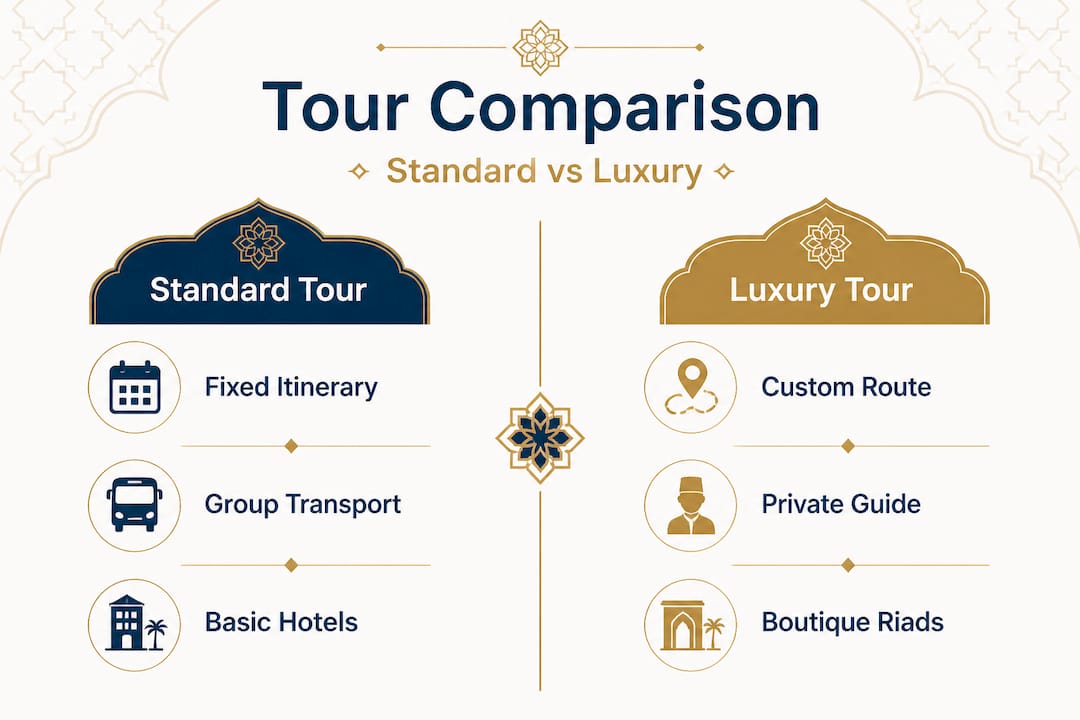
Accommodations are another area where the gap between standard and becomes obvious immediately. Budget and mid-range tours book large chain hotels. Tours often place you inside boutique riads, which are traditional Moroccan houses built around a central courtyard, filled with hand-painted zellige tile work, carved cedarwood screens, and rooftop terraces that look out over ancient city skylines. In the Sahara, the difference is even sharper: a standard camp has canvas tents and communal facilities, while a private camp offers styled Berber tents with proper beds, en-suite bathrooms, and chilled wine under a sky full of stars.
Guide quality changes everything. Tours employs multilingual experts, usually historians, geographers, or cultural specialists who grew up in the regions they are guiding. They do not read from a script. They answer difficult questions, introduce you to artisans by name, and get you into spaces that are never listed in any travel guide. That access, that local knowledge, is the real currency of premium travel.
Standard vs. guided tours: a direct comparison
| Feature | Standard group tour | Guided tour |
|---|---|---|
| Itinerary | Fixed, group-based | Fully customized |
| Accommodation | Chain hotels or basic guesthouses | Boutique riads, hotels, private desert camps |
| Dining | Set menus at tourist restaurants | Private dinners, market tastings, chef-led experiences |
| Guide | General knowledge, large groups | Specialist, multilingual, small group or private |
| Site access | Standard public hours | Early entry, after-hours, private viewings |
| Transportation | Shared coach | Private vehicles |
| Concierge services | None or minimal | Full 24/7 support |
Pro Tip: When booking tours, ask specifically about guide specializations. A guide who has a background in Moroccan architecture will give you a completely different Fes experience than a generalist.
Here are the core elements you should expect on any premium guided tour:
- Custom pacing: no forced early wake-ups unless you want them
- Private transport: air-conditioned 4x4s or Mercedes vans, not coaches
- Curated accommodations: hand-picked and pre-inspected by the tour operator
- Exclusive access: private market visits, after-hours site access, local family dinners
- Dedicated concierge: real humans available for changes, requests, or emergencies
A well-designed Morocco Grand Tour pulls all these threads together, moving you through imperial cities, mountain passes, desert dunes, and coastal towns without a single moment feeling rushed or generic.
Must-see highlights and unique experiences
Having established what “Morocco guided tours” means, let us explore the destinations and experiences you can actually access when you travel this way.
Morocco is one of the most geographically diverse countries in the world, and its guided tour circuit reflects that range. The four imperial cities form the cultural backbone of any serious Morocco itinerary. Marrakech stuns with its Djemaa el-Fna square, the Bahia Palace, and the endless narrow lanes of the medina. Fes is arguably the most intense: a UNESCO-listed medieval city where tanners still dye leather by hand in open-air vats that have not changed since the 10th century. Rabat, as the capital, combines a thoughtful pace with genuine political history. Casablanca is Morocco’s economic engine, worth more than a quick stop at the Hassan II Mosque.
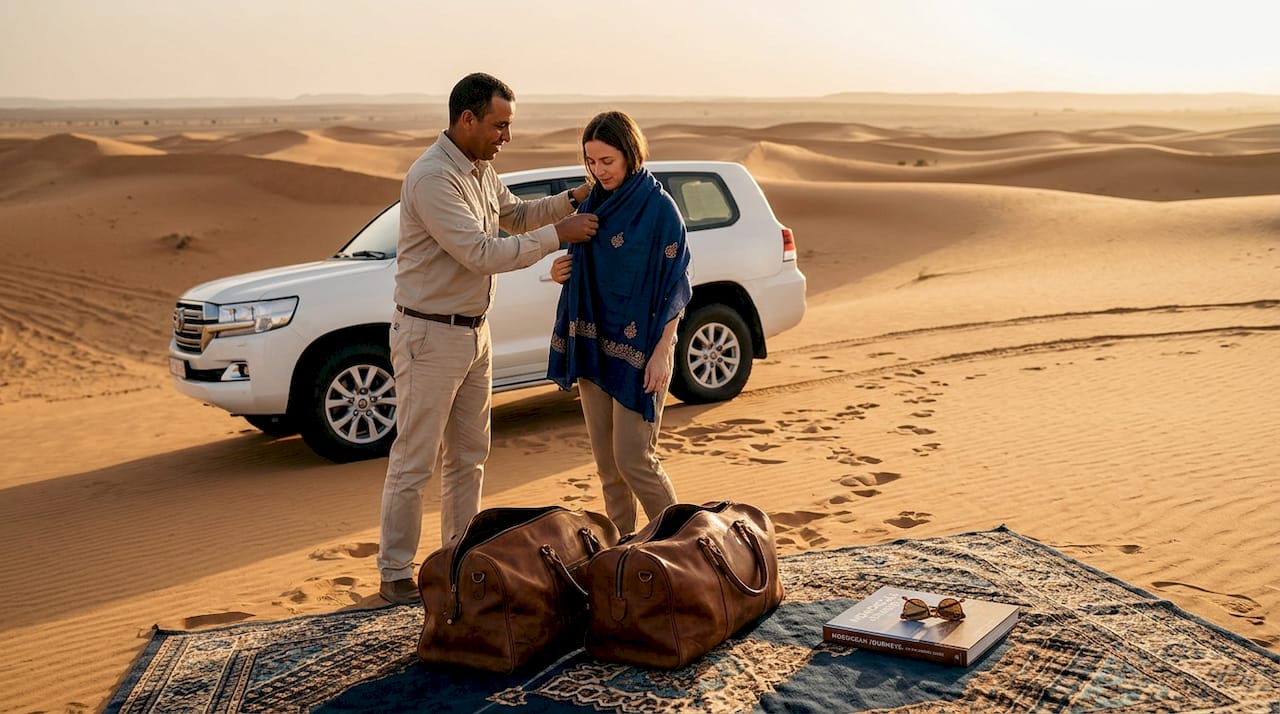
The Sahara Desert is what many international travelers most want to see, and rightly so. A desert experience involves camel rides into the dunes at dusk; a private camp where silence and stars replace every city noise; and waking at dawn to see the light change the color of the sand from gray to deep gold to orange. Signature tours consistently include this desert element precisely because nothing else quite matches it.
The High Atlas Mountains offer a different kind of awe. Trekking routes through Berber villages give you direct contact with communities that have lived in these valleys for centuries. Village guesthouses here serve homemade bread, fresh mint tea, and lamb cooked over wood fires. The contrast with the polished medinas below is genuinely striking.
Unique experiences by region
| Region | Signature experience | What makes it exclusive |
|---|---|---|
| Marrakech | Private riad dinner, night medina walk | After-hours access to palace gardens |
| Fees | Tannery viewing with artisan introduction | Private family workshop visits |
| Sahara Desert | Private camp, camel trek, stargazing | No shared facilities, personal butler |
| High Atlas | Berber village immersion, mountain trek | Local family homestay, traditional meals |
| Essaouira (Atlantic coast) | Wind sports, seafood market tour | Private fish market access, sailing |
| Chefchaouen | Blue city photography tour, mountain hike | Sunrise access before crowds arrive |
Pro Tip: The Morocco Highlights Tour is an excellent starting point if this is your first visit and you want to cover the essential contrast between city, mountain, and desert without feeling like you are rushing.
A few experiences stand out as genuinely hard to replicate:
- Private heritage museum visits in Fes with a curator who explains each artifact in detail
- Saharan stargazing with a telescope and an astronomy guide who knows the southern sky
- Cooking classes inside a private riad where the host family teaches you how to make bastilla, the iconic sweet-savory pigeon pie
- Desert wildlife walks at dawn to spot desert foxes, tracks, and flora most visitors never see
- Souk shopping with a local buyer who helps you understand fair prices and authentic craft sources
For those who want the group energy without sacrificing quality, the Morocco Group Tour offers a way to share the experience with like-minded travelers while still keeping numbers small and service high. And if the desert is the primary draw, a dedicated Morocco Desert Tour gives you maximum time in the Sahara with full services throughout.
Customization for families and couples
Once you know what is possible, it is crucial to understand how Morocco guided tours adapt to your specific travel group, whether you are traveling as a family with children or as a couple looking for something deeply romantic and private.
Family travel in Morocco is more practical and more rewarding than most parents expect. The key is pacing. Children do not want four hours in a museum, but they absolutely love a camel ride through a palm grove, a pottery class where they can actually get their hands in the clay, and a night in a desert tent that feels like something out of an adventure story. As family vacation tours demonstrate, the best operators design activities that engage children genuinely rather than sidelining them.
For couples, Morocco offers an almost embarrassing range of romantic options. A private rooftop dinner above the Marrakech medina at sunset, a hammam ritual for two in a centuries-old bathhouse, a night in a candlelit desert camp with no other guests for miles—these are experiences that feel designed for intimacy because, in this version, they genuinely are.
How to customize your tour step by step
- Share your travel profile: Tell the tour designer who is traveling, ages of children if relevant, any accessibility needs, pace preferences, and deal-breaker experiences.
- Define your priorities: Is this trip about food? History? Adventure? Relaxation? Knowing this shapes every accommodation and activity choice.
- Review the proposed itinerary: A good operator will send you a detailed day-by-day plan with alternatives clearly explained.
- Adjust freely: Change the order of destinations, swap a city day for a mountain hike, add a cooking class, or cut a site that does not excite you.
- Confirm logistics: Locks in guides, transport, accommodation, and any private experiences.
- Stay flexible on arrival: The best guides will always have a spontaneous suggestion that is not in the plan — good operators build buffer time in so you can say yes.
Here are the amenities and services that genuinely differentiate family and couple tours:
- Nanny or childcare services available at key accommodations
- Stroller-accessible and lift-equipped riads for families with infants
- Private transfers between cities so no one is cramped in a shared vehicle
- In-room welcome gifts tailored to the traveler (children’s adventure kits, couples’ spa baskets)
- Flexible meal times so children do not have to sit through late-night Moroccan dinner service
- Private guides who specialize in family or romantic travel rather than general tour delivery
Pro Tip: If you are planning a honeymoon or anniversary trip, tell your operator explicitly. A skilled team can arrange surprises at key moments in the journey, like a private musician at dinner in Fes, flower petals in a desert tent, or a note left with your breakfast tray in Marrakech—details that cost little but mean everything.
Gastronomy, hospitality, and cultural immersion
Beyond destination highlights, gastronomy, service, and cultural immersion enrich every Morocco guided tour in ways that last long after the trip ends.
Moroccan food is extraordinary, and not just the famous tagine. Every region has its own culinary identity. Fes is known for pastilla and slow-cooked mrouzia, a sweet lamb and honey dish. Marrakech has its street food culture, the smoky kefta skewers, and fried fish at the night market. Essaouira’s seafood is among the freshest on the continent. The interior of the country produces argan oil, which flavors everything from salad dressings to dessert pastries. A serious Moroccan food tour takes you through all of these layers, connecting food to geography, history, and family tradition in a way that no restaurant meal back home ever could.
“Cuisine and hospitality are integral to experiencing Morocco’s soul. Food here is not just sustenance — it is ceremony, community, and identity expressed on a plate.”
Moroccan hospitality has a specific word, “difaa,” which describes the tradition of honoring a guest with an abundance of food, attention, and warmth. This is not performed for tourism. It is cultural. When you sit down for tea with a guide’s family or share a slow lunch in a Berber village, you are participating in a living tradition that predates mass tourism by centuries. Tours prioritize these moments because they understand that these are what international travelers remember most: not the hotel thread count but the afternoon when someone invited them in as a genuine guest.
According to gastronomic tour itineraries, the best culinary experiences combine regional market visits, home-kitchen classes, and meals in restaurants that locals actually eat at rather than those designed for tourist traffic.
Here is what premium guided tours consistently include in their cultural and culinary programming:
- Spice market tours with a guide who explains medicinal, culinary, and ritual uses of each product
- Private cooking classes inside working family kitchens, not hotel demonstration spaces
- Artisan workshop visits to zellige tile makers, leather tanners, carpet weavers, and silversmiths
- Traditional hammam experiences with attendants who walk you through the full ritual
- Music and storytelling evenings featuring Gnawa musicians or Berber folk performers in private settings
- Food and wine pairings using Moroccan wines from the Meknes region alongside regional dishes
The tour booking guide walks through exactly how to request these experiences as part of your package, which matters because many of them require advance notice and relationships that only established operators can access.
Hospitality also extends to the physical spaces you stay in. The best riads in Fes and Marrakech are generational family properties, lovingly restored and managed by families who know every craftsperson who worked on the building. Staying in one of these is fundamentally different from checking into a branded hotel. You feel the age of the city through the walls.
What most travelers miss about Morocco guided tours
Here is something we have observed across years of planning premium Morocco journeys: the most satisfied travelers are almost never the ones who arrived with the longest list of sites to tick off. They are the ones who left room for the unexpected.
Too many affluent travelers arrive with a perfectly optimized itinerary and then spend their whole trip executing it. They visit the tanneries, check. They ride a camel, check. They photograph the blue streets of Chefchaouen, check. And then they go home wondering why the trip felt slightly hollow despite being objectively beautiful. The problem is not the destinations. It is the approach.
Real in Morocco is relational. It is the moment your guide stops the car because a local festival has just started in a village square and you spend an unplanned hour watching men in white djellabas dance to drums you have never heard before. It is the tea that appears without being asked for after a long mountain walk. It is the carpet dealer who turns out to be a poet and recites something for you in Darija that your guide translates as you listen.
We have learned that the single most valuable question a traveler can ask their guide is, “What is happening right now in this place that tourists never see?” The answer almost always leads somewhere remarkable. A seasonal harvest, a neighborhood wedding, a private ceremony open to respectful outsiders, a market that only operates on Tuesdays and only sells handmade items. This is the Morocco that changes you.
The workflow for Morocco tours is designed specifically to create this kind of space, building flexibility into even the most structured itinerary so that when something extraordinary presents itself, you can say yes without losing the rest of your trip.
The other thing many travelers miss is the value of slow travel within Morocco. Spending three nights in Fes instead of one and a half means you stop rushing. You start noticing things: the way the call to prayer echoes differently at noon versus sunset, the smell of bread baking in communal ovens at 6 a.m., the specific quality of light in the medina in the late afternoon that has inspired painters for centuries. Morocco rewards patience in a way that few destinations can match.
Explore curated Morocco guided tours
With insights and practical guidance under your belt, the next step is finding the specific tour that matches your vision. Whether you are drawn to the imperial cities and Saharan dunes of the Morocco Signature Tour, the sweeping cross-country journey of the Morocco Grand Tour, or the deeply immersive culinary adventure of the Morocco Food Tour, every package is designed to be customized around your dates, group size, and interests. Browse the full range of curated itineraries, and reach out to the team to start building your ideal journey. The conversations are free, the expertise is genuine, and the experiences waiting for you in Morocco are unlike anything else on earth.
Frequently asked questions
What level of customization is available for Morocco guided tours?
Morocco tours are fully customizable with tailored itineraries, accommodations, and activities, meaning you can adjust pacing, destinations, dining, and guide specializations to match exactly what you want from your trip.
Are Morocco guided tours suitable for families with young children?
Yes, family vacation tours are designed specifically with kid-safe activities, flexible scheduling, and family-focused amenities so parents and children both have a genuinely rewarding experience.
What is the minimum group size for a private guided tour?
Private Morocco tours accommodate solo travelers, couples, and small groups with no fixed minimum, making them ideal for anyone who wants an exclusive experience without waiting for a group to fill.
Do guided tours in Morocco include culinary experiences?
Many guided tours include food tastings, cooking classes, and local market visits as standard, while dedicated gastronomic tours go even deeper into Morocco’s diverse regional food traditions.
How are accommodations selected for guided tours?
Accommodations are hand-picked based on guest preferences and pre-inspected for quality, typically including boutique riads, hotels, and desert camps that offer a genuinely Moroccan atmosphere alongside premium comfort.