
Meknes: Morocco’s Imperial City Worth Discovering
- Meknes is an overlooked imperial city founded as a modest settlement in the 11th century, transformed into Morocco’s capital by Sultan Moulay Ismaïl.
- Its cohesive 17th-century architecture and monumental gates reflect Ismaïl’s power, making it ideal for heritage enthusiasts seeking authenticity.
- Visitors should allocate at least two days to explore its sites, including nearby Volubilis and Moulay Idriss, for a comprehensive cultural experience.
Morocco has four imperial cities. Most travelers fight for space in Marrakech’s souks or spend days decoding Fes’s labyrinthine medina. Meknes quietly sits 60 kilometers to the west, largely ignored and deeply underestimated. That’s a mistake worth correcting. This city was once the seat of one of Morocco’s most powerful sultans; its walls stretch over 40 kilometers, and its monuments rival anything you’ll find in the more photographed corners of the country. If you’re serious about Moroccan history and culture, Meknes belongs at the top of your list.
Table of Contents
- Key takeaways
- Meknes and its imperial origins
- Top Meknes attractions to see
- Practical tips for visiting Meknes
- What makes visiting Meknes genuinely different
- My honest take on Meknes
- See Meknes with Moroccotours
- FAQ
Key takeaways
| Point | Details |
|---|---|
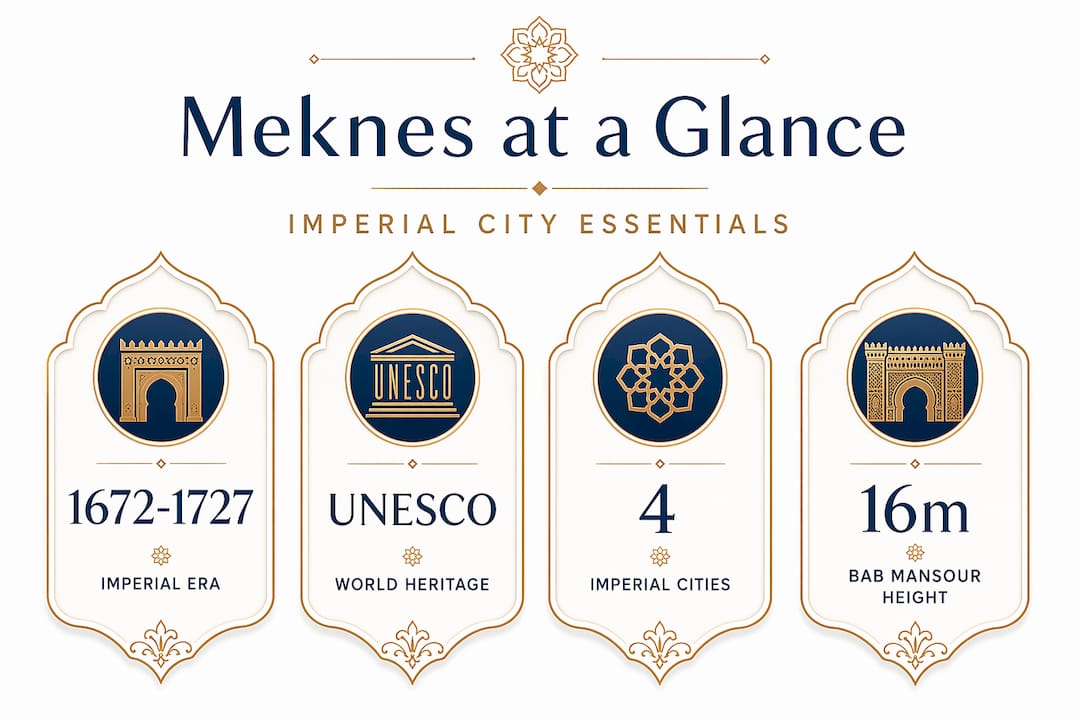
| An overlooked imperial capital | Meknes served as Morocco’s imperial capital under Sultan Moulay Ismaïl and holds UNESCO World Heritage status since 1996. |
| Monumental architecture awaits | The Bab Mansour gate, royal granaries, and the sultan’s mausoleum rank among the most striking monuments in North Africa. |
| Less crowded than rivals | Visitors experience a quieter, more authentic atmosphere compared to Marrakech or Fes, with flexible access to major sites. |
| Perfect base for day trips | Meknes sits within 30 km of Volubilis and Moulay Idriss, making combined heritage excursions both easy and rewarding. |
| Ideal for serious heritage travelers | The city’s compact imperial core and coherent 17th-century urban planning offer a focused, deeply satisfying cultural visit. |
Meknes and its imperial origins
Most cities earn their importance gradually. Meknes earned its in a single, furious burst of ambition. The city itself predates that moment by centuries. The Almoravids founded it in the 11th century as a modest Berber settlement in the fertile plains between the Rif and Middle Atlas mountains. It stayed relatively secondary for hundreds of years, overshadowed by Fes and Marrakech, until one sultan changed everything.
Sultan Moulay Ismaïl took the throne in 1672 and ruled until 1727, and in that time he reshaped Meknes from a provincial town into a capital designed to announce his power to the world. He chose it deliberately. Fes was associated with religious elites he didn’t fully trust. Marrakech sat too far south. Meknes offered fertile land, strategic positioning between two mountain ranges, and the room he needed to build without the constraints of a city already dense with rival power centers.
What he built is staggering even by modern standards. The imperial palace complex contained granaries, royal stables, gardens, mosques, underground water systems, and military barracks, all enclosed within a vast fortified perimeter. His engineers designed a hydraulic network of wells, canals, and norias to supply water across the enormous complex, allowing the city to sustain a siege indefinitely. This wasn’t just a royal residence. It was a self-contained imperial machine.
Here’s what makes the Meknes history and culture story particularly interesting:
- Moulay Ismaïl modeled parts of his ambitions on the court of Louis XIV at Versailles, having made diplomatic contact with the French king
- The city’s construction drew on a mix of paid craftsmen, soldiers, and enslaved laborers, though popular accounts of Christian slave labor are largely exaggerated; the so-called “prisons” were primarily grain storage facilities
- The monumental urban design was intended as a direct statement of absolute authority, with architecture serving political and psychological purposes as much as practical ones
- The entire palace district covers roughly 700 hectares, comparable in scale to the Versailles complex itself
Pro Tip: When reading about Meknes history and culture, pay attention to the strategic logic behind the city’s layout. The separation between the medina and the imperial quarter isn’t accidental. It was designed to keep administrative and military power physically distinct from the civilian population.
Top Meknes attractions to see
You could spend a full day just standing in Place El Hedim, the grand square at the heart of the old city, watching Meknes do what it does best: living as a real city, not a museum. But the monuments surrounding that square demand your attention.
Bab Mansour
Nothing in Morocco quite prepares you for your first look at Bab Mansour. Standing roughly 16 meters tall, this gate commands the western edge of Place El Hedim with an authority that feels almost theatrical. The zellij tilework covers the surface in geometric precision. Horseshoe arches frame the entrance. Marble columns lifted from the Roman ruins at Volubilis flank the structure, a deliberate recycling of ancient grandeur into Moulay Ismaïl’s new order. It was completed in 1732 by Moulay Abdallah, Moulay Ismaïl’s son, several years after the sultan’s death. That continuity of ambition tells you something important about the dynasty.
The Mausoleum of Moulay Ismaïl
The mausoleum is one of the few religious sites in Morocco that non-Muslims may enter, and the experience rewards the visit. The interior courtyard is all white stucco and cedar wood, fountains, and quiet. The sultan’s tomb sits behind an elaborately decorated doorway. The atmosphere is genuinely peaceful, more contemplative than performative. Visiting Meknes, Morocco, without stopping here would be like skipping the Eiffel Tower in Paris.
Heri es-Souani
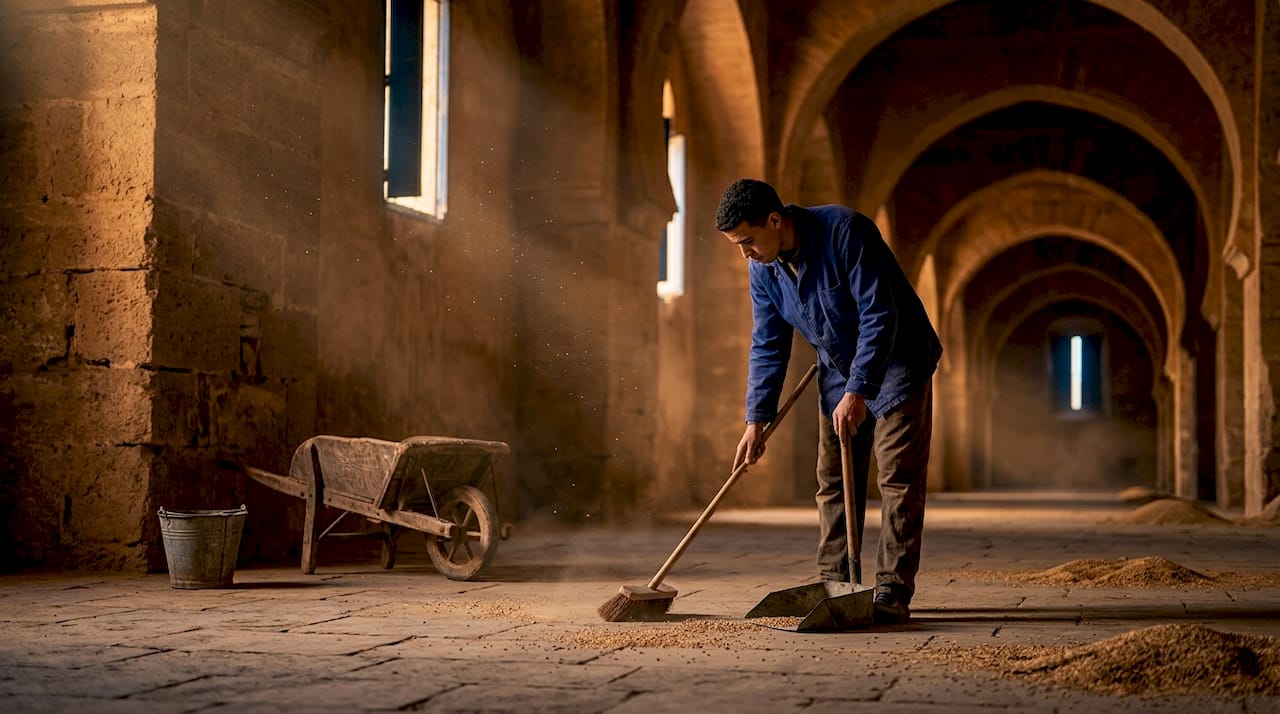
The royal granaries and adjoining stables at Heri es-Souani rank among the most surprising things to do in Meknes. These aren’t ruins in the crumbling sense. The granary vaults are partially restored, and their scale is genuinely astonishing. Moulay Ismaïl reportedly kept 12,000 horses here. Walking through the long stone corridors gives you a physical sense of the sultan’s logistical obsession, his need to feed and equip an army that could hold a city against any siege.
Bou Inania Madrasa
This 14th-century theological college predates the imperial period but fits perfectly into Meknes’ layered cultural identity. The carved stucco panels and cedar wood ceilings rival anything in Fes, yet the Bou Inania Madrasa in Meknes sees a fraction of the visitor traffic. You can actually study the craftsmanship without someone’s shoulder in your way.
Here’s a quick orientation of the key Meknes attractions:
| Site | Era | Why it matters |
|---|---|---|
| Bab Mansour | 17th to 18th century | One of North Africa’s greatest monumental gates |
| Mausoleum of Moulay Ismaïl | 17th century | Open to all visitors, finest royal mausoleum in Morocco |
| Heri es-Souani | 17th century | Shows the logistical scale of Moulay Ismaïl’s imperial vision |
| Bou Inania Madrasa | 14th century | Finest example of Marinid architecture in Meknes |
| Place El Hedim | Ongoing | Central square and social hub connecting old and new city |
Practical tips for visiting Meknes
Getting to Meknes is straightforward, and the city rewards visitors who actually plan their time rather than wandering and hoping.
- Arrive by train. The ONCF train network connects Meknes directly to Casablanca, Rabat, and Fes. The Fes to Meknes leg takes about 45 minutes and costs very little. The train station sits just outside the medina area, making the transition to your accommodation simple.
- Start at Place El Hedim. Orient yourself here first. Bab Mansour is right in front of you. The medina entrance is to your right. The walk to Heri es-Souani takes about 20 minutes from this square, and that route passes through the old imperial zone.
- Visit Volubilis in the morning. The Roman ruins at Volubilis sit roughly 30 km north of Meknes. Take a shared grand taxi from the main taxi stand near Bab El Khemis. Plan for two to three hours on site, then loop through Moulay Idriss on the return trip. Both stops combined with Meknes make for one of the richest heritage days in Morocco.
- Book a medina riad, not a chain hotel. The medina has excellent mid-range and boutique accommodation options. Staying inside the walls puts you within walking distance of every major site and lets you experience the city’s rhythm at dawn and dusk, when the light is extraordinary.
- Go on a weekday. Meknes receives far fewer tourists than Fes or Marrakech, but weekends bring Moroccan day-trippers from nearby cities. A Monday or Tuesday visit gives you near-solitary access to major monuments.
Pro Tip: Combining Meknes with Volubilis and Moulay Idriss in a single day is logistically efficient when you use Meknes as your base. Book your shared taxi the evening before to secure your spot and avoid the morning scramble at the stand.
The medina itself deserves more than a rushed loop. Walking Meknes’ medina takes you through covered market streets where leather goods, spices, and locally made textiles share space with neighborhood bakeries and small cafes where nobody is trying to sell you a rug. The pace is genuinely different from Fes. You can stop and look without feeling chased.
What makes visiting Meknes genuinely different
Meknes received UNESCO World Heritage status in 1996, recognized for its exceptional preservation of 17th-century Maghrebi urbanism and monumental architecture. That designation matters practically, not just symbolically. It means the medina’s core character has been protected from the kind of unchecked development that has altered other Moroccan cities. The streets feel old because they are old, and the buildings haven’t been retrofitted for mass tourism.
“Meknes offers something genuinely rare in Morocco: a city where history hasn’t been curated for your convenience. You have to meet it on its own terms, and when you do, the rewards are exceptional.” — Heritage travel writer, Lotuseaters.travel
The urban coherence of Meknes is unusual among imperial cities because most of its major monuments were built during a single concentrated reign. Fes accumulated layers across multiple dynasties spanning centuries. Meknes feels like it was conceived in one mind, driven by one vision. That coherence makes it easier to understand as a whole, easier to read as a statement of power and purpose.
Local life runs alongside the heritage sites rather than being displaced by them. The medina’s souks serve the neighborhood first and tourists second. Cafes on the edge of Place El Hedim fill with locals in the evenings, long after the tour groups have moved on. For a heritage traveler, this creates a specific quality of experience. You’re not visiting a preserved set piece. You’re walking through a working city that happens to contain extraordinary architecture at every turn.
Visitors who prefer flexible, less rushed access to heritage sites will find Meknes particularly satisfying. There are no timed entry slots at most monuments. No mandatory guided groups. You can spend forty minutes studying the carved plasterwork in the Bou Inania courtyard without anyone asking you to move along.
My honest take on Meknes
I’ve watched Meknes sit in Fes’s shadow for years, and it genuinely puzzles me. Every time I walk through the Bab Mansour arch and into the imperial zone, I’m reminded that this city contains some of the most ambitious construction in Moroccan history, and most international travelers drive past it without stopping.
What I’ve noticed is that people who skip Meknes tend to use it as a footnote in a larger imperial cities trip. They stop in Fes for three days, spend a morning in Meknes, and leave before the city has had a chance to reveal itself. That’s the wrong approach. Meknes requires at least two full days to properly absorb. One day for the monuments. One day for exploring the medina and the surrounding heritage landscape.
What I find most compelling about Meknes is the architectural honesty of it. Moulay Ismaïl wasn’t trying to create a spiritual center like Fes or a sensory bazaar like Marrakech. He was building a power center designed to intimidate and impress in equal measure. Once you understand that intention, every gate, every wall, every oversized granary makes sense as part of a single argument about authority. That’s a rare thing to encounter in travel: a city where the urban form is itself the message.
My advice is to pair Meknes with at least one of its neighboring sites. Volubilis and Moulay Idriss together add layers of Roman and Moroccan Islamic heritage that frame Meknes’ imperial story with remarkable depth. You leave understanding not just one sultan’s vision but the full sweep of civilization across this stretch of North Africa.
— Moroccotours.co
See Meknes with Moroccotours
Meknes rewards travelers who give it time and context, and that’s exactly where a well-designed tour makes the difference. Moroccotours builds private and small-group Morocco imperial cities tours that include dedicated time in Meknes alongside Fes, Rabat, and Marrakech. Every itinerary includes a private guide with deep knowledge of the city’s history, curated accommodation inside or near the medina, and transport that takes the logistics off your plate entirely.
For those who want a longer experience, the 14-day Morocco Highlights Tour covers Meknes as part of a full imperial cities and Sahara circuit, combining cultural immersion with desert landscapes in one cohesive journey. If you want a truly personalized experience built around your specific interests in heritage and culture, Moroccotours can customize every detail. Explore the full range of luxury Morocco packages and start planning a trip that gives Meknes the attention it deserves.
FAQ
What is Meknes known for?
Meknes is known as one of Morocco’s four imperial cities and the former capital under Sultan Moulay Ismaïl. It’s recognized for the Bab Mansour gate, royal granaries, the Mausoleum of Moulay Ismaïl, and its UNESCO World Heritage medina.
Is Meknes worth visiting?
Yes. Meknes offers an authentic, less commercialized experience than Marrakech or Fes, with major monuments and a living medina that rewards slow exploration. Its proximity to Volubilis and Moulay Idriss makes it even more worthwhile as a base.
How long should I spend in Meknes?
Two full days gives you enough time to cover the main monuments and explore the medina properly. A third day works well if you plan a day trip to Volubilis and Moulay Idriss.
What is the best way to get to Meknes?
The easiest option is the ONCF train from Fes, which takes about 45 minutes. Direct trains also connect Meknes to Casablanca and Rabat, making it well integrated into any imperial city’s itinerary.
When did Meknes receive UNESCO recognition?
UNESCO inscribed the Historic City of Meknès on the World Heritage List in 1996, recognizing its exceptional 17th-century Maghrebi urbanism and the monumental scale of Moulay Ismaïl’s imperial building program.