
Morocco Hot Air Balloon Tours: Your Adventure Guide
- Morocco hot air balloon tours provide scenic flights over the Atlas Mountains, deserts, and valleys, combined with cultural breakfasts.
- Safety depends on weather conditions, with pilots making final decisions at sunrise, and booking buffer days is highly recommended due to frequent cancellations.
- Choosing licensed operators and planning in spring or autumn ensures the best experience during this adventure.
Morocco hot air balloon tours are guided balloon flights over some of North Africa’s most dramatic terrain, including the Atlas Mountains, the Agafay Desert, and the palm groves surrounding Marrakech. The industry term is “hot air balloon tours,” and operators in Morocco have built a full experience around it: pre-dawn pickups, certified pilots, and post-flight Berber breakfasts that make the morning feel like a ceremony. If you are researching balloon adventures in Morocco, this guide covers every decision you will face, from choosing a provider to handling a weather cancellation with your itinerary intact.
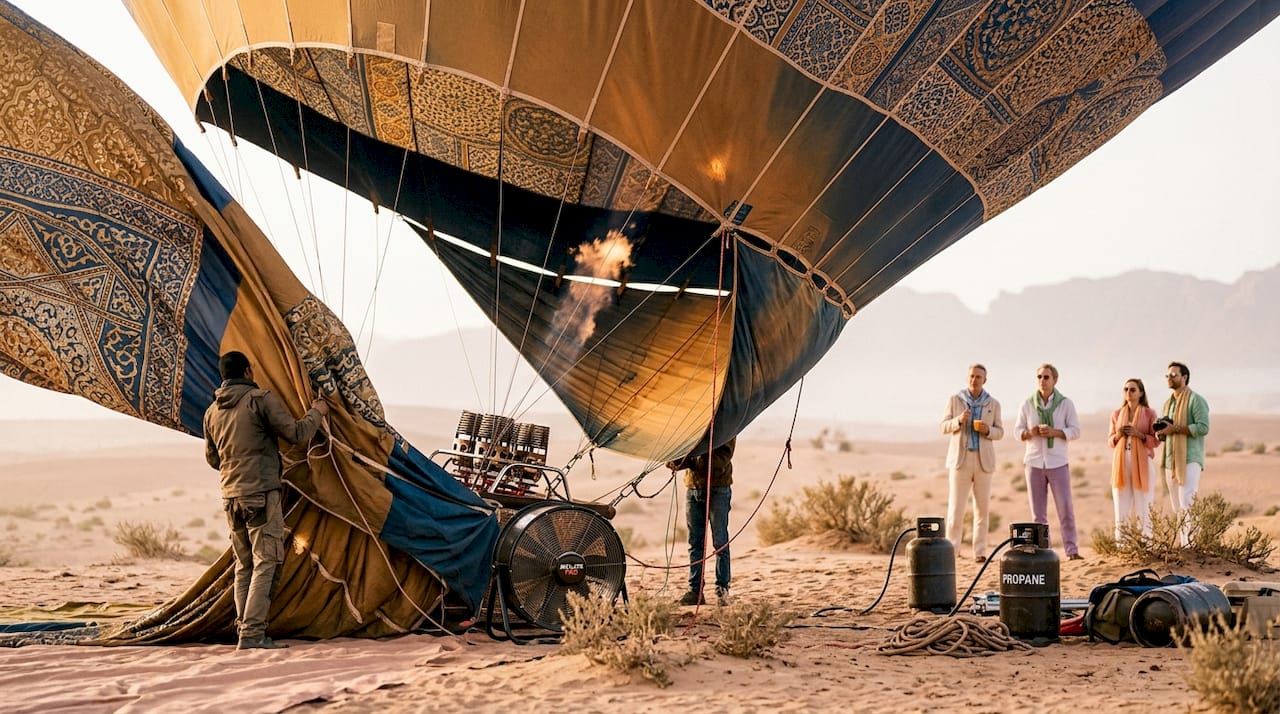
What Morocco hot air balloon tours actually look like
The structure of a Morocco hot air balloon tour is tighter than most adventure travelers expect. You are not simply showing up and floating away. The experience follows a precise sequence, and understanding it before you book will change how you plan your entire trip.
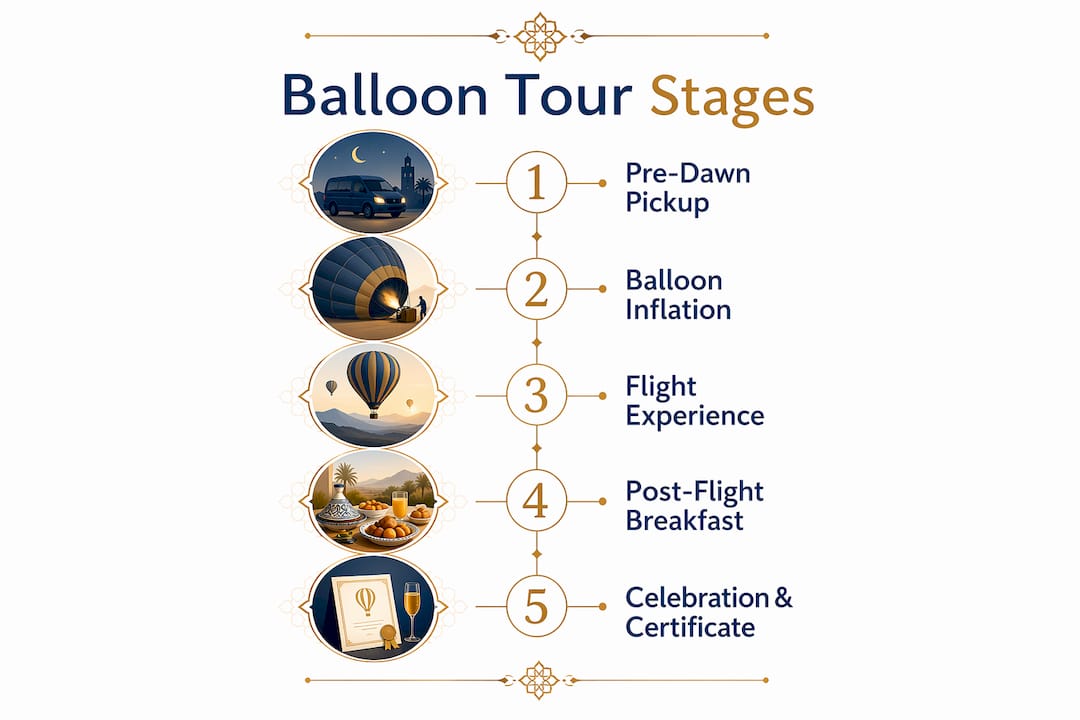
1. Pre-dawn hotel pickup
Most operators collect guests between 5:00 and 5:30 AM. This is not arbitrary. Balloon flights depend on calm, stable air, which exists only in the narrow window around sunrise. Early morning flights last approximately 40 to 60 minutes, with altitudes typically ranging between 500 and 1,000 meters. That altitude range puts you high enough to see the full sweep of the Atlas Mountains while keeping the desert floor close enough to read its texture.
2. Balloon inflation viewing
After arriving at the launch site, guests watch the crew inflate the balloon. This takes 20 to 30 minutes and is genuinely worth watching. The sheer scale of the envelope filling with hot air, lit by the first gray light of morning, sets the tone for everything that follows.
3. The flight itself
Once airborne, the pilot navigates using wind currents rather than a fixed route. Scenic flights over Morocco’s Atlas Mountains reveal a landscape that shifts from ochre desert to terraced farmland to snow-capped ridgelines within a single flight. Over the Agafay Desert, the geometry of the rocky plateau looks almost lunar from above.
4. Post-flight celebration
Packages typically include round-trip transfers, the flight, a traditional Berber breakfast, and sometimes a flight certificate. The breakfast is not an afterthought. Operators like Adventure Balloon Marrakech and Sunrise Balloon Marrakech set up full spreads of mint tea, msemen flatbread, honey, and argan oil in the desert, often with storytelling from local guides. It turns a flight into a cultural event.
Pro Tip: Book a private flight if you are traveling as a couple or small group. The price difference is significant, but you get a personalized route briefing and the pilot’s full attention for photography stops.
Safety, weather, and cancellation policies for balloon rides in Morocco
Safety is the non-negotiable foundation of every reputable Morocco balloon operation. Understanding how operators make flight decisions will help you plan smarter and stress less when conditions shift.
The most critical moment in any balloon tour happens before you ever leave the ground. Pilots make a final go/no-go decision close to sunrise after reviewing detailed weather data. This decision is made unilaterally by the pilot, regardless of how many passengers are waiting. No reputable operator will override a pilot’s safety call for commercial reasons.
The weather conditions that ground flights most often are:
- High winds: Even moderate gusts make balloon control unpredictable and landing dangerous.
- Rain: Wet conditions affect envelope integrity and visibility.
- Low visibility: Fog or dust haze prevents pilots from reading the terrain and identifying safe landing zones.
- Thermal instability: Rapidly changing air temperatures create unpredictable lift, which is unacceptable at low altitudes.
High winds, rain, and low visibility are the most common causes of cancellation across Morocco’s balloon corridors. This matters for your planning because Marrakech and the Atlas region can experience sudden weather shifts, particularly in winter and early spring.
“The final flight decision happens minutes before takeoff based on current weather conditions, making itinerary flexibility vital for anyone booking a balloon tour in Morocco.” — Adventure Balloon Marrakech
Cancellation policies across the industry follow a consistent pattern. Free cancellation up to 72 hours before the flight is standard, with full refunds or rescheduling offered when operators cancel due to weather or safety concerns. What varies between providers is how quickly they communicate cancellations and how flexible they are with reschedule dates during peak season.
The practical implication: if your Morocco itinerary includes only one morning allocated to ballooning, a weather cancellation leaves you with no recourse. Booking buffer days in your itinerary is the single most effective way to protect your experience. Many operators explicitly recommend this approach, particularly for travelers flying in from overseas who cannot easily extend their stay.
Major providers like Adventure Balloon Marrakech and Sunrise Balloon Marrakech hold licenses from Morocco’s Civil Aviation Authority and operate modern fleets with documented safety records. Choosing a licensed operator is not optional. It is the baseline requirement for any balloon tour you book.
How do Morocco hot air balloon tours providers and locations compare?
Choosing where and with whom to fly is the most consequential decision in planning Morocco sky tours. The geography, the operator, and the gondola size all shape the experience in ways that price alone does not capture.
Key flight locations across Morocco
| Location | Landscape | Best for |
|---|---|---|
| Palm Grove of Marrakech (Palmeraie) | Date palms, gardens, city skyline | First-time flyers, shorter transfers |
| Agafay Desert | Rocky plateau, lunar terrain | Desert atmosphere without Sahara travel |
| Jbilet Hills | Rolling semi-arid hills | Varied terrain, less crowded launch sites |
| Atlas Mountain foothills | Mountain ridges, Berber villages | Dramatic elevation changes, photography |
Tours in the Atlas Mountains deliver the most visually varied flights, with the Toubkal massif visible on clear mornings and traditional Berber villages dotting the valleys below. The Agafay Desert, roughly 30 kilometers from Marrakech, offers a genuine desert experience without requiring an overnight journey to the Sahara. It pairs naturally with a Morocco oasis experience for travelers who want to extend the desert theme across multiple days.
Comparing providers and what they offer
Balloons typically accommodate between 8 and 20 passengers, and gondola size directly affects the intimacy and price of your flight. Group flights in a 16 to 20 passenger gondola are the most affordable option, generally ranging from 150 to 250 USD per person depending on the season and inclusions. Private VIP flights in a smaller gondola of 4 to 8 passengers run significantly higher, often 400 to 700 USD per couple, but include personalized service and more flexible routing.
Adventure Balloon Marrakech and Sunrise Balloon Marrakech are the two most established operators in the Marrakech corridor. Both emphasize eco-friendly practices and cultural integration, including Berber-themed breakfasts and local storytelling. The differentiators between them come down to fleet size, communication speed during cancellations, and the quality of their ground transportation.
Pro Tip: Ask any operator directly whether their pilots hold Moroccan Civil Aviation Authority certification and how many flight hours they log annually. A confident, specific answer is a good sign. Vague responses are not.
When comparing Moroccan desert balloon rides, factor in transfer time from your accommodation. A launch site 45 minutes from your riad adds 90 minutes of ground travel to an already early morning. Some operators offer pickup from specific hotel zones only, which can affect your choice of accommodation.
For travelers combining ballooning with broader luxury guided tours across Morocco, the Agafay Desert location works best because it sits close to Marrakech’s main hotel districts and connects easily to onward routes toward the Sahara or the imperial cities.
Tips for booking and getting the most from your Morocco balloon adventure
Preparation separates a smooth, memorable flight from a stressful morning that ends before it begins. These are the decisions and habits that experienced balloon travelers use.
- Book during spring or autumn. March through May and September through November offer the most stable weather windows for hot air balloon Morocco flights. Summer heat creates thermal instability by mid-morning, and winter brings higher cancellation rates due to wind and rain.
- Reserve at least 4 to 6 weeks in advance. Balloon tours in Marrakech sell out during peak travel months, particularly around European school holidays. Last-minute availability exists but is unreliable for specific dates.
- Build two consecutive mornings into your itinerary. This is the single most practical piece of advice for any traveler booking a Moroccan desert balloon ride. If your first flight is canceled due to weather, you have an automatic fallback without scrambling to rebook.
- Dress in layers. Temperatures at 1,000 meters above the Atlas foothills can be 10 to 15 degrees Celsius cooler than ground level, even in summer. Lightweight layers that pack into a small bag are ideal.
- Bring a fully charged camera or phone. The early morning pickup around 5:00 AM means you will be shooting in low light during inflation and golden-hour light during the flight. A phone with a strong camera sensor handles both conditions well.
- Arrive on time, without exception. Punctuality is critical because balloon crews inflate the envelope immediately after guests arrive. Delays compress the safety briefing and inflation window and, in rare cases, can force a cancellation if the weather window closes before the balloon is ready.
- Engage with the post-flight breakfast. This is not a courtesy snack. The Berber breakfast component of most tours is a genuine cultural exchange. Ask your guide about the ingredients, the traditions around mint tea preparation, and the significance of the landing site. The best memories from Morocco balloon adventures often come from this hour on the ground, not the hour in the air.
- Check your travel insurance coverage. Standard travel policies vary widely on adventure activity coverage. Confirm that the hot air balloon is included before you depart, and check whether weather cancellations qualify for reimbursement under your specific policy.
Key takeaways
Morocco balloon tours deliver the most value when travelers combine a licensed operator, flexible itinerary scheduling, and genuine engagement with the cultural components built into every flight package.
| Point | Details |
|---|---|
| Flight structure is fixed | Expect pre-dawn pickup, a 40 to 60 minute flight, and a post-flight Berber breakfast as standard inclusions. |
| Weather drives all decisions | Pilots make the final go/no-go call at sunrise; high winds, rain, and low visibility are the top cancellation triggers. |
| Buffer days are non-negotiable | Build two consecutive mornings into your itinerary to protect against weather cancellations. |
| Location shapes the experience | The Atlas Mountain foothills offer dramatic scenery; the Agafay Desert suits travelers who want a desert atmosphere close to Marrakech. |
| Operator licensing matters | Only book with providers certified by Morocco’s Civil Aviation Authority and with documented safety records. |
What I have learned from years of watching travelers take their first flight over Morocco
Most travelers arrive at the launch site expecting the flight to be the highlight. They are usually wrong, and I mean that as a compliment to Morocco.
The flight itself is extraordinary. Watching the Atlas Mountains catch the first light of morning from 800 meters up, with nothing between you and the horizon, is the kind of experience that resets your sense of scale. But what I have observed, working with travelers across dozens of Morocco itineraries, is that the hour after landing often produces the stronger memory. The Berber breakfast, the conversation with the pilot about wind patterns, the moment when a local guide explains why the landing field was chosen. That is where Morocco reveals itself.
I have also watched travelers make the same avoidable mistake repeatedly: they book a single morning for ballooning and treat it as a guaranteed item on their checklist. When a weather cancellation hits, the frustration is disproportionate to the situation because they had no flexibility built in. The operators are not at fault. The weather is not at fault. The itinerary was simply too rigid for an activity that is, by its nature, dependent on conditions no one controls.
My honest recommendation is to treat the balloon tour as the anchor of a two- or three-day Marrakech segment rather than a single-morning add-on. Pair it with a luxury Morocco itinerary that includes the Agafay Desert, the Palmeraie, and at minimum one full day of buffer. That structure gives you the best chance of flying and the best experience if you do.
The operators who have earned long-term reputations in this space, specifically Adventure Balloon Marrakech and Sunrise Balloon Marrakech, are genuinely good at what they do. Their safety culture is real, not performative. Their cultural programming is thoughtful. The travelers who get the most from Morocco sky tours are the ones who show up curious, on time, and without a rigid agenda for the morning.
— Moroccotours.co
Plan your Morocco hot air balloon tours with Moroccotours
Moroccotours designs private and luxury Morocco travel packages that integrate hot air balloon flights with the broader adventure of exploring this country. Whether you want a desert expedition that pairs a Sahara camel ride with an Agafay balloon flight or a curated Marrakech experience built around the best scenic flights Morocco offers, Moroccotours handles the logistics, the licensed operators, and the cultural programming that makes the difference. Browse the full range of Morocco luxury travel packages and connect with a travel specialist who can build an itinerary around your specific travel dates and preferences.
FAQ
How long do Morocco hot air balloon tours last?
Most Morocco hot air balloon tours last 40 to 60 minutes in the air, with the full morning experience, including pickup, inflation, flight, and post-flight breakfast, running approximately 4 to 5 hours total.
What is the best time of year for Morocco hot air balloon tours?
Spring (March to May) and autumn (September to November) offer the most stable weather conditions for hot air balloon Morocco flights, with lower cancellation rates than in winter or peak summer.
What happens if my balloon flight is canceled due to weather?
Reputable operators offer a full refund or free rescheduling when they cancel due to weather or safety concerns. Free cancellation up to 72 hours before the flight is standard across most providers.
Are hot air Morocco balloon tours safe?
Licensed operators like Adventure Balloon Marrakech and Sunrise Balloon Marrakech hold certification from Morocco’s Civil Aviation Authority and fly modern, maintained fleets. Pilots make all safety decisions independently, including the final go/no-go call at sunrise.
How many people are on a typical Morocco hot air balloon flight?
Most balloons carry between 8 and 20 passengers on group flights. Private VIP options with smaller gondolas of 4 to 8 passengers are available at a higher price point and offer a more personalized experience.