
Moroccan Hammam Spa: A Traveler’s Complete Guide
- A Moroccan hammam spa is a traditional multi-step cleansing ritual involving steam, black soap, exfoliation, and clay that offers tangible skin and relaxation benefits.
- Private spa experiences provide guidance, supplies, and privacy, making them ideal for first-timers, while public hammams offer authentic, social environments at lower costs.
- The ritual promotes improved skin texture, circulation, and mental calmness, reflecting Moroccan cultural traditions practiced for generations.
A Moroccan hammam spa is defined as a traditional multi-step cleansing ritual combining steam heat, black soap, kessa exfoliation, and ghassoul clay in a purpose-built stone or tile bathhouse. This is not a sauna or a simple steam room. The hammam is one of Morocco’s oldest social institutions, practiced daily by locals across Marrakech, Fes, Chefchaouen, and every medina in between. For wellness travelers, it delivers measurable skin, circulation, and relaxation benefits that no hotel spa treatment replicates. This guide walks you through every step of the ritual, the difference between public and private hammams, what to pack, and how to get the most out of the experience on your first visit.
What to expect during a traditional Moroccan hammam spa ritual
The full hammam ritual lasts between 45 and 90 minutes and follows a fixed sequence that has not changed in centuries. Each step builds on the last. Skipping any stage reduces the quality of the result, particularly the exfoliation, which depends on the skin being fully softened by steam and black soap first.
Here is the standard sequence you will move through:
- Warm steam room (10 to 15 minutes). You enter a heated chamber where the temperature holds at roughly 40 to 45°C with high humidity. This opens pores, relaxes muscles, and prepares the skin for what follows. The heat feels intense at first but becomes deeply comfortable within a few minutes.
- Savon noir application (5 to 10 minutes). An attendant or you apply Savon Noir, a thick olive-oil-based black soap, across your entire body. This is left to sit and penetrate the skin. The soap is not rinsed off immediately. It continues softening the outer layer of dead skin while you rest in the steam.
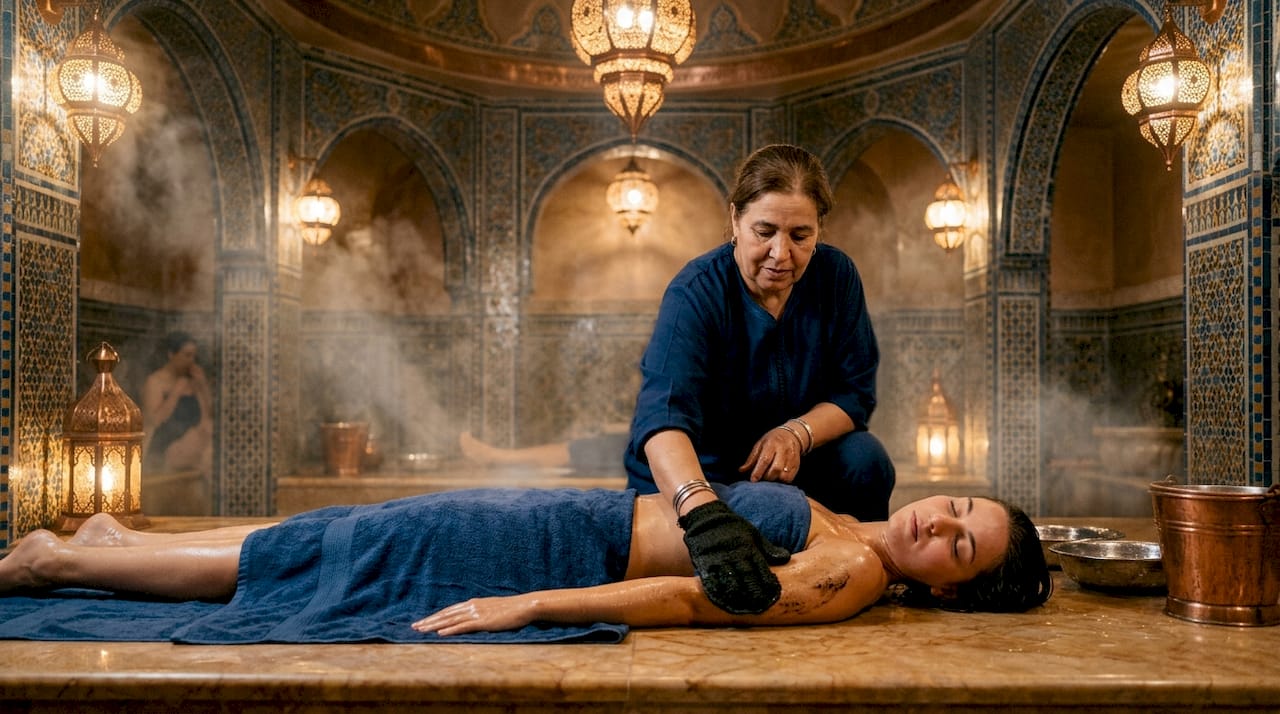
- Kessa exfoliation (10 to 15 minutes). This is the defining moment of the hammam experience. The attendant uses a rough kessa glove to scrub your skin in long, firm strokes. Dead skin rolls off in visible shavings, which surprises most first-timers. The sensation ranges from pleasantly scratchy to intense depending on pressure.
- Ghassoul clay mask (5 to 10 minutes). A mineral-rich clay sourced from the Atlas Mountains is applied to the skin and sometimes the hair. Ghassoul draws out impurities, tightens pores, and leaves the skin feeling smooth and matte. Some spas also apply it as a face mask.
- Rinses and rest (10 to 15 minutes). Warm water clearly rinses the clay. You rest on a warm marble slab, wrapped in a towel, and are often served mint tea. The body temperature gradually returns to normal, and the skin feels noticeably different: softer, cleaner, and more alive.
Pro Tip: Tell your attendant at the start of the kessa step how firm you want the pressure. Most attendants default to vigorous scrubbing because that is what locals prefer. If you are new to exfoliation or have sensitive skin, asking for lighter pressure keeps the experience comfortable without losing any of the benefit.
Luxury private spas extend this sequence considerably. Some curated sessions run three hours and include tea breaks, facials, and full-body massages between the core ritual steps, with robes and attendants provided throughout.
Public hammams vs. private spa hammams: which is right for you?
The primary difference between hammam experiences for travelers is the level of guidance and privacy, not the products used. Both settings use black soap and kessa gloves. What changes is the environment, the cost, and how much hand-holding you receive.
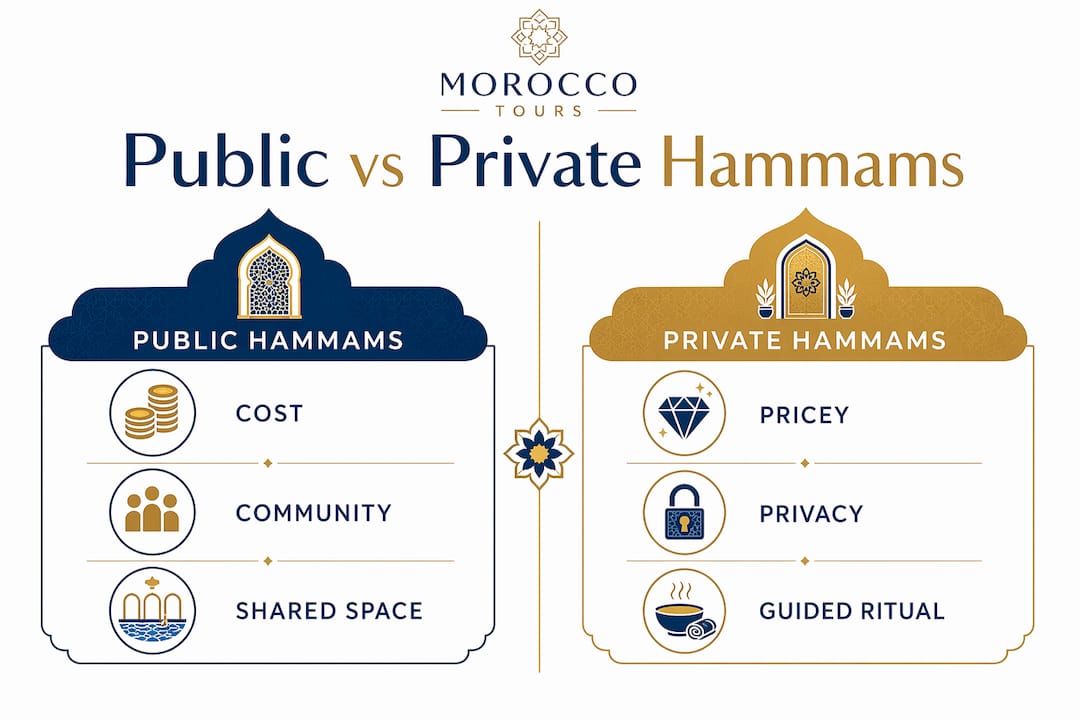
| Feature | Public hammam | Private spa hammam |
|---|---|---|
| Cost | 15 to 30 MAD entry plus 50 to 70 MAD for scrub | €30 to €80 or higher per session |
| Language support | Arabic or Darija only | English-speaking staff common |
| Supplies provided | Bring your own | Towels, slippers, disposable underwear included |
| Privacy level | Communal, same-gender sections | Private rooms or curtained areas |
| Atmosphere | Authentic, social, local | Curated, quiet, retreat-style |
| Session pacing | Self-directed | Attendant-guided throughout |
Public hammams are communal spaces where local women or men gather to bathe, socialize, and help each other scrub. They are busy, loud in a comfortable way, and entirely authentic. The experience is real Morocco, not a performance of it. However, they offer minimal guidance, no English, and you are expected to manage your own water buckets and modesty without instruction.
Private spa hammams sit at the opposite end of the spectrum. They cost significantly more, but they remove every logistical friction point. Staff walk you through each step, supplies are provided, and the pacing is controlled. Private spas offer the most reliable retreat-style sessions for visitors on a fixed travel schedule who want the full benefit without the uncertainty.
Pro Tip: If this is your first hammam visit, book a private spa session. Once you understand the ritual sequence, the products, and the etiquette, a public hammam becomes far less intimidating and far more rewarding. Think of the private spa as your orientation session.
For travelers staying in Marrakech, riads in the medina often have in-house hammams or partnerships with nearby spas. In Fes, the historic Bou Inania neighborhood has functioning public hammams that have operated for centuries. Essaouira offers a coastal wellness setting that pairs hammam visits with ocean air and a slower pace.
How to prepare for your hammam visit
Preparation separates a smooth hammam experience from an awkward one. Knowing what to bring and how to behave removes the anxiety that stops many travelers from trying the ritual at all.
For a public hammam, pack the following:
- Dark-colored underwear or swim bottoms (light colors become transparent when wet)
- Flip-flops or sandals (wet floors are slippery and shared)
- A large towel and a smaller one for your hair
- Savon beldi (black soap, available at any medina souk for a few dirhams)
- A kessa glove (also sold at souks, costs under 20 MAD)
- Ghassoul clay powder or paste
- Cash in small denominations for entry and tip
- A change of dry clothes for after
For a private spa hammam, bring nothing except yourself and your swimwear. The spa provides towels, slippers, disposable underwear, black soap, and clay. Some upscale riads even provide robes.
Private hammams handle all supplies and guidance, which is the main practical advantage for first-time visitors. Footwear matters in both settings because wet marble floors present a real slip risk.
Etiquette is non-negotiable in both environments. No photos inside the hammam, ever. Respect the modesty of other bathers by keeping your eyes forward. In public hammams, nudity norms vary by region: in some cities, women bathe topless in the women’s section; in others, swimwear is standard. When in doubt, keep your swimwear on until you observe what is normal in that specific space.
Couples cannot share a hammam session in public facilities because sections are strictly gender-separated. Private spas sometimes offer couples’ hammam rooms, but you need to book this specifically. After your session, wear loose, breathable clothing. Your skin will be sensitive and warm, and tight fabric will feel uncomfortable.
Pro Tip: Buy your kessa glove and black soap at a medina souk before your visit rather than from a tourist shop. The quality is identical, the price is a fraction of what tourist-facing stores charge, and the transaction itself is a small cultural experience.
What are the health benefits of a Moroccan hammam?
The hammam ritual’s combination of steam, exfoliation, and clay delivers skin and circulation benefits that include unclogged pores, moisture restoration, improved blood flow, and muscle relaxation. These are not marketing claims. They reflect what happens physiologically when you apply sustained heat, mechanical exfoliation, and mineral clay to the body in sequence.
The exfoliation step alone produces results that last five to seven days. The kessa glove removes the outermost layer of dead skin cells more thoroughly than any at-home scrub because the steam has already loosened them completely. The skin that emerges is smoother, more receptive to moisture, and visibly clearer.
Thermal bathing at 40 to 45°C improves cardiovascular function by dilating blood vessels and increasing circulation. This is the same mechanism behind the documented heart health benefits of regular sauna use, and the hammam delivers it in a more gradual, sustained way than a quick sauna session. Muscle tension releases naturally in this environment, which is why athletes and people with chronic tension find hammam sessions particularly effective.
The mental benefits are equally significant. The session’s warmth and pace activate the parasympathetic nervous system, the branch responsible for rest and recovery. This produces measurable stress relief and often leads to deeper sleep the night after a session. The hammam forces you to slow down in a way that a gym or a quick massage does not.
“I came out feeling like I had shed an entire layer of myself, not just skin. The combination of the heat, the scrubbing, and the silence afterward reset something I didn’t know needed resetting.” — Traveler review of a Marrakech hammam experience
Historically, Moroccan hammams served as preparation for Friday prayers and as spaces for social bonding before weddings and celebrations. That cultural weight is still present in every session. You are not just cleaning your body. You are participating in a ritual that Moroccan families have practiced for generations.
Key takeaways
The Moroccan hammam spa is a structured, multi-step ritual that delivers genuine skin, circulation, and mental wellness benefits when experienced in the correct sequence with proper preparation.
| Point | Details |
|---|---|
| Ritual sequence matters | Steam, black soap, kessa scrub, and clay must follow in order for full exfoliation results. |
| Public vs. private cost gap | Public hammams cost under €3; private spa sessions run €30 to €80 or more. |
| First-timers should book private | Private spas provide English guidance, supplies, and controlled pacing for new visitors. |
| Skin benefits last days | Kessa exfoliation removes dead skin and improves texture for five to seven days post-session. |
| A mental reset is real | The parasympathetic activation from heat and slow pacing produces measurable stress relief and better sleep. |
What I’ve learned from years of sending travelers to Moroccan hammams
Most travelers arrive in Morocco with the hammam on their list but talk themselves out of it by the time they reach Marrakech. The reasons are always the same: they don’t know what to expect, they’re nervous about nudity norms, or they assume the public version will be chaotic and unwelcoming. I’ve heard this from hundreds of clients over the years, and my answer is always the same. Book the private spa first. Go once. Then decide.
What I find most interesting is how quickly the anxiety disappears the moment the steam hits. The warmth is immediately disarming. The smell of savon noir, earthy and faintly smoky, is unlike anything in a Western spa. The kessa glove feels aggressive for about thirty seconds, and then your body adjusts and the sensation becomes deeply satisfying. By the time the ghassoul clay goes on, most first-timers are completely relaxed.
The cultural dimension is what separates this from any other spa treatment. You are not in a branded wellness center with ambient music and a menu of add-ons. You are in a space that Moroccan families use for real life. That context changes how the experience feels. It makes it matter more.
My practical advice: schedule your hammam session on day two or three of your Morocco trip, not the last day. Your skin will look and feel noticeably better for the rest of your time there, and you’ll have time to go back if you want to try a public hammam after your private introduction. Pairing it with a luxury Morocco itinerary that includes cultural visits gives the hammam the context it deserves rather than treating it as an isolated spa appointment.
One more thing: tip your attendant. The scrub is physical work, and the skill involved in a thorough kessa exfoliation is real. Ten to twenty dirhams is appropriate in a public hammam; private spas often include gratuity, but check.
— Moroccotours.co
Plan your hammam experience with Moroccotours.co
Moroccotours builds luxury Morocco travel packages that include authentic hammam spa visits as part of a curated cultural itinerary, not as an afterthought. The 10-Day Morocco Signature Tour pairs private hammam sessions in Marrakech and Fes with medina walks, Atlas Mountain excursions, and Sahara nights, all arranged with private guides and premium accommodations. The 14-Day Morocco Highlights Tour covers the imperial cities with time built in for wellness experiences at each stop. Every package is customizable, and Moroccotours handles all bookings, logistics, and on-the-ground coordination so you arrive at your hammam appointment knowing exactly what to expect.
FAQ
What is a Moroccan hammam spa?
A Moroccan hammam spa is a traditional bathhouse ritual involving steam, black soap application, kessa glove exfoliation, and ghassoul clay treatment. Sessions typically last 45 to 90 minutes and are practiced across Morocco as both a wellness and cultural tradition.
How much does a hammam experience cost in Morocco?
Public hammams cost roughly 15 to 30 MAD for entry plus 50 to 70 MAD for a scrub service. Private spa hammams range from €30 to €80 per session, with luxury curated experiences running higher.
What should I wear to a Moroccan hammam?
For a public hammam, wear dark-colored underwear or swim bottoms and bring flip-flops. Private spas provide disposable underwear, slippers, and towels, so you only need to bring yourself and a swimsuit.
Is a hammam safe for first-time visitors?
Yes. Private hammams are specifically designed for visitors unfamiliar with the ritual, with English-speaking staff, provided supplies, and guided pacing. First-timers should start with a private spa before attempting a public neighborhood hammam.
How long do the skin benefits of a hammam last?
The exfoliation benefits, including smoother texture and clearer skin, typically last five to seven days after a session. Regular visits, once a week or every two weeks, maintain these results consistently.