
Morocco SideCar Tours: Your Adventure Guide
- Morocco sidecar tours provide guided vintage or modern motorcycle experiences through the country’s landscapes, combining adventure and cultural immersion.
- These tours emphasize safety, authenticity, and storytelling, accessible to all travelers regardless of riding experience.
- Booking through licensed operators ensures a safe, memorable, and customizable Moroccan adventure.
Morocco sidecar tours are chauffeur-driven motorcycle sidecar experiences that take travelers through the country’s most dramatic landscapes, from the red-walled medinas of Marrakech to the golden dunes of the Agafay Desert. The industry term for this format is “guided sidecar touring,” and it sits at the intersection of adventure travel and cultural immersion. Unlike a standard bus excursion or private car transfer, a sidecar puts you at street level, open to the smells of spice markets and the sounds of the call to prayer, moving slowly enough to actually absorb it all. Operators in Marrakech, Essaouira, and the Agafay Desert have built entire businesses around restored vintage machines, and the experience has become one of Morocco’s most talked-about adventure offerings.
What to expect on Morocco sidecar tours: routes, sights, and experiences
Sidecar motorcycle trips in Morocco cover a wider range of terrain than most travelers expect. The most popular starting point is Marrakech, where operators run city loops through the medina, past Djemaa el-Fna square, and into the quieter Mellah district. These urban rides typically last two to three hours and focus on hidden alleys and local neighborhoods that tour buses physically cannot reach.
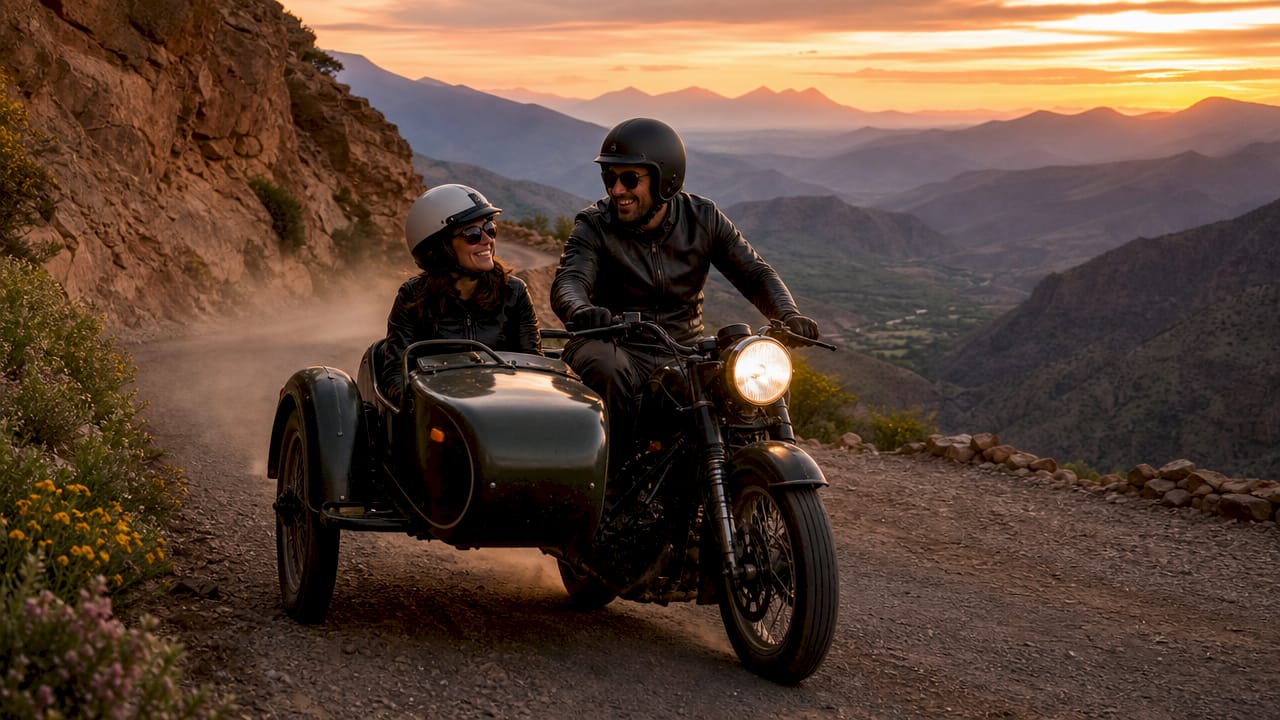
Desert excursions push further out. The Agafay Desert, roughly 30 kilometers southwest of Marrakech, is the most accessible option for a half-day sidecar adventure. The lunar rock landscape there looks nothing like the sand dunes most travelers picture, which makes it genuinely surprising. For travelers with more time, operators offer routes toward the Ourika Valley and the foothills of the Atlas Mountains, where the scenery shifts dramatically within a single ride.
Sidecar tours average around 25 km/h, which is the sweet spot for slow travel. At that pace, you can hold a conversation with your guide, photograph a passing donkey cart, and actually register what you are seeing rather than watching it blur past a window.
What makes sidecar tours in Morocco genuinely different from other Morocco adventure tours is the storytelling element. Licensed local guides double as drivers, and the best ones narrate the city like a living history book. They point out the house where a famous Gnawa musician grew up, explain why a particular neighborhood smells of cedar wood, and stop at a neighborhood bakery that no guidebook has ever listed.
Key experiences you can expect on a typical tour:
- Morning rides through the souks before the crowds arrive
- Stops at panoramic viewpoints over the medina or desert plateau
- Visits to artisan workshops for leather, pottery, or weaving
- Mint tea breaks at family-run cafes off the main tourist circuit
- Sunset rides across the Agafay Desert with the Atlas Mountains as a backdrop
Pro Tip: Book a morning departure for city tours. The medina before 9 a.m. belongs to locals, not tourists, and the light for photography is exceptional.
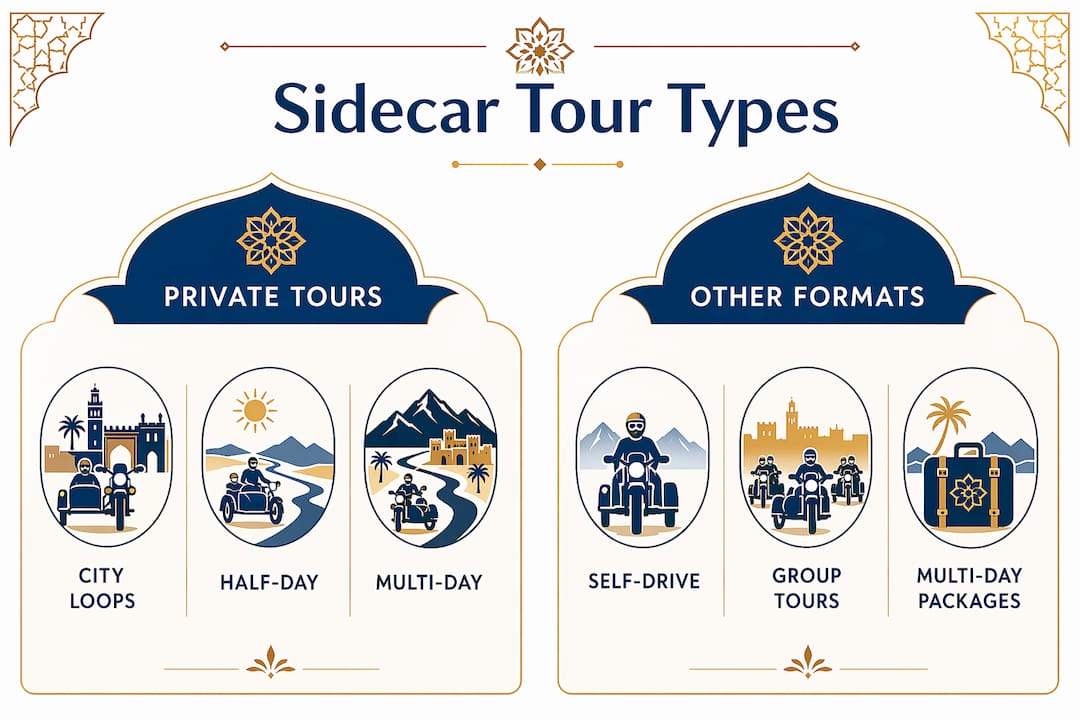
Sidecar tours are available as short city loops, half-day desert excursions, and multi-day adventure packages, so the format works whether you have three hours or three days.
How safe are sidecar motorcycle tours in Morocco?
Safety is the most legitimate concern travelers raise before booking, and it deserves a direct answer. Motorcycle users now account for about 42% of road fatalities in Morocco, up from 28% in 2015. That statistic reflects general road conditions and unregulated motorcycle use across the country. It does not describe the risk profile of a guided sidecar tour with a licensed operator, but it does explain why choosing the right operator matters enormously.
Morocco’s Permanent Committee for Road Safety launched a 2026 to 2030 action plan specifically targeting motorcycle safety as a national priority. For travelers, this means the regulatory environment around guided motorcycle tourism is tightening, and reputable operators are aligning their practices accordingly.
“Travelers are advised to listen closely to driver safety briefings and stay seated while the sidecar is in motion. Helmets and waterproof gear are standard equipment provided by established operators.”
Here is what responsible sidecar tour operators provide and what you should verify before booking:
- Helmets and riding gear. Operators provide helmets and basic gear as standard. Confirm this before paying. Any operator who treats helmets as optional is not worth your business.
- Licensed drivers. Your guide should hold a valid Moroccan motorcycle license and carry proof of it. Ask directly.
- Vehicle maintenance records. Vintage sidecars are charming, but they require regular mechanical attention. Established operators service their fleet on a fixed schedule.
- Insurance coverage. Reputable tour companies carry passenger liability insurance. Booking through established platforms rather than informal street vendors is the clearest way to confirm this.
- Route selection. The safest sidecar experiences stay on well-maintained roads and avoid peak traffic hours. Morning departures and routes that bypass major highway intersections reduce exposure significantly.
The best times to ride are early morning and late afternoon. Midday traffic in Marrakech is chaotic, and the heat between noon and 3 p.m. in summer makes open-air riding genuinely uncomfortable. The Agafay Desert is best visited between October and April, when temperatures are manageable and the light is extraordinary.
Comparing types of sidecar tours and vehicles in Morocco
Not all sidecar experiences are the same, and the differences between tour types affect comfort, price, and the overall quality of the memory you take home.
The vehicle itself is the first variable. Vintage WWII-style sidecars dominate the Marrakech market. These are typically restored Ural or Dnepr models, originally manufactured in the Soviet Union and now prized for their retro aesthetic. They photograph beautifully and deliver an unmistakably old-world feel. Modern Ural models, still in production, offer the same visual appeal with updated mechanics and more predictable handling. A small number of operators use custom-built sidecars with wider passenger compartments, which suits travelers who prioritize comfort over vintage authenticity.
The table below breaks down the main tour formats available across Morocco:
| Tour type | Vehicle style | Group size | Duration | Best for |
|---|---|---|---|---|
| Private city tour | Vintage WWII-style | 1 to 2 passengers | 2 to 3 hours | Couples, honeymooners |
| Shared group ride | Vintage or modern | 3 to 6 passengers | 2 to 4 hours | Solo travelers, small groups |
| Half-day desert excursion | Modern Ural | 1 to 2 passengers | 4 to 5 hours | Adventure seekers |
| Multi-day adventure package | Modern or custom | 1 to 4 passengers | 2 to 7 days | Serious explorers |
| Self-drive sidecar rental | Modern | 1 driver plus passenger | Flexible | Experienced riders only |
Private chauffeured tours are the most popular format among international visitors, and for good reason. Sidecar touring is fully accessible to travelers with no motorcycle experience because the licensed guide always drives. This makes it one of the few adventure formats in Morocco that works equally well for a 25-year-old backpacker and a 65-year-old retiree.
Multi-day packages represent the highest-value format for travelers who want to combine a Morocco sidecar experience with other activities. A well-designed itinerary might include a sidecar city tour in Marrakech, a camel-riding excursion into the Sahara, and an overnight stay in a desert camp. The Morocco Signature Tour from MoroccoTours is one example of a luxury adventure package that layers multiple experiences across ten days.
Self-drive rentals exist but carry a different risk profile entirely. Moroccan road conditions, combined with the handling characteristics of a loaded sidecar, require genuine riding experience. Most travelers are better served by the chauffeured format.
Practical tips for booking and enjoying your Morocco sidecar tour
Booking through a reputable operator is the single most important decision you make. Curated luxury Morocco tours bundle sidecar experiences with other activities like camel rides and cultural visits, which simplifies logistics and guarantees a baseline of quality. Informal vendors near Djemaa el-Fna square offer cheaper rides, but the trade-off in safety standards and guide quality is real.
What to wear and pack:
- Closed-toe shoes, not sandals. The sidecar’s exterior can get warm from the engine.
- A light scarf or buff for dust on desert routes.
- Sunglasses with UV protection. Wind at 25 km/h is enough to dry your eyes significantly over a three-hour ride.
- A small daypack for a water bottle, sunscreen, and your camera.
- Layers for morning rides. Marrakech mornings in winter drop to around 8 degrees Celsius, and the open sidecar amplifies the chill.
Pricing varies by tour type and operator. City loops in Marrakech typically run between $60 and $120 per person for a two- to three-hour private tour. Half-day desert excursions range from $150 to $250 depending on distance and inclusions. Multi-day packages are priced per itinerary and can range from $400 to well over $1,000 when luxury accommodations are included.
Cancellation policies differ between operators. Established platforms generally offer free cancellation up to 24 or 48 hours before departure. Always confirm this in writing before paying a deposit.
Language is rarely a barrier with professional operators. Most guides in Marrakech speak English, French, and Spanish. Engaging your guide in basic Arabic or Darija phrases, the Moroccan dialect, earns immediate goodwill and often unlocks stories that never make it into the standard tour script. “Shukran” for “thank you” and “Labas” for “how are you” go a long way.
Combining a sidecar tour with a camel riding adventure creates a full-day desert experience that covers both the visual drama of the landscape and the cultural tradition of desert travel. Many operators coordinate both activities through a single booking, which removes the logistical friction of arranging them separately.
Pro Tip: Ask your operator specifically whether the sidecar tour includes a stop at a local home or workshop. The best tours in Marrakech include a mint tea invitation from a local family, and this is never advertised. You have to ask.
For solo travelers, a solo travel planning guide can help you structure a Morocco itinerary that incorporates sidecar touring alongside other independent activities without overcomplicating the logistics.
Key takeaways
Morocco sidecar tours deliver the most authentic, accessible, and scenically rich adventure format available in the country, provided you book through a licensed operator and follow basic safety protocols.
| Point | Details |
|---|---|
| Operator quality is everything | Book through licensed, insured operators rather than informal vendors to guarantee safety and guide quality. |
| Vintage sidecars define the experience | Restored WWII-style Ural and Dnepr models are the signature vehicles and are available primarily in Marrakech. |
| Safety requires active participation | Confirm helmets, insurance, and driver licensing before paying. Morocco’s road fatality rate for motorcycles is rising. |
| Tour formats suit all travelers | Private chauffeured rides require zero riding experience and work for couples, families, and solo adventurers alike. |
| Combine tours for maximum value | Pairing a sidecar city tour with a desert camel ride or multi-day package creates a complete Morocco adventure. |
How sidecar tours changed how I think about Morocco travel
I have organized and personally experienced dozens of Morocco adventure tours across every format imaginable, from private helicopter transfers over the Sahara to mule treks through the High Atlas. Nothing has produced the same quality of spontaneous human connection as a sidecar ride through the Marrakech medina at 7 a.m.
The speed is the secret. At 25 km/h, you are moving fast enough to cover real ground but slow enough that a shopkeeper can shout a greeting, a child can wave and actually see you wave back, and your guide can pull over without drama when something genuinely interesting appears. A car creates a glass barrier between you and the city. A sidecar removes it entirely.
What I tell travelers who hesitate over safety is this: the risk is real but manageable. The rising motorcycle fatality rate in Morocco is a legitimate concern, and it is exactly why I recommend booking only through operators who can show you their vehicle maintenance logs and driver licenses without hesitation. The operators who push back on those questions are the ones to avoid.
The detail most travelers overlook is the guide relationship. A great sidecar guide is not a driver who recites facts. The best ones I have worked with are local historians, amateur comedians, and genuine ambassadors for their neighborhoods. Tipping generously and asking open questions rather than yes-or-no questions transforms a good tour into a genuinely memorable one.
Sidecar touring also pairs better with a Morocco honeymoon itinerary than almost any other activity. The intimacy of the two-seat format, the visual drama of the landscape, and the unhurried pace create a shared experience that a standard city tour simply cannot replicate.
— Moroccotours.co
Plan your Morocco sidecar adventure with Moroccotours.co
Moroccotours designs private, luxury Morocco tours that incorporate sidecar experiences as part of fully customized itineraries. Every package includes vetted local guides, confirmed safety-compliant vehicles, and the flexibility to combine sidecar rides with desert camps, imperial city visits, and coastal excursions. The team handles logistics, accommodations, and scheduling so you arrive at each experience without the friction of independent planning. Whether you want a two-hour medina ride or a seven-day adventure across multiple regions, Moroccotours builds the itinerary around your travel style. Explore the full range of curated Morocco packages and request a custom quote directly through the site.
FAQ
What are Morocco sidecar tours?
Morocco sidecar tours are guided motorcycle experiences where a licensed local driver takes one or two passengers through cities, deserts, or coastal routes in a vintage or modern sidecar. The driver always operates the vehicle, so no riding experience is required.
How long does a typical sidecar tour in Morocco last?
Tour durations range from two-hour city loops to full multi-day adventure packages. Half-day desert excursions to the Agafay Desert typically run four to five hours, including travel time from Marrakech.
Are sidecar tours in Morocco safe for first-time visitors?
Sidecar tours are accessible and relatively safe when booked through licensed operators who provide helmets, carry passenger insurance, and use well-maintained vehicles. Travelers should verify these standards before booking, given Morocco’s rising motorcycle accident rates.
What is the best time of year for a Morocco sidecar experience?
October through April offers the most comfortable conditions for open-air sidecar riding. Summer heat between June and August makes midday rides in the desert genuinely taxing, though early morning departures remain viable year-round.
Can I combine a sidecar tour with other Morocco adventure tours?
Yes. Many operators and luxury travel agencies like Moroccotours bundle sidecar city tours with camel riding, desert camping, and imperial city visits into single itineraries, which are the most efficient way to experience multiple adventure formats in one trip.