
Morocco Tours From South Africa: Travel Guide
- Morocco offers a rich cultural experience with diverse landscapes, ideal for multi-day, personalized tours from South Africa.
- Travelers should choose certified local guides and plan for at least ten days to fully explore cities, deserts, and mountains at a relaxed pace.
- High-quality accommodations like riads and desert camps enhance cultural immersion without sacrificing comfort.
Morocco is defined as one of Africa’s most culturally layered destinations, and Morocco tours from South Africa give travelers direct access to ancient medinas, Saharan dunes, and Atlas Mountain villages in a single trip. The country sits roughly 8,000 kilometers north of Johannesburg, yet the cultural contrast feels far greater than the distance. South Africans booking Morocco travel packages in 2026 will find curated multi-day itineraries that cover Marrakech, Fes, the Sahara Desert near Merzouga, and the Atlantic coast. Moroccotours specializes in exactly this kind of personalized, luxury-focused experience for travelers who want more than a highlight reel.
What are the best Morocco tours from South Africa?
Popular tours to Morocco from South Africa typically span 7–15 days and cover a circuit that moves through imperial cities, desert landscapes, mountain terrain, and coastal towns. That range is what separates a Morocco trip from most other African travel experiences. You get ancient Islamic architecture in Fes, Berber nomadic culture in the Sahara, and Atlantic sea breezes in Essaouira, all within one itinerary.
The most common route starts in Casablanca or Marrakech, moves east through the Atlas Mountains to Merzouga, then loops back through Fes and north toward Chefchaouen before ending on the coast. Most comprehensive tours include a night in Sahara Desert camps, visits to UNESCO World Heritage sites such as Ait Benhaddou, and guided exploration of historic medinas. That combination ensures travelers see Morocco’s geographic and cultural range rather than just its most photographed corners.
Key destinations on a standard Morocco circuit
- Marrakech: The Djemaa el-Fna square, the Majorelle Garden, and the souks of the medina form the core of any Marrakech visit.
- Fes: Home to the world’s oldest university, Al-Qarawiyyin, and a medina that UNESCO designated a World Heritage site in 1981.
- Merzouga and the Sahara: The gateway to the Erg Chebbi dunes, where camel treks and desert camp nights are the centerpiece.
- Chefchaouen: The blue-painted mountain town in the Rif Mountains, known for its photogenic alleys and relaxed pace.
- Essaouira: A fortified Atlantic port city with strong Gnawa music traditions and fresh seafood markets.
Tour length options
| Tour Length | Best For | Typical Destinations Covered |
|---|---|---|
| 7–8 days | First-time visitors | Marrakech, Atlas Mountains, Sahara, Fes |
| 10–12 days | Cultural depth seekers | Above, plus Chefchaouen and Essaouira |
| 14–15 days | Slow travelers | Full circuit including coastal towns and Berber villages |
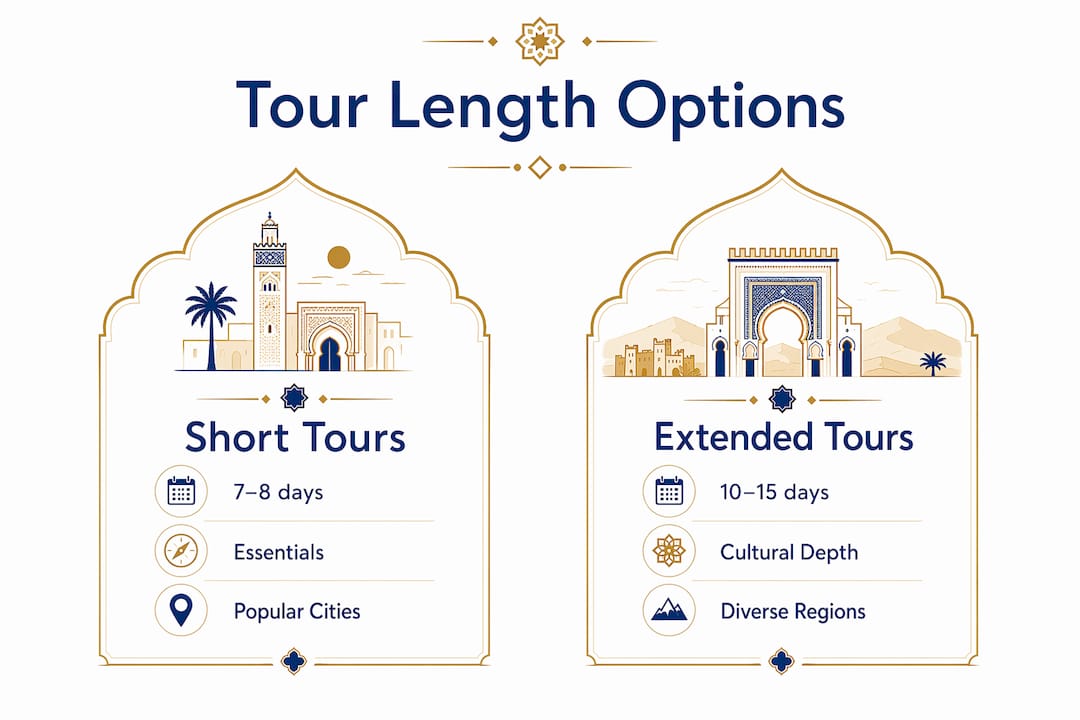
A 7-day tour covers the essentials but leaves little room for unplanned stops. Travelers who want genuine cultural depth should plan for at least 10 days.
How to choose personalized Morocco tours for South African travelers
The single most important factor in a successful Morocco tour is the quality of the guide. Certified local driver-guides with deep cultural knowledge prevent forced shopping stops, unlock off-the-beaten-path villages, and translate cultural context that a generic audio tour never could. A licensed guide is not a luxury add-on. It is the difference between observing Morocco and actually understanding it.
South African travelers tend to prefer tours that blend adventure with cultural education, particularly those offering direct interaction with Berber communities and local artisans. That preference aligns well with what Morocco actually offers. The country’s best experiences happen at the community level, not at the ticket booth.
Factors to evaluate before booking
- Group size: Private tours allow full itinerary flexibility. Small group tours (typically 8–16 travelers) offer social energy at lower cost. Large group packages often sacrifice pace for logistics.
- Guide certification: Ask specifically whether guides hold a national certification from Morocco’s Ministry of Tourism. Unlicensed guides are common and significantly reduce the quality of cultural access.
- Pace of the itinerary: Transit fatigue is a real risk on rushed tours. Experts recommend trips longer than one week for a meaningful experience. A well-structured itinerary builds in leisure time at each stop.
- Cultural engagement: Look for tours that include shared meals with local families, visits to working artisan workshops, and community-based activities rather than staged performances.
- Adventure options: Camel trekking, 4×4 dune drives, and Atlas Mountain hikes should be optional add-ons, not mandatory filler.
Pro Tip: Ask your tour operator for the specific names and certifications of the guides assigned to your trip before you book. A reputable operator will answer that question without hesitation.
The slow travel philosophy is increasingly shaping how Morocco tours are structured. Slow travel prioritizes quality over quantity, and that approach resonates strongly with discerning South African travelers who have already experienced safari and bush travel at a considered pace. Morocco rewards the same mindset.
What cultural and adventure experiences can South Africans expect?
Morocco delivers a layered experience that few destinations can match. The cultural depth, the physical variety of the terrain, and the warmth of local hospitality combine in a way that consistently surprises first-time visitors from South Africa.
Here are the standout experiences that define the best Morocco cultural tours:
- Medina exploration in Fes and Marrakech. The medinas are working cities, not museums. You will find leather tanneries, spice merchants, and Quranic schools operating exactly as they have for centuries. A certified guide is the only way to navigate these spaces without getting lost or being redirected into tourist traps.
- Sahara desert camp nights near Merzouga. Multi-night stays in remote desert camps provide access to nomadic traditions, handcrafts, and storytelling that city hotels cannot replicate. Waking up to silence and dunes at sunrise is a genuinely different experience from anything available in southern Africa.
- Camel trekking and 4×4 dune drives. Both activities are available near Merzouga and the Agafay Desert outside Marrakech. The Agafay Desert offers a rocky, moonscape alternative to the classic Saharan dunes, and it sits just 30 kilometers from Marrakech.
- Atlas Mountain trekking. The High Atlas range includes Toubkal, North Africa’s highest peak at 4,167 meters. Day hikes through Berber villages in the Ourika Valley are accessible to most fitness levels and offer direct community contact.
- Souk and artisan workshops. Moroccan craftsmanship includes zellige tilework, hand-knotted carpets, and silver jewelry. Visiting working workshops in Fes or Marrakech gives travelers context for what they are buying and supports local economies directly.
“True authenticity in Morocco is achieved when travelers share a meal with a local family or sit with an artisan at work. That direct engagement is what separates a meaningful trip from a sightseeing checklist.” — Moroccotours
The food alone justifies the trip. Moroccan cuisine, built around preserved lemons, argan oil, saffron, and slow-cooked tagines, is one of the most distinctive in the world. Eating in a local home or a family-run restaurant in the medina delivers a completely different experience from hotel dining.
What luxury accommodation options are available on Morocco tours?
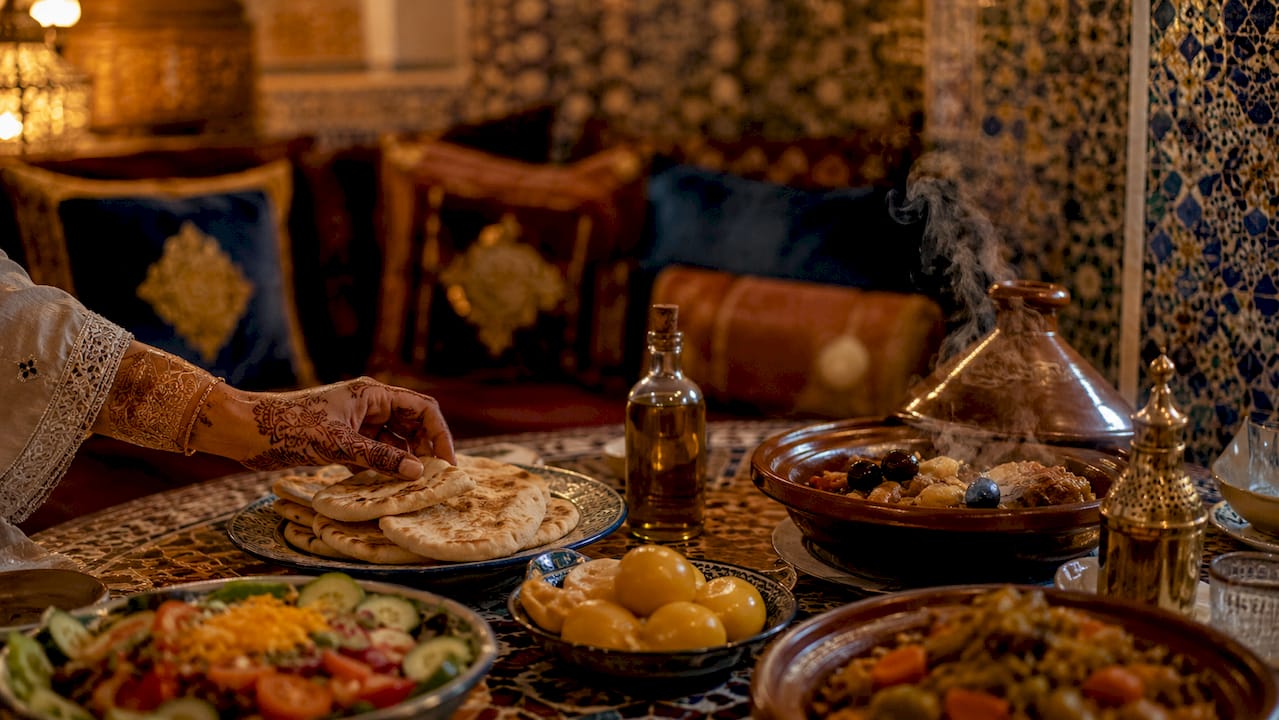
South African travelers accustomed to high-end safari lodges will find Morocco’s luxury accommodation scene equally impressive, though the aesthetic is entirely different. The country offers a range of lodging that combines genuine cultural character with serious comfort.
Riads stay in the medinas
Riads are traditional Moroccan houses built around a central courtyard. Many have been converted into boutique hotels with plunge pools, rooftop terraces, and hand-painted tilework throughout. Staying in a riad inside the Fes or Marrakech medina places you inside the living city rather than at its edge. The experience is quieter and more personal than a large hotel, and the architecture alone is worth the stay.
Luxury desert camps
Luxury desert camps near Merzouga combine upscale amenities with a genuine Saharan atmosphere. Expect private tents with proper beds, en-suite bathrooms, and evening entertainment featuring Gnawa and Berber music around a fire. The best camps are small, limiting guest numbers to preserve the sense of isolation. This is where the combination of comfort and cultural immersion is most concentrated.
Accommodation comparison by experience type
| Accommodation Type | Cultural Immersion | Comfort Level | Best Location |
|---|---|---|---|
| A riad in medina | Very high | High | Fes, Marrakech |
| Luxury desert camp | High | High | Merzouga, Agafay |
| Boutique coastal hotel | Moderate | High | Essaouira, Agadir |
| Mountain guesthouse | High | Moderate | Atlas Mountains |
- Riads offer the most authentic urban experience and are available at a wide range of price points.
- Luxury desert camps deliver the most memorable single night of any Morocco itinerary.
- Boutique coastal hotels in Essaouira combine Atlantic views with relaxed medina access.
- Mountain guesthouses in the Atlas region provide direct Berber community contact and cooler temperatures.
Moroccotours curates accommodation selections across all four categories, matching lodging to the pace and focus of each traveler’s itinerary.
Practical travel tips for South Africans planning Morocco trips
Getting the logistics right before you leave makes a significant difference to how much you enjoy the trip itself. Morocco is straightforward to navigate with the right preparation.
Flights and travel time. Direct flights from Johannesburg to Casablanca operate via Royal Air Maroc and take approximately 8–9 hours. Connecting flights through Addis Ababa, Nairobi, or Dubai add travel time but are often more affordable. Casablanca’s Mohammed V International Airport is the main entry point for most South Africa to Morocco travel itineraries.
Best travel months. Spring and autumn are the optimal travel periods, specifically March through May and September through November. Summer temperatures in the Sahara regularly exceed 40°C, which makes desert activities uncomfortable. Winter in the Atlas Mountains can bring snow, which closes some mountain roads.
Visa requirements. South African passport holders do not require a visa to enter Morocco for stays up to 90 days. Confirm this with the Moroccan consulate before travel, as entry requirements can change.
Key practical tips
- Currency: Morocco uses the Moroccan Dirham (MAD). ATMs are widely available in cities. Carry cash for souks, tips, and smaller guesthouses that do not accept cards.
- Tipping: Tipping is expected and culturally important. Budget roughly 10–15% at restaurants and 20–50 MAD per day for guides and drivers.
- Packing: Pack layers. Mornings in the Atlas Mountains and desert nights are cold even in spring. Modest clothing is respectful in medinas and rural areas.
- Health: No vaccinations are mandatory for South African travelers entering Morocco, but hepatitis A and typhoid are recommended by most travel health clinics.
- Safety: Morocco ranks as one of Africa’s safer tourist destinations. Standard urban precautions apply in medinas. Avoid unofficial guides who approach you unsolicited near major tourist sites.
Pro Tip: Book your riad and desert camp well in advance for spring travel. The best small properties in Fes and Merzouga fill up months ahead during the March-to-May peak season.
Respecting local customs goes a long way. Dress modestly near mosques, ask before photographing people, and learn a few words of Darija (Moroccan Arabic) or French. Even a simple greeting in the local language shifts how locals respond to you.
Key Takeaways
Morocco tours from South Africa deliver the most value when they combine certified local guides, a pace of at least 10 days, and a mix of desert, mountain, city, and coastal experiences.
| Point | Details |
|---|---|
| Optimal tour length | Plan for 10–15 days to avoid transit fatigue and experience genuine cultural depth. |
| Guide quality matters | Book only tours with certified local guides to access authentic experiences and avoid tourist traps. |
| Best travel months | March to May and September to November offer the most comfortable conditions across all regions. |
| Accommodation choice | Riads and luxury desert camps deliver the strongest combination of comfort and cultural immersion. |
| Visa access | South African passport holders can enter Morocco visa-free for up to 90 days. |
Why the right pace changes everything in Morocco
Most travelers I speak with who felt disappointed by Morocco share one thing in common. They tried to cover too much in too little time. A 5-day sprint through Marrakech and the Sahara leaves you with photographs but not much else. The country does not reveal itself quickly.
What I have found, working with South African travelers specifically, is that the safari mindset actually transfers well to Morocco. You already understand that the best moments happen when you slow down and wait. The same is true in a Fes medina or at a Berber family’s home in the Atlas Mountains. The experience arrives when you stop rushing toward the next checkpoint.
The other thing I would push back on is the idea that luxury and authenticity are in tension. They are not. A well-run luxury desert camp near Merzouga gives you a private tent, a proper bed, and Gnawa musicians playing around a fire under a sky with no light pollution. That is not a compromise. That is the experience at its best. The travelers who get the most out of Morocco are the ones who invest in quality accommodation and a certified guide, then let the itinerary breathe.
South Africans also tend to underestimate how much French is spoken in Morocco. A basic working knowledge of French opens doors that English alone does not. It is worth brushing up before you go.
— Moroccotours.co
Moroccotours.co: private and luxury Morocco tours for South Africans
Moroccotours.co designs luxury Morocco tours specifically for travelers who want personalized itineraries, certified local guides, and accommodation that reflects the character of each region. Every package is built around your travel dates, group size, and interests, whether that means a private desert camp experience, a deep dive into the imperial cities, or a coastal retreat in Essaouira. The team handles flights, transfers, accommodation, and guided activities as a single coordinated package. South African travelers can browse full Morocco travel packages on the Moroccotours website and request a custom itinerary directly. No generic group tours. No compromises on quality.
FAQ
Do South Africans need a visa for Morocco?
South African passport holders do not need a visa to enter Morocco for stays up to 90 days. Confirm current entry requirements with the Moroccan consulate before travel.
How long should a Morocco tour from South Africa be?
Experts recommend a minimum of 10 days to avoid transit fatigue and experience meaningful cultural immersion across Morocco’s key regions.
What are the best months for Morocco holidays from South Africa?
March to May and September to November are the best travel periods, offering comfortable temperatures across the Sahara, Atlas Mountains, and coastal towns.
What makes Morocco adventure tours worth the trip?
Morocco adventure tours combine camel trekking, 4×4 dune drives, Atlas Mountain hikes, and Sahara Desert camp nights in a single itinerary, offering a range of outdoor experiences unavailable anywhere else in North Africa.
What is the flight time from South Africa to Morocco?
Direct flights from Johannesburg to Casablanca take approximately 8–9 hours via Royal Air Maroc. Connecting flights through East African or Middle Eastern hubs are also available.