
Best Morocco Destinations: Top Places to Visit
- Travelers often focus too heavily on Marrakech and overlook Morocco’s diverse regions offering unique cultural and natural experiences.
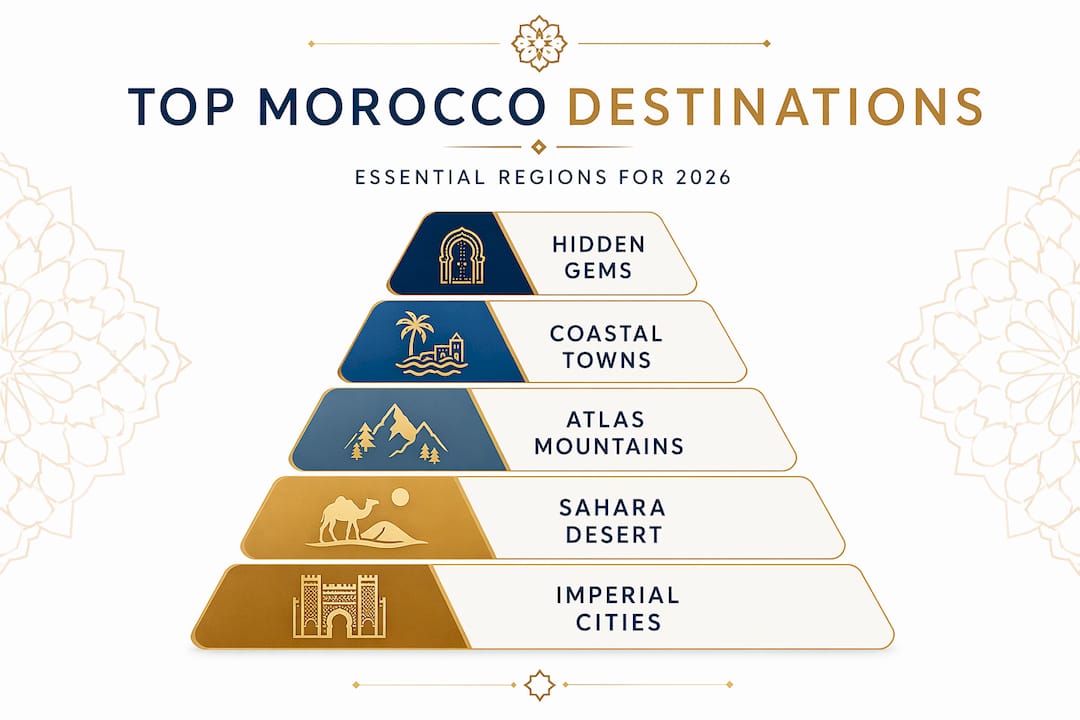
- Exploring imperial cities, Sahara dunes, mountain villages, and coastal towns creates a richer, more balanced trip.
- Prioritizing slow travel, local guides, and hidden gems enhances genuine cultural immersion and unforgettable adventures.
Morocco is one of those countries that consistently exceeds expectations, yet most travelers arrive with an itinerary built almost entirely around Marrakech. That is a mistake worth correcting before you book. The best Morocco destinations span medieval imperial cities, towering Saharan dunes, mountain villages, and windswept Atlantic coastline. Each region feels like a different country. This guide walks you through the must-see cities in Morocco, the Sahara experience at Erg Chebbi, the Atlas Mountains, coastal gems like Essaouira, and the hidden corners that turn a good trip into an unforgettable one.
Table of Contents
- Key takeaways
- Best Morocco destinations: the imperial cities circuit
- The Sahara Desert experience at Erg Chebbi
- Atlas Mountains and coastal towns: contrasting escapes
- Hidden gems worth adding to your trip
- My honest perspective on planning a Morocco trip
- Plan your Morocco trip with Moroccotours
- FAQ
Key takeaways
| Point | Details |
|---|---|
| Go beyond Marrakech | Morocco’s top cities, desert, coast, and mountains each offer entirely different cultural and natural experiences. |
| Timing matters a lot | October to April delivers comfortable temperatures across most Moroccan regions, making it the ideal window for most itineraries. |
| Fes is unmissable | The world’s largest car-free medieval city rewards slow exploration and cultural depth that Marrakech cannot replicate. |
| Pair cities with nature | Combining imperial cities with the Sahara, Atlas, or coast gives your trip balance and prevents sensory overload. |
| Hidden gems add depth | Chefchaouen, Meknes, and Volubilis are far less crowded and often become the most memorable stops for returning travelers. |
Best Morocco destinations: the imperial cities circuit
When travel writers talk about Marrakech, Fes, and the Sahara as the core of a first-time Morocco itinerary, they are not exaggerating. But “seeing all three” is very different from understanding what each one actually offers and how to get the most out of each stop.
Marrakech: sensory immersion and the right neighborhood choice
Marrakech is where most flights land, and the temptation is to pack it full of Jemaa el-Fnaa square, souk shopping, and hammams. All of that is worth doing. But the single factor that shapes your Marrakech experience more than any activity is where you sleep.
The medina is the soul of the city. Staying inside a riad there means waking up to the call to prayer, stepping directly into narrow alleys, and feeling the texture of a city that has not fundamentally changed in centuries. It is occasionally disorienting, always alive, and genuinely unlike anything in Europe or North America.
Gueliz and Hivernage, Marrakech’s newer districts, trade that rawness for convenience. Better restaurants, easier taxi access, and quieter streets. Choosing your Marrakech neighborhood comes down to traveler type: if cultural immersion is the goal, stay in the medina. If you need ease of movement for a packed multi-city schedule, Gueliz makes logistical sense. Some travelers split their nights between both.
Pro Tip: Book your riad at least six weeks in advance for travel between October and March. The best-value properties inside the medina sell out fast during peak season.
Fes: the city that stops time
Fes is where Morocco gets serious about history. The medina of Fes el-Bali is over 9,000 narrow alleyways with no car access, making it the largest car-free urban environment of its kind anywhere on the planet. UNESCO recognized it as a World Heritage Site for good reason. The tanneries, where leather has been dyed using methods unchanged since the medieval era, are the most photographed sight in the city. But the artisan workshops, the Bou Inania Madrasa, and the Qarawiyyin Mosque complex (the oldest continuously operating university in the world) are equally significant.
Plan a minimum of two full days in Fes. One day is not enough to go beyond the tourist surface. A licensed local guide is not optional here. The medina is genuinely confusing to navigate solo, and a good guide adds context to every doorway and workshop you pass.
Rabat: the imperial capital without the crowds
Rabat does not get the credit it deserves as a Morocco travel hotspot. As the political capital, it has the Hassan Tower, the Kasbah of the Udayas, and the Chellah ruins, all with a fraction of Fes or Marrakech’s tourist density. If you are building a circuit that includes all four imperial cities, Rabat makes an excellent two-night stop between Casablanca arrivals and Fes. Train connections are reliable and affordable.
- Marrakech: 2 to 3 nights minimum; best for souks, food, and Majorelle Garden
- Fes: 2 to 3 nights minimum; best for medieval depth, artisans, and history
- Rabat: 1 to 2 nights; best for monuments, city parks, and a calmer pace
- Transport: The ONCF rail network connects Rabat, Casablanca, Fes, and Marrakech with comfortable, punctual trains
Consider the 8-day Imperial Cities tour from Moroccotours if you want this circuit planned without the logistics headache.
The Sahara Desert experience at Erg Chebbi
Nothing on a Morocco itinerary produces more genuine awe than the first sight of the Erg Chebbi dunes. Words fall short. You arrive through a landscape of flat, rocky scrub, and then suddenly the dunes appear, orange and enormous, pushing up against the horizon. They rise to around 150 meters and stretch nearly 28 kilometers north to south. The base town of Merzouga serves as the access point, and the experience you build from there depends entirely on how much time you give it.
Here is what a well-structured An Erg Chebbi visit looks like this:
- Arrive in the late afternoon. The light on the dunes at golden hour is genuinely extraordinary, and arriving early enough to settle before sunset makes the whole experience more relaxed.
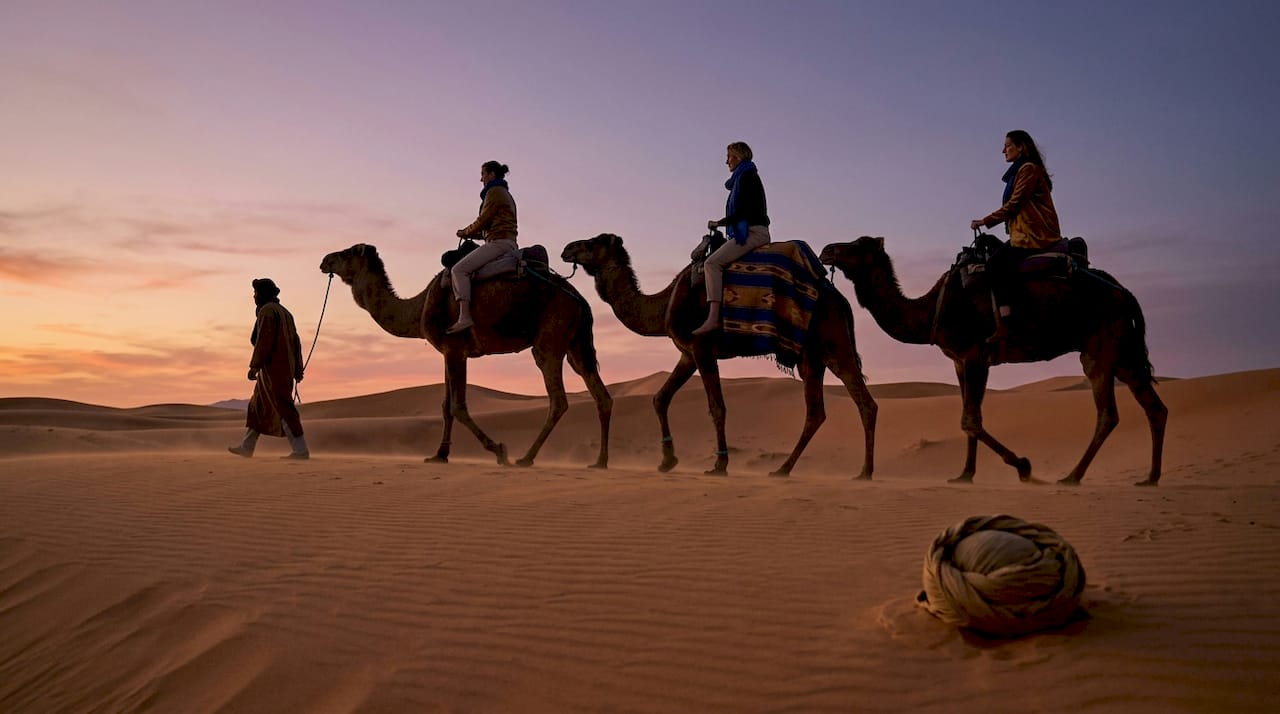
- Take a sunset camel ride into the dunes. Most desert camps organize this as a 45 to 90-minute guided trek out to the camp. It is slower and physically different than most people expect, and that is part of the appeal.
- Spend one night in a luxury desert camp. The best camps include private tent suites, hot showers, Berber music around the fire, and a view of the sky that is impossible to replicate anywhere near a city. For a deeper look at what quality camp experiences involve, the Morocco oasis experience guide from MoroccoTours covers it thoroughly.
- Wake up before dawn for the sunrise from the dunes. This requires effort. It is worth every step.
- Explore the surroundings the next morning. Ksar of Ait-Ben-Haddou, Merzouga’s local Berber villages, and the small oasis settlements around the dunes reward the extra hours.
Pro Tip: October and November are ideal for Sahara visits. Temperatures during the day are warm without being punishing, and the nights cool down to a comfortable sleeping temperature. Avoid July and August unless you have significant heat tolerance.
The most common mistake travelers make with the Sahara is treating it as a quick overnight add-on. Two nights in the desert changes the experience from a novelty to something genuinely transformative.
Atlas Mountains and coastal towns: contrasting escapes
Morocco’s best Moroccan travel experiences are not limited to cities and sand. The High Atlas Mountains, sitting between Marrakech and the Sahara, offer a completely different sensory register: cooler air, terraced valleys, Berber villages, and silence. The coastal town of Essaouira, three hours from Marrakech by road, delivers something else entirely.
Atlas Mountains vs. Essaouira: Which fits your itinerary?
| Category | Atlas Mountains | Essaouira |
|---|---|---|
| Atmosphere | Quiet, dramatic, rural | Relaxed, artsy, wind-swept |
| Best activities | Hiking, village visits, luxury lodge stays | Beach walks, seafood, music festivals |
| Best season | Spring and fall for moderate temperatures | Spring and fall for mild coastal weather |
| UNESCO status | No (though Ait-Ben-Haddou nearby is listed) | Yes, UNESCO World Heritage medina |
| Distance from Marrakech | 1 to 3 hours depending on destination | About 3 hours by road |
| Who it suits | Hikers, luxury travelers, nature seekers | Couples, artists, travelers needing a reset |
Essaouira is particularly underrated in multi-city Morocco itineraries. It has UNESCO cultural heritage status and a medina with a completely different energy than Marrakech or Fes. The winds that make it unappealing for serious beach swimming make it one of the world’s top windsurfing destinations. Spring and fall are ideal here.
The Atlas, meanwhile, works beautifully as either a day trip from Marrakech (visit Imlil village and the Toubkal trailhead) or a multi-night retreat. Several luxury lodge options perch on mountain ridges above the Ourika Valley with exceptional food and mountain views. For travelers who feel overstimulated by the medinas, a night or two in the Atlas resets the whole trip.
Both destinations serve as ideal connective tissue between imperial cities and the Sahara, adding natural depth to what would otherwise be an all-urban itinerary.
Hidden gems worth adding to your trip
The popular attractions in Morocco get the most coverage, but the destinations below consistently earn the strongest reviews from travelers who include them. None require massive detours.
- Chefchaouen: The blue city in the Rif Mountains is one of the most photographed places in Morocco, and the photos do not lie. Every alley and staircase is painted in shades of blue and white. It has a genuine mountain town atmosphere rather than a purely tourist one. Two nights is ideal. Access is straightforward from Fes (about 4 hours by bus or shared taxi).
- Meknes: Often overlooked because it sits between Fes and Rabat, Meknes was once Morocco’s imperial capital under Sultan Moulay Ismail. The Bab El Mansour gate is one of the most impressive monumental structures in North Africa, and the city’s Place el Hedim is dramatically less hectic than Jemaa el-Fna in Marrakech. It makes an easy half-day or full-day stop between other imperial cities.
- Volubilis: Just 20 miles north of Meknes sit the best-preserved Roman ruins in Morocco. A UNESCO World Heritage Site with mosaics still visible in situ, Volubilis takes about two to three hours to explore properly and combines naturally with a Meknes visit. Most travelers who include it call it a highlight they nearly skipped.
- Dades Valley and Todra Gorges: Located on the road between the Atlas Mountains and Erg Chebbi, the Dades Valley and Todra Gorges are where river canyons cut through dramatic red rock walls surrounded by kasbahs and Berber villages. The Todra Gorge in particular is a rock climber’s destination with walls rising over 300 meters. Even non-climbers find it stunning. These stops fit naturally into any desert-bound itinerary without adding significant distance.
The consistent thread across these hidden gems is lower tourist density and higher authenticity. Travelers who build itineraries around Chefchaouen, Meknes, and the Dades Valley report fewer crowds, more genuine interaction with locals, and a fuller picture of what Morocco actually is beyond the branded highlights.
My honest perspective on planning a Morocco trip
I have seen hundreds of travelers return from Morocco with a list of regrets, and the pattern is always the same. They crammed too many destinations into too few days, spent most of their time in transit, and never slowed down long enough to actually feel the place.
Morocco rewards patience. The medina of Fes means nothing if you walk through it in three hours and check it off a list. The Sahara is transformative only if you give the silence enough time to settle in. The Atlas Mountains feel like a different planet, but you have to stop moving to feel it.
What I’ve learned from working with travelers over the years is that the right neighborhood in Marrakech matters more than any single activity. Travelers who stay in a riad inside the medina consistently report a richer experience than those who stay in a modern hotel in Gueliz. That immediate, physical connection to the city’s texture is irreplaceable. At the same time, I’ve found that split stays between the medina and Gueliz work well for longer visits of five or more nights.
My strongest recommendation: use a local guide for at least your first day in both Fes and Marrakech. Not because you cannot find the tanneries on your own, but because a good guide transforms those places from sights into stories. The cultural depth you gain in one guided morning is worth more than three solo afternoons of wandering.
The travelers who leave Morocco most satisfied are not those who saw the most places. They are the ones who chose fewer destinations and went deeper into each one.
— Moroccotours.co
Plan your Morocco trip with MoroccoTours. co
If reading through these destinations has you ready to start planning, Moroccotours has built itineraries specifically designed to cover the best of what Morocco offers without the logistical complexity of doing it solo. The 8-day Morocco desert tour combines imperial cities with a Sahara camel ride and overnight camp, making it ideal for first-timers who want the full experience in a structured format. For more time and more depth, the 14-day Morocco highlights tour adds coastal towns, mountain villages, and additional imperial city time with expert local guides throughout. Every tour includes private transport, hand-selected accommodations, and itineraries built around the destinations covered in this article. You can also customize any package to suit your specific travel dates, pace, and interests.
FAQ
What are the best Morocco destinations for first-time visitors?
Marrakech, Fes, and the Sahara Desert at Erg Chebbi form the core circuit for first-time visitors, covering imperial history, medieval culture, and desert adventure in a single itinerary.
When is the best time to visit Morocco?
October through April offers the most comfortable travel conditions across Morocco, with October temperatures in cities like Marrakech dropping to around 27°C and desert nights becoming pleasantly cool.
How many days do you need to see Morocco properly?
A minimum of 10 days allows for a balanced itinerary covering Marrakech, Fes, the Sahara, and one or two additional stops. Fewer than 7 days limits you to one or two destinations.
Is Fes worth visiting compared to Marrakech?
Yes. Fes offers a different, deeper experience than Marrakech. Its car-free medieval medina with over 9,000 alleyways and active artisan workshops provides cultural immersion that Marrakech’s more tourist-oriented center cannot replicate.
What are the best hidden gems in Morocco?
Chefchaouen, Meknes, Volubilis, and the Dades Valley and Todra Gorges rank as the most rewarding off-the-beaten-path destinations, offering dramatic scenery, historical depth, and significantly fewer crowds than Morocco’s major cities.