
Morocco trekking tours: Adventure, bespoke journeys
- Morocco trekking tours have evolved to focus on personalized guides, high-end accommodations, and curated experiences that eliminate logistical stress.
- These trips emphasize safety, comfort, and cultural immersion, with flexible itineraries tailored to individual fitness and interests.
- Choosing a reputable operator with expert guides and strong safety protocols ensures a truly elevated adventure in Morocco’s diverse landscapes.
Morocco trekking tours have quietly undergone a transformation that most travelers haven’t caught up with yet. The image of basic camping tents, shared meals from a single pot, and grueling days with no recovery plan no longer represents what’s available to serious adventurers. Today’s Morocco trekking scene offers private guides, curated itineraries, high-comfort lodges, and personalized pacing that adapts to you rather than a fixed group schedule. Whether you’re eyeing the snow-dusted peaks of the High Atlas, the endless golden expanse of the Sahara, or the lush coastal hinterlands, a bespoke approach changes everything about the experience.
Table of Contents
- What makes Morocco trekking tours luxurious?
- Choosing your region: Atlas, Sahara, and beyond
- Health, safety, and comfort on the trail
- Understanding costs and inclusions: Budgeting
- Why high-end trekking in Morocco requires expert nuance
- Start your trekking journey in Morocco
- Frequently asked questions
Key Takeaways
| Point | Details |
|---|---|
| Trekking is bespoke | Top-tier Morocco trekking tours are customized with private guides and comfort upgrades. |
| Safety and expertise matter most | Includes acclimatization, pacing, and emergency readiness led by experienced locals. |
| Region choice shapes the adventure | Atlas, Sahara, and coastal tours offer distinct landscapes, comfort, and experiences for different travelers. |
| Transparent pricing ensures value | Packages include guides, meals, permits, and transport; clarity on inclusions protects against hidden costs. |
What makes Morocco trekking tours luxurious?
Trekking isn’t about avoiding the outdoors. It’s about removing unnecessary friction so you can fully absorb the landscape, culture, and physical challenge without compromise. The distinction matters because it shapes every decision, from where you sleep to who walks beside you on the trail.
At the core of any high-end Morocco trekking tour is the private guide. Unlike shared group treks where a single guide manages eight to twelve travelers of varying fitness levels and interests, a private guide focuses entirely on you and your party. That means pace adjustments happen in real time. Detours to a Berber village or a hidden waterfall are possible because no one else is waiting. Local expertise is shared generously rather than compressed into a brief group talk.
Established operators position Morocco trekking as private or bespoke itineraries combining expert local guides with higher-comfort stays in riads, eco-lodges, or quality hotels rather than basic camping-only trips. That positioning reflects a growing demand from travelers who want both the physical satisfaction of trekking and the restorative pleasure of a proper bed and thoughtfully prepared meal at the end of the day.
Here’s what typically distinguishes a Morocco trekking experience from a standard package:
- Private certified guide with deep regional knowledge and multilingual capability
- Curated itinerary built around your fitness level, cultural interests, and preferred pace
- High-comfort accommodations ranging from traditional riads in Marrakech to mountain eco-lodges in Imlil
- Catered meals featuring fresh Moroccan cuisine prepared on-site or at lodge restaurants
- Dedicated transport including 4×4 transfers between trailheads, cities, and airports
- Mule or porter support so you carry only a daypack on the trail
- Flexible scheduling that allows for spontaneous decisions without disrupting the whole group
“The best trekking tours don’t try to sanitize the wilderness. They simply remove the logistical stress that prevents you from being fully present in it.”
Accommodation choices deserve special attention. The riad experience in Marrakech or Fes before and after a trek sets a tone of cultural immersion rather than simply hotel convenience. Mid-route, well-run eco-lodges in valleys like Aït Benhaddou or near the Toubkal base camp at Imlil provide warm showers, cooked breakfasts, and communal areas where you can recover with a mint tea and a map of tomorrow’s route. For a deeper look at the range of premium services available, the ultimate travel guide is a valuable starting point. You can also browse curated exclusive tours that showcase the full spectrum of high-end Morocco experiences.
Choosing your region: Atlas, Sahara, and beyond
Morocco is not one single landscape. There are many, and each trekking region offers a fundamentally different character, challenge level, and set of rewards. Choosing the right region is the first genuinely strategic decision in planning your Morocco trek.
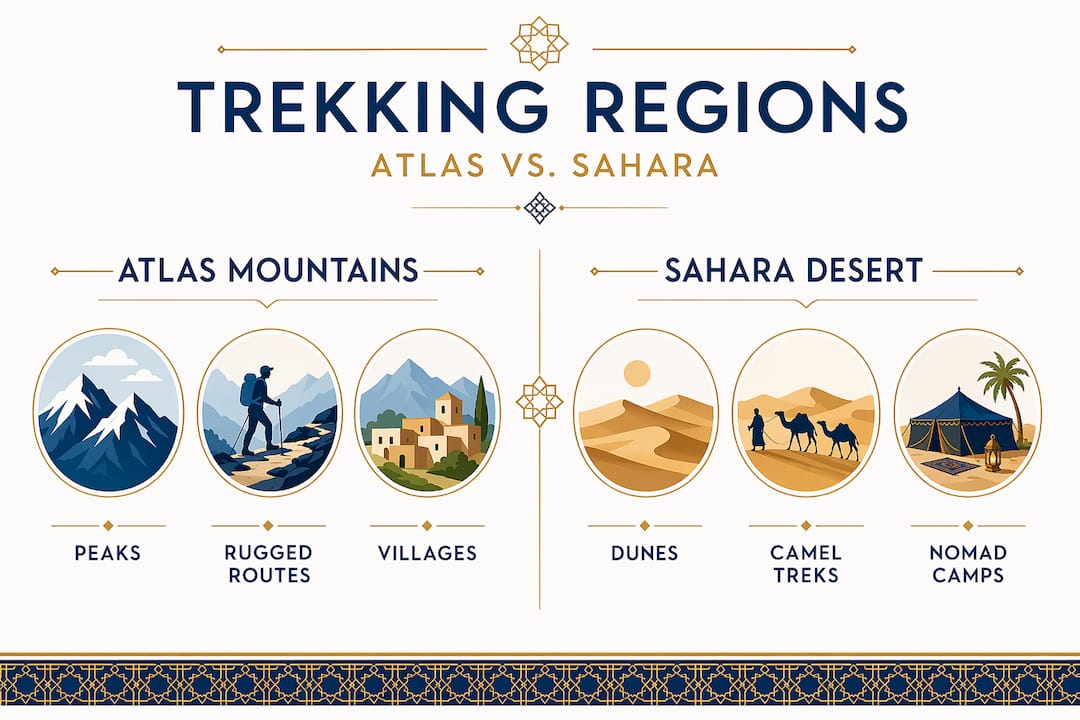
The High Atlas is the most iconic choice. Centered on the Imlil Valley and the Toubkal massif, this region offers the highest peak in North Africa, Jebel Toubkal, at 4,167 meters, and a dense network of Berber villages, terraced agriculture, and rugged alpine terrain. A common trekking approach for Morocco is to base the trek around well-known regions, especially the High Atlas via Imlil and Toubkal, and then adapt difficulty and pacing with guidance, mule support, and lodge stays. This means even travelers without serious mountaineering backgrounds can approach the summit safely with the right operator.
The Sahara Desert region, centered around Merzouga and Erg Chebbi, offers a completely different kind of journey. Desert trekking here can involve multi-day camel treks, guided sand dune crossings, and nights in desert camps with proper beds, hot showers, and stargazing terraces. The physical demands are lower than High Atlas climbing, but the heat management, navigation, and immersive cultural experience are unique.
Coastal and other regions such as the Anti-Atlas, the Draa Valley, and the Rif Mountains offer hybrid experiences that blend trekking with market visits, coastal villages, and agricultural landscapes. These routes are excellent for travelers who want variety within a single trip.
| Region | Difficulty | Best season | Key highlights | Typical accommodation |
|---|---|---|---|---|
| High Atlas (Toubkal) | Moderate to hard | April to June, Sept to Oct | Summit climbs, Berber villages | Eco-lodges, mountain refuges |
| Sahara (Merzouga) | Easy to moderate | October to April | Dune trekking, camel rides | Desert camps |
| Anti-Atlas | Moderate | March to May, Oct to Nov | Remote villages, rock formations | Guesthouses, boutique lodges |
| Draa Valley | Easy to moderate | November to March | Palm groves, kasbahs | Riads, heritage lodges |
| Rif Mountains | Moderate | April to June, Sept to Oct | Cedar forests, traditional towns | Boutique hotels, guesthouses |
For detailed planning, the Atlas trekking guide covers terrain-specific logistics. If you’re ready to compare packages directly, the Morocco trekking tour package page offers a side-by-side look at curated options across regions.
Pro Tip: Don’t lock in a single difficulty rating before consulting your guide. A skilled private guide can adjust the same route’s challenge level by modifying rest stops, choosing alternative paths, and managing the overall daily elevation gain. What one traveler finds demanding, another finds comfortable, and a private guide calibrates the experience in real time.
A few key questions to help choose your region:
- Are you interested in summiting a peak, or is the journey itself the priority?
- Do you prefer cool alpine terrain or warm, arid desert landscapes?
- How many days can you commit, and how much daily walking is realistic for your fitness level?
- Do you want cultural immersion in Berber communities or a more remote wilderness experience?
Answering these questions honestly will narrow your region choice quickly. Your guide can then design an itinerary that maximizes what matters most to you.
Health, safety, and comfort on the trail
Trekking raises the comfort floor significantly. But it doesn’t change the mountains or the desert. The physical environment remains demanding, and comfort benchmarks still rely on practical mountain safety fundamentals: acclimatization, pacing, and early action if altitude illness symptoms appear.
Altitude sickness is the primary health risk in the High Atlas. Jebel Toubkal’s summit sits well above 4,000 meters, a height where acute mountain sickness (AMS) is a real possibility for travelers arriving from sea level. AMS symptoms include headache, nausea, dizziness, and fatigue, and they typically appear within the first 24 hours at altitude. Left unmanaged, AMS can develop into more serious conditions.
Here’s how reputable operators manage altitude and safety:
- Gradual acclimatization scheduling with planned rest days built into the itinerary before major elevation gains
- Daily health check-ins where your guide monitors for early symptoms using structured questions and observation
- Adjusted daily ascent rates, keeping elevation gain within safe limits, typically no more than 300 to 500 meters per active trekking day above 2,500 meters
- Immediate descent protocol if symptoms of AMS progress beyond mild headache, because descending even 300 to 500 meters relieves symptoms quickly
- Emergency communication devices and coordination with local rescue services in areas where cell coverage is limited
- Mule or porter support to reduce physical load and conserve energy for the ascent itself
| Health concern | Risk level | Prevention method | Guide response |
|---|---|---|---|
| Altitude sickness (AMS) | High above 3,000m | Gradual ascent, hydration | Adjust pace; consider descent |
| Dehydration | Moderate across all regions | 3+ liters of water daily | Monitor intake and carry reserves |
| Sunburn and heat exhaustion | High in desert and high altitude | Sun protection and rest at midday | Schedule shaded rest stops |
| Hypothermia | Moderate to high in Atlas winters | Layered clothing, emergency shelter | Check weather and carry emergency kit |
| Blisters and foot fatigue | Low to moderate | Quality footwear, moleskin | Early treatment, pace adjustment |
Comfort features in treks also serve a safety function. When travelers sleep in proper lodge beds rather than thin sleeping mats, they recover more thoroughly. Nutritious catered meals fuel the next day’s exertion better than self-prepared camp food. Hot water for washing at the end of a day prevents small skin irritations from becoming trail-ending problems. The expert advice on Atlas trekking covers these logistics in depth. For a broader picture of how professional guide services operate, the guide to guided tours in Morocco is worth reading before you finalize your operator choice.
Pro Tip: Ask any operator directly whether their guides carry a pulse oximeter. This small device measures blood oxygen saturation and is one of the most reliable early indicators of altitude sickness. An operator who carries one and knows how to use it demonstrates a serious commitment to safety over optics.
Understanding costs and inclusions: Budgeting
Trekking costs more than a basic guided group trek. That’s expected. What matters is understanding exactly what you’re paying for and whether the price reflects genuine expertise, quality logistics, and authentic value.
Trekking budgets are sensitive to what’s included: guide fees, meals, lodging, or refuge stays; transport; national park and permit fees; and optional equipment like ice axes and crampons for winter or technical routes. When comparing operators, a lower headline price frequently reflects stripped-down inclusions rather than a genuinely better deal.
Here’s what a well-structured trekking package typically includes:
- Private certified guide for the full duration, with relevant mountaineering or desert guiding credentials
- All accommodations from arrival to departure, including pre- and post-trek nights in a riad or quality hotel
- Full board on the trail with breakfasts, packed lunches, and dinners prepared by a cook or at lodge restaurants
- All transfers, including airport pickup, city to trailhead, and return transport
- Mule or porter support to carry gear between camps and lodges
- Toubkal National Park permit or equivalent entry fees for the region you’re trekking
- Emergency equipment, including first aid kit, communication devices, and weather monitoring
- Equipment rental for technical gear when needed, such as crampons or trekking poles
What drives pricing up or down in Morocco trekking?
Guide expertise and certification. A licensed Moroccan mountain guide with international credentials commands a premium. That expertise directly affects safety and experience quality. Never treat guide costs as a line item to negotiate away.
Accommodation tier. A mid-range eco-lodge in Imlil differs significantly from a premium lodge with private en-suite rooms, heated common spaces, and a proper restaurant. The gap in nightly cost reflects real differences in comfort and recovery quality.
Group size. A truly private tour for two people costs more per person than a small group of six. But the difference in attention, flexibility, and experience depth is substantial. For most travelers, the per-person premium for a fully private experience is well worth the investment.
Seasonal pricing. Spring (April to June) and early autumn (September to October) are peak seasons in the High Atlas, with the best weather and trail conditions. Rates reflect demand. Winter treks to Toubkal are possible and rewarding but require technical gear and specialized guides, which adds cost. Summer is hot in the desert and busy in the mountains.
Duration and region. A three-day High Atlas circuit will naturally cost less than a twelve-day combined High Atlas and Sahara journey. But longer itineraries offer far richer cultural and physical experiences, and the per-day cost often decreases as fixed logistics costs are spread across more days.
For a clear breakdown of what Morocco travel typically costs across different service tiers, the travel cost breakdown is a useful reference. If you’re ready to see specific package pricing and inclusions side by side, the all-inclusive trekking tour page provides that comparison directly.
Why high-end trekking in Morocco requires expert nuance
Here’s something the polished brochures don’t say often enough: Branding in Morocco trekking can be a surface coat over shallow operational depth. A riad stay and a gourmet tagine look spectacular in a marketing photo. But neither item tells you whether the operator has a credible plan if you develop altitude sickness above 3,500 meters, or whether the guide genuinely understands the difference between a tired traveler and one who needs to descend immediately.
The uncomfortable truth is that many operators who use the word have invested heavily in accommodation aesthetics and photography and far less in guide training, emergency protocols, and weather contingency planning. Discerning travelers get burned by this gap regularly.
If you’re considering a Toubkal-style summit or any route that can turn wintry, the benchmark recommendation is to prioritize operators that explicitly cover altitude and gear logic and emergency response readiness via experienced local guides. That’s not a throwaway line. It’s the single most reliable filter for separating genuinely expert operators from those who have simply rebranded basic trekking with premium accommodations.
What we’ve learned from years of working with travelers across Morocco’s mountain and desert regions is that the most satisfied clients are never the ones who prioritized the most impressive-sounding lodge. They’re the ones who asked hard questions about their guide’s experience, understood the safety protocols before they arrived, and chose an operator based on depth of knowledge rather than the quality of the website photos.
True expert nuance in Morocco trekking shows up in small, specific ways. It’s a guide who notices you’re breathing harder than usual during a rest stop and changes tomorrow’s plan accordingly. It’s an operator who tells you honestly that a winter Toubkal summit isn’t right for your fitness level and suggests an equally spectacular alternative. Its itinerary flexibility is built into the contract, not just mentioned in a sales call. For travelers who want that depth of service, the guide to guided trekking expertise covers what to look for when evaluating operators.
Morocco trekking should be earned from the inside out, starting with safety, knowledge, and genuine local connection, and finishing with the comfortable bed and excellent meal. When it’s assembled in the opposite order, you’re paying a premium for something that looks better than it performs.
Start your trekking journey in Morocco
If this article has helped you see Morocco trekking as the layered, sophisticated experience it genuinely is, the next step is finding a partner who can bring that vision to life with the precision it deserves. At MoroccoTours.co, we specialize in exactly that intersection of adventure and expertise. Browse our curated trekking tours to see detailed itineraries, inclusions, and pricing across the High Atlas, Sahara, and beyond. For those seeking a complete Morocco journey that pairs trekking with cultural immersion and imperial city visits, our signature adventure tours offer a beautifully sequenced multi-region experience. Or start by exploring the full range of Morocco travel packages to find the right entry point for your adventure.
Frequently asked questions
What are typical inclusions in Morocco trekking tours?
Most trekking packages include a private expert guide, curated meals, high-comfort lodging, transport, permits, and safety equipment. As the Toubkal trek cost resource notes, budgeting depends heavily on whether gear rental, park fees, and mule support are included in the headline price.
Is trekking in the High Atlas safe for first-time visitors?
Yes, with the right operator. Safety is significantly improved with experienced local guides who manage acclimatization, pacing, and emergency response. The High Atlas trekking guide emphasizes that even for travelers, mountain safety fundamentals like acclimatization and pacing remain non-negotiable.
How do trekking tours handle altitude sickness?
Expert guides monitor symptoms continuously, adjust the daily ascent rate, and initiate immediate descent if symptoms progress beyond mild discomfort. The High Atlas guide’s core advice is that early action is always the right call, regardless of how close you are to the summit.
Can I customize difficulty and pacing on a Morocco trek?
Absolutely. Reputable operators tailor every aspect of the trek to your fitness level and personal goals, often with built-in flexibility to adjust day by day. As the Toubkal trek approach confirms, adapting difficulty and pacing with experienced guidance and logistics support are the defining characteristics of a truly bespoke trekking experience.