
Ouarzazate, Morocco: Your Travel Guide
TL;DR:
- Ouarzazate, known as the “Door of the Desert,” offers a rich blend of UNESCO heritage sites, film studios, and desert access.
- Its dramatic landscapes and historic kasbahs attract filmmakers and travelers alike, with optimal visits during late afternoon light.
- The city serves as a versatile base for desert excursions, cultural exploration, and scenery-driven productions, rewarding visitors who take time to explore beyond the main attractions.
Most travelers pass through Ouarzazate on their way to the Sahara and never look up long enough to realize they’re missing one of Morocco’s most layered cities. This place is a provincial capital at 1,151 m elevation with a nickname that tells you everything: “Door of the Desert.” But that door opens onto far more than sand dunes. Ancient kasbahs, a UNESCO World Heritage Site, and film studios that have hosted productions from Gladiator to Game of Thrones all share the same dramatic backdrop. This Ouarzazate travel guide covers it all.
Table of Contents
- Key takeaways
- Ouarzazate: geography, climate, and history
- Cultural heritage sites worth your time
- Ouarzazate film studios: the Hollywood of Africa
- Desert excursions from Ouarzazate
- Getting to Ouarzazate and where to stay
- My honest take on visiting Ouarzazate
- Plan your Ouarzazate trip with Moroccotours
- FAQ
Key takeaways
| Point | Details |
|---|---|
| More than a desert stop | Ouarzazate combines UNESCO heritage, a thriving film industry, and Sahara access in one city. |
| Best timing for visits | Late afternoon light transforms earthen architecture and is ideal for photography at kasbahs. |
| Desert base advantage | The city gives easy access to Erg Chebbi dunes, Draa Valley, and the Valley of the Thousand Kasbahs. |
| Climate demands preparation | Summers are extremely hot and winters get surprisingly cold, so pack for both. |
| Film tourism is real here | Atlas Studios is one of the world’s largest, and public tours are available to visitors. |
Ouarzazate: geography, climate, and history
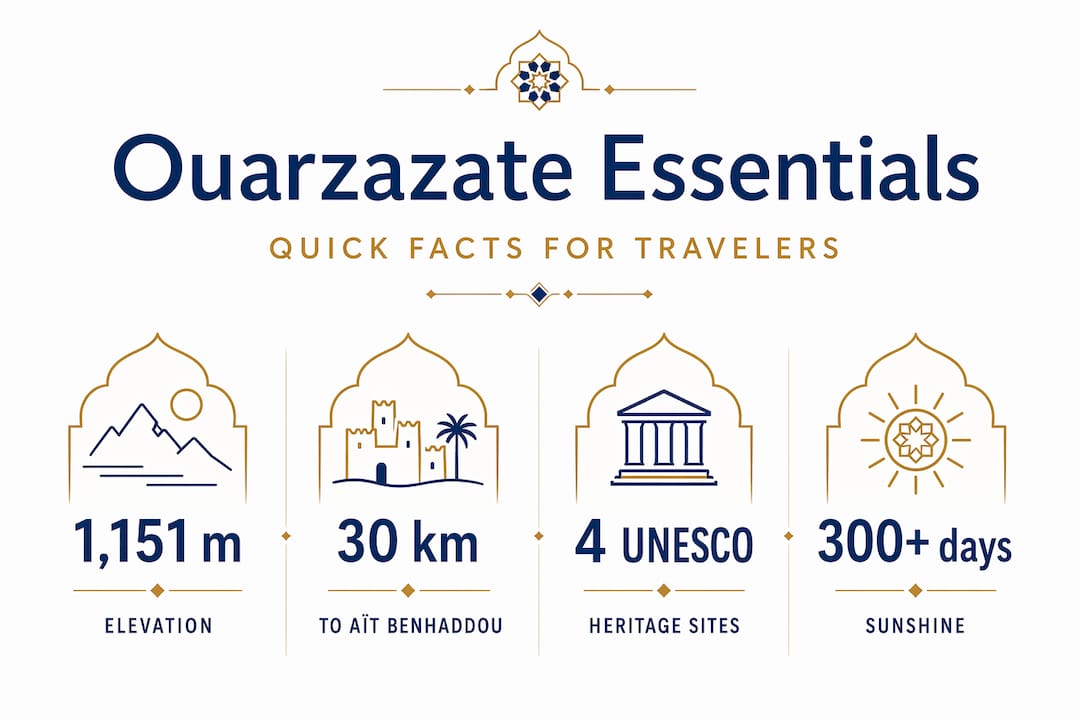
Ouarzazate sits in south-central Morocco, where the High Atlas Mountains meet the pre-Saharan plains. At 1,151 meters above sea level, it occupies a strategic position that ancient traders understood long before modern tourists did. The city has a population of around 71,000 and functions as the capital of its province, making it a real working city rather than just a tourist outpost.
Climate at a glance
The weather here follows a hot desert pattern (Köppen BWh classification), which means the city delivers extreme contrasts. Average summer temperatures sit between 27°C and 32°C, while winter daytime temperatures hover between 6°C and 11°C with annual precipitation around just 120 mm. The result is a place that can bake you in July and freeze you in January, sometimes within the same 24 hours.
| Season | Temperature Range | What to Expect |
|---|---|---|
| Spring (Mar–May) | 15–25°C | Ideal travel weather, blooming oases |
| Summer (Jun–Aug) | 27–38°C | Intense heat; early morning activity only |
| Fall (Sep–Nov) | 15–28°C | Best overall season for exploration |
| Winter (Dec–Feb) | 6–15°C | Cold nights and mornings, mild afternoons |
Historically, Ouarzazate emerged as a critical caravan crossroads. Berber communities settled here long before any colonial maps existed, and a Jewish community contributed significantly to trade and craft traditions across the region. When French colonial forces arrived in the early 20th century, they formally established the town as an administrative center, which cemented its position on regional routes connecting Marrakech to the deep south.
Pro Tip: Winter mornings in Ouarzazate can drop below freezing with icy winds despite warm afternoon sunshine. If you visit between November and February, a proper fleece or light down jacket is not optional. Pack it regardless of what the average temperature charts suggest.
Cultural heritage sites worth your time
The cultural density around Ouarzazate surprises even experienced Morocco travelers. Within a 30-minute drive in any direction, you encounter architecture and history that most countries would make a national centerpiece.
Taourirt Kasbah
Right in the city itself, Taourirt Kasbah is the most accessible major historic structure in Ouarzazate. This fortress-palace complex was once a seat of power for the powerful Glaoui family, who dominated southern Moroccan politics in the colonial era. The complex includes dozens of rooms, decorative plasterwork, carved cedarwood, and a small medina quarter still populated by local families. It is undervisited relative to its quality, which means you often have it largely to yourself.
Aït Benhaddou: the crown jewel
About 30 kilometers northwest of Ouarzazate, Aït Benhaddou is the site that draws the cameras and the crowds. UNESCO has listed it as a World Heritage Site since 1987, recognizing its authentic earthen architecture along the historic caravan route that linked the Sahara to Marrakech. The ksar (fortified village) is a collection of earthen towers, homes, and granaries stacked against a hillside above a seasonal river.
What makes the architecture genuinely remarkable is the material: rammed earth, adobe, and gypsum, built without steel or concrete and shaped by hand over centuries. UNESCO monitoring continues because this type of construction requires ongoing maintenance to resist erosion from the rare but intense rain events the region experiences. The vulnerability is part of what makes the site feel alive rather than simply preserved behind glass.
Key things to know before your visit:
- Only about eight families still live inside the old ksar, lending it an authentic rather than staged atmosphere.
- You cross the river on foot or by a short footbridge, which adds to the feeling of arriving somewhere genuinely removed from the modern world.
- The site connects directly to several major film productions, so you may recognize specific towers and alleys from cinema.
- Guided walks typically take 45 to 90 minutes depending on depth of coverage.
- The hill climb to the granary at the top rewards you with a panoramic view across the river valley that no photo fully captures.
Pro Tip: Late afternoon raking light from around 4 to 6 PM brings out the textures and warm tones of earthen walls at their best. Schedule your Aït Benhaddou visit in the late afternoon, and stay until the light fades. The same principle applies to Taourirt Kasbah in the city.
The surrounding oases and the stretch of territory known as the Valley of the Thousand Kasbahs extend this heritage experience considerably. Villages like Aït Ben Moro and the palmeraies around Skoura offer earthen towers in states ranging from active homes to photogenic ruins, with far fewer visitors competing for the same view.
Ouarzazate film studios: the Hollywood of Africa
The phrase “Hollywood of Africa” gets applied to various places, but Ouarzazate has the actual credentials to back it up. The city attracts 20 to 50 international productions annually, with crews and directors drawn by the combination of dramatic landscape, reliable sunshine, proximity to diverse terrain, and competitive production costs.
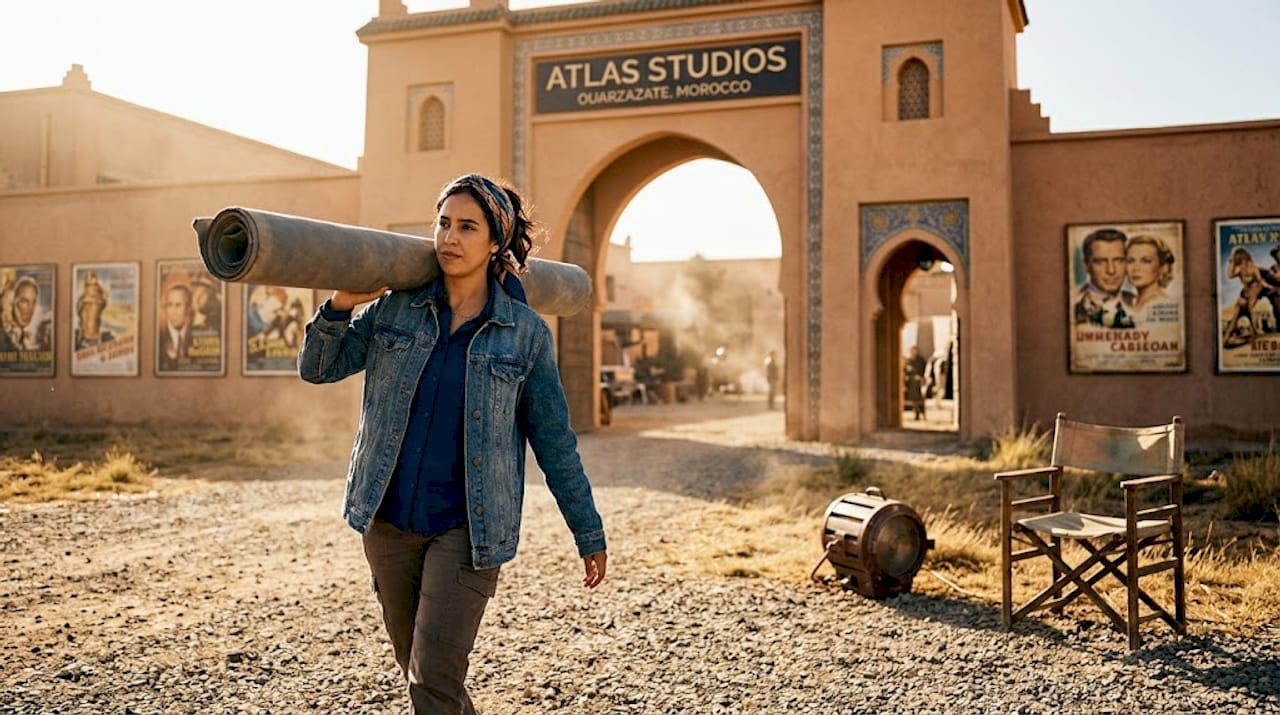
The two main facilities are Atlas Studios and CLA Studios. Atlas Studios is the headline act. Set outside the city near Aït Benhaddou, it sprawls across an enormous area that makes it one of the largest film studios in the world by physical footprint. Sets from multiple major productions remain standing there simultaneously, which creates a surreal walk through collapsed timelines of cinema history.
Notable productions shot in and around Ouarzazate include:
- Lawrence of Arabia (1962), which established the region’s cinematic potential decades before the studios existed in their current form.
- The Last Temptation of Christ (1988), filmed largely at Aït Benhaddou.
- Gladiator (2000), with the desert plains standing in for ancient Rome’s North African provinces.
- Alexander (2004), utilizing the studio infrastructure heavily.
- Game of Thrones (seasons 3 and 4), in which Aït Benhaddou served as Yunkai and other cities of Essos.
- The Mummy (1999) and its sequels, shot extensively at local desert locations.
“Ouarzazate is where landscape becomes a character. Directors choose this city because the terrain does work that no set construction team could replicate at any budget.” — Observation consistent across multiple production accounts tied to Atlas Studios visits.
About 80% of production staff on shoots here are Moroccan, which has created a skilled local workforce and embedded the film industry into the city’s cultural identity in an unusual way. You will meet former extras, drivers who have worked as location scouts, and hotel owners who have rented rooms to cast members. The industry is not a foreign imposition. It is woven into daily life.
Visitor tours of Atlas Studios run most days and are inexpensive relative to what you experience. You walk through standing sets, see construction workshops, and often encounter active preparations for incoming productions. Combine this with a trip to Aït Benhaddou, and you get a coherent picture of why this corner of Morocco became one of the world’s most filmed landscapes.
Desert excursions from Ouarzazate
The practical value of Ouarzazate as a base is hard to overstate. From here, you can reach drastically different terrain within a few hours, which means one city can anchor multiple types of adventure without requiring you to keep moving accommodations.
The most popular longer excursion takes you south and east to Merzouga and the Erg Chebbi dunes, a roughly four-hour drive that passes through date palm valleys, ancient ksour, and the geological drama of the pre-Saharan plains. Most travelers opt for an overnight trip, spending a night in a desert camp under stars that are genuinely spectacular at that elevation and distance from light pollution. If you want the full experience, consider adding this to a longer itinerary like this 8-day Sahara tour that threads through the desert and imperial cities.
Key options for desert activities from Ouarzazate:
- Camel trekking: One to three-hour rides near Merzouga or shorter rides arranged through local operators near the city. Choose operators who provide well-cared-for animals and include proper footwear guidance.
- Quad biking: Available at several locations in the dunes. Best done in the early morning before heat builds and reduces visibility due to thermal shimmer.
- Fint Oasis: A hidden green valley just 12 km from the city center, offering an easy half-day walk through palm groves and traditional Berber villages. Far fewer visitors than Merzouga but deeply rewarding.
- Draa Valley: A full-day drive south through one of Morocco’s most scenic river valleys, with kasbahs and oases every few kilometers.
- Guided off-road tours: 4×4 routes into the desert require experienced local guides. Do not attempt unmarked piste roads independently without GPS equipment and local knowledge.
Pro Tip: Temperature swings in the desert are severe enough to affect safety, not just comfort. Schedule camel treks and dune walks before 9 AM or after 4 PM in spring and fall, and avoid midday activity altogether in summer. The desert is most beautiful at these hours anyway, so this is a genuine win.
For those who want luxury desert tours that handle logistics without sacrificing the wild experience, Moroccotours offers curated options that match high-end camps with knowledgeable local guides.
Getting to Ouarzazate and where to stay
How to get to Ouarzazate
The most common approach from Marrakech is the road over or through the High Atlas via the Tizi n’Tichka Pass, a mountain road that takes three to four hours but delivers scenery worth treating as part of the journey. Buses run this route daily through CTM and other operators. Renting a car gives you the most flexibility. Private transfers are the most comfortable option, especially if you are using Ouarzazate as a base for surrounding sites.
Ouarzazate Taourirt Airport receives limited direct flights from a few European cities and connects domestically through Casablanca and Marrakech. Check schedules carefully since routes change seasonally.
Accommodation overview
| Type | Example Style | Approximate Price Range |
|---|---|---|
| Budget guesthouse | Family-run riads near the kasbah | $25–$50 per night |
| Mid-range hotel | Modern rooms with pool and views | $60–$120 per night |
| Ecolodge | Desert-edge lodge with local design | $80–$150 per night |
| Luxury property | Private villa with guide services | $200+ per night |
Plan for a minimum of two full days in Ouarzazate if you want to cover Taourirt Kasbah, Aït Benhaddou, and one studio visit without rushing. Three days lets you add Fint Oasis or a day in the Draa Valley. Five to seven days opens up a proper Merzouga desert excursion and more of the surrounding valleys.
Packing note: Light linen and cotton for summer, but always carry a fleece regardless of season. A wide-brim hat, high-SPF sunscreen, and a good water bottle are not optional given the desert climate.
My honest take on visiting Ouarzazate
I’ve seen travelers rush through Ouarzazate in half a day on the way to Merzouga and come home with a collection of dune photos and almost nothing else. That is a genuine loss. In my experience, the most memorable Morocco trips use Ouarzazate as a hub rather than a highway.
What I find most interesting about this city is how the film industry has not erased local culture. It has layered on top of it in ways that feel organic rather than synthetic. When you walk through Aït Benhaddou, knowing that Game of Thrones filmed there, and then a local guide points to the wall repairs done by his grandfather using the same techniques as the original builders, you get something rare: living history that is simultaneously a world film set and a genuinely inhabited cultural site. That combination does not exist in many places.
The pitfall I see most often is visitors treating Ouarzazate as a single-attraction stop. They go to Aït Benhaddou, tick it off, and leave. What they miss is the Fint Oasis, fifteen minutes away; the Taourirt Kasbah in the city center that costs almost nothing to enter; and the late afternoon light that transforms every earthen wall from brown to gold to deep amber. You cannot fully appreciate earthen architecture in flat noon light. Come back at 4 PM, and it is a different world.
My advice: schedule your Ouarzazate visit within a broader Morocco itinerary that gives you at least three days here. Resist the urge to treat it as a transit point. The city rewards the curious traveler who slows down.
— Moroccotours
Plan your Ouarzazate trip with Moroccotours
Ouarzazate is at its best when the logistics are handled and you are free to actually experience it. Moroccotours builds luxury Morocco tours that thread through the city’s cultural sites, film locations, and desert excursions without the guesswork. Whether you want a private guided walk through Aït Benhaddou followed by a camp night in the Erg Chebbi dunes, or a deeper cultural program that includes Jewish heritage sites and a culinary route through southern Morocco, the itineraries are designed around how travelers actually experience these places.
The Morocco Jewish Heritage Tour includes stops near Ouarzazate and connects the region’s layered history in a way that standalone visits rarely achieve. For food-driven travelers, the 9-day culinary tour covers the spice markets and tagine traditions that extend into the south. Every Moroccotours package includes private guides, vetted accommodations, and the flexibility to adapt the itinerary to what you find interesting once you arrive.
FAQ
What is Ouarzazate known for?
Ouarzazate is known as Morocco’s “Door of the Desert” and as a major film production hub. It is home to Atlas Studios, the UNESCO-listed Aït Benhaddou kasbah, and serves as the main gateway to Sahara Desert excursions.
How do I get to Ouarzazate from Marrakech?
The most common route is by car or bus over the Tizi n’Tichka mountain pass, a drive of three to four hours. Private transfers and guided tours from Marrakech are available and handle the route comfortably.
What films were shot in Ouarzazate?
Major productions include Gladiator, Lawrence of Arabia, The Mummy, and multiple seasons of Game of Thrones. Atlas Studios remains one of the world’s largest studio complexes by area and continues to host 20 to 50 international productions per year.
When is the best time to visit Ouarzazate?
Fall (September to November) and spring (March to May) offer the most comfortable temperatures for outdoor exploration. Summer brings extreme heat above 35°C, and winter nights can fall near freezing despite warm daytime temperatures.
What should I pack for Ouarzazate?
Pack light layers you can add or remove throughout the day, a wide-brim sun hat, high-SPF sunscreen, and a fleece or light jacket for evenings and winter mornings. Comfortable closed-toe shoes work best for walking through kasbahs and oasis trails.