
Tetouan, Morocco: Cultural Heritage Travel Guide
TL;DR:
- Tetouan is a UNESCO-listed city with well-preserved Andalusian architecture, rich in artisan traditions.
- New direct flights from London Gatwick make it easily accessible for cultural exploration and day trips.
- Engaging with local crafts and exploring the historic medina offers an authentic Moroccan experience beyond tourist hotspots.
Few Moroccan cities stop travelers in their tracks the way Tetouan does. Known as the “White Dove of the Mediterranean,” Tetouan carries a depth of Andalusian heritage that most northern Morocco itineraries miss entirely. While Marrakech and Fes pull the crowds, this compact city in the Rif foothills has been quietly collecting UNESCO honors, building a living craft economy, and improving flight connections for international visitors. This guide covers everything you need to know: history, the medina, artisan culture, top things to do in Tetouan, and practical planning advice.
Table of Contents
- Key takeaways
- Tetouan’s history and Andalusian roots
- The medina: a UNESCO World Heritage Site
- Tetouan’s craft traditions and artisan culture
- Practical travel information
- Top things to do in Tetouan
- My honest take on Tetouan as a travel destination
- Plan your Tetouan trip with Moroccotours
- FAQ
Key takeaways
| Point | Details |
|---|---|
| UNESCO dual recognition | Tetouan holds both a World Heritage medina and a creative city of crafts status, making it uniquely significant. |
| Andalusian heritage city | Refugees expelled from Spain in 1492 rebuilt Tetouan, giving it architecture unlike anywhere else in Morocco. |
| The craft economy is alive | Nearly 6,000 craft units operate here, with working artisan workshops open to engaged visitors year-round. |
| New UK direct flights | Royal Air Maroc now flies twice weekly from London Gatwick, cutting travel time to just over two hours. |
| More than the medina | Tamuda Bay beaches, Chefchaouen, and the Rif Mountains sit within easy reach for multi-day trip planning. |
Tetouan’s history and Andalusian roots
To understand Tetouan, you have to go back further than most travelers expect. The site began as a Berber settlement called Tamuda, traces of which remain in ruins just outside the modern city. What you see today, though, is largely the product of one of history’s most dramatic population movements.
When Ferdinand and Isabella signed the Alhambra Decree in 1492, hundreds of thousands of Muslims and Jews were expelled from Spain. A significant wave of these Andalusian refugees crossed the strait and settled in northern Morocco, and Tetouan became their primary reconstruction project. They rebuilt the city from near ruin, bringing with them the urban planning sensibilities, architectural details, and craft traditions of Al-Andalus.
The result is a city that feels unlike any other in Morocco. Stucco detailing, courtyard houses, and tiled facades carry a distinctly Hispano-Moorish character that gives Tetouan’s streets a visual identity closer to Granada than to Marrakech.
The city’s Jewish community played an equally formative role. Sephardic Jewish refugees established their own quarter, the mellah, and contributed to trade, craft production, and the city’s cosmopolitan character for centuries. Travelers with an interest in that history will find it richly documented throughout the medina and surrounding neighborhoods.
The Spanish Protectorate era from 1912 to 1956 added another distinct layer. Spain used Tetouan as the administrative capital of its Moroccan protectorate, building a new town adjacent to the medina with wide boulevards, Spanish colonial architecture, and public squares that still feel unmistakably European today. Walking from the medina into the Ensanche district is like crossing a border in time without leaving the city.
Key historical periods that shaped Tetouan:
- Pre-1492: Berber origins as Tamuda; early Islamic settlement
- Post-1492: Andalusian Muslim and Jewish refugees rebuild the city
- 16th-18th centuries: Corsair activity, fortification of city walls and gates
- 1912-1956: Spanish Protectorate; creation of the European new town
- Post-independence: Cultural revival and UNESCO recognition process
Tetouan is arguably Morocco’s most layered city. Nowhere else do Berber origins, Andalusian exile culture, Sephardic Jewish heritage, and Spanish colonial urbanism exist within a few hundred meters of each other.
The medina: a UNESCO World Heritage Site
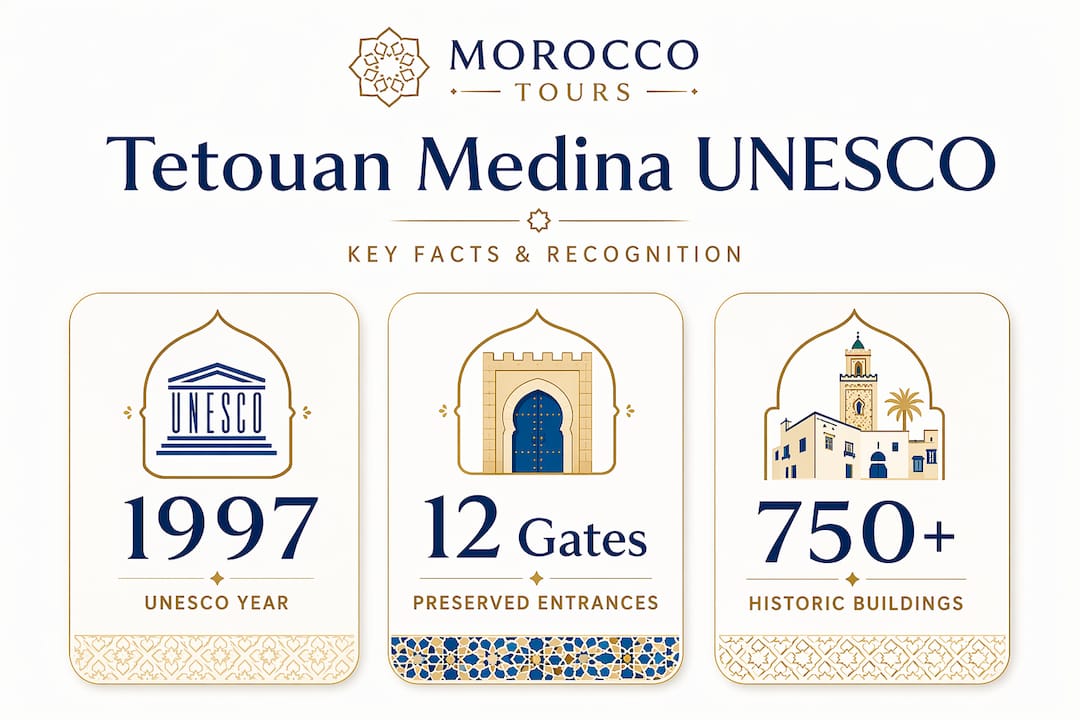
The medina of Tetouan received its UNESCO World Heritage inscription in 1997, recognized for its exceptionally well-preserved Andalusian-influenced urban fabric. That recognition was not ceremonial. The medina genuinely stands apart from Morocco’s other historic cores in both layout and character.
What makes the medina unique
Where Fes’s medina is dense and disorienting in a way that feels almost medieval, Tetouan’s feels more considered. Streets are narrow but not chaotic. Residential quarters transition logically into commercial souks, artisan zones, and religious buildings. The seven historic city gates punctuate roughly five kilometers of defensive wall, and each gate marks a transition between distinct neighborhoods and functions.
Funduqs, the traditional caravanserai-style merchant inns, are scattered throughout the medina. Several remain active as workshops or storage spaces, giving you a window into commercial life that has changed very little structurally in five centuries. The mosques and zawiyas (Sufi lodges) that anchor each quarter are not just religious sites. They orient the entire urban layout, with neighborhoods radiating outward from these spiritual centers.
Medina vs. other Moroccan historic cities
| Feature | Tetouan medina | Fes el-Bali | Marrakech medina |
|---|---|---|---|
| UNESCO status | World Heritage Site (1997) | World Heritage Site (1981) | World Heritage Site (1985) |
| Architectural influence | Andalusian-Moorish | Moroccan-Islamic | Moroccan-Berber and Islamic |
| Tourist density | Low to moderate | Very high | Very high |
| Street navigability | Moderate, logical pattern | Complex, high disorientation | Moderate |
| Craft authenticity | High, working workshops | High but tourist-facing | Mixed |
The courtyard houses, known as riads in other cities but called dars here, feature the same inward-facing design philosophy, with elaborate tilework and carved plasterwork framing central courtyards. What distinguishes Tetouan is that many of these houses remain in active family use rather than converted into hotels or restaurants, which preserves the authentic residential character of the neighborhood.
Pro Tip: Enter the medina through Bab el-Okla, the eastern gate, in the morning. Artisans set up early, light is best for photography, and the crowds that build by midday have not yet arrived. Give yourself at least half a day to walk without a fixed agenda.
Tetouan’s craft traditions and artisan culture
Tetouan’s second UNESCO designation tells a different story from the first. Where the World Heritage Site recognizes what has been preserved, the Creative City of Crafts and Folk Art status recognizes what is still being made. And the scale is significant.
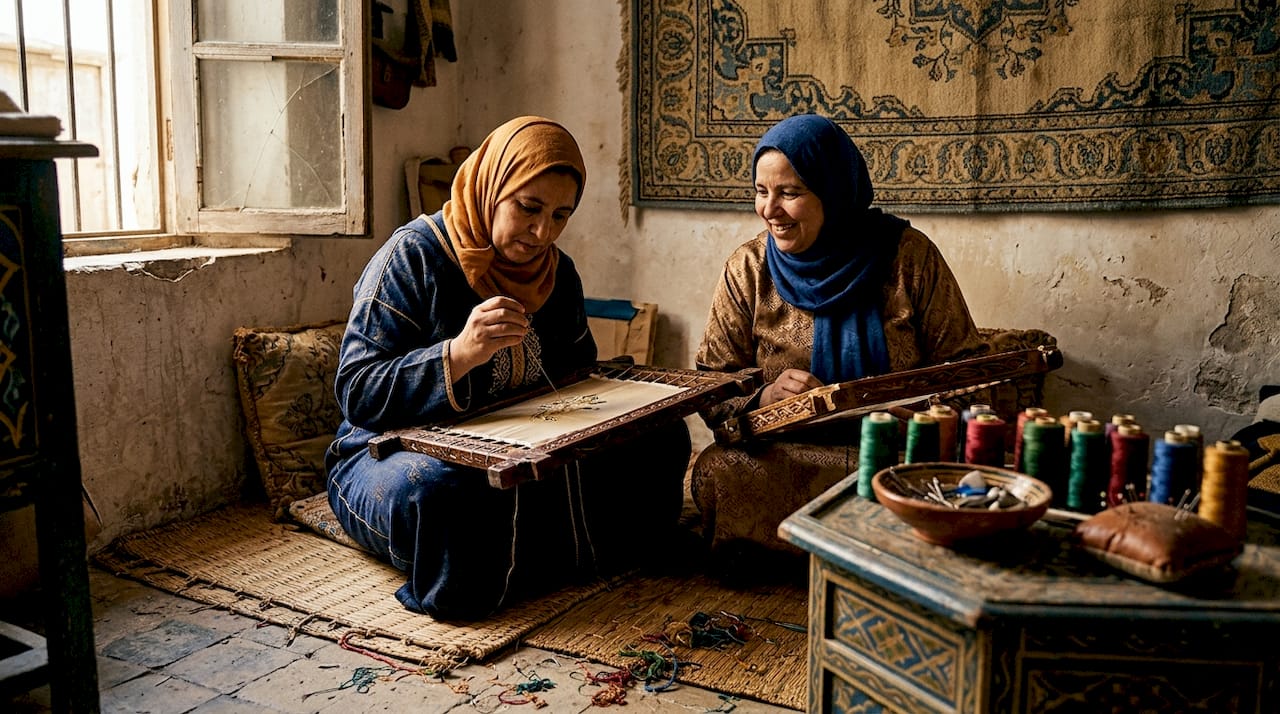
The city operates nearly 6,000 craft units with over 150 young artisans joining the market each year. This is not a fading tradition maintained for tourist photography. It is a functioning economic system tied to the city’s identity, urban structure, and daily life.
The crafts you will actually find here
- Zellige tilework: The geometric mosaic tile tradition brought from Andalusia is practiced here with particular refinement. You can watch craftsmen cut individual tesserae by hand in workshops near the medina’s artisan quarters.
- Taajira embroidery: This form of silk thread embroidery on velvet is specific to Tetouan and nearly impossible to find elsewhere in Morocco with this level of craft integrity. Look for it in the textile souks near Bab er-Remz.
- Painted woodwork: Cedar and thuya wood are carved and painted with traditional geometric and arabesque motifs for architectural elements, furniture, and decorative pieces.
- Wrought ironwork: Lanterns, grilles, and decorative hardware produced by local blacksmiths follow design patterns traceable directly to Andalusian craft guilds.
- Leather goods and weaving: Traditional tanning and dyeing operations continue, though on a smaller scale than Fes.
The city’s craft guild federations actively support training programs, infrastructure upgrades, and partnerships with social economy organizations. Women-led artisan cooperatives are a growing part of this picture, particularly in embroidery and textile production.
Pro Tip: Visit workshops between 9 a.m. and noon on weekdays. Saturday afternoons and Sundays see reduced activity. Ask your guide to arrange a direct introduction to a workshop rather than a medina shop, where the craft connection is often several steps removed from production.
Timing matters even more when major craft events are on. Tetouan hosts seasonal festivals that center on artisan culture, drawing buyers, designers, and cultural tourists who engage with the work seriously rather than as background atmosphere.
Practical travel information
Getting to Tetouan has changed meaningfully. Royal Air Maroc now flies direct from London Gatwick to Tetouan’s Sania Ramel Airport twice weekly, with a flight time of just over two hours. Previously, most international travelers routed through Tangier and completed the journey by road, adding hours to the arrival experience. This connectivity shift makes Tetouan realistic for a focused four or five-day cultural city break in a way it simply was not before.
When to visit and what’s on
The best months for visiting Tetouan are April through June and September through October. Summer is hot and crowded with domestic tourists, many of them wealthy Moroccans heading to Tamuda Bay. Winter is mild and quiet, good for medina exploration without the heat, though some workshops reduce hours.
Key events to align your visit with:
- Moroccan Poets Festival: The 7th edition featured over 50 poets and intellectuals at Teatro Español. Held with support from Moroccan and Sharjah cultural ministries, this is a genuinely significant literary event, not a tourist-facing spectacle.
- Craft and artisan festivals: Several seasonal events in the medina showcase zellige, embroidery, and woodwork from regional producers.
- Tetouan International Contemporary Art Festival: Held periodically, this event brings contemporary visual art into dialogue with the historic urban setting.
Beyond the medina: day trips and nearby attractions
Tetouan’s location between mountains and sea makes it an unusually flexible base. You can combine medina exploration with serious outdoor or beach time within the same short trip.
- Tamuda Bay: A 30-minute drive east delivers you to one of Morocco’s cleanest stretches of Mediterranean beach. Resorts and beach clubs here cater to a well-traveled crowd.
- Chefchaouen: The famous blue city sits roughly 60 kilometers south. It makes a full-day trip or an overnight, and the contrast with Tetouan’s urban texture is genuinely interesting.
- Rif Mountains: Hiking and mountain village exploration are accessible for day trips. The scenery above the city is dramatic and largely uncrowded by international tourism standards.
- Tangier: Just over an hour away, Tangier pairs well with Tetouan for a northern Morocco itinerary that covers both the modern port city and the historic inland medina.
For food, Tetouan’s restaurant scene rewards those who eat where locals eat. Seek out places serving Tetouani-style bastilla (a savory-sweet pastry pie), fresh seafood brought up from the coast, and the local version of harira (a slow-cooked legume soup). The medina has a handful of family-run restaurants tucked behind unassuming doorways that serve lunch only, and those are worth prioritizing.
Top things to do in Tetouan
A well-planned visit to Tetouan moves through layers rather than checking off landmarks. Here is a practical sequence for a one to two-day stay.
- Walk the medina walls and gates. Start at Bab el-Okla and follow the walls counterclockwise. The gates each have a distinct character, and the walk gives you the full scale of the historic perimeter before you go inside.
- Explore the artisan souks by function. Rather than wandering randomly, move through the souks by trade: the tanning quarter, the woodworkers’ lane, the textile market near Bab er-Remz. Each zone has its own logic and rhythm.
- Visit Dar Sanaa (the School of Arts and Crafts). This 16th-century palace now serves as a craft school and gallery. You can watch students working on traditional techniques while viewing finished pieces in a genuine architectural setting.
- Walk the Ensanche district. The Spanish colonial new town outside the medina walls is rarely mentioned in Tetouan travel guides, but its Art Deco facades, tiled cafes, and central plaza, the Place Moulay el-Mehdi, are worth two hours of your time.
- Eat lunch in the medina proper. Find one of the family-run lunch spots near the main souk. The food is direct, seasonal, and nothing like the tourist-targeted menus near major landmarks.
- Take an afternoon drive to Tamuda Bay. End a medina-heavy day with an hour at the beach. The shift from dense historic streets to open Mediterranean coastline is a contrast that stays with you.
- Attend a cultural event if timing allows. The Moroccan Poets Festival, local music performances at the teatro, and craft market days add a dimension to Tetouan that pure sightseeing cannot replicate.
For a two-day visit, split the days between the medina and surroundings on day one and Chefchaouen or a Rif Mountains excursion on day two. Tetouan works well as a base for both.
My honest take on Tetouan as a travel destination
I’ve helped travelers plan Morocco itineraries for years, and Tetouan is the city I find myself recommending more often lately. Not because it’s trendy. Because it’s real.
Most of Morocco’s flagship destinations have been visitor-optimized to the point where what you experience is a polished version of the culture rather than the culture itself. Tetouan hasn’t reached that point. The medina is lived-in. The craft workshops exist because the market for quality work exists, not because a tour group is expected on Thursday. The cafes in the Ensanche fill with locals who aren’t particularly interested in your camera.
What I’ve learned from talking to travelers who visit Tetouan is that the ones who engage directly with the artisan economy get something the others miss entirely. Sitting with a zellige craftsman for an hour while he explains the geometry behind a single tile panel is an experience that changes how you see every tiled surface in Morocco afterward. It costs you nothing but time and the willingness to slow down.
The new direct flights from London Gatwick matter more than they might seem. They don’t just save time. They change the mental framing. Tetouan becomes a destination in its own right, not an add-on to a Tangier trip. That shift in framing changes what travelers bring to the experience, and in my experience, people who plan specifically for Tetouan leave with more than those who arrive by accident.
If I had to give one piece of advice: resist the urge to fill every hour. Tetouan rewards patience in a way that Morocco’s more famous cities, with their insistent energy, sometimes don’t allow.
— Moroccotours
Plan your Tetouan trip with Moroccotours
Tetouan sits at the center of some of MoroccoTours’ most requested northern Morocco itineraries, and for good reason. Its medina, craft culture, and Andalusian heritage make it a natural anchor for a culturally focused trip, whether you have four days or two weeks.
The 14-Day Morocco Highlights Tour builds Tetouan into a full circuit of Morocco’s imperial cities and Sahara landscapes, with private guides who know the medina well enough to take you past the obvious. For travelers focused on northern Morocco specifically, the 10-Day Morocco Signature Tour covers Tetouan alongside Chefchaouen, Tangier, and Fes with luxury accommodations and private airport transfers from Sania Ramel Airport. Those interested in Tetouan’s Sephardic Jewish heritage should look at the Morocco Jewish heritage tour, which traces the Andalusian Jewish legacy across northern and imperial Morocco.
Moroccotours handles everything from airport logistics to artisan workshop introductions, so you spend your time experiencing Tetouan rather than organizing them. Browse the full range of luxury Morocco tours to find the right fit for your travel style and timeline.
FAQ
What is Tetouan known for?
Tetouan is known for its well-preserved Andalusian-Moorish medina, a UNESCO World Heritage Site since 1997, and its status as a UNESCO Creative City of Crafts and Folk Art. The city is also recognized for its unique blend of Moroccan, Andalusian, and Spanish colonial architecture.
How do you get to Tetouan from the UK?
Royal Air Maroc operates twice-weekly direct flights from London Gatwick to Tetouan’s Sania Ramel Airport, with a flight time of just over two hours. This route, added in 2026, makes Tetouan one of the most accessible northern Moroccan cities for UK travelers.
What are the best things to do in Tetouan?
Top experiences include walking the medina walls, exploring the artisan souks by trade quarter, visiting Dar Sanaa craft school, walking the Spanish colonial Ensanche district, and taking a day trip to Tamuda Bay or Chefchaouen. Attending a local cultural event like the Moroccan Poets Festival adds further depth.
What crafts is Tetouan famous for?
Tetouan is famous for zellige tilework, taajira silk embroidery, carved and painted woodwork, and wrought ironwork. These crafts trace directly to the Andalusian refugee tradition of the 15th century and remain part of a functioning artisan economy with nearly 6,000 active craft units.
What is the best time to visit Tetouan?
April through June and September through October offer the best weather and cultural activity. Summer brings heat and heavy domestic tourism around Tamuda Bay, while winter is quiet and mild, well suited for medina exploration with fewer crowds.