
Hotels in Morocco: Your Traveler’s Guide
- Morocco offers diverse accommodations, including traditional riads, luxury resorts, and modern boutique hotels.
- Choosing the right property depends on your priorities for atmosphere, amenities, and location, with many travelers benefiting from splitting stays.
- Careful review of recent feedback and understanding the differences between riads and hotels enhances the overall Moroccan travel experience.
Hotels in Morocco span three distinct categories: traditional riads tucked inside ancient medinas, full-service luxury resorts, and contemporary hotels with standardized amenities. The range is wider than most travelers expect. A single city like Marrakech holds properties from La Mamounia, where rooms start at $900 per night, to family-run riads charging under $100. Knowing the difference between these accommodation types before you book is the single most important decision you will make for your Morocco trip.
What types of hotels are available in Morocco?
Morocco’s accommodation market divides cleanly into three categories: riads, hotels and resorts, and boutique properties that blend both traditions. Each delivers a fundamentally different experience.
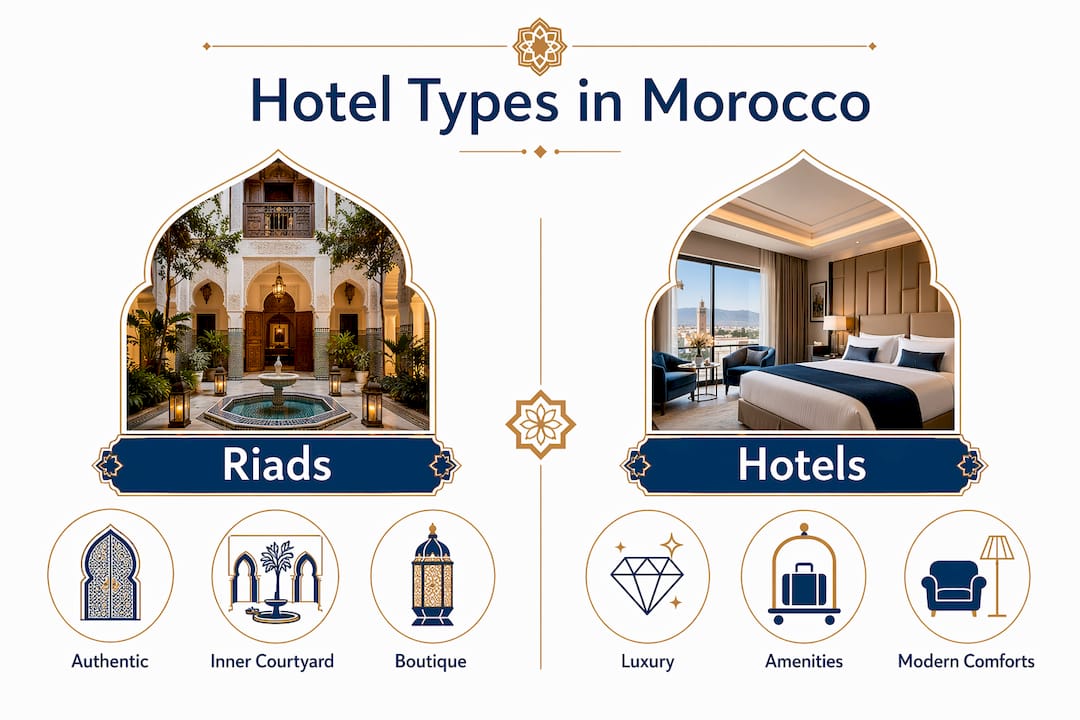
Riads are the most distinctly Moroccan option. A riad is a traditional medina home converted into a boutique hotel, built around an inner courtyard that serves as the social and architectural heart of the property. Riads vary enormously in size and luxury, from a six-room family-run guesthouse to the Royal Mansour Marrakech, which operates 53 standalone private riads, each with its own courtyard, plunge pool, rooftop terrace, and hammam. The interiors range from traditional Moroccan maximalism loaded with zellige tile and carved plaster to modern interpretations that keep the courtyard structure but strip back the ornamentation.
Large hotels and resorts operate on a completely different scale. Properties like La Mamounia carry 209 rooms and offer spas, fitness centers, multiple restaurants, and family-friendly facilities. Amanjena, also in Marrakech, adds tennis clinics and spa facilities to its offering. These properties deliver the predictable comfort travelers associate with international hotel brands: elevators, 24-hour front desks, luggage storage, and on-site dining that does not require navigating a medina at night.
Boutique hotels occupy the middle ground. Nobu Hotel Marrakech, which opened in 2023 with 71 rooms, is the clearest example. It combines a modern hotel structure with a rooftop bar offering 360-degree city views, making it a property where the experience extends well beyond the room itself. This category appeals to travelers who want reliable amenities but also want something memorable and specific to Morocco.
- Riads: 5–10 rooms on average, medina locations, courtyard-centered design, hammam access, highly personal service
- Large hotels and resorts: 50+ rooms, full amenity suites including pools and spas, easier vehicle access, standardized comfort
- Boutique hotels: 30–100 rooms, design-forward interiors, signature dining or bars, blend of local character and modern convenience
Pro Tip: When browsing riads online, check whether the property has air conditioning in individual rooms. Many older riads rely on the courtyard’s natural ventilation, which works well in spring but can fall short during July and August when temperatures in Marrakech regularly exceed 100°F.
What are the best hotels in Morocco for every budget?
The best hotel for your Morocco trip depends entirely on what you are optimizing for: atmosphere, privacy, amenities, or price. Here is how the top properties stack up across traveler segments.
Luxury travelers
La Mamounia in Marrakech is the reference point for luxury accommodations Morocco travelers discuss most. With 209 rooms, a world-class spa, and a starting rate around $900 per night, it consistently ranks among the world’s top hotels. Amanjena offers a quieter alternative with spa facilities, tennis clinics, and a promotion that includes a complimentary fourth night, which meaningfully improves the value of a longer stay. For travelers who want coastal luxury, Royal Mansour Tamuda Bay delivers 55 villas and suites near the Mediterranean, each with butler service and private balconies or patios. That level of privacy is difficult to find anywhere else in North Africa.
Couples and design-focused travelers
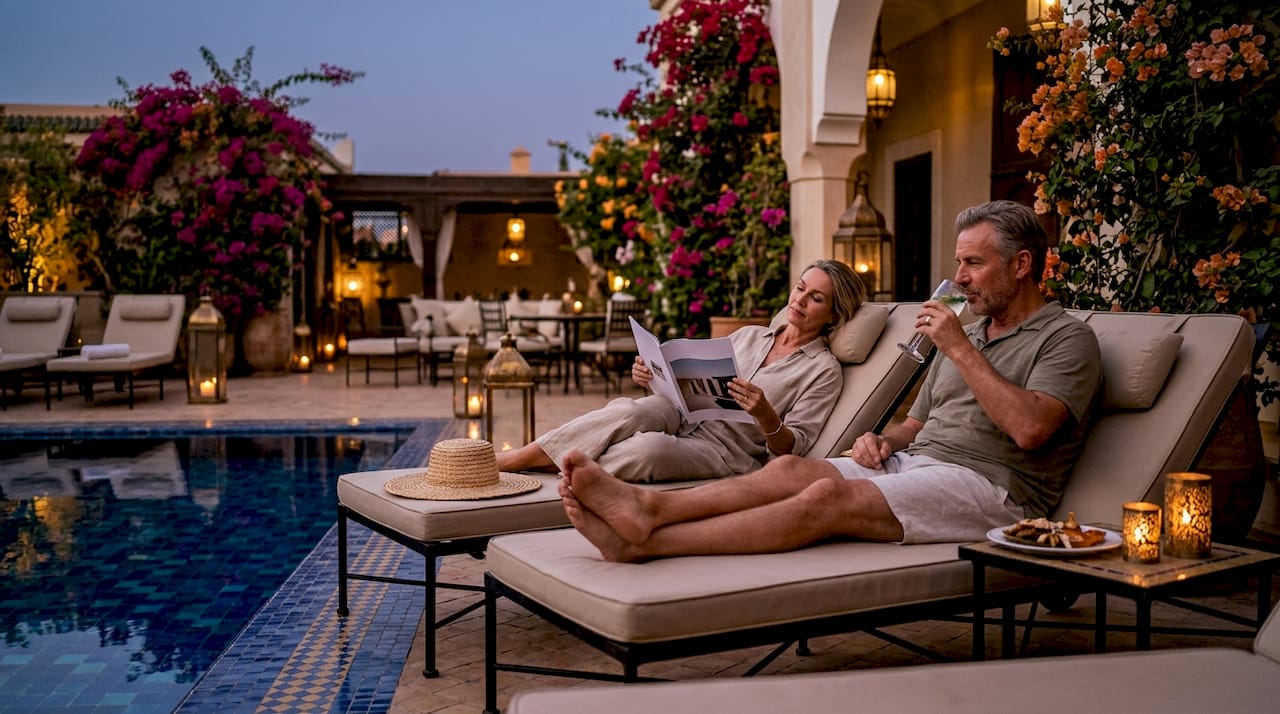
Nobu Hotel Marrakech targets this segment precisely. Rooms start from approximately 4,800 MAD on a bed-and-breakfast basis, and the rooftop bar with city views is one of the most talked-about hotel amenities in the country. For couples who want a more intimate setting, a well-chosen boutique riad in the Marrakech medina delivers something no large hotel can match: the feeling of having a private Moroccan home for a few nights.
Families
La Mamounia’s family-friendly facilities make it the most practical luxury choice for families. Large hotels and resorts generally handle families better than riads, which often have steep internal staircases, no elevators, and rooms that vary significantly in size and layout.
Budget and mid-range travelers
Morocco hotel deals exist at every price point. Mid-range riads in Marrakech, Fez, and Chefchaouen regularly come in under $150 per night and offer far more character than a comparable international chain hotel. The key is reading recent reviews carefully, since riad quality varies more than hotel quality at the same price point.
| Traveler Type | Best Property Type | Example Property | Key Feature |
|---|---|---|---|
| Luxury | Large resort or private riad | La Mamounia, Royal Mansour | Spa, butler service, full amenities |
| Couples | Boutique hotel or intimate riad | Nobu Hotel Marrakech | Rooftop bar, design-forward rooms |
| Families | Large hotel with resort facilities | La Mamounia | Family-friendly amenities, pool access |
| Budget/Mid-range | Independent riad | Various in Marrakech and Fez | Character, personal service, lower cost |
| Coastal retreat | Luxury villa resort | Royal Mansour Tamuda Bay | Private villas, Mediterranean access |
Pro Tip: If you are targeting top-rated hotels Morocco travelers rave about but want to manage costs, book Amanjena during shoulder season (April or November) and take advantage of the complimentary fourth-night promotion. You get the full luxury experience at a lower effective nightly rate.
How do riads compare to traditional hotels in Morocco?
The riad versus hotel decision is the most consequential choice you will make when planning where to stay in Morocco. Both have real advantages. Neither is universally better.
Riads typically range from 5–10 rooms and sit inside medinas, the historic walled city centers found in Marrakech, Fez, and other imperial cities. Hotels generally run 50 or more rooms and offer standardized amenities, including pools, spas, and gyms. That size difference shapes everything: the atmosphere, the service model, the logistics, and the price.
Here is how the two options compare across the factors that matter most to travelers:
- Atmosphere and authenticity. Riads win here without question. Sleeping inside a 300-year-old medina, waking to the sound of the morning call to prayer, and eating breakfast in a tiled courtyard is an experience no modern hotel can replicate. The courtyard-centered layout creates a private, inward-facing world that feels completely removed from the streets outside.
- Amenities and comfort. Hotels win here. A large resort like La Mamounia or Amanjena offers a gym, multiple pools, a full-service spa, and on-site restaurants. Most riads offer a hammam and breakfast. Some offer a small plunge pool. Very few offer a gym or a full restaurant.
- Logistics and access. Hotels are significantly easier to reach. Medina riads require walking from the nearest vehicle drop-off point through narrow, car-free lanes, often over cobblestone paths. Arriving with large luggage is genuinely difficult. Most riads arrange porter services, but you need to confirm this in advance. Hotels outside the medina accept taxis and private cars directly to the front door.
- Privacy and service. A small riad with eight rooms delivers a level of personal attention that a 200-room hotel cannot match. Staff know your name, your preferences, and your schedule. That said, the Royal Mansour Marrakech’s 53 private riads with individual butler service prove that the two models are not mutually exclusive at the top end of the market.
- Practical considerations. Many riads and hotels in Morocco lack elevators. Some riad rooms have no exterior windows, relying entirely on the courtyard for light and air. Heating and cooling can vary significantly between rooms in the same property. These are not dealbreakers, but they are worth researching before you book, especially for shoulder-season travel in March or November when temperatures swing widely.
The smartest strategy for trips of four or more nights: split your stay between a medina riad and a newer-town hotel. You get the immersive medina experience for two or three nights, then move to a hotel with a pool and easy transport access for the remainder. This approach is common among experienced Morocco travelers and solves the main trade-off between atmosphere and convenience.
Where should you stay in Morocco?
Location shapes your Morocco experience as much as the property itself. The country offers dramatically different hotel environments depending on the city and neighborhood you choose.
- Marrakech is the most hotel-dense city in Morocco and the best starting point for first-time visitors. The medina holds hundreds of riads at every price point. The Gueliz neighborhood (the new town) holds larger hotels and resorts with easier transport links. Marrakech is also the home base for luxury Morocco travel itineraries that combine city stays with desert excursions.
- Fez offers the most authentic medina experience in the country. The Fez el-Bali medina is a UNESCO World Heritage Site and one of the largest car-free urban areas in the world. Riads here tend to be quieter and less commercialized than their Marrakech counterparts. Hotel options outside the medina are more limited, so most travelers stay in riads by default.
- Casablanca operates on a different register entirely. It is Morocco’s commercial capital, and its hotels reflect that. Large international brands like Hyatt and Sofitel anchor the hotel market here. Riads are rare. If you are spending time in Casablanca, a business-style hotel or a design hotel in the Corniche area makes the most sense.
- Chefchaouen is a small mountain town famous for its blue-painted streets. Hotels and riads here are almost entirely in the budget-to-mid-range category. The town is compact, so location within it matters less than the quality of the individual property.
- Coastal towns like Essaouira and Agadir offer a different mix. Essaouira has a strong riad culture inside its medina walls. Agadir is a resort town with large beachfront hotels that cater to package tourists. The two towns appeal to completely different traveler profiles.
- Medina vs. new town: The medina gives you atmosphere, proximity to souks and historic sites, and a genuinely Moroccan experience. The new town gives you easier access, more reliable transport, and hotels with the full range of modern amenities. Neither is wrong. The choice depends on your priorities.
Pro Tip: If you are staying in a medina riad for the first time, ask the property to send a staff member to meet you at a nearby landmark when you arrive. Medina navigation is genuinely confusing on a first visit, and a five-minute escort from a recognizable point saves significant frustration.
Key takeaways
Choosing the right accommodation in Morocco requires matching your property type, location, and budget to your specific travel goals before you book.
| Point | Details |
|---|---|
| Know your accommodation types | Riads, large hotels, and boutique properties each deliver a fundamentally different Morocco experience. |
| Match property to traveler type | Luxury travelers should consider La Mamounia or the Royal Mansour; families need resort-scale amenities; couples benefit from boutique riads or design hotels. |
| Plan for medina logistics | Riads inside medinas require walking with luggage through car-free lanes; confirm porter services before arrival. |
| Split your stay strategically | Combining two or three medina riad nights with a new-town hotel stay is the most effective way to balance atmosphere and comfort on longer trips. |
| Location determines experience | Marrakech offers the widest hotel range; Fez delivers the most authentic medina stays; Casablanca suits business and modern hotel preferences. |
What i’ve learned about choosing hotels in morocco
After years of helping travelers plan Morocco trips through Moroccotours.co, the single most common mistake I see is booking entirely based on photos. Riad photography is extraordinarily good. The courtyard looks magical. The breakfast table looks perfect. What the photos do not show is whether the room has a window, whether the air conditioning actually works in August, or whether the walk from the taxi drop-off is five minutes or fifteen.
My honest recommendation: always read the most recent reviews, not the highest-rated ones. Look specifically for comments about room temperature, luggage access, and noise. A riad next to a mosque or a busy souk can be loud from 5 a.m. onward. That is authentic, but it is also worth knowing before you commit.
The other thing I have found is that travelers consistently underestimate how much the hotel shapes the entire trip. A well-chosen riad in the Fez medina does not just give you a place to sleep. It gives you a knowledgeable host, a breakfast table where you meet other travelers, and a base that makes the medina feel navigable rather than overwhelming. A large resort outside the medina gives you comfort and logistics, but you lose that connective tissue.
For luxury travelers, the Morocco itinerary that works best pairs a high-end riad in Marrakech or Fez with a resort stay on the coast or near the desert. You get both worlds. For budget travelers, the best value in Morocco is almost always a well-reviewed mid-range riad. The price-to-experience ratio beats anything a comparable international chain hotel can offer.
One more thing: do not skip the hammam. Whether your property has one on-site or you visit a neighborhood hammam, it is the most distinctly Moroccan experience available to a hotel guest. Every property worth staying at either has one or can arrange access to one nearby.
— MoroccoTours.co
Plan your Morocco stay with MoroccoTours.co
Selecting the right hotel is only one part of a well-planned Morocco trip. Moroccotours builds curated Morocco tour packages that include hand-picked accommodations matched to your travel style, whether that means a private riad in the Marrakech medina, a luxury resort on the Mediterranean coast, or a desert camp under the Saharan sky. Every package combines lodging, private guides, and transport into a single itinerary so you are not piecing together logistics from multiple sources. If you want a luxury Morocco experience built around the properties that actually deliver on their promise, Moroccotours handles the details from the first night to the last.
FAQ
What is the difference between a riad and a hotel in Morocco?
A riad is a traditional medina home converted into a boutique hotel, built around an inner courtyard, typically with 5–10 rooms. A hotel is a larger, purpose-built property with standardized amenities like pools, spas, and gyms.
How much do hotels in Morocco cost per night?
Prices range from under $100 per night for a mid-range riad to over $900 per night at La Mamounia in Marrakech. Nobu Hotel Marrakech starts at approximately 4,800 MAD per night on a bed-and-breakfast basis.
Is it better to stay in a riad or a hotel in Morocco?
The answer depends on your priorities. Riads deliver atmosphere and authenticity inside historic medinas. Hotels offer more amenities and easier logistics. Many experienced travelers split their stay between both property types on trips of four or more nights.
Where is the best place to stay in Morocco for first-time visitors?
Marrakech is the most practical base for first-time visitors, with the widest range of riads, hotels, and resorts at every price point, plus strong transport connections to other Moroccan cities and the Sahara.
Do hotels in Morocco include breakfast?
Many riads include breakfast in the room rate, and it is often one of the highlights of the stay. Large hotels typically offer breakfast as an add-on. Always confirm what is included when booking, since policies vary significantly by property.