
Marrakech, Sahara, and Chefchaouen: Travel Guide
- A 9- to 10-day Morocco itinerary links Marrakech, the Sahara, and Chefchaouen into a diverse cultural and scenic circuit.
- It covers about 1,050 kilometers, best with a private driver for flexibility and comfort, especially in the Sahara and mountain regions.
- Traveling during spring or autumn offers optimal weather conditions for exploring all three destinations comfortably.
The most rewarding Morocco itinerary combines Marrakech, the Sahara, and Chefchaouen into a single circuit that spans vibrant souks, vast golden dunes, and a blue-painted mountain medina. These Marrakech Sahara Chefchaouen combinations represent Morocco’s greatest geographic and cultural range within one trip. The circuit covers roughly 1,050 km and works best as a 7-to-10-day loop, giving travelers enough time to absorb each destination without burning out. Moroccotours designs private itineraries across this exact route, and the planning details below reflect what actually works in practice.
What is the best itinerary for Marrakech, Sahara, and Chefchaouen?
The 7-to-10-day loop is the industry standard for this circuit. It covers roughly 1,050 km and balances driving time with meaningful exploration at each stop. Anything shorter forces you to spend more time in a car than at the destinations themselves.
The route most travel professionals call the “Golden Loop” runs: Marrakech → Ait Benhaddou → Dades Gorge → Merzouga (Sahara) → Fes → Chefchaouen → Tangier or Casablanca. This direction minimizes backtracking and keeps the scenery changing throughout the trip. Reversing the route works equally well depending on your flight schedule.
Day-by-day structure for a 9-day trip
- Day 1–2: Marrakech. Jemaa el-Fnaa, the souks, Bahia Palace, and the Majorelle Garden.
- Day 3: Drive south through the Valley of a Thousand Kasbahs. Stop at Ait Benhaddou.
- Day 4: Continue to Dades Gorge. Short hike or walk through the canyon.
- Day 5: Drive to Merzouga. Camel trek into the Sahara at sunset.
- Day 6: Full Sahara day. Sunrise over the dunes, overnight camp.
- Day 7: Drive north toward Fes via Ziz Valley. Arrive in Fes by evening.
- Day 8: Fes medina, Chouara Tannery, Al-Qarawiyyin, and the old city gates.
- Day 9: Drive to Chefchaouen. Afternoon in the blue medina.
- Day 10: Depart from Tangier or Casablanca.
Pro Tip: Flying open-jaw into Marrakech and out of Tangier or Casablanca eliminates the need to retrace your route and saves a full travel day.
Key route distances and times
| Leg | Distance | Driving time |
|---|---|---|
| Marrakech to Ait Benhaddou | 200 km | 3.5 hours |
| Ait Benhaddou to Merzouga | 350 km | 5.5 hours |
| Merzouga to Fes | 430 km | 7 hours |
| Fes to Chefchaouen | 200 km | 3 hours |
| Chefchaouen to Tangier | 120 km | 2 hours |
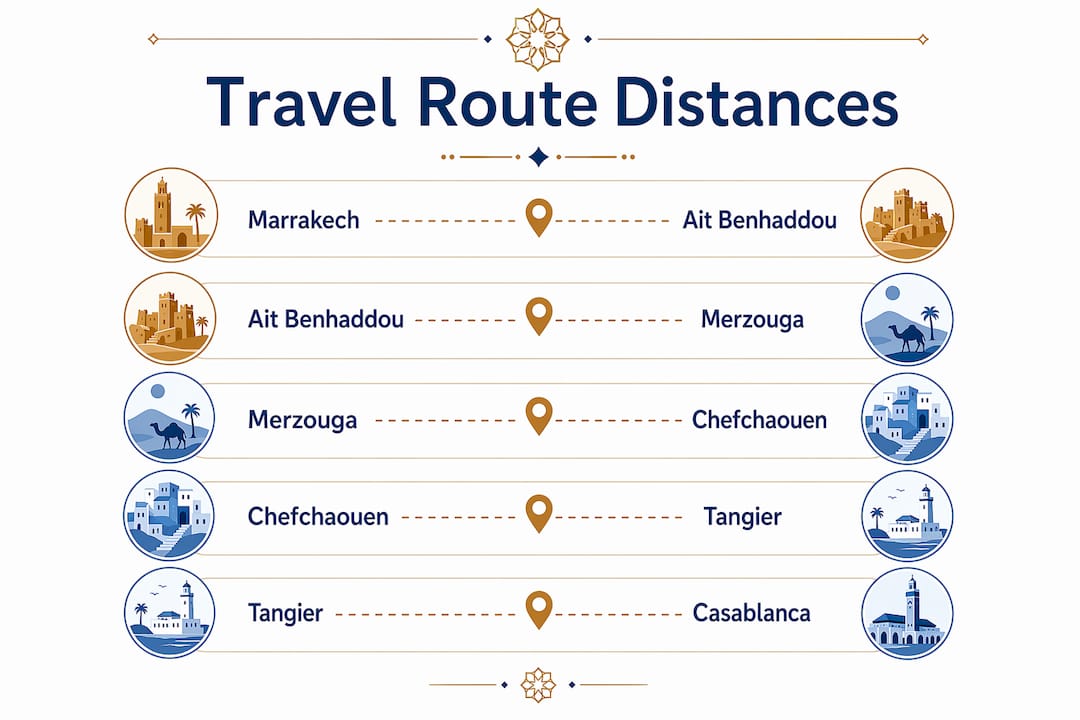
Organized tours for this circuit cost between $800 and $1,200. A private driver runs 1,200–1,800 MAD per day, which gives you more flexibility on stops and timing.
When is the best time to travel this Moroccan circuit?
Spring and autumn are the best seasons for this trip. Daytime temperatures of 20–28°C make desert walking, medina exploration, and mountain driving comfortable across all three destinations. That temperature range also means cooler nights in the Sahara, which are genuinely cold and worth packing for.
Summer creates real problems for the Sahara leg. Midday temperatures in Merzouga regularly exceed 45°C in July and August, making camel treks dangerous and outdoor time limited to early morning and evening. The best time to visit Morocco for this specific circuit is March through May or September through November.
Winter travel is possible but comes with trade-offs. Chefchaouen and the Rif Mountains can see cold rain and occasional snow in December and January. The Sahara nights drop below freezing. Desert camps provide blankets, but light packers will be caught off guard.
- Spring (March–May): Wildflowers in the Atlas Mountains, mild Sahara temperatures, moderate crowds.
- Autumn (September–November): Cooler after summer heat, harvest season in the south, excellent light for photography.
- Summer (june–august): Avoid the Sahara leg or shift it to very early morning only.
- Winter (december–february): Manageable with proper gear; Chefchaouen is quieter and more atmospheric.
Pro Tip: The Imilchil Marriage Festival takes place in September in the High Atlas. If your route passes through, it is one of the most authentic cultural events in Morocco and worth timing your trip around.
What unique experiences define each destination on this route?
Each of the three anchor destinations delivers a completely different Morocco. That contrast is exactly what makes this circuit worth the travel time.
Marrakech
Marrakech is Morocco’s most visited city for good reason. Jemaa el-Fnaa square transforms from a daytime market into a full outdoor theater by evening, with storytellers, musicians, and food stalls filling every corner. The souks behind the square sell everything from hand-stamped leather to hand-knotted rugs, and the negotiation culture is part of the experience. The Majorelle Garden, restored by Yves Saint Laurent, offers a quiet contrast to the medina’s energy. Budget at least two full days here to avoid feeling like you only skimmed the surface.
The Sahara desert
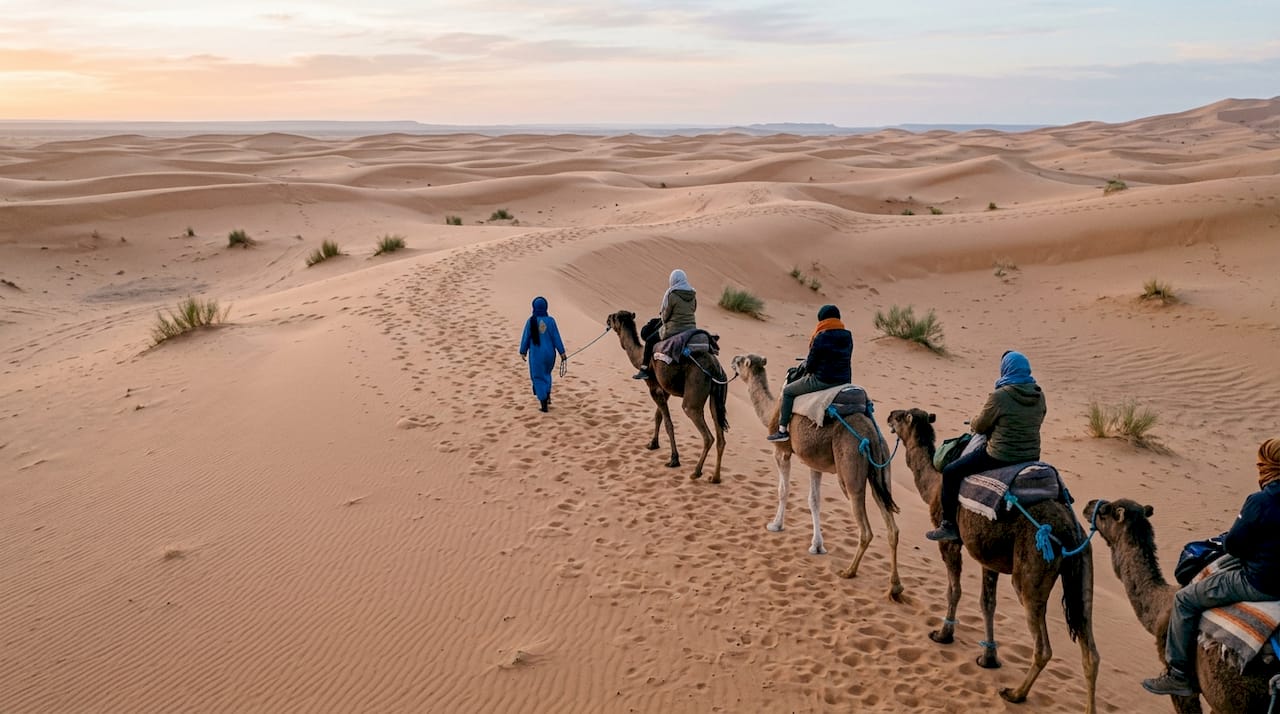
The Sahara experience centers on Merzouga and the Erg Chebbi dunes, which rise to 150 meters in places. A camel trek at sunset takes roughly 90 minutes and deposits you at a desert camp for the night. The real reward is the silence. No traffic, no city noise, just wind and the sound of the fire at camp. Berber musicians often perform after dinner, and the star visibility on a clear night is extraordinary. Moroccotours offers private desert camps that include private tents, traditional meals, and guided sunrise walks.
Chefchaouen
Chefchaouen sits in the Rif Mountains at roughly 600 meters elevation. The blue-painted medina is genuinely as striking in person as in photographs, and the color comes from a tradition that dates back centuries. The Spanish Mosque above the town offers the best panoramic view and is a 20-minute walk from the center. Local craft shops sell woven blankets and leather goods at prices well below Marrakech. One full day is sufficient to see the medina, hike to the mosque, and eat at a rooftop restaurant.
The stops in between
The journey segments hold real value. The Valley of a Thousand Kasbahs along the Draa River is a stretch of ancient mud-brick fortresses against red rock cliffs. The cedar forests near Azrou, between Fes and the Sahara, are home to wild Barbary macaques that approach travelers directly. These scenic stopovers are not detours. They are part of what makes this circuit feel like a complete picture of Morocco rather than a highlight reel.
How to organize transport and accommodation for this circuit?
Transport is the most important logistical decision on this trip. The Moroccan rail network covers Casablanca, Marrakech, and Fes efficiently, but public transport stops there. The Sahara leg and the Chefchaouen leg both require a vehicle. Buses exist but run on fixed schedules with no stops for photography or detours.
A private driver is the best option for the full circuit. The flexibility to stop at Ait Benhaddou for an hour, pull over for a roadside view of the Atlas, or adjust your arrival time at a desert camp is worth the daily cost. Private drivers typically include a comfortable 4×4 or minivan and local knowledge that no GPS can replicate.
Accommodation by destination
| Destination | Best option | Price range (per night) |
|---|---|---|
| Marrakech | Riad in the medina | $80–$300 |
| Sahara (Merzouga) | Luxury desert camp | $100–$400 |
| Chefchaouen | Boutique hotel or riad | $50–$150 |
| Fes | Medina riad | $70–$250 |
Pro Tip: Book desert camps at least 6 weeks in advance during spring and autumn. The best private camps in Merzouga sell out fast, and the difference between a standard camp and a quality one is significant in terms of comfort and food.
Riads are the right choice in Marrakech and Fes. They are traditional courtyard houses converted into guesthouses, and staying inside the medina walls puts you within walking distance of the main sites. In Chefchaouen, the medina is small enough that almost any accommodation puts you close to everything.
What mistakes should travelers avoid on this circuit?
Rushing this trip is the single most common mistake. Attempting the full loop in under 7 days turns it into an endurance test rather than a travel experience. The driving distances are long, and arriving exhausted at each destination means you absorb very little.
- Do not skip Fes. Many travelers cut Fes to save time. The medina is a UNESCO World Heritage Site and the largest car-free urban area in the world. It deserves at least a full day.
- Do not over-allocate time to Chefchaouen. One day is genuinely enough for the blue city. Extra days are better spent in the Sahara or Fes.
- Do not underestimate road conditions. The road to Merzouga is paved but long. Mountain roads near Dades Gorge require a confident driver. A private driver handles this without stress.
- Do not rely on public buses for the Sahara leg. Buses run to Merzouga but on schedules that rarely align with sunset camel treks or early morning departures.
- Do not skip the in-between stops. Direct drives save time but sacrifice the Valley of a Thousand Kasbahs, Azrou’s cedar forests, and the Ziz Valley oasis road. These segments are part of the experience.
A 9-day trip with one night in the Sahara, two nights in Marrakech, one night in Fes, and one night in Chefchaouen is the minimum comfortable structure. Ten days allows for a second Sahara night and a more relaxed pace throughout.
Key Takeaways
The most effective Marrakech-Sahara-Chefchaouen circuit runs 9–10 days, uses a private driver for the desert and mountain legs, and flies open-jaw to eliminate backtracking.
| Point | Details |
|---|---|
| Optimal trip length | Plan 9–10 days minimum to avoid exhaustion and see each destination properly. |
| Best travel seasons | Spring and autumn offer 20–28°C temperatures ideal for desert and mountain travel. |
| Transport strategy | Use a private driver for the Sahara and Chefchaouen legs; trains only cover major cities. |
| Time allocation | Give Marrakech 2 days, Sahara 2 nights, Fes 1 day, and Chefchaouen 1 day. |
| Book camps early | Reserve Sahara Desert camps at least 6 weeks ahead during peak seasons. |
What I’ve learned planning this route for hundreds of travelers
The most common feedback I hear after this circuit is, “I wish I had stayed longer in the Sahara.” Almost no one says they needed more time in Chefchaouen. That tells you something important about where the emotional weight of this trip actually lives.
The Sahara night is an experience that people remember for years. The silence, the stars, the cold air at 3 a.m. when you step outside the tent. That is not something you can replicate anywhere else in Morocco. One night is the minimum. Two nights lets you settle into the rhythm of the desert instead of just passing through it.
I also think travelers underestimate the value of the road itself. The drive from Ait Benhaddou to Merzouga through the Valley of a Thousand Kasbahs is one of the most visually striking stretches of road I have seen anywhere. A private driver who knows where to stop makes that drive a highlight rather than a means to an end. Moroccotours builds those stops into every custom Morocco itinerary rather than treating them as optional extras.
The one piece of advice I give every traveler planning this circuit: resist the urge to add more cities. The temptation to squeeze in Casablanca or Essaouira is real, but it dilutes the experience. Marrakech, the Sahara, and Chefchaouen are already three very different Moroccos. That contrast is the point.
— MoroccoTours.co
Planning your private Morocco Tour with MoroccoTours.co
Moroccotours.co builds fully private, customizable tours across the Marrakech, Sahara, and Chefchaouen circuits for travelers who want expert guidance without the constraints of a group tour. Every itinerary includes a dedicated private driver, hand-selected riads and desert camps, and local guides at each major destination. The luxury Morocco tours portfolio covers everything from 7-day express loops to 14-day extended circuits with additional stops in Fes, Essaouira, and the Draa Valley. Pricing is transparent, itineraries are fully adjustable, and the team handles all logistics so you focus on the experience. Browse the full range of curated Morocco itineraries to find the structure that fits your schedule and travel style.
FAQ
How many days do I need for Marrakech, Sahara, and Chefchaouen?
A minimum of 9–10 days covers all three destinations without rushing. Attempting the circuit in under 7 days leads to exhaustion and very little meaningful time at each stop.
What is the best way to travel between these destinations?
A private driver is the most practical option for the full circuit. Trains cover Marrakech and Fes efficiently, but the Sahara and Chefchaouen legs require a private vehicle.
Is Chefchaouen worth visiting on this route?
Yes, but one full day is enough. The blue medina, Spanish mosque viewpoint, and local craft shops are all accessible within a single day, leaving more trip time for the Sahara.
What is the cheapest way to do this circuit?
Organized group tours cost between $800 and $1,200 for the full loop and are the most budget-friendly option. Private drivers run 1,200–1,800 MAD per day and offer more flexibility.
Can I do this circuit without a guide?
The Marrakech and Chefchaouen portions are manageable independently. The Sahara leg is significantly better with a local guide or organized desert camp, both for logistics and for the cultural context a guide provides.