
Morocco Helicopter Tours: Your Adventure Guide
- Morocco helicopter tours offer private and small-group aerial experiences showcasing the country’s dramatic landscapes from unprecedented perspectives.
- Travelers can choose routes like Marrakech to Zagora or direct desert camp landings for immersive scenic flights and exclusive desert arrivals.
Morocco helicopter tours are private or small-group aerial experiences that reveal the country’s most dramatic terrain, from the snow-capped High Atlas Mountains and the Draa Valley oasis to the towering dunes of the Sahara Desert, all from a perspective no road can match. The best operators combine certified aircraft, expert pilots, and tailored luxury service to create sightseeing flights over Morocco that feel less like transportation and more like a cinematic event. Marrakech serves as the primary departure hub, placing you within striking distance of landscapes that span three distinct climate zones in under two hours of flight time. Whether you are a honeymooner, a photographer, or a time-pressed executive, aerial tours over Morocco’s iconic terrain offer a level of immersion that ground-based itineraries simply cannot replicate.
What are the main routes and sightseeing highlights of Morocco helicopter tours?
The route you choose defines the entire character of your flight. Moroccotours.co and other specialist operators offer several distinct corridors from Marrakech, each with its own balance of aerial time, ground transfer, and scenic payoff.
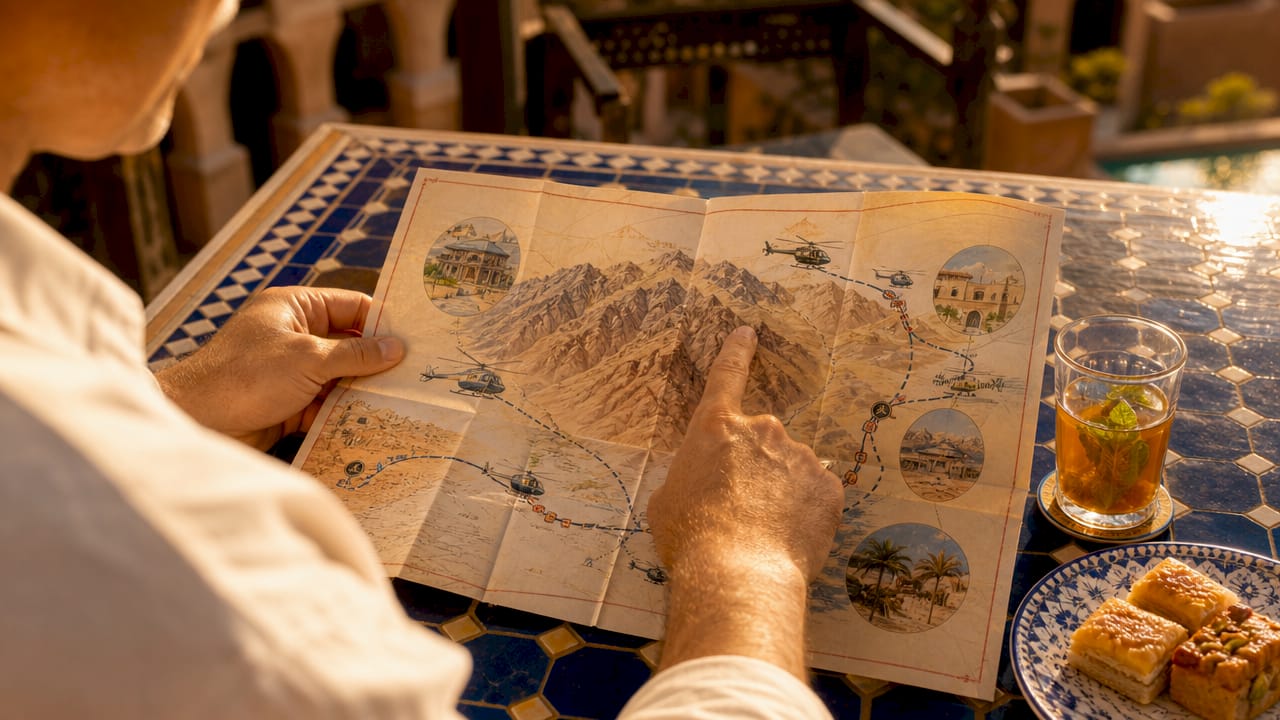
The most popular option is the Marrakech to Zagora airport route. This 60- to 75-minute flight is followed by a 45-minute 4×4 transfer to reach the dunes. It delivers strong aerial scenery over the High Atlas and Draa Valley while keeping costs lower than a full direct-to-camp flight. Travelers who want more time in the air than on the ground should consider the direct camp landing option, which runs approximately 100 minutes of continuous flight and deposits you at a private desert camp with no ground leg at all.
A third route, Marrakech to Ouarzazate, runs 35 to 45 minutes of flight time but requires a five-hour ground transfer to reach the deep desert. This option works best when the destination, not the flight, is the priority. The aerial progression from Marrakech through the High Atlas peaks, across the Draa Valley palms, and over the Sahara dunes creates a visual narrative that longer routes deliver most powerfully.
Pro Tip: For the most visceral desert experience, choose Erg Chegaga over Erg Chebbi. Erg Chegaga is significantly more remote and sees far fewer visitors, making a direct helicopter landing there feel genuinely exclusive.
The table below compares the three main routes at a glance.
| Route | Flight time | Ground transfer | Best for |
|---|---|---|---|
| Marrakech to Zagora airport | 60 to 75 minutes | 45 minutes by 4×4 | Balanced aerial and ground experience |
| Direct camp landing (Erg Chegaga) | Approx. 100 minutes | None | Maximum aerial immersion and privacy |
| Marrakech to Ouarzazate | 35 to 45 minutes | Approx. 5 hours by road | Destination-focused travelers |
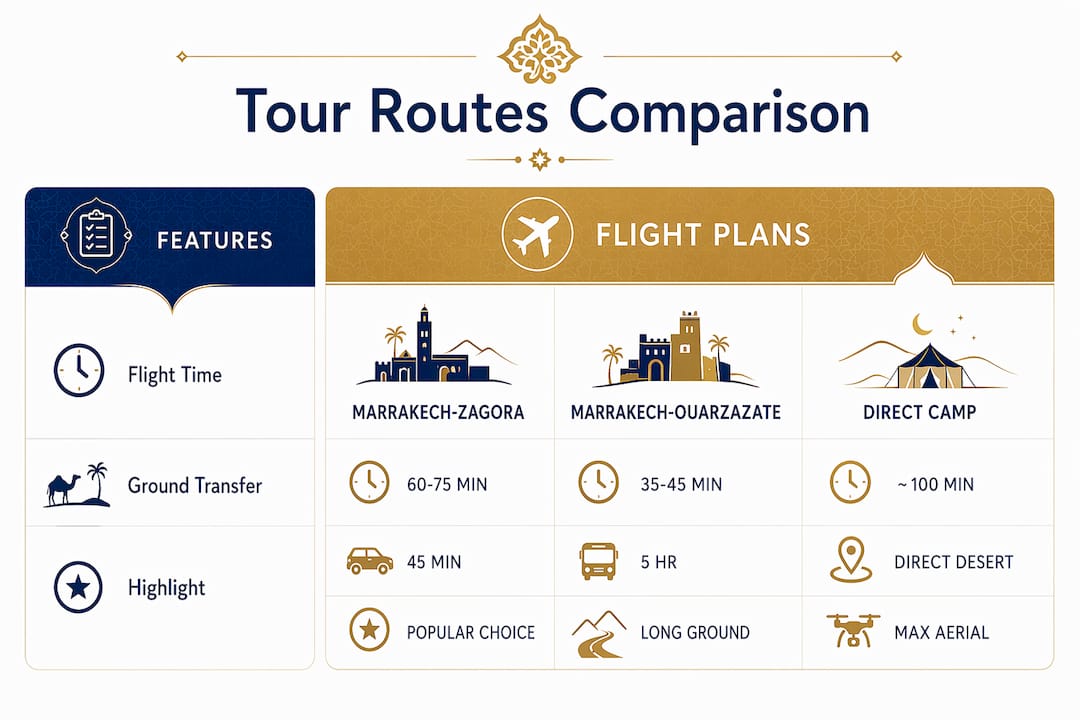
The key decision every traveler faces is whether the helicopter is the main event or simply a transfer leg. Route choice determines how much of Morocco’s layered terrain you absorb from the air versus from a vehicle window. Choosing the longer direct-camp route means you trade a lower price for an unbroken aerial journey that most visitors never experience.
How do safety, scheduling, and operational details work?
Morocco’s helicopter operators function under a well-defined regulatory framework. The country’s Civil Aviation Code, Law No. 40-13, and the Direction Générale de l’Aviation Civile (DGAC) enforce safety management system requirements aligned with ICAO guidelines. Every certified operator must maintain licensed pilots, documented maintenance schedules, and formal safety protocols. This is not optional paperwork. It is the baseline that separates credible operators from informal charter arrangements.
Operationally, private airfields allow fast loading with no public terminal queues, which means check-in at a Marrakech helipad can take as little as 15 minutes before departure. Apps used by pilots and charter coordinators allow real-time checks of visibility, wind speed, and estimated flight costs, giving both operators and travelers accurate pre-flight information. This speed and transparency are part of what makes helicopter trips in Marrakech feel fundamentally different from commercial aviation.
Weather is the single biggest variable in scheduling. Flight times vary with wind conditions, and operators routinely cancel or delay flights when conditions are unsafe. Reputable operators always arrange ground vehicle backups so that a weather cancellation does not strand you without a desert arrival option. A willingness to cancel a flight rather than push through marginal conditions is actually the clearest signal of a trustworthy operator.
Here is what to expect and prepare for before your flight:
- Arrive at the private airfield at the specified time, typically 15 minutes before departure.
- Attend a pre-flight safety briefing from your pilot covering emergency procedures and communication signals.
- Keep carry-on luggage minimal. Most helicopters used for these tours have strict weight and volume limits per passenger.
- Dress in layers. Temperatures at altitude over the High Atlas can drop sharply even in summer.
- Confirm your operator’s cancellation and rebooking policy in writing before you pay a deposit.
- Ask specifically whether a ground transfer backup is included if weather grounds the flight.
Pro Tip: Book your helicopter tour for the morning. Wind speeds in the Atlas and Sahara regions are consistently lower before noon, which means smoother flights and better visibility for photography.
Safety in helicopter tours depends on four interlocking factors: operator certification, pilot licensing, aircraft maintenance, and sound weather judgment. No single factor is sufficient on its own. When evaluating an operator, ask for their DGAC certification number and the maintenance record interval for the specific aircraft you will fly in.
How do luxury, adventure, and cultural helicopter experiences differ?
Morocco’s aerial tour market has matured enough to offer genuinely distinct experience categories. Understanding the differences helps you match the flight to your travel personality rather than simply booking the most expensive option.
Luxury-focused tours center on the arrival experience. Direct landings to desert camps using dust-rated helicopters like the Airbus H130 or H125 eliminate ground transfers entirely and deliver guests directly to private camps with exclusive hospitality. These tours prioritize comfort, privacy, and the theatrical impact of stepping off a helicopter onto Saharan sand. The Airbus H130 is the preferred aircraft for direct desert landings because its dust-rated systems handle the fine sand of ergs without mechanical risk.
Adventure-focused tours maximize time in the air. Longer routes over the High Atlas and Draa Valley give photographers and landscape enthusiasts extended windows to shoot the terrain from above. These tours often combine helicopter flights with other adventure tours in Morocco, such as camel trekking, 4×4 expeditions, or overnight bivouacs in remote desert locations.
Cultural itinerary tours link aerial flights with ground visits to kasbahs, Berber villages, and UNESCO-listed sites like the Aït Benhaddou fortified village near Ouarzazate. The helicopter provides rapid transit between sites that would otherwise require full days of driving. This format suits travelers who want historical and cultural depth alongside the aerial spectacle.
Booking records show that the customer base for these tours spans family offices, honeymooners, professional photographers, business travelers, and mobility-limited guests who cannot manage long desert drives. Each group has different priorities, which is why the best operators build itineraries around the traveler rather than a fixed product.
| Experience type | Aircraft | Key amenity | Ideal traveler |
|---|---|---|---|
| Luxury direct-camp arrival | Airbus H130 or H125 | Private camp landing, no ground leg | Honeymooners, VIP guests |
| Adventure aerial exploration | Standard 4- to 6-seat helicopter | Extended flight over Atlas and Draa | Photographers, adventure seekers |
| Cultural circuit tour | Standard 4- to 6-seat helicopter | Kasbah and village ground visits | History and culture travelers |
| Business transfer | Executive helicopter | Fast point-to-point, minimal stops | Time-limited executives |
The group size question matters more than most travelers realize. Smaller helicopters seat four to six passengers and offer unobstructed window views for everyone. Larger executive models carry more passengers but can reduce the intimacy of the experience. For photography, request a front-seat position or confirm that the operator will open a window or door for aerial shots.
What practical tips should travelers know before booking?
Planning a helicopter tour in Morocco rewards preparation. The following steps, taken in order, will protect your investment and maximize the experience.
- Verify operator certification first. Confirm that your chosen operator holds a current DGAC license and that their pilots are type-rated for the specific aircraft. Ask for documentation, not just assurances.
- Book at least four to six weeks in advance for direct camp landings. Direct landings require advance planning because dust-rated aircraft availability is limited and camp coordination takes time.
- Choose your season deliberately. Spring (March to May) and autumn (September to November) offer the most reliable flying conditions. Summer heat creates thermal turbulence over the desert, and winter storms can close High Atlas corridors for days at a time.
- Pack light and pack smart. Most tour helicopters impose a 5- to 10-kilogram luggage limit per passenger. Use a soft duffel bag rather than a hard-shell suitcase, since soft bags compress into cargo holds more efficiently.
- Confirm your ground backup in writing. Weather cancellations happen. A reputable operator will have a 4×4 vehicle and driver on standby so your desert arrival is delayed, not canceled.
- Combine your helicopter tour with a broader Morocco itinerary. The flight works best as a centerpiece, not an isolated activity. Pair it with a night at a luxury desert camp, a medina tour in Marrakech, or a private excursion to the Todra Gorge for a complete adventure arc. Moroccotours specializes in building these multi-experience itineraries around a helicopter flight as the anchor event.
- Communicate your specific interests before booking. Tell your operator whether you are a photographer who needs door-off access, a honeymooner who wants champagne on arrival, or a business traveler who needs a specific departure window. The best operators will adjust the itinerary accordingly.
Pro Tip: If you are arriving in Morocco by private jet, coordinate your helicopter departure from the same airfield. Several Marrakech operators work directly with private aviation terminals to create a seamless transfer from jet to helicopter without leaving the airside area.
For travelers who want to stay connected during their Morocco trip, having a local data connection matters for real-time weather updates and operator communication. An eSIM for Morocco from providers like Esimglobe lets you activate local data before you land, which is useful when coordinating last-minute flight timing with your operator.
Key takeaways
Morocco helicopter tours deliver the most immersive aerial experience when you match the route length, aircraft type, and experience category to your specific travel priorities before booking.
| Point | Details |
|---|---|
| Route choice is the core decision | Longer direct-camp routes maximize aerial immersion; shorter routes prioritize ground destination access. |
| Safety requires four factors | Operator certification, pilot licensing, aircraft maintenance, and weather judgment all must be present. |
| Aircraft type affects the experience | Dust-rated helicopters like the Airbus H130 are required for direct desert landings at remote ergs. |
| Book early for luxury options | Direct camp landings need four to six weeks of advance notice due to limited aircraft availability. |
| Season determines reliability | Spring and autumn offer the most stable flying conditions across the Atlas and Sahara corridors. |
Why helicopter tours are Morocco’s most underrated adventure
Having worked with travelers across Morocco’s full range of experiences, from camel treks to private riad stays, I find that helicopter tours are consistently the most underestimated option on the itinerary. Most travelers treat them as a luxury add-on rather than the defining experience of the trip. That framing is wrong.
The aerial view of Morocco is not just a prettier version of what you see from the road. It is a fundamentally different understanding of the country’s geography. Watching the green valleys of the High Atlas give way to the red rock of the Draa Valley and then to the pure gold of the Sahara dunes, all in under two hours, reframes everything you see at ground level for the rest of the trip. It is the kind of perspective shift that changes how you read a landscape.
What I tell every traveler who asks: do not book the shortest, cheapest flight just to say you did it. The 35-minute Ouarzazate route followed by five hours in a 4×4 is not a helicopter tour. It is a helicopter transfer. If you are going to invest in this experience, choose a route where the flight itself is the event. The direct Erg Chegaga landing is the one I recommend most consistently, not because it is the most expensive but because it is the most complete. You get the full visual arc from city to mountain to desert, and you arrive somewhere genuinely remote.
I also want to be direct about safety: the operators who cancel flights in bad weather are the ones worth trusting. Any operator who promises you a guaranteed departure regardless of conditions is prioritizing revenue over your safety. Delays are not failures. They are the system working correctly. For a deeper look at how luxury desert travel integrates with helicopter arrivals, the planning details matter as much as the flight itself.
— Moroccotours.co
Plan your Morocco helicopter tour with Moroccotours.co
Moroccotours designs private helicopter tours integrated with exclusive Morocco travel packages that combine aerial sightseeing with luxury desert camps, cultural excursions, and expert local guides. Every itinerary is built around your schedule, interests, and preferred experience level, whether that means a direct Erg Chegaga landing with a private camp arrival or a cultural circuit linking kasbahs and Berber villages by air. The team handles operator coordination, aircraft selection, weather contingency planning, and ground logistics so you focus entirely on the experience. Reach out to Moroccotours directly to start building a personalized Morocco itinerary with a helicopter tour at its center.
FAQ
What is the typical flight time for a Morocco helicopter tour?
Flight times range from 35 minutes for short transfer routes to approximately 100 minutes for direct desert camp landings, depending on the route chosen from Marrakech.
Are Morocco helicopter tours safe?
Yes, when booked with DGAC-certified operators. Safety depends on operator certification, licensed pilots, regular aircraft maintenance, and sound weather judgment, including willingness to cancel flights in unsafe conditions.
What is the best time of year for helicopter tours in Morocco?
Spring (March to May) and autumn (September to November) offer the most reliable flying conditions, with lower wind speeds and stable visibility over both the High Atlas and Sahara regions.
What luggage can I bring on a Morocco helicopter tour?
Most tour helicopters allow 5 to 10 kilograms of luggage per passenger. Soft duffel bags are strongly preferred over hard-shell cases because they fit more efficiently into the aircraft’s cargo space.
Can I land directly at a Sahara desert camp by helicopter?
Yes. Direct camp landings are available using dust-rated aircraft like the Airbus H130 or H125, but they require booking four to six weeks in advance due to limited aircraft availability and camp coordination requirements.