
Morocco Tours from Spain: Your Travel Guide
- Morocco from Spain is accessible via short ferry rides or direct flights, each suited for different travel plans.
- Longer trips of 7 to 9 days provide a comprehensive experience, including the Sahara, imperial cities, and cultural highlights.
- Proper planning, flexible booking, and guided tours enhance the trip and help travelers absorb Morocco’s rich culture.
Morocco tours from Spain are defined by two fast transit options: a 35-minute ferry from Tarifa to Tangier or a direct flight from Madrid, Barcelona, or Malaga to Marrakech or Casablanca in under 2.5 hours. That proximity makes Morocco the most accessible non-European destination for travelers based in Spain. Whether you want a quick cultural immersion in Tangier’s medina or a nine-day circuit through the Sahara desert and imperial cities like Fes and Marrakech, the options scale to fit your schedule and interests. This guide covers every practical detail you need to plan the right trip, from ferry schedules and passport rules to itinerary structures and what to look for in a tour package.
What are the main travel options for Morocco tours from Spain?
Two transit methods define how Spain to Morocco excursions work: ferry and direct flight. Each shapes your itinerary in a different way, so choosing between them is the first real decision you make.
Ferry routes: Tarifa and Algeciras to Tangier
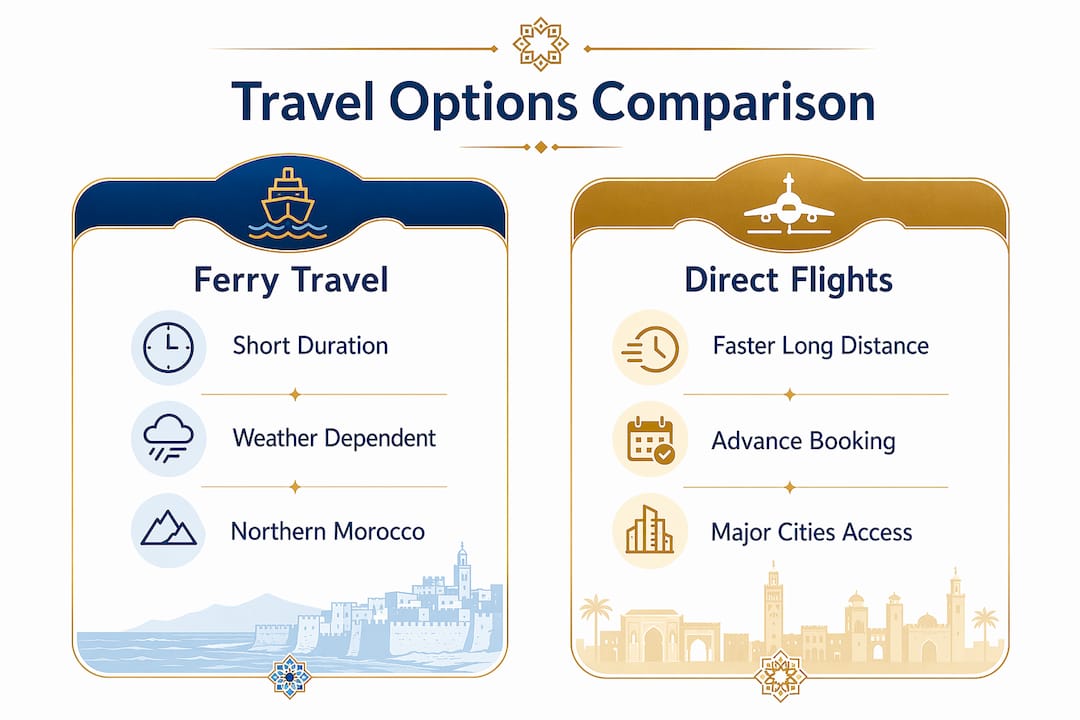
The ferry from Tarifa to Tangier takes approximately 35 minutes. The Algeciras to Tangier route runs slightly longer, closer to 60 minutes. Both crossings operate multiple times daily, making them the go-to option for travelers departing from Seville, Malaga, or anywhere in Andalusia. The ferry suits day trips and short multi-day tours because it deposits you directly into northern Morocco, where Tangier, Chefchaouen, and Tetouan are all within easy reach.
The downside is weather. Ferry schedules face disruptions from strong winds in the Strait of Gibraltar, which can delay or cancel crossings with little warning. That unpredictability is not a reason to avoid the ferry. It is a reason to build buffer time into your schedule and never book the last return crossing of the day.
Pro Tip: Book a morning ferry outbound and an afternoon return. That gap gives you flexibility if your departure is delayed without risking a missed connection.
Direct flights: Madrid, Barcelona, and Malaga to Marrakech or Casablanca
Direct flights from Spanish hubs to Marrakech take roughly 90 minutes from Malaga and around 2.5 hours from Madrid or Barcelona. Casablanca is a comparable flight time. Flights open up southern Morocco, the Atlas Mountains, and the Sahara desert to travelers who cannot justify spending two days in transit for a short trip. They also eliminate the weather risk entirely.
The trade-off is cost and airport logistics. Flights require more advance planning, and you land far from northern Morocco’s most accessible cities. If Chefchaouen or Tangier is on your list, the ferry wins on convenience.
| Factor | Ferry (Tarifa/Algeciras) | Direct Flight (Madrid/Malaga) |
|---|---|---|
| Travel time | 35–60 minutes | 90 minutes to 2.5 hours |
| Best for | Northern Morocco, day trips | Marrakech, Sahara, longer tours |
| Weather risk | Yes, wind delays possible | Minimal |
| Cost | Generally lower | Varies by airline and season |
| Departure cities | Tarifa, Algeciras | Madrid, Barcelona, Malaga, Seville |
| Flexibility | High (multiple daily crossings) | Lower (fixed schedules) |
Border formalities apply on both routes. Spanish and EU citizens must carry a valid passport. An ID card is not accepted at the Moroccan border. Your tour provider should handle ferry manifests and border paperwork, but confirm this before booking.
Which tour itineraries work best for travelers from Spain?
Tour length is the single biggest factor in what you can realistically experience. Morocco sightseeing tours from Spain range from a few hours in Tangier to nine-day circuits that cover four imperial cities and the Sahara.
Day trips: Tangier and the north
A day trip from Tarifa or Algeciras to Tangier gives you a genuine first look at Morocco. You get the medina, the Kasbah, the Grand Socco market, and a traditional Moroccan lunch, which is often included in organized packages. That is a real experience. But expert guides recommend at least 2–3 days to properly absorb Moroccan cuisine, architecture, and daily life. A day trip works as an introduction. It does not work as a substitute for the real thing.
Some tours also include Ceuta and Tetouan as part of a day excursion from La Línea de la Concepción, combining Spanish enclave history with Moroccan culture in a single itinerary.
Short trips: 2–4 days
- Tangier and Chefchaouen (2 days). Arrive by ferry, spend the first afternoon in Tangier’s medina, then head south to Chefchaouen. The blue-painted mountain town is one of Morocco’s most photographed places and sits about 2.5 hours from Tangier by road. Return by ferry on day two.
- Tangier, Chefchaouen, and Fes (3–4 days). Adding Fes extends the trip into Morocco’s cultural heartland. Fes el-Bali, the medieval walled city, is a UNESCO World Heritage Site. Its tanneries, mosques, and souks require at least a full day to cover properly. A guided Fes tour with a local expert makes the difference between getting lost and understanding what you are seeing.
- Malaga or Madrid to Marrakech (3–4 days). Flying into Marrakech puts you in the most visited city in Morocco. Jemaa el-Fna square, the Majorelle Garden, the Bahia Palace, and the souks of the medina fill two full days easily. A Marrakech-focused itinerary works well for travelers who want maximum cultural density in minimum time.
Longer tours: 7–9 days
Tours spanning 7–9 days cover the full circuit: Tangier, Chefchaouen, Fes, Meknes, Rabat, Casablanca, Marrakech, and the Sahara desert near Merzouga or Zagora. These Morocco travel packages from Spain deliver the complete picture of the country’s geography and culture. The Sahara segment alone, with camel trekking and a night in a desert camp under open sky, justifies the longer commitment for most travelers.
Pro Tip: Avoid scheduling more than two major cities per day. Moroccan heat, medina navigation, and sensory overload add up fast. A slower pace produces better memories than a packed checklist.
The Morocco Highlights Tour covering imperial cities and the Sahara is a strong reference point for what a well-structured longer itinerary looks like.
What practical considerations matter when booking from Spain?
Logistics separate a smooth Morocco trip from a stressful one. These are the details that experienced travelers get right before they leave Spain.
- Passport validity. Morocco requires a valid passport for entry. EU ID cards are not accepted. Your passport must be valid for the duration of your stay. Provide full passport details at booking so your tour operator can complete ferry manifests and border registration in advance.
- Ferry scheduling. Book an earlier return crossing rather than the last ferry of the day. Wind delays in the Strait of Gibraltar are common, especially in winter and spring. Missing the last ferry means an unplanned overnight in Tangier, which is manageable but disruptive.
- What tours typically include. Quality Morocco travel packages from Spain cover airport or port transfers, private or shared transport within Morocco, accommodation, local guides, and at least some meals. Included activities often extend to traditional Moroccan lunches, folklore shows, and guided medina walks. Confirm exactly what is and is not covered before you pay.
- Local guides versus self-guided travel. Moroccan medinas are genuinely difficult to navigate without local knowledge. A licensed local guide provides historical context, handles vendor interactions, and keeps you oriented in cities where streets are unmarked and GPS is unreliable.
- Currency and connectivity. Morocco uses the Moroccan dirham. ATMs are available in major cities, but carrying some cash from arrival is practical. SIM cards with local data plans are inexpensive and widely available at Tangier port and Marrakech airport.
- Travel season. Spring (March through May) and fall (September through November) offer the most comfortable temperatures across Morocco. Summer heat in Marrakech and the Sahara regularly exceeds 40°C, which makes sightseeing physically demanding. Winter is mild in the north but cold in the mountains and desert at night.
How to choose the right Morocco tour based on interests and budget
The right tour depends on three variables: how much time you have, what kind of experience you want, and how much control you want over the itinerary.
Private tours versus group tours
| Factor | Private tour | Group tour |
|---|---|---|
| Flexibility | The full itinerary adjusts to you | Fixed schedule |
| Cost | Higher per person | Lower per person |
| Group size | 1–6 travelers typically | 10–20 travelers |
| Pace | Your preference | Predetermined |
| Best for | Families, couples, specific interests | Solo travelers, social experience |
Private tours cost more but deliver a fundamentally different experience. Your guide adjusts the pace, skips sites that do not interest you, and takes you to places group tours never reach. For travelers with specific interests, whether culinary, historical, or photographic, private tours are the better investment.
Budget versus luxury Morocco travel packages from Spain
Budget tours from Spain to Morocco typically cover shared transport, basic guesthouses or riads, and a fixed itinerary. They work well for younger travelers or anyone prioritizing cost over comfort. The experience is genuine, but the pace is often rushed and the accommodation basic.
Luxury packages include private riad stays, personal guides, curated meals at well-regarded restaurants, and flexible scheduling. A Morocco culinary tour that includes market visits, cooking classes, and traditional multi-course meals represents the kind of depth that budget packages cannot replicate.
Questions to ask before booking
- Does the price include all transfers, or will you pay separately for transport within Morocco?
- Is the guide a licensed local expert or a generalist driver?
- What happens if the ferry is delayed or canceled?
- Can the itinerary be adjusted after booking?
- Are accommodations listed by name or described generically?
Reputable operators answer these questions directly. Vague answers on logistics are a reliable signal to keep looking.
Key takeaways
Morocco tours from Spain work best when travelers match their transit method, itinerary length, and tour type to their actual interests rather than defaulting to the most popular option.
| Point | Details |
|---|---|
| Ferry versus flight | Choose the ferry for northern Morocco; fly direct to Marrakech for southern destinations. |
| Minimum trip length | Plan at least 2–3 days to experience Moroccan culture beyond a surface-level visit. |
| Passport required | EU ID cards are not accepted; a valid passport is mandatory for all Morocco border crossings. |
| Book flexible ferry returns | Avoid the last crossing of the day to protect against weather-related delays. |
| Private guides add real value | Licensed local guides provide context and navigation that self-guided travel cannot replicate. |
What I have learned from years of Morocco travel planning
The most common mistake travelers from Spain make is treating Morocco as a day trip destination. I understand the appeal. Tangier is 35 minutes from Tarifa. The crossing feels trivial. But Morocco is not a backdrop. It is a country with a distinct culture, language, and rhythm that takes time to absorb.
Travelers who spend a single day in Tangier often come back saying Morocco felt chaotic or overwhelming. Travelers who spend three or four days, even just in the north, come back saying it was the best trip they have taken. The difference is time. Time to sit in a cafe, get lost in a medina without a schedule, and eat a proper meal without rushing to catch a ferry.
My honest recommendation is to skip the day trip entirely if you can. Spend at least two nights. If your schedule only allows one day, go to Tangier, hire a licensed guide from the moment you arrive, and let go of any plan to see everything. Pick three things and do them properly.
The other thing I have seen consistently is that travelers underestimate the value of a well-structured Morocco itinerary built by someone who knows the country. The difference between a good trip and a great one is usually not the destinations. It is the pacing, the local contacts, and the small decisions that an experienced operator makes without you ever noticing.
Travel in spring or fall if you have any flexibility. The light is better, the heat is manageable, and the crowds at major sites are thinner. Those conditions make every experience more enjoyable.
— Moroccotours.co
Moroccotours.co: private Morocco tours designed for travelers from Spain
Moroccotours.co specializes in luxury private Morocco tours built around your schedule, interests, and departure point in Spain. Every package includes licensed local guides, private transfers, and hand-selected accommodations ranging from boutique riads in Fes to desert camps in the Sahara. The team handles all ferry manifests, border paperwork, and in-country logistics so you arrive focused on the experience rather than the administration. Whether you want a focused three-day northern Morocco circuit or a 14-day Spain and Morocco private tour, Moroccotours builds the itinerary around what you actually want to see.
FAQ
How long does it take to get from Spain to Morocco?
The ferry from Tarifa to Tangier takes approximately 35 minutes. Direct flights from Malaga to Marrakech take around 90 minutes, while flights from Madrid or Barcelona run closer to 2.5 hours.
Do Spanish citizens need a passport for Morocco?
Yes. A valid passport is required for all Spanish and EU citizens entering Morocco. National ID cards are not accepted at the border.
What are the best Morocco day trips from Spain?
The most popular day trip is Tangier from Tarifa or Algeciras by ferry. Some tours also combine Ceuta and Tetouan in a single-day excursion from La Línea de la Concepción.
How many days should I spend in Morocco from Spain?
Expert guides recommend a minimum of 2–3 days to experience Moroccan cuisine, medinas, and landscapes beyond a surface-level visit. Longer trips of 7–9 days allow for imperial cities and the Sahara Desert.
Is a private tour better than a group tour for Morocco?
Private tours offer full itinerary flexibility and a personalized pace, making them the better choice for travelers with specific cultural, culinary, or adventure interests. Group tours cost less per person and suit solo travelers looking for a social experience.