
Is Morocco Safe for Solo Women? Your 2026 Guide
Highlights
TL;DR:
- Morocco is generally safe for solo female travelers who dress respectfully, stay prepared, and use vetted transportation. Most issues relate to cultural friction and street harassment rather than physical danger, which is rare. Confidence, proper dress, local knowledge, and a well-planned itinerary help women enjoy their trip safely.
Morocco is generally safe for solo female travelers when you follow local customs and apply basic street smarts. Violent crime against tourists is rare. The real challenge is street harassment, which is common in busy medinas but manageable with the right preparation. Solo female travel in Morocco sits in a category that experienced travelers call “safe but demanding.” That distinction matters. Morocco rewards women who arrive informed, dress respectfully, and understand the cultural environment they are entering.
Is Morocco safe for solo women: what the real risks look like
The honest answer is that Morocco’s safety picture for solo women has two separate layers. Physical danger from violent crime is genuinely low. The friction you will actually encounter is social, not criminal.
Street harassment in tourist medinas is higher than in Western Europe, especially in crowded areas like Marrakech’s Jemaa el-Fna. That harassment is almost always verbal. Expect staring, unsolicited comments, and persistent touts trying to sell you something or guide you somewhere. Physical aggression is rare and not the norm.
Coastal cities tell a different story. Essaouira, for example, reports noticeably lower harassment levels than Marrakech or Fes. Rural areas are quieter still. The intensity of unwanted attention tracks closely with tourist density and medina foot traffic, not with Morocco as a whole.
The key distinction to hold onto: most uncomfortable moments are cultural friction, not personal threats. A man calling out to you from a shop doorway is not targeting you because you are in danger. He is doing what shopkeepers do in a negotiation-based market culture. Recognizing that difference changes how you respond and how much mental energy you spend on it.
What solo female travelers typically encounter:
- Verbal comments or compliments from strangers on the street
- Persistent touts offering “free” directions that lead to a shop
- Men following briefly to continue a sales pitch
- Staring, especially in smaller towns and rural areas
- Occasional unsolicited questions about your marital status or travel companions
None of these are pleasant. All of them are manageable. The women who struggle most in Morocco are those who expected it to feel like Paris. The women who thrive are those who prepared for a high-energy, negotiation-based environment and brought their confidence with them.
Pro Tip: Tell persistent strangers you are meeting your husband nearby. This single phrase ends most interactions faster than any argument or explanation.
How to dress and behave to reduce unwanted attention
Conservative dress significantly reduces unwanted attention and aligns with local cultural norms across Morocco. Covering your shoulders, torso, and knees is the baseline. This is not about hiding yourself. It is about moving through public space with less friction.
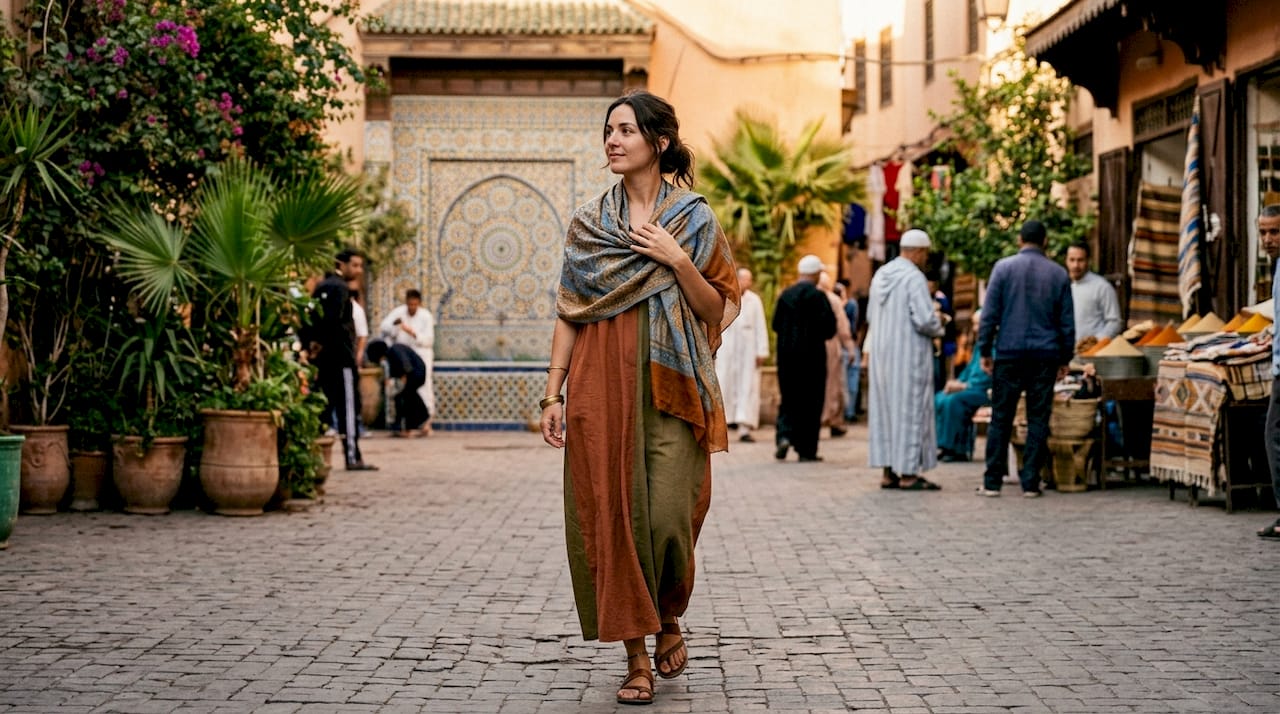
The dress standard shifts by region. In Marrakech’s medina and rural areas, loose, opaque clothing that covers your arms and legs is the practical choice. In Casablanca’s modern districts or Rabat’s administrative neighborhoods, you will see Moroccan women in a wider range of styles. Coastal towns like Agadir, which caters heavily to European beach tourism, are more relaxed. Read the room when you arrive in each city.
Behavior matters as much as clothing. Avoiding direct eye contact with men who are trying to engage you is not rudeness. It is a clear social signal that you are not interested in conversation. Walking with purpose, keeping your phone in your bag rather than in your hand, and not stopping to look at your map in the middle of a busy alley all reduce the chance of being approached.
Practical dress and behavior checklist:
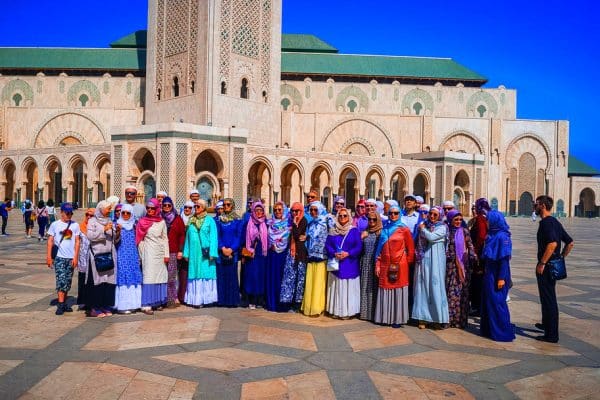
- Carry a lightweight scarf to cover your hair when entering mosques or traditional neighborhoods
- Wear loose trousers or a long skirt rather than shorts in medinas
- Choose closed-toe shoes for cobblestone medina streets
- Keep sunglasses on as a natural barrier to eye contact
- Avoid eating or drinking alone on the street in conservative areas
Learning a few words of Darija, the Moroccan Arabic dialect, pays dividends. “La, shukran” means “No, thank you.” Saying it once, firmly, without smiling, and then walking away is the most effective refusal technique available to you.
Pro Tip: Wearing a plain ring on your left hand and mentioning a waiting husband or brother is a culturally understood signal that ends most persistent approaches immediately.
Practical safety tips for transportation, navigation, and accommodation
Transportation choices directly affect your safety level in Morocco. First-class trains and CTM or Supratours buses are the best options for longer journeys between cities. They are comfortable, reliable, and used by a mix of Moroccan families and tourists. Shared grand taxis, while cheap, put you in close quarters with strangers and offer less control over your situation.
At night, use a ride app or ask your riad to arrange a taxi. Hotel-arranged taxis cost slightly more but eliminate the negotiation and the uncertainty of flagging down an unknown driver after dark. This is one area where spending a few extra dollars is worth it every time.
Choosing the right accommodation
Riads, the traditional courtyard guesthouses found inside medinas, are the best accommodation choice for solo female travelers. They are secure, staff-heavy, and oriented around hospitality. The front door is typically locked, and staff know their guests. Staying in a riad on a well-lit, named street rather than a dead-end alley improves your comfort significantly.
Check your riad’s location before booking. A five-minute walk from the main square sounds convenient until you realize the route passes through unlit passages at midnight. Read recent reviews from solo female travelers specifically. Their observations about the neighborhood and staff responsiveness are more useful than general star ratings.
Navigating medinas safely
Digital maps often fail inside medinas because the narrow, winding alleys are not accurately mapped. Relying solely on Google Maps in Fes’s medina, for example, will get you lost in a quiet corner with no clear exit. The practical solution is an orientation walk on your first day, ideally arranged through your riad or a Morocco guided tour with a vetted local guide.
Transportation and navigation safety at a glance:
| Situation | Recommended option | Why it matters |
|---|---|---|
| Intercity travel | First-class train or CTM bus | Safer, more comfortable, avoids shared taxi risks |
| Night transit | Riad-arranged or app-based taxi | Eliminates unknown driver risk |
| Medina navigation | Orientation walk with local guide | Reduces risk of getting lost in quiet areas |
| Getting directions | Ask riad staff or trusted shopkeepers | More reliable than digital maps in narrow alleys |
| Local communication | Local SIM card | Keeps navigation and emergency contact available |
Pro Tip: Buy a local SIM card at the airport on arrival. Morocco’s mobile networks cover most cities and many rural areas. Having data for maps and messaging apps is your most practical safety tool.
How to handle street harassment and avoid tourist scams
The most common scam targeting solo female travelers in Morocco involves “faux guides.” These are unofficial guides who approach you near a medina entrance, offer to help you find something, and then lead you into a shop where they earn a commission. Engaging with them encourages persistence. Ignoring them or using a brief, firm refusal ends the interaction.
The insider technique that works: say “La, shukran” once, keep walking, and do not look back. Ignoring faux guides completely is more effective than arguing or explaining. Arguing signals that you are open to negotiation. Silence and forward movement signal that you are not.
Common scams and how to handle them:
- The “free” directions scam: A stranger offers to show you the way, then demands payment or leads you to a shop. Decline all unsolicited guidance. Use your riad staff instead.
- The “closed today” scam: Someone tells you a landmark or restaurant is closed and offers an alternative. Verify independently before changing your plans.
- The carpet shop invitation: A friendly conversation leads to tea and then a high-pressure sales environment. You can enjoy the tea and leave without buying anything, but know the dynamic before you sit down.
- Overpriced taxis: Agree on a price before getting in any taxi without a meter. Ask your riad what a fair fare looks like for your destination.
Knowing when to seek help matters too. Tourist police, called “police touristique,” operate in major medinas and are specifically trained to assist visitors. If you feel genuinely threatened or followed, walking into any hotel lobby, riad, or shop and asking staff for help is a reliable option. Moroccan hospitality culture means most people will assist you without hesitation.
For broader protection against travel scams, avoiding common tourist traps requires the same core skill everywhere: slow down, verify, and never let urgency pressure you into a decision.
Pro Tip: Pretending to be on a phone call when you walk through a high-pressure area of the medina is a surprisingly effective deterrent. Touts rarely interrupt someone who appears to be mid-conversation.
Which cities and regions work best for solo female travelers?
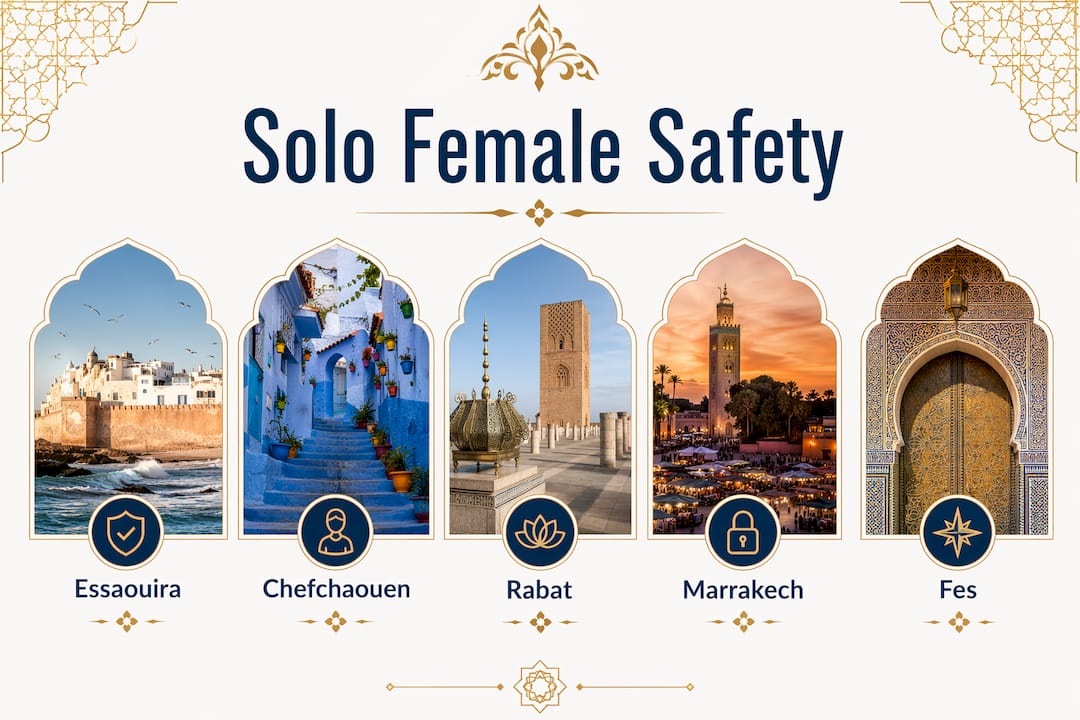
Not every part of Morocco demands the same level of preparation. Starting in calmer, coastal cities like Essaouira or the mountain town Chefchaouen helps you build confidence before tackling the intensity of Marrakech or Fes. This phased approach is the single best structural decision a first-time solo female traveler can make.
Essaouira has a relaxed, artsy atmosphere and a strong tradition of welcoming independent travelers. Chefchaouen, the famous blue city in the Rif Mountains, is small, walkable, and has a noticeably calmer street culture than the imperial cities. Both are excellent starting points.
Rabat, Morocco’s capital, offers a different kind of ease. It is a modern administrative city with wide boulevards, a well-maintained medina, and lower street harassment than Marrakech. Solo female travelers consistently rate it as one of the most comfortable cities in Morocco for independent movement.
Marrakech and Fes are worth visiting. They are also the most demanding. The medinas are dense, loud, and full of touts. Go to both. Go prepared.
| City or region | Harassment level | Physical safety | Solo-friendly rating |
|---|---|---|---|
| Essaouira | Low | High | Excellent for beginners |
| Chefchaouen | Low | High | Excellent for beginners |
| Rabat | Low to moderate | High | Very good, modern city feel |
| Marrakech | High in medina | Good overall | Requires preparation |
| Fes medina | High | Good overall | Requires preparation |
| Rural areas | Low | Moderate | Best with a guide |
The Morocco desert tour route through the Sahara is another category entirely. The desert itself is peaceful and the harassment dynamic of city medinas disappears. The challenge is logistics. Traveling solo to remote desert areas is best done with a vetted operator who handles transportation and accommodation.
Key Takeaways
Morocco is safe for solo female travelers who prepare for cultural friction, dress respectfully, and use vetted transportation and accommodation.
| Point | Details |
|---|---|
| Violent crime is rare | Physical danger is low; the main challenge is verbal harassment in busy medinas. |
| Dress conservatively | Covering shoulders and knees reduces unwanted attention in traditional areas. |
| Start in calmer cities | Essaouira and Chefchaouen build confidence before tackling Marrakech or Fes. |
| Use vetted transport | First-class trains, CTM buses, and riad-arranged taxis are the safest options. |
| “La, shukran” works | One firm refusal followed by walking away ends most unwanted interactions. |
What I’ve learned from watching women travel Morocco alone
The women who have the hardest time in Morocco are not the ones who face the most harassment. They are the ones who were not told what to expect. Surprise is the real enemy. When you know that a man outside a medina entrance is almost certainly a faux guide running a commission scheme, his approach does not rattle you. You say your phrase, keep walking, and move on with your day.
What I have observed, working with travelers across Morocco’s cities and regions, is that understanding Moroccan social dynamics as cultural rather than personal changes everything. The noise, the negotiation, the persistent attention: none of it is aimed at you specifically. It is the texture of the environment. Once you stop taking it personally, you start seeing what is actually around you. The architecture. The food. The extraordinary hospitality that appears the moment you step off the main tourist drag.
The women who thrive here are not fearless. They are prepared. They carry a scarf, know two phrases in Darija, have their riad’s number saved, and walk like they know where they are going even when they do not. That combination of preparation and confidence is more protective than any app or gadget.
My honest recommendation: do not skip Morocco because of the warnings. Do not arrive without reading them either. The middle path is a well-planned trip that mixes independent exploration with guided experiences, especially in your first few days. A Morocco riad stay in a well-located property gives you a safe base and staff who genuinely want your trip to go well. That combination of preparation and local support is what turns a stressful trip into a memorable one.
Solo travel in Morocco is not always comfortable. It is almost always worth it.
— Moroccotours
How Moroccotours supports solo female travelers in Morocco
Moroccotours designs private and group tours with local expert guides who know Morocco’s cities, medinas, and desert routes in detail. For solo female travelers, that local knowledge is not a luxury. It is a practical safety advantage. A vetted guide handles the navigation, the taxi negotiation, and the medina orientation so you can focus on the experience itself.
The luxury Morocco tours include private accommodations, curated riads, and itineraries built around comfort and cultural depth. The Morocco group tour option connects solo travelers with small groups, which reduces the solo visibility that attracts unwanted attention in busy medinas. For solo female travelers who want single travel insurance before they book, solo travel protection is worth reviewing before departure.
FAQ
Is Morocco safe for solo female travelers in 2026?
Yes. Violent crime against tourists is rare, and Morocco’s tourist police actively patrol major medinas. Street harassment is common but manageable with preparation and cultural awareness.
What is the safest city in Morocco for solo women?
Essaouira and Chefchaouen consistently rank as the most comfortable cities for solo female travelers. Rabat is also a strong choice for its modern layout and lower harassment levels.
What should solo women wear in Morocco?
Cover your shoulders and knees, especially in medinas and rural areas. A lightweight scarf is useful for entering mosques or traditional neighborhoods. Coastal resort towns are more relaxed.
How do you handle street harassment in Morocco?
Say “La, shukran” once, firmly, without smiling, and keep walking. Do not engage, argue, or explain. Walking with purpose and avoiding eye contact prevents most approaches before they start.
Do I need a guide as a solo female traveler in Morocco?
A guide is not required but is strongly recommended for your first days in a major medina. Digital maps are unreliable in narrow medina alleys, and an orientation walk with a local guide builds confidence and route knowledge quickly.
Itinerary Expand all Collapse all
Included
Price
Related Tours
Morocco Desert Tour
Northern Morocco Tour
Morocco Family Tour
Morocco Spain Tour
Morocco Trekking Tour
Morocco Highlights Tour
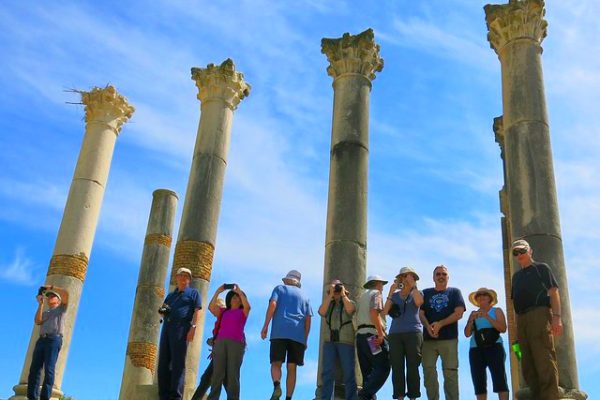
Morocco Group Tour
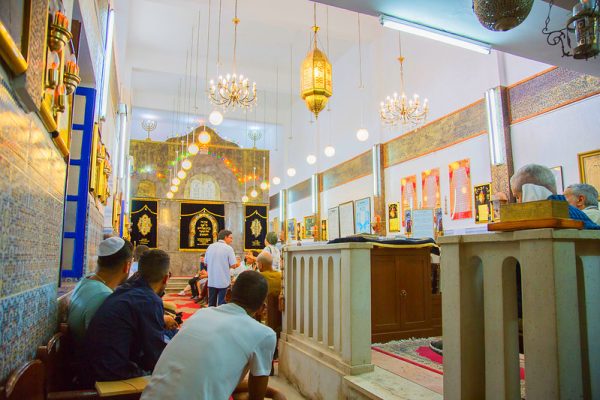
Morocco Jewish Tour
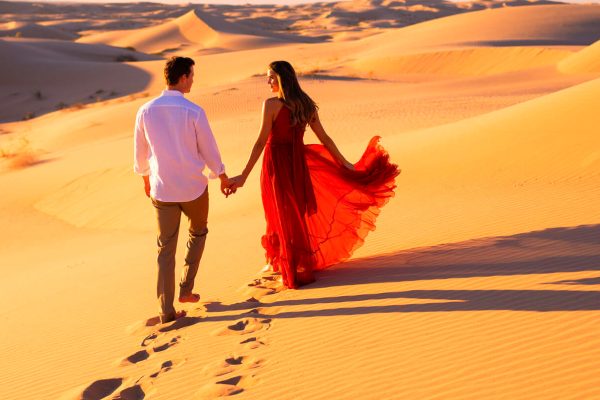
Morocco Honeymoon Tour
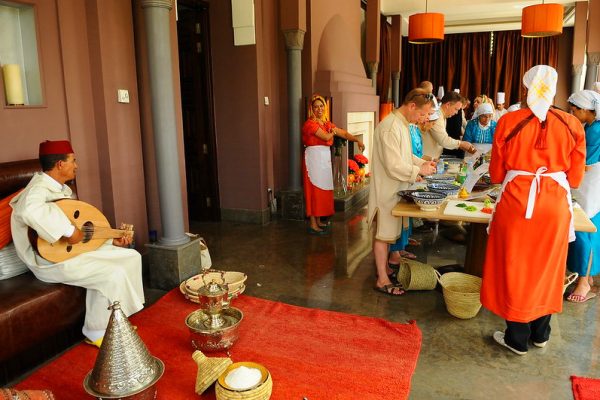
Morocco Food Tour
Morocco Golf Tour
Morocco Photography Tour
Morocco Signature Tour
Morocco Imperial Cities Tour
Morocco Grand Tour

Is Morocco Safe for Solo Women? Your 2026 Guide
