Is Morocco Safe for Tourists? Your 2026 Guide
Highlights
TL;DR:
- Morocco is a safe destination for tourists, with violent crime being very rare and mainly petty theft. Travelers should stay attentive to scams and follow safety tips, especially in crowded medinas and tourist hotspots. Overall, Morocco’s safety level is comparable to other European countries, and respectful engagement enhances security.
Morocco is a safe destination for tourists, with violent crime against travelers being exceptionally rare and the country welcoming 17.4 million visitors in 2024 alone. That number tells you something important: Morocco is not a fringe destination with unpredictable risks. It is a well-traveled, well-policed country with a functioning tourism infrastructure. The real safety concerns travelers face are petty theft, scams, and occasional verbal harassment, not violent crime. US and UK travel advisories rate Morocco similarly to France, Italy, and Spain, placing it in the “exercise increased caution” category rather than any high-risk tier. This guide breaks down exactly what risks exist, where they are concentrated, and how to handle them so you can travel with confidence.
Is Morocco safe for tourists visiting in 2026?
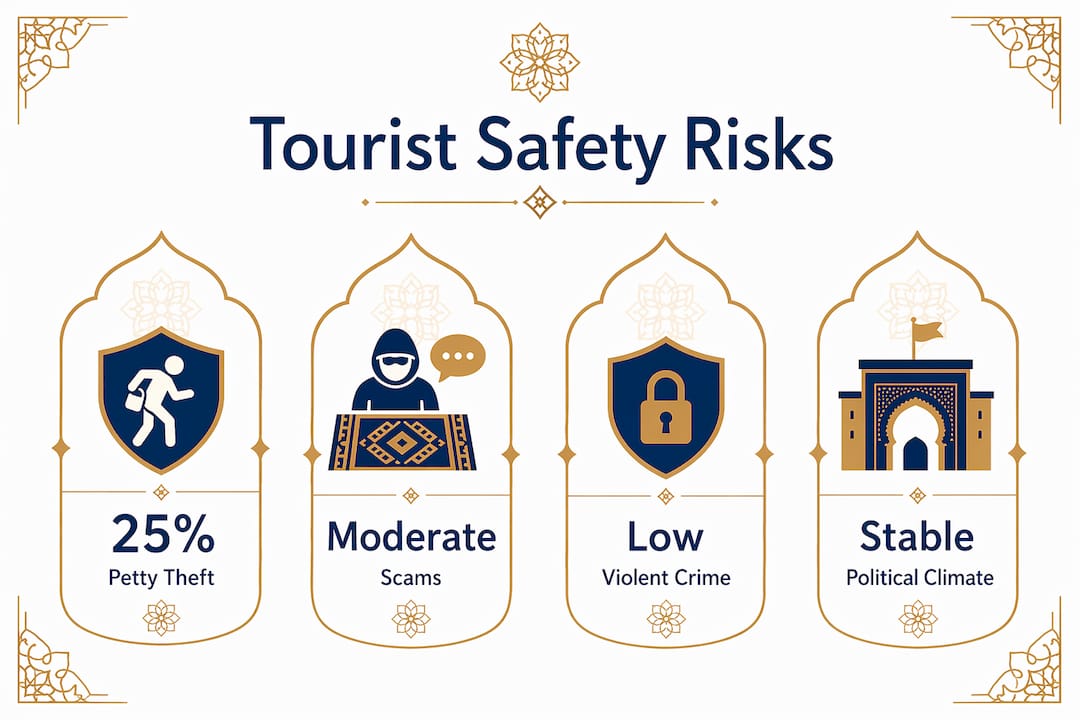
Morocco is safe for tourists by any reasonable measure. The country’s 17.4 million tourist arrivals in 2024 reflect a destination that functions reliably for international travelers. Violent crime targeting tourists is not a pattern here. The risks that do exist, primarily petty theft and opportunistic scams, are concentrated in specific areas and are entirely manageable with basic awareness.
Official travel advisories from the US State Department and the UK Foreign Office place Morocco in the same safety tier as major European destinations. That comparison matters. Travelers who visit Paris or Barcelona without a second thought face statistically similar advisory language when visiting Marrakech or Fes. The difference is perception, not reality.
Morocco’s political climate is stable relative to its regional neighbors. The government has invested heavily in tourism security, including dedicated tourist police units in high-traffic areas. For travelers planning a visit to Morocco in 2026, the baseline answer is clear: go, but go informed.
What are the common safety risks tourists face in Morocco?
The most frequent risks in Morocco fall into two categories: petty theft and scams. Neither is unique to Morocco, and neither requires you to avoid the country. They do require you to pay attention.
Petty theft in medinas
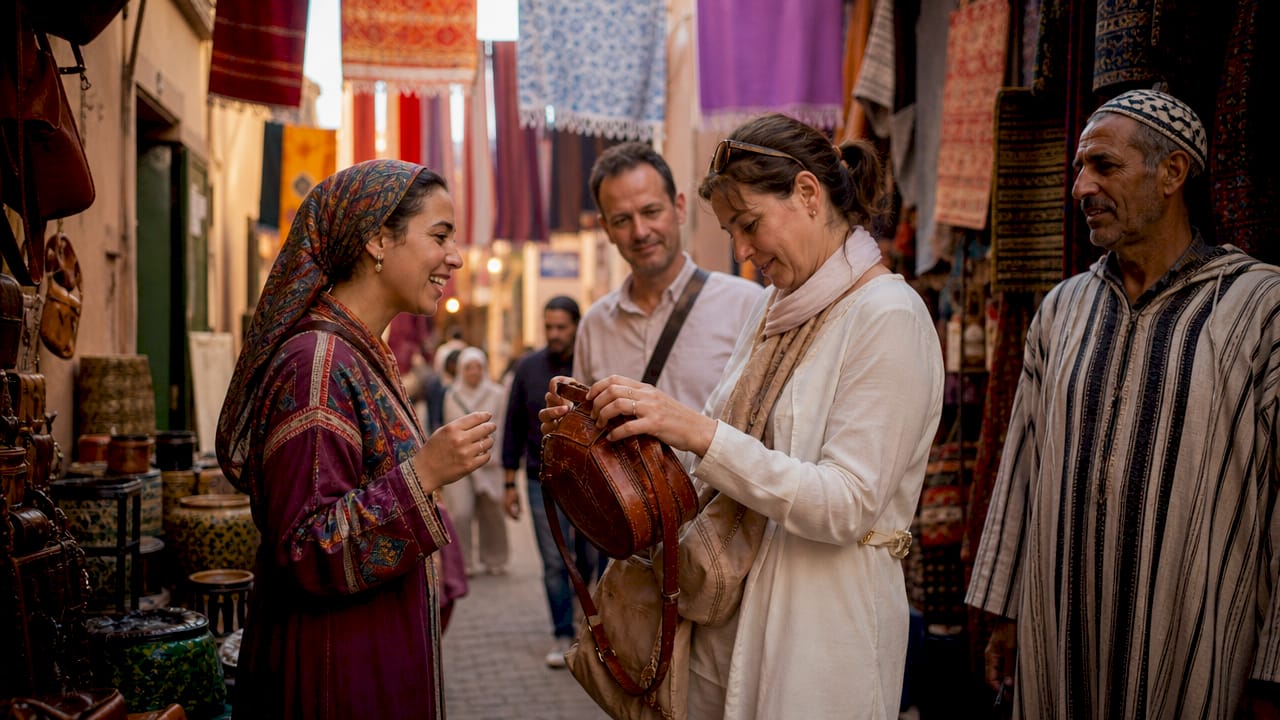
Pickpocketing occurs in crowded medinas, particularly in Marrakech’s Djemaa el-Fna square, the Fes el-Bali medina, and busy market streets. Bag snatching from motorcycles happens occasionally near medina entrances. The risk spikes in crowds and drops sharply in quieter residential neighborhoods and rural areas.
Common scams targeting tourists
Scams and petty theft are frequent but manageable in tourist hotspots. The most common schemes include:
- Taxi overcharging: Drivers quote inflated flat rates, especially at airports and train stations.
- Fake guides: Strangers offer to show you around, then demand payment or lead you to commission-paying shops.
- Restaurant price inflation: Menus near major tourist squares often charge two to three times local rates.
- Unsolicited “gifts”: Someone places an item in your hands, then demands money for it.
- Wrong directions: A local “helpfully” redirects you away from your destination and toward a shop.
Regional safety variations
Safety in Morocco is not uniform across the country. Cities carry higher scam pressure than rural areas. The Sahara desert and Atlas Mountain villages are generally calmer and more hospitable than the medinas of Marrakech or Fes. The one area that requires a hard boundary is Western Sahara. Travel within 30 km of the Berm is prohibited due to landmine risks. This is not a soft advisory. It is a firm restriction with genuine physical danger.
| Risk type | Frequency | Severity | Primary locations |
|---|---|---|---|
| Petty theft | Moderate | Low | Medinas, crowded squares |
| Taxi scams | High | Low | Airports, train stations |
| Fake guides | High | Low | Medina entrances |
| Violent crime | Very rare | High | No specific pattern |
| Western Sahara hazards | Rare | Critical | Near the Berm |
Pro Tip: Always ask for the meter (“compteur”) in taxis or agree on a price before you get in. If a driver refuses both, walk away and find another cab.
How safe is Morocco for solo female travelers?
Solo female travel in Morocco is entirely possible and rewarding. The experience requires more preparation than a trip to Western Europe, but it does not require avoiding the country. Physical harassment is very rare. Verbal attention, including catcalling and persistent approaches from men, is common in busy tourist cities like Marrakech and Fes. That distinction matters when planning your trip.
Cities that are easier for solo women
Not all Moroccan cities carry the same level of street pressure. Essaouira and Agadir are consistently more relaxed for solo female travelers. Both cities have a more open, coastal culture and lower levels of medina hustle. Marrakech and Fes offer incredible experiences but demand more confidence and boundary-setting in public spaces. For a first solo trip, starting in Essaouira before moving to Marrakech is a practical approach.
Practical steps that make a real difference
Modest dress covering shoulders and knees is the most effective way to reduce unwanted attention in busy tourist environments. This is not about compliance with a rule. It is a practical tool that changes how you are perceived on the street. Beyond clothing, these habits help:
- Walk at a steady, confident pace and avoid stopping to check your phone in open areas.
- Pre-book your accommodation and know your route before leaving your riad or hotel.
- Agree on taxi fares before entering the vehicle, or use ride-hailing apps like Careem.
- Avoid isolated streets and unlit alleys after dark, even in areas that feel safe during the day.
- Trust your instincts. If a situation feels wrong, leave it without explanation.
Licensed Moroccan guides consistently note that most locals are genuinely hospitable and protective toward foreign visitors. The small minority who target tourists are opportunists, not representative of the broader culture.
Pro Tip: Wearing a wedding ring, real or not, reduces persistent approaches in some areas. It is a low-effort signal that many solo female travelers find useful in Marrakech and Fes.
What security measures protect tourists in Morocco?
Morocco’s government treats tourism security as an economic priority, and the infrastructure reflects that. Tourist police brigades and plainclothes officers actively patrol high-traffic zones including Djemaa el-Fna, the Fes medina, and major coastal resorts. These are not symbolic gestures. Officers intervene in scams, assist lost travelers, and maintain a visible presence during peak tourist hours.
The country’s counter-terrorism record is strong. Morocco’s proactive investment in tourism safety has successfully prevented major terrorist attacks since 2011. The government works closely with European and American intelligence agencies on counter-terrorism, and that cooperation has produced measurable results. Terrorism risk exists in Morocco as it does in France or the UK, but the threat level for tourists is low and actively managed.
Here is how Morocco’s security system operates at the ground level:
- Dedicated tourist police: Uniformed officers stationed at major tourist sites speak French, English, and Spanish and are trained to handle tourist complaints.
- Plainclothes officers: Undercover police operate in medinas and souks to deter pickpockets and scammers without disrupting the market atmosphere.
- Counter-terrorism units: Specialized security forces monitor borders, transport hubs, and large public gatherings.
- Embassy coordination: Morocco maintains open channels with foreign embassies to share threat intelligence and respond to incidents involving foreign nationals.
- Restricted zone enforcement: Military checkpoints near Western Sahara enforce the travel ban within 30 km of the Berm, protecting travelers from landmine zones.
Morocco also sits in an active seismic zone. The September 2023 earthquake near Marrakech was a reminder that natural disaster risk is real. Moroccan authorities responded quickly, and the government has since reinforced emergency response protocols in tourist areas. Checking your accommodation’s emergency procedures is a reasonable step, not a cause for alarm.
What practical safety tips keep you safe in Morocco?
Smart habits eliminate the majority of risks travelers encounter in Morocco. The country does not require special survival skills. It requires the same awareness you would apply in any unfamiliar city.
Transportation safety
Ride-hailing apps like Careem and InDriver are the most reliable way to avoid taxi overcharging. Both apps show the fare upfront and track your route. When apps are unavailable, request the meter or negotiate a fixed price before entering the cab. Airport taxis are the highest-risk point for overcharging. Knowing the standard fare to your destination before you land removes the leverage drivers rely on.
Staying safe in medinas
Walking confidently and avoiding stopping in alleys or looking at maps in the open reduces pickpocket risk and tout pressure significantly. Medinas are designed to disorient. That disorientation is what scammers exploit. Download an offline map of your destination before entering so you can check directions privately.
General safety habits that work
- Keep your passport in your accommodation safe and carry a photo copy instead.
- Distribute cash across multiple pockets rather than keeping everything in one wallet.
- Avoid sharing your accommodation address or travel plans with strangers you meet on the street.
- Respect local customs, particularly around mosques and during Ramadan, to avoid misunderstandings.
- Purchase travel insurance that covers medical evacuation. Morocco has good hospitals in major cities, but rural medical facilities are limited.
- Register with your country’s embassy online before arrival. The US Smart Traveler Enrollment Program (STEP) and the UK’s equivalent service send alerts and can assist in emergencies.
Pro Tip: Book your first night’s accommodation near the medina entrance rather than deep inside it. Navigating an unfamiliar medina with luggage after a long flight is where most first-day problems start.
For travelers staying in traditional accommodations, a Morocco riad guide explains what to expect from gated guesthouses, which offer a natural layer of security compared to street-facing hotels.
Key Takeaways
Morocco is safe for tourists when travelers apply basic street awareness, respect regional restrictions, and use reliable transport options like ride-hailing apps.
| Point | Details |
|---|---|
| Overall safety level | Violent crime against tourists is exceptionally rare; petty theft and scams are the primary risks. |
| Official advisory rating | US and UK advisories rate Morocco at the same level as France, Italy, and Spain. |
| Solo female travel | Physical harassment is rare; modest dress and confident movement reduce verbal attention significantly. |
| Regional restrictions | Travel within 30 km of the Western Sahara Berm is prohibited due to active landmine hazards. |
| Best safety tool | Use ride-hailing apps or negotiate taxi fares upfront to avoid the most common tourist scam. |
What I’ve learned after years of guiding travelers through Morocco
The travelers who struggle most in Morocco are not the ones who face the most danger. They are the ones who arrive expecting either a theme park or a war zone. Neither is accurate. Morocco is a real country with real complexity, and that complexity is most of what makes it worth visiting.
The medinas of Marrakech and Fes are genuinely chaotic. That chaos is also what makes them extraordinary. Moroccan hospitality is genuine even when it coexists with pressure-selling and overpricing attempts. Most people who approach you in a medina are not trying to harm you. They are trying to make a living. Knowing that distinction changes how you respond, and how you respond changes your experience.
The travelers I have seen get the most out of Morocco are the ones who engage rather than retreat. They learn a few words of Darija. They sit down for tea without immediately suspecting a trap. They ask their riad host which streets to avoid rather than relying entirely on online forums written by people who visited once three years ago.
Local guide Youness puts it well: Morocco requires street smarts, not fear. Rural areas and desert camps often deliver stronger hospitality and genuine calm than the cities that dominate travel headlines. If your itinerary only covers Marrakech, you are seeing the most pressured version of Morocco. Add Merzouga, Chefchaouen, or the Draa Valley and the country reveals a completely different character.
Respectful cultural engagement is not just a courtesy. It is the most effective safety practice available to any traveler in Morocco.
— Moroccotours
Plan your Morocco trip with expert local guidance
Moroccotours specializes in luxury private Morocco tours built around expert local guides who know the country’s safety landscape as well as its cultural highlights. Every itinerary accounts for regional conditions, transport logistics, and the kind of local knowledge that no travel forum replicates. For first-time visitors or travelers who want to move through Morocco without the friction of navigating scams and logistics alone, a guided private tour removes the guesswork entirely. Moroccotours’ guides are licensed, vetted, and deeply familiar with the areas they cover, from the Marrakech medina to the Sahara. Browse Morocco guided tours to find the right fit for your travel style and timeline.
FAQ
Is Morocco safe for American tourists specifically?
Morocco is safe for American tourists. The US State Department rates Morocco at “exercise increased caution,” the same level applied to France and Spain, and the US maintains a strong diplomatic relationship with Morocco.
Is Marrakech safe for tourists?
Marrakech is safe for tourists but carries the highest concentration of scams and petty theft in Morocco. Staying alert in the medina and using verified transport removes most of the risk.
What areas of Morocco should tourists avoid?
Tourists should avoid travel within 30 km of the Western Sahara Berm due to active landmine hazards. This restriction is enforced by military checkpoints and is not optional.
Do I need travel insurance for Morocco?
Travel insurance is strongly recommended for Morocco. Medical facilities in major cities are adequate, but rural areas have limited resources, and evacuation coverage is worth having for any remote travel.
Is Morocco safe for solo travelers at night?
Morocco is generally safe at night in well-lit tourist areas. Solo travelers should avoid unlit alleys, isolated streets, and unfamiliar neighborhoods after dark, particularly in Marrakech and Fes.
Itinerary Expand all Collapse all
Included
Price
Related Tours
Morocco Desert Tour
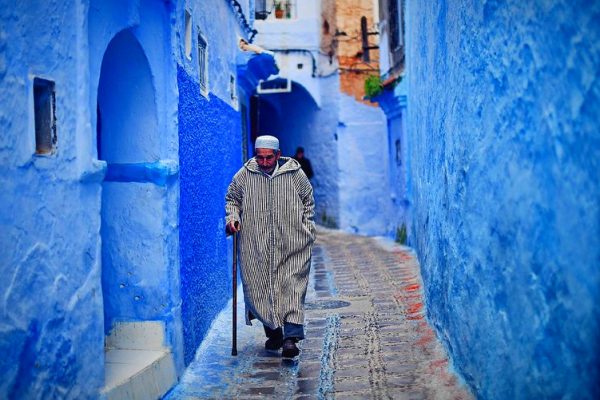
Northern Morocco Tour
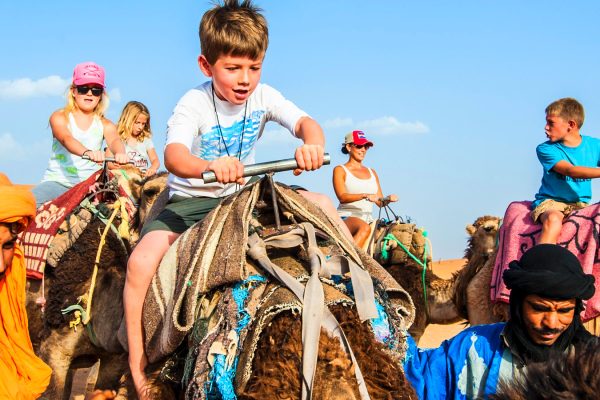
Morocco Family Tour
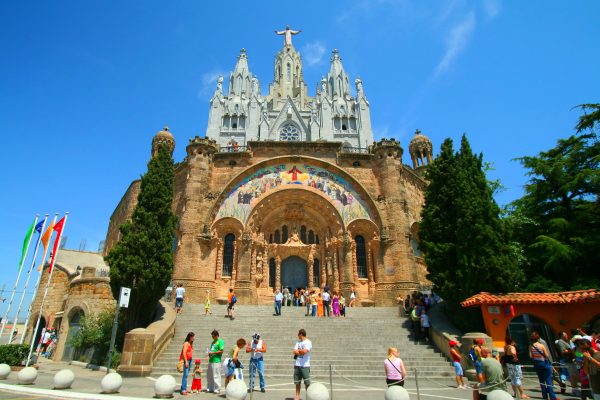
Morocco Spain Tour
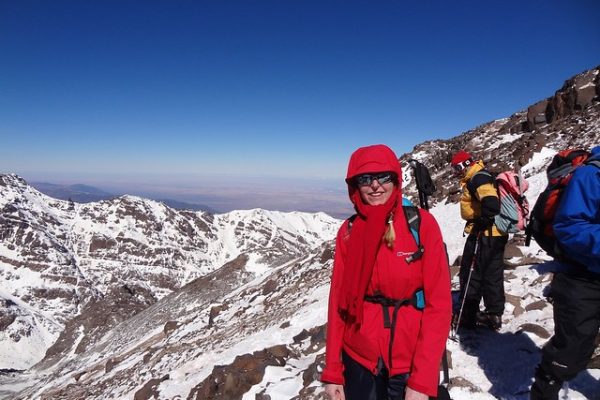
Morocco Trekking Tour
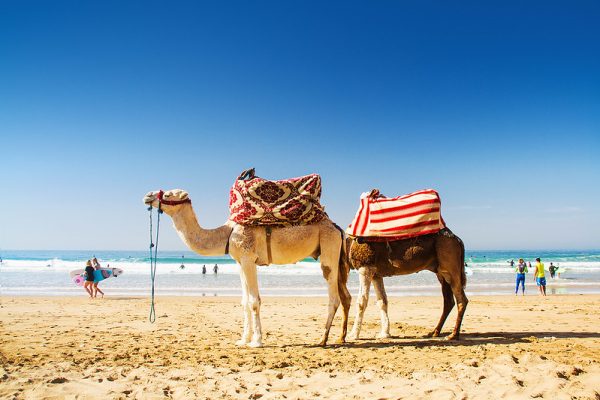
Morocco Highlights Tour
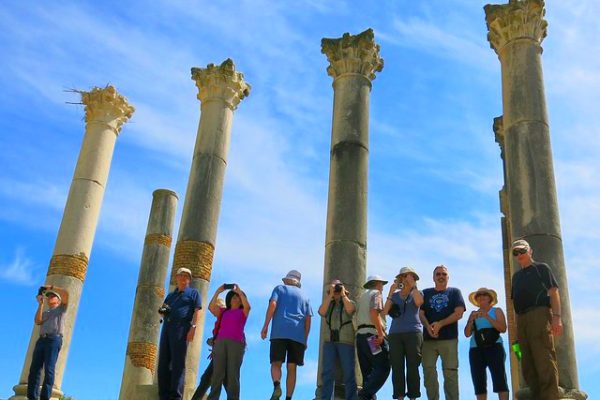
Morocco Group Tour
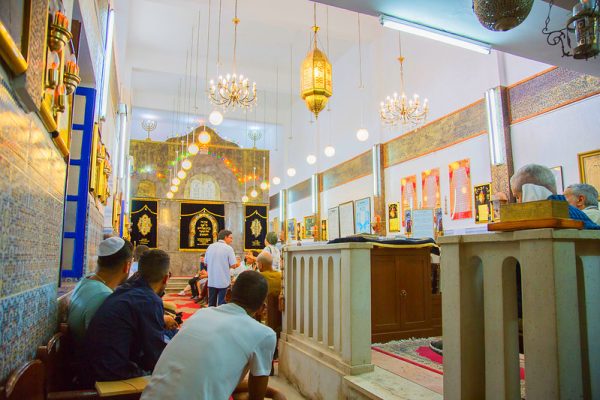
Morocco Jewish Tour
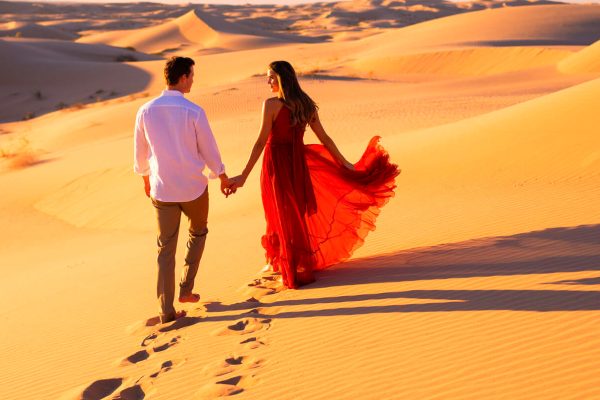
Morocco Honeymoon Tour
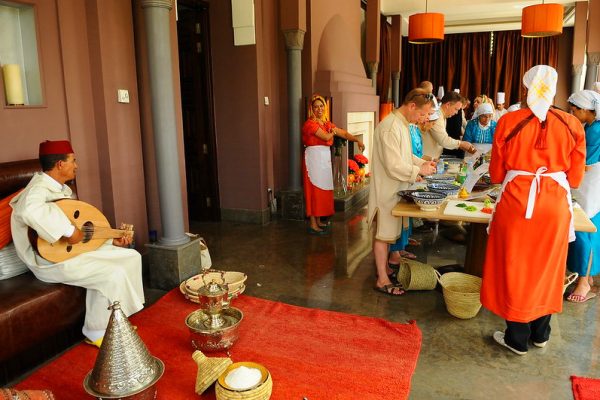
Morocco Food Tour
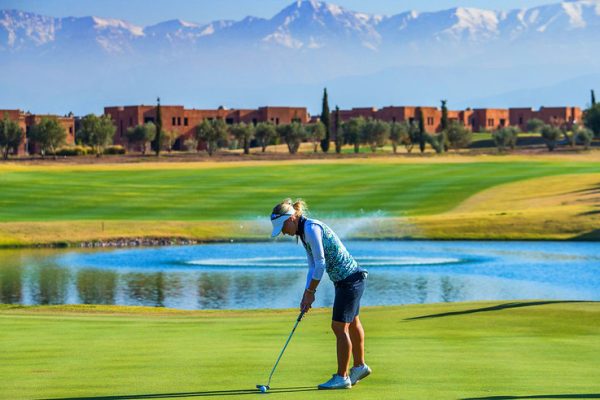
Morocco Golf Tour
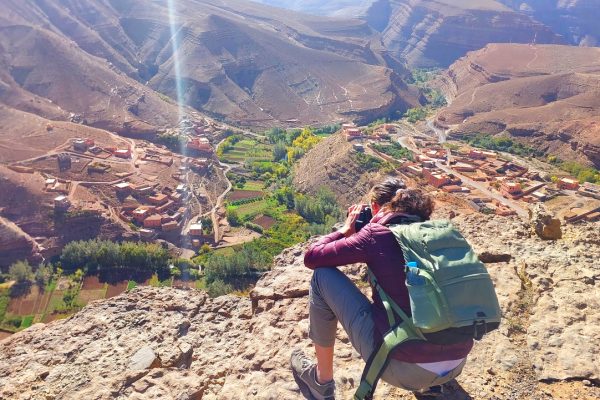
Morocco Photography Tour
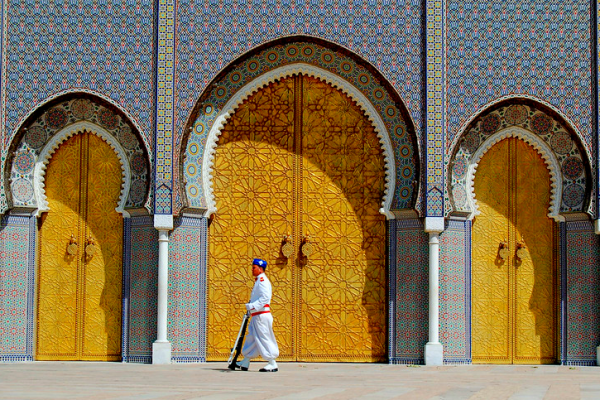
Morocco Signature Tour
Morocco Imperial Cities Tour
Morocco Grand Tour

Is Morocco Safe for Solo Women? Your 2026 Guide

Morocco Itinerary Guide: 7, 10, and 14 Days