
Morocco Travel Guide for Indian Travelers
- Indian passport holders can visit Morocco visa-free for up to 90 days.
- Most travel routes involve connecting flights through Middle Eastern or Istanbul hubs, with total travel times of 10 to 18 hours.
- The best time to visit is during spring and fall when conditions are most pleasant.
Morocco is one of the few African destinations where Indian passport holders enjoy visa-free entry up to 90 days, making Morocco tours from India far more accessible than most travelers realize. No visa appointment, no embassy queue, no waiting period. You book your flights, pack your bags, and go. A well-planned 9-day trip covers Casablanca, Marrakech, Fez, the Sahara Desert, and Chefchaouen without feeling rushed. Moroccotours specializes in exactly this kind of customized itinerary for Indian travelers, combining cultural depth with practical logistics from day one.
What travel routes and flight options are available from India to Morocco?
No direct flights connect India and Morocco. Every route requires at least one connecting flight, typically through Dubai, Doha, Abu Dhabi, or Istanbul. That single fact shapes your entire trip planning process.
Total travel time ranges from 10 to 18 hours depending on your layover city and connection time. A flight from Mumbai or Delhi through Dubai to Casablanca typically lands in the 12 to 14 hour range. Istanbul connections tend to run longer but often offer competitive fares.
Mohammed V International Airport in Casablanca is the standard entry point for most Morocco travel packages. From there, most guided tour itineraries begin with a city orientation before moving south toward Marrakech or east toward Fez.
Key flight planning considerations for Indian travelers:
- Dubai (DXB) via Emirates or flydubai offers the most frequent connections and shortest layovers.
- Doha (DOH) via Qatar Airways is a strong option from Chennai, Hyderabad, and Kolkata.
- Abu Dhabi (AUH) via Etihad works well for travelers departing from Mumbai.
- Istanbul (IST) via Turkish Airlines often has the best fares but adds travel time.
Morocco runs 4.5 hours behind Indian Standard Time. That gap is small enough that most travelers adjust within a day, but it does affect your first morning if you arrive on a red-eye.
Pro Tip: Book flights with a minimum 2-hour layover at Middle Eastern hubs. Tight connections at Dubai or Doha during peak travel periods frequently cause missed flights, and rebooking options to Casablanca are limited.
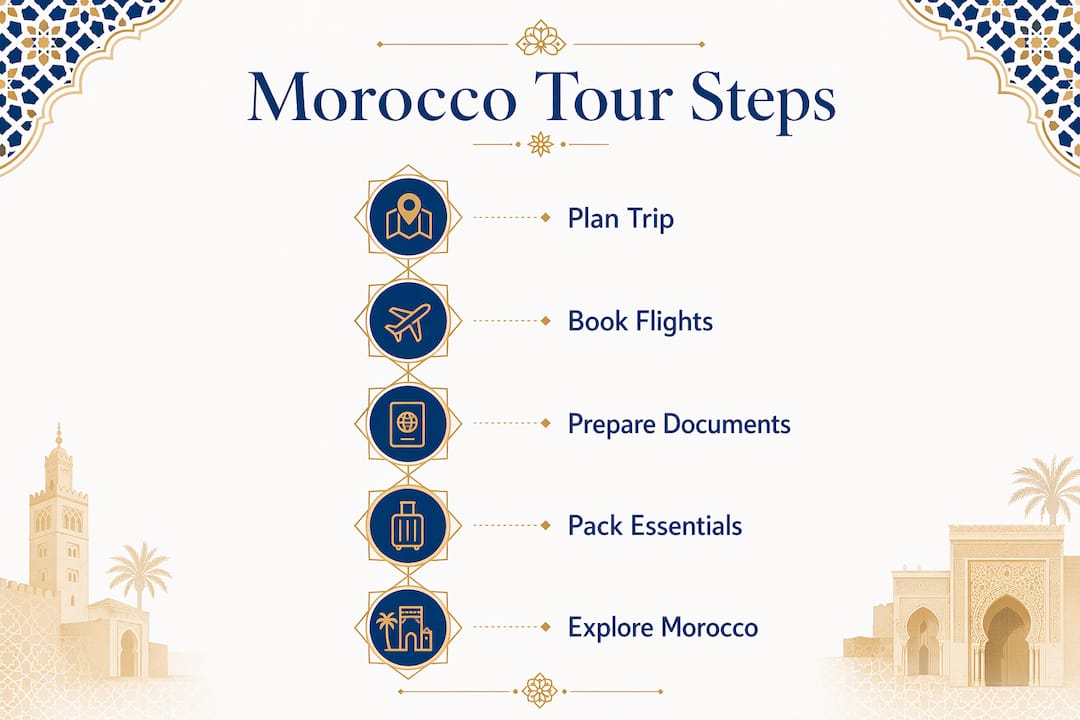
How do Indian travelers handle visa and entry requirements for Morocco?
Indian passport holders enter Morocco visa-free for stays up to 90 days. This policy applies to tourism, and it removes one of the biggest friction points in international travel planning. Most Indian travelers are surprised to learn this, since Morocco is not a destination typically associated with easy access.
Your passport must be valid for at least six months beyond your travel dates. This is the single most common reason travelers get stopped at immigration, not the visa policy itself.
Carry these documents physically, not just on your phone:
- Return or onward flight itinerary printed and dated
- Hotel bookings for every night of your stay
- Proof of funds, such as a recent bank statement showing sufficient balance
- Travel insurance documentation (not mandatory but strongly recommended)
Immigration officers at Casablanca Airport ask standard questions: Where are you staying? How long are you visiting? What is the purpose of your trip? Answers should be clear and consistent with your documents. Travelers on a Morocco guided tour with pre-booked accommodations clear immigration faster because every question has a paper answer.
Pro Tip: Carry a physical copy of your complete Morocco itinerary for travelers, including hotel names, addresses, and contact numbers. Immigration officers respond well to organized documentation, and it signals that you are a prepared, legitimate tourist.
One common misconception: some Indian travelers believe they need a visa because Morocco is in Africa. The visa-free policy is well established and has been in place for years. Passport validity is the only real checkpoint.
When is the best time to visit Morocco from India?
Spring and fall are the optimal seasons for a Morocco vacation from India. March through May and September through November offer the most comfortable temperatures across all the major destinations, from the coastal cities to the Sahara Desert.
Moroccan summers are genuinely harsh. Marrakech regularly exceeds 40°C in July and August. The Atlas Mountains turn cold and sometimes snowy from December through February, which limits access to certain routes. Indian travelers who plan around school holidays should note that April and October are the sweet spots that avoid both extremes.
| Season | Months | Conditions | Best For |
|---|---|---|---|
| Spring | March–May | Warm days, cool nights | All regions, including Sahara |
| Summer | June–August | Extreme heat in south | Coastal cities only |
| Fall | September–November | Mild and dry | Full itinerary, festivals |
| Winter | December–February | It’s cold in the mountains. | Imperial cities, not Sahara |
Customized 9-day tour packages start at approximately ₹1,41,000 per person excluding international flights. That price point covers accommodation, ground transport, guided tours, and most meals. Luxury extensions and private vehicle upgrades add to that base.
Seasonal highlights worth planning around:
- Marrakech Popular Arts Festival in july (for those who can handle the heat)
- Rose Festival in Kelaat M’Gouna in may, a genuinely rare cultural experience
- Eid al-Adha timing varies by year and affects business hours and local transport
For a deeper look at how each season affects specific destinations, Moroccotours publishes a season-by-season breakdown that covers weather, crowds, and pricing across the full calendar year.
What are the popular itinerary highlights and cultural experiences in Morocco?
The classic Morocco itinerary for travelers from India follows a circuit: Casablanca arrival, Marrakech, Fez, Chefchaouen, Sahara Desert, and back. This route covers Morocco’s most iconic destinations while giving travelers a genuine cross-section of the country’s geography and culture.
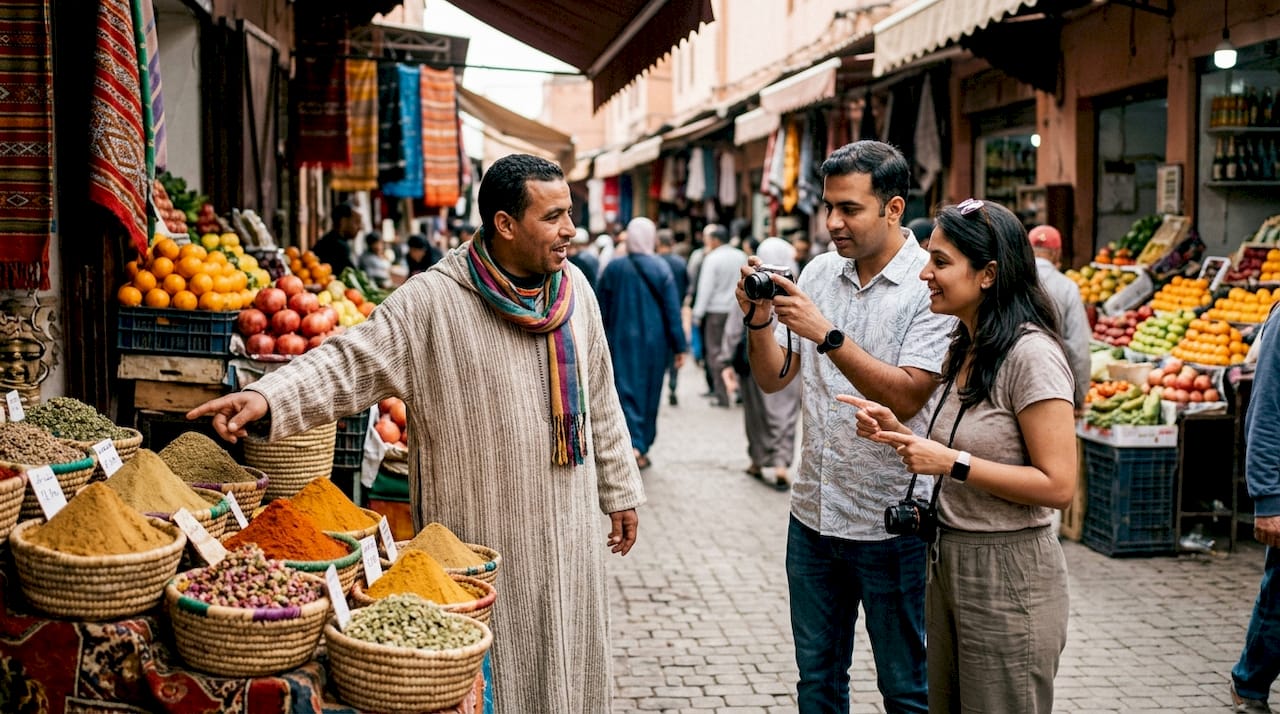
The core circuit explained
Casablanca is the entry point and commercial capital. Most travelers spend half a day here before moving on. The Hassan II Mosque, one of the largest mosques in the world, is worth the visit even for non-Muslim travelers.
Marrakech is the sensory center of any Morocco adventure trip. The Djemaa el-Fna square transforms from a market by day to an open-air theater by night. The Bahia Palace and Saadian Tombs add historical depth. Marrakech also serves as the gateway to the Atlas Mountains for day trips.
Fez holds Morocco’s oldest medina, a UNESCO World Heritage Site. The tanneries at Chouara are the most photographed spot in the country. Fez rewards slow travel. Two full days here is the minimum to absorb its layers.
Chefchaouen is the blue city in the Rif Mountains. It photographs beautifully, but it also offers something quieter: a mountain town pace that contrasts sharply with Marrakech’s energy. Most travelers spend one night here.
The Sahara Desert near Merzouga is the experience that defines most Morocco trips. Camel trekking into the dunes at sunset, sleeping in a desert camp, and waking to silence before sunrise are experiences that stay with travelers for years. This is where the 9-day itinerary earns its price.
Cultural immersion beyond sightseeing
Authentic people-to-people interactions define the best Morocco tours. Visiting a women’s argan oil cooperative in the Souss Valley, sharing a home-cooked meal with a Berber family in the Atlas Mountains, or joining a pottery workshop in Fez gives travelers a connection that no museum can replicate. These experiences are not add-ons. They are the core of what makes Morocco different from other destinations.
Practical tips for navigating medinas:
- Medinas are intentionally maze-like. Getting lost is part of the experience, but carry your riad’s address written in Arabic.
- Unofficial guides will approach you at medina entrances. A firm, polite “La shukran” (no thank you) and continued walking is the correct response. Do not engage, do not explain.
- Always agree on taxi fares before getting in. Petit taxis in Marrakech and Fez rarely use meters for tourists.
- Bargaining in souks is expected. Start at roughly half the asking price and meet somewhere in the middle.
Pro Tip: Ask your Moroccotours guide to arrange a cooking class in a local home rather than a tourist-facing restaurant. You learn to make tagine and couscous from scratch, and the meal you eat afterward tastes completely different.
For a detailed day-by-day breakdown, Moroccotours offers a full Morocco itinerary covering luxury accommodation options and curated local experiences across the full circuit.
How to customize Morocco tours from India to suit your preferences and budget?
Morocco tour packages vary widely from shared group departures to fully private luxury experiences. The right choice depends on three factors: your group size, your budget, and how much control you want over daily scheduling.
Choosing your tour type
- Group tours are the most affordable entry point. You travel with 8–16 other travelers, follow a fixed itinerary, and share transport costs. The trade-off is flexibility. You cannot linger in Fez if the group is moving to Chefchaouen.
- Private guided tours give you a dedicated driver and guide for the full trip. You set the pace. If you want two nights in the Sahara instead of one, that is your call. Moroccotours builds these itineraries from scratch based on your interests.
- Luxury private tours add premium riads, private desert camps, and curated dining experiences. These packages suit travelers who want the cultural depth of Morocco without compromising on comfort. Moroccotours’ luxury Morocco tours are built specifically for this traveler profile.
Regional extensions worth considering
The standard 9-day circuit is excellent, but Morocco rewards longer stays. Two extensions stand out for Indian travelers:
- Northern Morocco: Adding Tangier and the Hercules Caves extends the trip by 2 days and adds a completely different coastal character. Tangier sits at the meeting point of the Atlantic and Mediterranean, and its history as an international zone gives it a distinct personality.
- Atlantic Coast: Essaouira is a walled port city with strong winds, fresh seafood, and a music festival tradition. It pairs well with Marrakech as a 2-day side trip.
Matching tour length to traveler type
- 7–9 days: Best for first-time visitors who want the highlights without overextending. Covers Casablanca, Marrakech, Fez, and Sahara.
- 10–12 days: Adds Chefchaouen and one Atlantic coast stop. Suits travelers who want more breathing room.
- 14–16 days: Full Morocco experience including northern cities, the Atlantic coast, and extended Sahara time. Moroccotours offers a 14-day highlights tour covering imperial cities and the Sahara in depth.
Pro Tip: If you are traveling as a family with children or seniors, request a private tour with a flexible daily schedule. Medina walks and Sahara treks can be adjusted in length and intensity when you are not locked into a group pace.
Key Takeaways
Morocco tours from India are most rewarding when planned around visa-free entry, spring or fall timing, and a private itinerary that balances cultural immersion with the Sahara experience.
| Point | Details |
|---|---|
| Visa-free entry | Indian passport holders enter Morocco for up to 90 days with no visa required. |
| Flight routing | All routes connect through Dubai, Doha, Abu Dhabi, or Istanbul with 10–18 hour total travel times. |
| Best travel seasons | Spring (march–may) and fall (september–november) offer the most comfortable conditions across all regions. |
| Tour pricing baseline | Customized 9-day packages start at approximately ₹1,41,000 per person, excluding international flights. |
| Customization options | Tours range from budget group departures to fully private luxury itineraries with regional extensions. |
What I have learned planning Morocco trips for Indian travelers
The single biggest mistake Indian travelers make is treating Morocco like a checklist destination. They rush through Fez in four hours, skip the Chefchaouen sunrise, and spend their Sahara night worrying about the next morning’s drive. Morocco does not reward that approach.
The travelers who come back with the best stories are the ones who slowed down. They sat in a Fez medina cafe for an hour, watching foot traffic. They accepted a Berber family’s invitation for mint tea in the Atlas Mountains. They let the Sahara silence do its work. Authentic local interactions produce a richer experience than any monument visit.
There is also a cultural parallel between India and Morocco that most travelers feel but cannot immediately name. Both countries have ancient medina-style markets, a strong tradition of hospitality toward guests, a layered relationship between religion and daily life, and a craft culture that has survived industrialization. Indian travelers tend to feel at home faster in Morocco than in most Western destinations. That comfort is real, and it is worth leaning into.
One practical note: understanding local customs like Friday business closures, the rhythm of prayer times, and the etiquette of bargaining prevents frustration and builds goodwill. These are not obstacles. They are the texture of the place. Prepare for them, and they become part of the experience rather than interruptions to it.
My honest advice is to book a private tour for your first Morocco trip. The medinas are genuinely disorienting, the logistics between cities are complex, and having a local guide who speaks Darija and knows the back roads changes everything. You can always do a self-guided trip on your second visit.
— Moroccotours.co
Morocco tours designed for Indian travelers
Moroccotours.co builds private and luxury Morocco tours specifically for travelers who want more than a standard package. Every itinerary is customized: you choose the duration, the regions, the pace, and the accommodation level. Expert local guides handle the logistics, the language, and the cultural context so you can focus on the experience. Whether you want a focused 9-day circuit or a 14-day deep dive into imperial cities and the Sahara, Moroccotours puts together a trip that fits your group. Browse the full range of Morocco tour packages or contact the team directly to start planning your trip.
FAQ
Do Indian citizens need a visa for Morocco?
Indian passport holders do not need a visa for Morocco. Visa-free entry allows stays up to 90 days, provided the passport is valid for at least six months beyond the travel date.
What is the best time for a Morocco vacation from India?
Spring (March through May) and fall (September through November) are the best seasons. These months avoid the extreme summer heat in southern Morocco and the winter cold in the Atlas Mountains.
How long does the flight from India to Morocco take?
Total travel time ranges from 10 to 18 hours depending on the connecting hub. Dubai, Doha, Abu Dhabi, and Istanbul are the most common layover cities.
How much does a Morocco tour from India cost?
Customized 9-day tours start at approximately ₹1,41,000 per person excluding international flights. Luxury private packages with premium riads and desert camps cost more depending on group size and itinerary length.
What are the must-see destinations in Morocco for Indian travelers?
The core circuit covers Casablanca, Marrakech, Fez, Chefchaouen, and the Sahara Desert near Merzouga. Camel trekking, medina exploration, and artisan workshops are the experiences that define most trips.