
Morocco Travel Tips for First Time Visitors
Highlights
- Morocco offers diverse landscapes, from ancient medinas to Sahara dunes, requiring proper planning for first-timers.
- Best travel seasons are spring and autumn, when temperatures are moderate and crowds manageable.
- For a rewarding visit, allocate 7 to 10 days to explore key regions comfortably.
Morocco is defined as one of the world’s most culturally layered destinations, where ancient medinas, Sahara dunes, and Atlas peaks exist within a single country. For first-time visitors, the gap between an overwhelming trip and a genuinely rewarding one comes down to preparation. The Morocco travel tips in this guide cover the essentials: best travel seasons, realistic itinerary planning, cultural customs, safety awareness, and how to handle the Moroccan Dirham (MAD). Moroccotours has helped hundreds of first-time travelers navigate exactly these questions, and the answers below reflect what actually works on the ground in 2026.
What are the best times to visit Morocco for first-time travelers?
The best seasons to visit Morocco are spring (March through May) and autumn (September through November). Temperatures are moderate, crowds are manageable, and most activities from desert trekking to city tours run at full capacity. These shoulder seasons give first-timers the most comfortable introduction to the country.
Summer is a different story inland. Desert temperatures exceed 40°C in areas like Merzouga and Zagora, making outdoor activities genuinely dangerous during midday hours. Coastal cities like Essaouira and Agadir stay cooler thanks to Atlantic breezes, but the imperial cities of Fez and Marrakech become punishing from june through august.
Winter travel works well for the south. The Sahara Desert is cool and clear from December through February, and daytime temperatures in Marrakech stay pleasant. The Atlas Mountains, however, can see snow above 2,000 meters, which closes some passes and limits trekking routes.
- Spring (march–may): Wildflowers in the Atlas, mild desert mornings, and ideal conditions for camel treks
- Autumn (september–november): Post-summer calm, cooler medinas, and harvest season in rural areas
- Winter (december–february): Great for desert tours; cold nights require layering
- Summer (june–august): Coastal areas only; avoid inland cities and desert regions
Pro Tip: Book spring trips at least three months in advance. March through April fills up fast, especially for desert camps and riads in Marrakech.
How long should a first trip to Morocco last?
The optimal trip length for first-time visitors is 7–10 days. That window gives you enough time to cover the major highlights without rushing between cities every 24 hours. Trips shorter than 5 days work only if you focus on a single city like Marrakech or Fez.
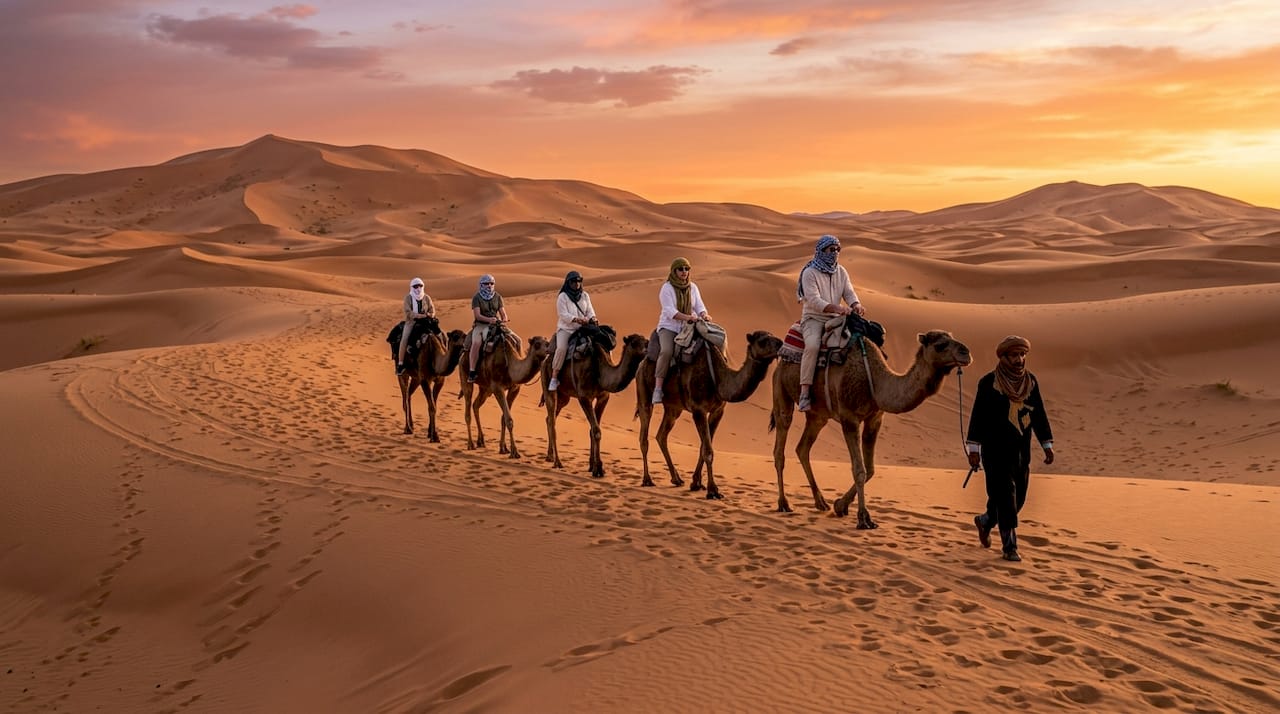
A classic 10-day loop typically runs Marrakech, the High Atlas, Merzouga (Sahara), Fes, and back. This route covers Morocco’s three defining landscapes: urban medinas, mountain passes, and open desert. It also includes enough downtime to actually absorb each place rather than just photograph it.
For travelers with 14 days, adding the northern circuit through Chefchaouen and Tangier is worth it. The 14-day Morocco highlights tour from Moroccotours covers imperial cities and the Sahara in a well-paced sequence that avoids the fatigue of self-driving unfamiliar roads.
| Trip length | Best for | Trade-off |
|---|---|---|
| 4–5 days | Single city deep dive (Marrakech or Fez) | Misses desert and mountains |
| 7 days | Marrakech, Atlas, and one desert night | Rushed transitions |
| 10 days | Classic loop: cities, Atlas, Sahara | Ideal pace for most travelers |
| 14+ days | Full circuit, including north and coast | Requires more planning and budget |
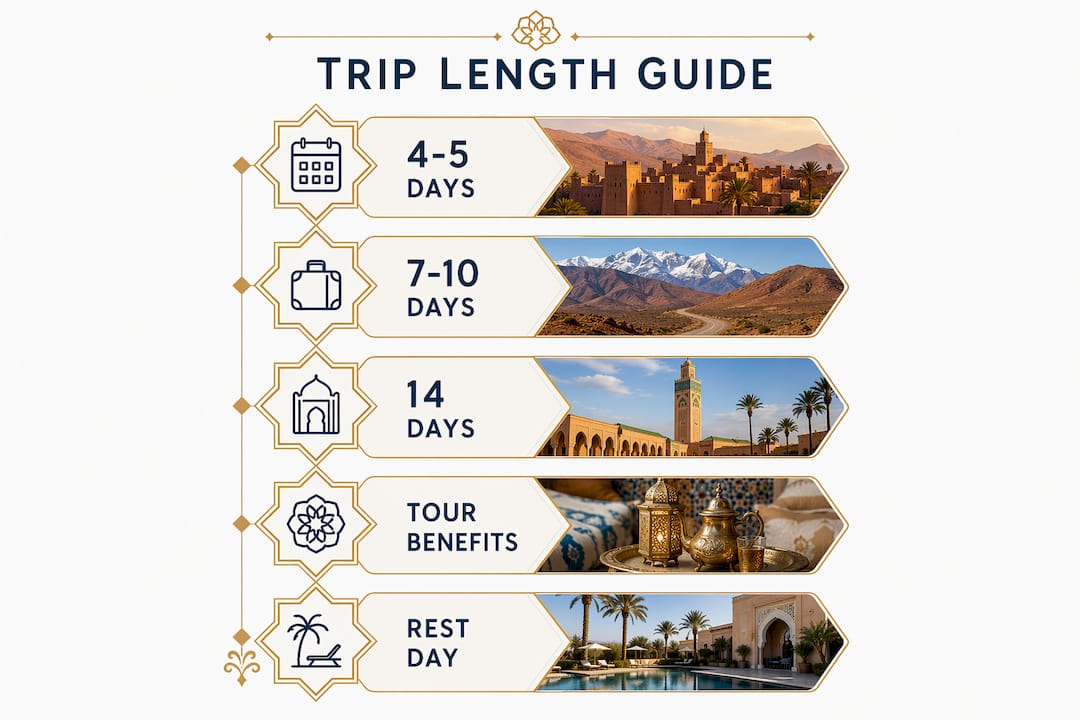
Traveling with a small group tour removes the stress of complex logistics, especially when venturing into the mountains and desert. For first-timers, that trade-off is almost always worth it.
Pro Tip: Build at least one full rest day into your Morocco itinerary for beginners. The medinas are physically demanding, and decision fatigue sets in faster than most travelers expect.
What cultural customs should first-time visitors know?
Cultural respect is the single most important preparation for the first time in Morocco. Moroccan society is predominantly Muslim, and local customs around dress, greetings, and behavior differ significantly from Western norms. Getting these basics right opens doors that a camera and a guidebook cannot.
Dress modestly. Covering shoulders and knees is the baseline, especially for women visiting mosques, rural villages, and traditional markets. In Marrakech’s Djemaa el-Fna square or Fez’s medina, loose-fitting clothing signals respect and reduces unwanted attention. Men should also avoid sleeveless shirts in religious areas.
Learn two phrases. Using “Salaam alaikum” (peace be upon you) and “Shukran” (thank you) opens social doors immediately. Moroccans respond warmly to visitors who make even a minimal effort with Arabic or Darija. These two phrases alone will change the quality of your interactions.
Bargaining is expected. Bargaining in Moroccan souks is a social ritual, not a confrontation. Start your offer at roughly 50% of the asking price, smile, and stay relaxed. The goal is a fair exchange, not a win. Establish your walk-away price mentally before you start, and calmly leaving the stall often brings the seller back with a better number.
- Photography: Always ask before photographing people, especially in rural areas and markets. A refusal is common and should be respected without argument.
- Ramadan: Eating, drinking, or smoking in public during daylight hours is considered disrespectful. Many restaurants close during the day; plan meals accordingly.
- Entering homes or riads: Remove shoes at the door unless told otherwise. This applies to some traditional shops as well.
- Physical greetings: Same-gender handshakes are standard. Cross-gender greetings vary; wait for the other person to initiate.
Pro Tip: Carry a lightweight scarf in your day bag. It works as a cover-up at religious sites, a sun shield in the desert, and a dust barrier in the medina. One item, three problems solved.
What safety tips should first-time travelers know about Morocco?
Morocco is a safe destination for most travelers, but visitors should exercise caution around petty crime and maintain situational awareness in crowded places. Pickpocketing in busy souks and tourist areas is the most common issue. Keep valuables in a front pocket or a cross-body bag, and avoid displaying expensive cameras or phones unnecessarily.
Scams targeting tourists are more common than violent crime. The most frequent involve “guides” who offer free help and then demand payment, or shop owners who invite you in for tea and create social pressure to buy. A polite but firm “no thank you” handles most situations. Booking a licensed guide through a reputable operator removes this friction entirely.
Visitors should avoid protests and large gatherings, heed local advice on restricted areas, and stay alert in isolated locations after dark. These precautions apply to most travel destinations, but Morocco’s mix of dense medinas and rural roads makes them especially relevant for first-time visitors.
Female and solo travelers face a specific dynamic. Dressing modestly and blending in with local styles reduces unsolicited attention in traditional areas. Walking with purpose, avoiding eye contact with persistent vendors, and staying in well-lit areas after dark are practical habits that make a real difference.
Health precautions are straightforward. Drink bottled or filtered water throughout your trip. Street food is generally safe when cooked fresh and hot, but avoid raw salads and unpeeled fruit from street stalls early in your trip until your stomach adjusts. Carry basic medication for stomach upset, sunscreen rated SPF 50 or higher, and oral rehydration salts for desert days.
- Keep a photocopy of your passport separate from the original.
- Share your daily itinerary with someone at home.
- Save the local emergency number (19 for police in Morocco) in your phone.
- Use hotel safes for passports and extra cash.
- Avoid isolated areas after dark, especially in unfamiliar neighborhoods.
Most Western travelers enter Morocco visa-free for up to 90 days, but your passport must be valid for at least 6 months beyond your departure date. Verify current entry requirements through your government’s official travel portal before booking.
How do you handle money and transportation in Morocco?
The Moroccan dirham (MAD) is a closed currency. You cannot buy it outside Morocco, so plan to exchange money after you land. Airport exchange bureaus are convenient but offer poor rates. The better move is to withdraw cash from a bank-affiliated ATM in a major city like Casablanca, Marrakech, or Fez within the first day of arrival.
Cash is the dominant payment method across Morocco. Credit cards work in upscale hotels and some restaurants in tourist areas, but markets, small restaurants, and rural guesthouses operate entirely on cash. Carry small denominations of MAD daily. A 200 MAD note is often difficult to break at a market stall.
- ATMs: Use machines attached to major banks (Attijariwafa Bank, Banque Populaire, BMCE). Avoid standalone machines in tourist zones.
- Airport exchange: Use only for small emergency amounts. Rates are consistently worse than city ATMs.
- Tipping: Standard practice. Tip restaurant servers, riad staff, guides, and drivers. 10–20 MAD for small services is appropriate.
- Budget buffer: Carry more cash than you think you need before heading into the desert or mountains, where ATMs are rare or absent.
Pro Tip: Notify your bank before you travel. Moroccan ATM withdrawals frequently trigger fraud alerts, which can freeze your card at the worst possible moment.
Transportation in Morocco follows a clear hierarchy. Trains connect Casablanca, Rabat, Tangier, Marrakech, and Fez reliably and affordably. The ONCF rail network is the backbone of intercity travel for the major routes. For areas outside the rail network, including the Sahara, Atlas villages, and coastal towns, buses, private transfers, and rental cars fill the gap.
Private transfers are the most comfortable option for first-timers covering long distances. Rental cars give flexibility but require confidence driving on mountain roads and navigating unmarked medina streets. For a well-planned Morocco itinerary, Moroccotours includes private transport as part of its tour packages, which removes the guesswork entirely.
Key Takeaways
Preparation and cultural awareness are the two factors that separate a frustrating first trip to Morocco from a genuinely memorable one.
| Point | Details |
|---|---|
| Travel in shoulder seasons | Spring (march–may) and autumn (september–november) offer the best temperatures and conditions. |
| Plan for 7–10 days | This duration covers cities, mountains, and desert without rushing between locations. |
| Respect local customs | Dress modestly, learn basic Arabic greetings, and treat bargaining as a social exchange. |
| Use city ATMs for cash | The Moroccan dirham is a closed currency; withdraw from bank-affiliated ATMs, not airport bureaus. |
| Book transport in advance | Trains cover major cities; private transfers handle desert and mountain routes most reliably. |
What I’ve learned after years of sending travelers to Morocco
Most first-timers arrive expecting chaos and leave surprised by the warmth. Moroccan hospitality is genuine, not performative. When a shopkeeper invites you for mint tea, the offer is real even if a sale might follow. Accepting it, sitting down, and having a conversation is one of the best things you can do on your first trip.
The travelers who struggle are usually the ones who try to control every variable. Morocco rewards patience. A wrong turn in the Fez medina leads somewhere interesting. A delayed bus means a conversation with a local family. The country has a way of filling unplanned moments with the most memorable experiences of the trip.
What I tell every first-timer: do your preparation work thoroughly, then hold your plans loosely. Know your budget, understand the customs, carry enough cash, and dress appropriately. After that, let the country do what it does best.
The cultural richness here is not a backdrop. It is the point. Travelers who approach Morocco with curiosity and respect consistently report it as the most rewarding destination they have visited. That outcome is not accidental. It is the direct result of showing up prepared and open.
— Moroccotours.co
Curated Morocco tours for first-time visitors
Planning a first trip to Morocco is easier with expert support behind you. Moroccotours designs private and luxury Morocco tours that handle the logistics most first-timers find hardest: transport between regions, vetted accommodations, licensed local guides, and desert camp bookings. The 10-day Morocco Signature Tour covers Marrakech, the Atlas Mountains, the Sahara, and Fez in a well-paced sequence built specifically for travelers visiting the country for the first time. Every itinerary is customizable, so you can add coastal days, extend desert time, or focus on a single region. Browse the full range of Morocco tour packages to find the right fit for your travel style and schedule.
FAQ
What is the best time of year for a first trip to Morocco?
Spring (March through May) and autumn (September through November) are the best periods. Temperatures are moderate, and most activities, including desert treks and city tours, operate at full capacity.
Do I need a visa to visit Morocco?
Most Western passport holders enter Morocco visa-free for up to 90 days. Your passport must be valid for at least 6 months beyond your planned departure date; confirm current requirements through your government’s official travel portal.
Is Morocco safe for solo female travelers?
Morocco is generally safe for solo female travelers who dress modestly and stay alert in crowded areas. Covering shoulders and knees reduces unwanted attention, and booking guided tours removes most logistical friction.
Can I use credit cards in Morocco?
Credit cards work in upscale hotels and tourist-facing restaurants, but cash is required in markets, rural guesthouses, and most small businesses. Withdraw Moroccan dirhams from a bank-affiliated ATM in a major city on arrival.
How much time do I need to see Morocco properly?
Seven to ten days covers the main highlights at a comfortable pace, including Marrakech, the Atlas Mountains, and the Sahara Desert. Trips under 5 days are better suited to a single city only.
Itinerary Expand all Collapse all
Included
Price
Related Tours
Morocco Desert Tour
Northern Morocco Tour
Morocco Family Tour
Morocco Spain Tour
Morocco Trekking Tour
Morocco Highlights Tour
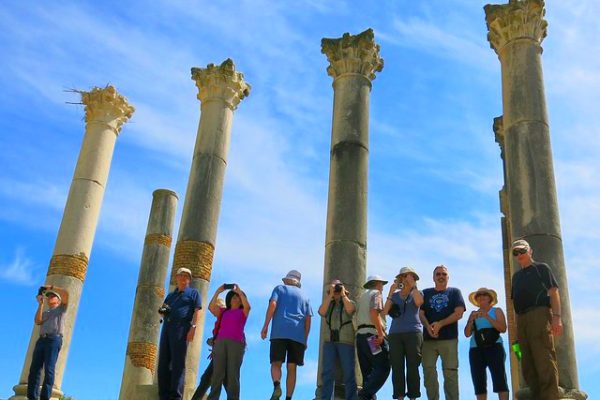
Morocco Group Tour
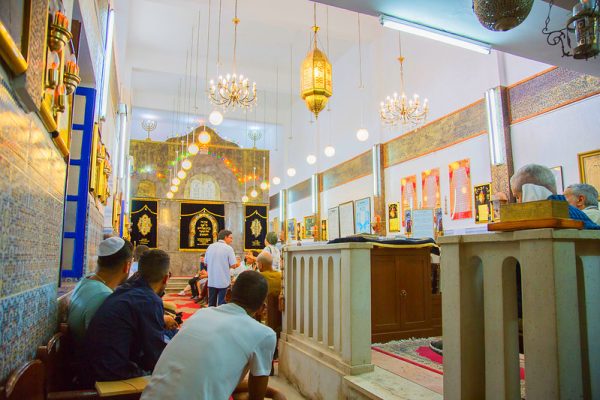
Morocco Jewish Tour
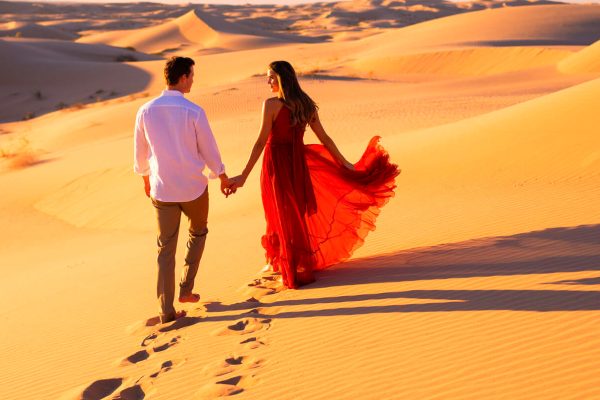
Morocco Honeymoon Tour
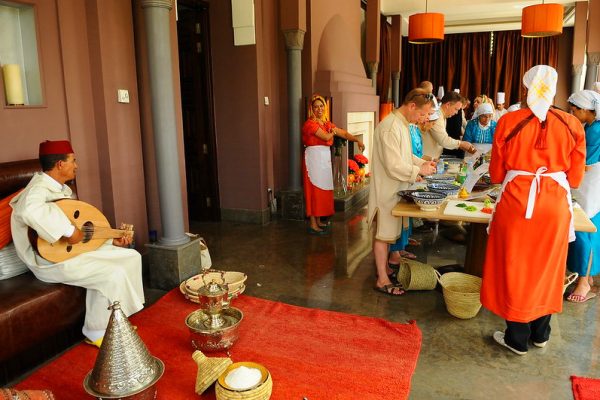
Morocco Food Tour
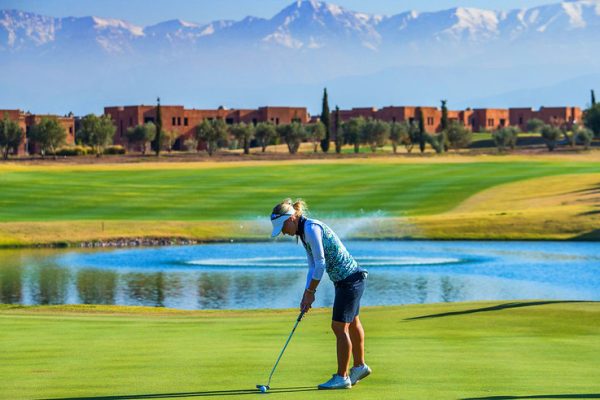
Morocco Golf Tour
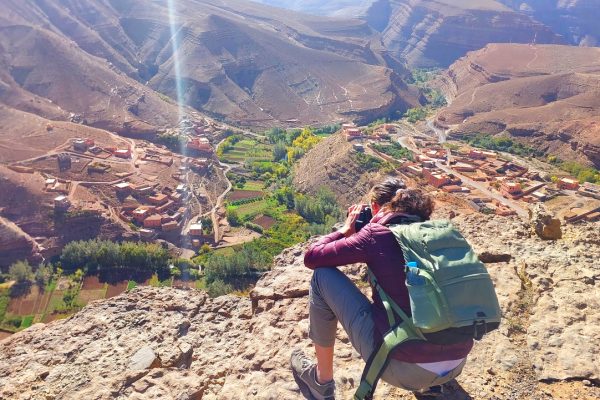
Morocco Photography Tour
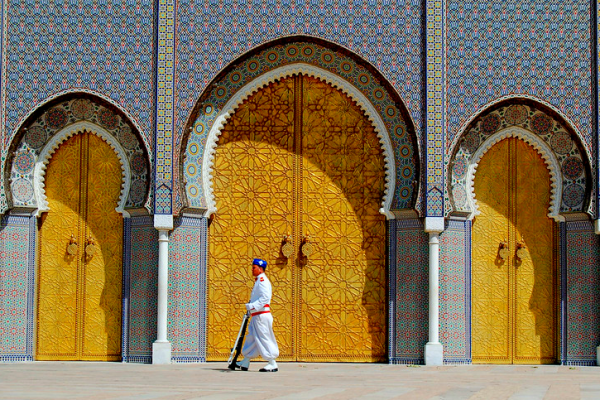
Morocco Signature Tour
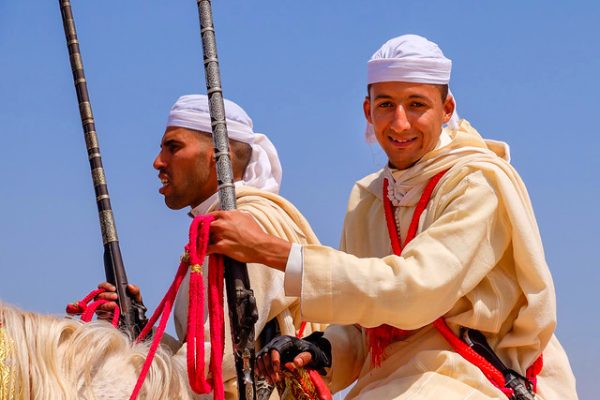
Morocco Imperial Cities Tour
Morocco Grand Tour

Is Morocco Safe for Solo Women? Your Guide

Morocco Itinerary Guide: 7, 10, and 14 Days
Is Morocco Safe for Tourists? Your Guide
Morocco Travel Tips for First Time Visitors

How Many Days Do You Need in Morocco

What to Know Before Visiting Morocco

10 Mistakes Travelers Make in Morocco

Morocco Travel Agency: Plan Your Luxury Tour

Morocco Visa Guide: Requirements and How to Apply

Morocco for Seniors: A Comfort-First Travel Guide
