
Morocco Visa Guide: Requirements and How to Apply
Highlights
- Most travelers from over 68 countries can enter Morocco visa-free for up to 90 days without prior registration or fees.
- Citizens from other nations need an embassy visa or a valid secondary visa for an eVisa, which allows shorter stays or longer stays with proper documentation.
- Travelers must ensure their passports are valid for at least six months beyond their arrival date to avoid border issues.
Morocco is one of the most accessible destinations in the world for international travelers, with over 68 countries granted visa-free entry for stays up to 90 days. Citizens of the United States, the United Kingdom, Canada, Australia, and all EU member states fall into this category, meaning no pre-registration, no fees, and no embassy appointment. The standard Morocco travel visa process applies only to nationals from countries outside this exempt group. Your passport must be valid for at least six months beyond your planned entry date, regardless of your visa status. Morocco welcomes millions of visitors each year, and understanding the entry rules before you book saves real time and real stress.
Which countries need a Morocco visa and which do not?
Morocco divides international visitors into three clear categories: visa-exempt, eVisa-eligible, and visa-required. Knowing which group you fall into is the first step in any Morocco visa requirements check.
Visa-free entry: who qualifies?
Citizens of 68+ countries enter Morocco without a visa for tourism stays up to 90 days. This group covers the largest traveler segments globally. No online form, no fee, and no prior approval is needed. You simply arrive, present your passport at border control, and receive an entry stamp.
Countries in this category include:
- United States
- United Kingdom
- Canada
- Australia
- All European Union member states
- Japan
- Brazil
- Argentina
- South Korea
- UAE
Travelers from these countries should still carry proof of accommodation and a return ticket. Border officers ask basic questions about your stay, and having clear answers speeds up the process considerably.
eVisa eligibility: a middle-tier option
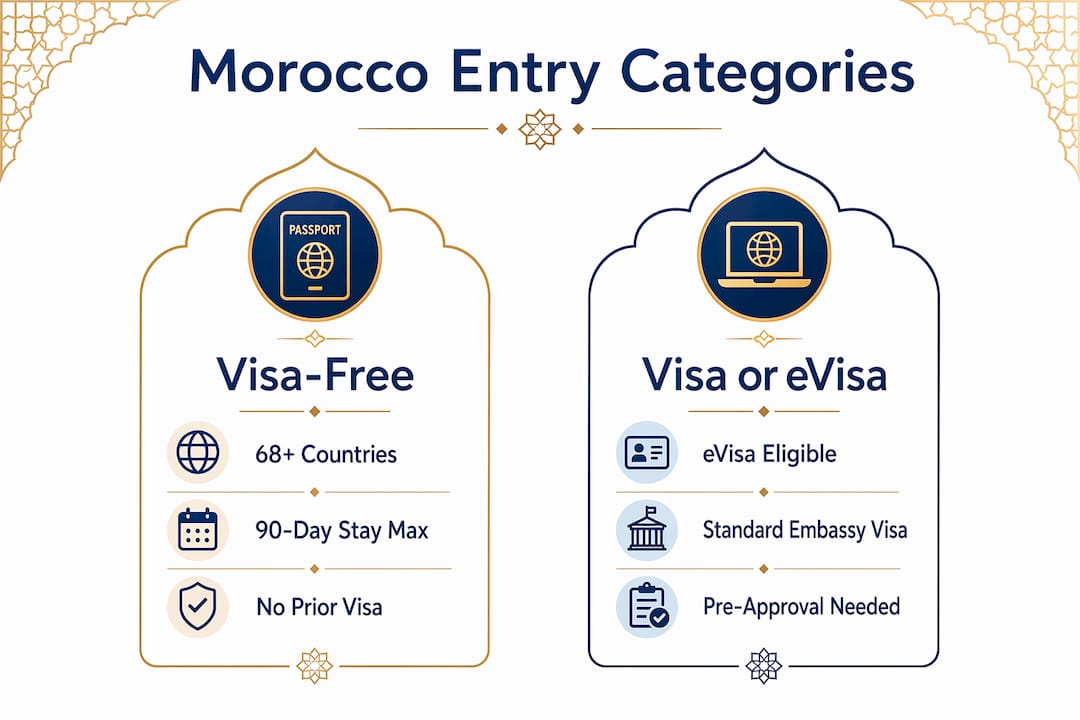
Morocco launched an official eVisa system for travelers who would otherwise need a standard embassy visa. To qualify, you must hold a valid secondary visa from a Schengen country, the United States, the United Kingdom, Canada, Australia, or Japan. The e-visa permits a 30-day stay and is applied for entirely online, with no embassy visit required. This option is particularly useful for Indian, Nigerian, and Filipino nationals who hold valid Schengen or US visas.
Visa-required nationals: standard embassy route
Travelers from countries not covered by visa-free entry or eVisa eligibility must apply for a Morocco entry visa at a Moroccan embassy or consulate before traveling. This includes most nationals from South Asia, sub-Saharan Africa, and parts of the Middle East. India is a clear example: Indian passport holders require a visa unless they hold a qualifying secondary visa for the eVisa route. The application process involves submitting documents, paying a fee, and waiting for processing.
| Category | Who qualifies | Stay allowed |
|---|---|---|
| Visa-free | US, UK, Canada, Australia, EU, 60+ others | Up to 90 days |
| e-Visa | Nationals with valid Schengen, US, UK, CA, AU, JP visa | Up to 30 days |
| Embassy visa | All other nationalities | Varies by visa type |
How to apply for a Morocco visa: types, documents, and process
The Morocco visa application process depends entirely on which visa type you need. Morocco issues short-stay tourist visas, long-stay visas, work visas, and student visas, each with its own document list and processing path.
Types of visas for Morocco
A short-stay tourist visa covers visits up to 90 days and is the most common type for travelers who fall outside the visa-free category. Long-stay visas apply to stays beyond 90 days and require stronger documentation, including proof of financial means and a clear reason for the extended stay. Work visas require a job offer from a Moroccan employer and must be processed before arrival. Student visas require an acceptance letter from a recognized Moroccan institution.
Documents required for a standard embassy visa
Travelers applying at embassies must submit the following:
- A valid passport with at least six months of remaining validity and two blank pages
- Two recent passport-sized photographs meeting standard biometric requirements
- A completed visa application form
- Confirmed flight itinerary showing entry and exit dates
- Proof of accommodation, such as a hotel booking or host invitation letter
- Bank statements from the past three months showing sufficient funds
- Travel insurance covering the full duration of the stay
- Employment letter or proof of self-employment or student enrollment
Processing times run between 5 and 15 working days. Fees range from 250 to 400 MAD depending on nationality and visa type. Apply at least three weeks before your travel date to allow buffer time for additional document requests.
How to apply through the eVisa platform
The official eVisa portal is acces-maroc.ma. The process runs entirely online and follows these steps:
- Visit acces-maroc.ma and create an account using your email address.
- Complete the application form with your personal details and travel dates.
- Upload scanned copies of your passport, your qualifying secondary visa (Schengen, US, UK, etc.), and a recent photograph.
- Pay the application fee online using a credit or debit card.
- Wait for email confirmation, which typically arrives within a few business days.
- Download and print your e-visa approval to present at the border.
Pro Tip: Check your secondary visa’s expiration date before applying. Your Schengen or US visa must still be valid at the time of your Morocco entry, not just at the time of application.
Travelers who have previously visited a Schengen country or the US on their qualifying visa have a stronger application. First-time holders of a secondary visa with no travel history may face additional scrutiny.
What are the entry procedures and common travel pitfalls?
Arriving in Morocco is straightforward for visa-exempt travelers, but several rules catch people off guard every year. Knowing them in advance prevents real problems at the border.
Passport validity: the most common mistake
Passports must be valid for at least six months beyond your arrival date. Airlines enforce this rule before boarding, not just at the Moroccan border. A traveler arriving in July with a passport expiring in October will be denied boarding at their departure airport. This rule applies to visa-exempt travelers just as strictly as it applies to visa holders.
Passports must also meet MRZ (Machine Readable Zone) standards. Passports without machine-readable codes or with handwritten data may be refused entry regardless of visa status. Check your passport’s data page before you travel.
What happens at border control for visa-exempt travelers
Visa-exempt travelers receive a passport stamp at the border allowing a 90-day stay. Border officers ask standard questions about your accommodation address, the purpose of your visit, and how long you plan to stay. These questions are routine, not adversarial. Having your hotel booking confirmation on your phone or printed out removes any friction from this process.
Common pitfalls to avoid at the border:
- Passport expiring within six months of entry. This is the single most common reason travelers are turned away.
- No proof of accommodation. Officers may ask for a hotel address or host contact. Carry it with you.
- Confusing eVisa with AEVM. The Electronic Travel Authorization (AEVM) is a separate requirement from the eVisa and applies to specific visa-exempt nationals, including certain diplomatic passport holders and nationals married to Moroccan citizens. These are two different systems.
- Insufficient blank passport pages. Most border officers require at least two blank pages for stamps.
- Assuming visa-free means no documentation needed. You still need proof of onward travel and accommodation.
Pro Tip: Save your hotel confirmation, return flight details, and travel insurance certificate in a single folder on your phone before you fly. Border checks move faster when you can pull up documents in seconds.
For first-time visitors, the Morocco travel tips from MoroccoTours cover practical preparation beyond just visa requirements.
How can you extend your stay or work and study in Morocco?
Staying beyond 90 days requires either a formal extension or a different visa category. Morocco does not automatically grant longer stays, and overstaying carries real consequences.
Extending a tourist stay
Visa extensions are applied for at local police headquarters or the Bureau des Etrangers at least 15 days before your current 90-day period expires. Extensions are discretionary, meaning Moroccan authorities decide case by case. A valid reason, such as ongoing medical treatment, a family situation, or a pending work contract, strengthens your application. Extensions can add up to an additional 90 days to your stay.
Documents typically required for an extension:
- Your original passport
- Proof of your current accommodation in Morocco
- A written explanation of why you need to extend
- Bank statements showing you can support yourself financially
- Any supporting documents relevant to your reason (medical records, employment letters, etc.)
Extension approval is at the discretion of Moroccan authorities and is never guaranteed. Apply early. Waiting until the last week before expiry leaves no time to respond to additional requests.
Work and student visas for longer stays
Work visas require a formal job offer from a Moroccan employer. The employer typically initiates the process with the Moroccan Ministry of Labor before the traveler applies at the embassy. Student visas require an acceptance letter from a recognized Moroccan university or language school. Both visa types must be secured before arrival. You cannot convert a tourist entry into a work or student visa while inside Morocco.
Digital nomads and remote workers
Morocco does not currently offer a formal digital nomad visa. Remote workers who earn income from foreign clients generally enter on a standard tourist authorization. This is widely practiced and not actively enforced, but it carries no legal protection. Nomads planning to stay long-term should monitor Moroccan immigration policy, as formal frameworks for remote workers are under discussion in several North African countries.
Overstaying without an approved extension risks fines and future entry bans. The fine structure is not publicly listed in detail, but repeat overstays can result in a multi-year ban from entering Morocco. Apply for an extension or exit and re-enter legally if your situation changes.
Key Takeaways
A valid passport with six months of remaining validity is the single most critical document for any traveler entering Morocco, regardless of visa status.
| Point | Details |
|---|---|
| Visa-free entry for 68+ countries | US, UK, Canada, Australia, and EU nationals enter Morocco for up to 90 days with no visa. |
| eVisa requires a qualifying secondary visa | Travelers holding a valid Schengen, US, UK, Canadian, Australian, or Japanese visa can apply online for a 30-day stay. |
| Passport validity is strictly enforced | Your passport must be valid for at least six months beyond your arrival date, or airlines will deny boarding. |
| Embassy visa processing takes 5–15 working days | Apply at least three weeks before travel and submit all documents, including bank statements and accommodation proof. |
| Extensions are discretionary, not automatic | Apply at least 15 days before your 90-day period expires and provide a valid reason for the extended stay. |
What I’ve learned from watching travelers get Morocco entry wrong
After years of working with international visitors planning trips to Morocco, the pattern is always the same. Travelers who run into problems at the border are not the ones who forgot their visa. They are the ones who assumed the rules were flexible.
The six-month passport validity rule is the clearest example. Travelers see their passport expiring in four months and think, “I’m only going for two weeks; that’s fine.” Airlines disagree. Moroccan border control disagrees. The rule is six months beyond arrival, not six months from today. I have seen this mistake made by experienced travelers who have visited dozens of countries. Check your passport expiration date the moment you book your flight, not the night before you leave.
The AEVM versus eVisa confusion is a newer problem. Morocco’s entry system has added layers in recent years, and the distinction between an electronic travel authorization and an eVisa is not obvious from a quick internet search. If you are a visa-exempt national who has received any communication about needing an electronic authorization before travel, verify directly with the Moroccan embassy or the official acces-maroc.ma platform. Do not rely on third-party summaries for this specific detail.
Accommodation documentation is underrated. Border officers at Casablanca Mohammed V International Airport and Marrakech Menara Airport ask for your hotel address regularly. Travelers who say “I haven’t booked yet” create delays for themselves. Book at least your first night before you fly. A Morocco riad or hotel confirmation takes five minutes to arrange and removes a real friction point at the border.
My strongest advice: treat your visa and entry preparation the same way you treat your flight booking. Do it early, confirm the details, and keep copies. Morocco is genuinely welcoming to international visitors. The entry process is not designed to be difficult. Most problems travelers face are self-created and entirely avoidable.
— MoroccoTours.co
Plan your Morocco trip with MoroccoTours.co
Once your entry requirements are sorted, the real planning begins. Moroccotours designs private and luxury tours across Morocco for travelers who want more than a standard itinerary. From the medinas of Marrakech and Fes to the dunes of the Sahara, every trip is built around your schedule and preferences. The team handles logistics, private guides, and premium accommodations so you spend your time experiencing Morocco rather than managing it. Whether you are planning a luxury Morocco tour or a dedicated Sahara Desert experience, Moroccotours offers the local expertise to make it count. Explore the full range of tours and start building your itinerary today.
FAQ
Do US citizens need a visa for Morocco?
US citizens do not need a visa for Morocco. They receive a 90-day entry stamp at the border with a valid passport.
What is the Morocco eVisa, and who can apply?
The Morocco eVisa is an online travel authorization for nationals who hold a valid Schengen, US, UK, Canadian, Australian, or Japanese visa. It permits a 30-day stay and is applied for at acces-maroc.ma without an embassy visit.
How long does a Morocco visa take to process?
Standard embassy visa processing takes between 5 and 15 working days. Apply at least three weeks before your travel date to allow time for any additional document requests.
Can I extend my stay beyond 90 days in Morocco?
Yes, but extensions are not automatic. You must apply at a local police headquarters or Bureau des Etrangers at least 15 days before your current stay expires, and approval is at the discretion of Moroccan authorities.
What documents do I need at the Morocco border as a visa-exempt traveler?
You need a valid passport with at least six months of remaining validity, proof of accommodation such as a hotel booking, a return or onward flight ticket, and the ability to answer basic questions about your visit purpose and length of stay.
Itinerary Expand all Collapse all
Included
Price
Related Tours
Morocco Desert Tour
Northern Morocco Tour

Morocco Family Tour
Morocco Spain Tour
Morocco Trekking Tour
Morocco Highlights Tour
Morocco Group Tour
Morocco Jewish Tour

Morocco Honeymoon Tour

Morocco Food Tour

Morocco Golf Tour
Morocco Photography Tour
Morocco Signature Tour
Morocco Imperial Cities Tour
Morocco Grand Tour

Is Morocco Safe for Solo Women? Your Guide

Morocco Itinerary Guide: 7, 10, and 14 Days

Is Morocco Safe for Tourists? Your Guide
Morocco Travel Tips for First Time Visitors

How Many Days Do You Need in Morocco

What to Know Before Visiting Morocco

10 Mistakes Travelers Make in Morocco

Morocco Travel Agency: Plan Your Luxury Tour

Morocco Visa Guide: Requirements and How to Apply
