
Morocco Honeymoon Guide: Romantic Trips
Highlights
- Morocco offers couples a romantic mix of ancient cities, deserts, mountains, and coast within a compact country.
- Planning a well-paced itinerary with boutique accommodations, private experiences, and deliberate rest days ensures a memorable honeymoon.
- Traveling in spring or autumn and booking logistics early improves comfort and overall experience.
Morocco is one of the most romantic honeymoon destinations on earth, offering couples a rare mix of ancient cities, Sahara dunes, Atlantic coastline, and Atlas Mountain villages within a single compact country. A 10-day Morocco honeymoon covers mountains, desert dunes, Atlantic beaches, and vibrant cities that would require multiple trips elsewhere. Boutique riads with private courtyards, candlelit rooftop dinners, and sunset camel rides create moments that large resort destinations simply cannot replicate. This Morocco Honeymoon Guide covers the best destinations, itinerary frameworks, luxury accommodations, and practical travel tips couples need to plan a trip worth remembering.
What are the best honeymoon destinations in Morocco?
Morocco’s top romantic destinations each offer a completely different mood. Choosing the right mix is what separates a good honeymoon from an exceptional one.
Marrakech: the city that sets the tone
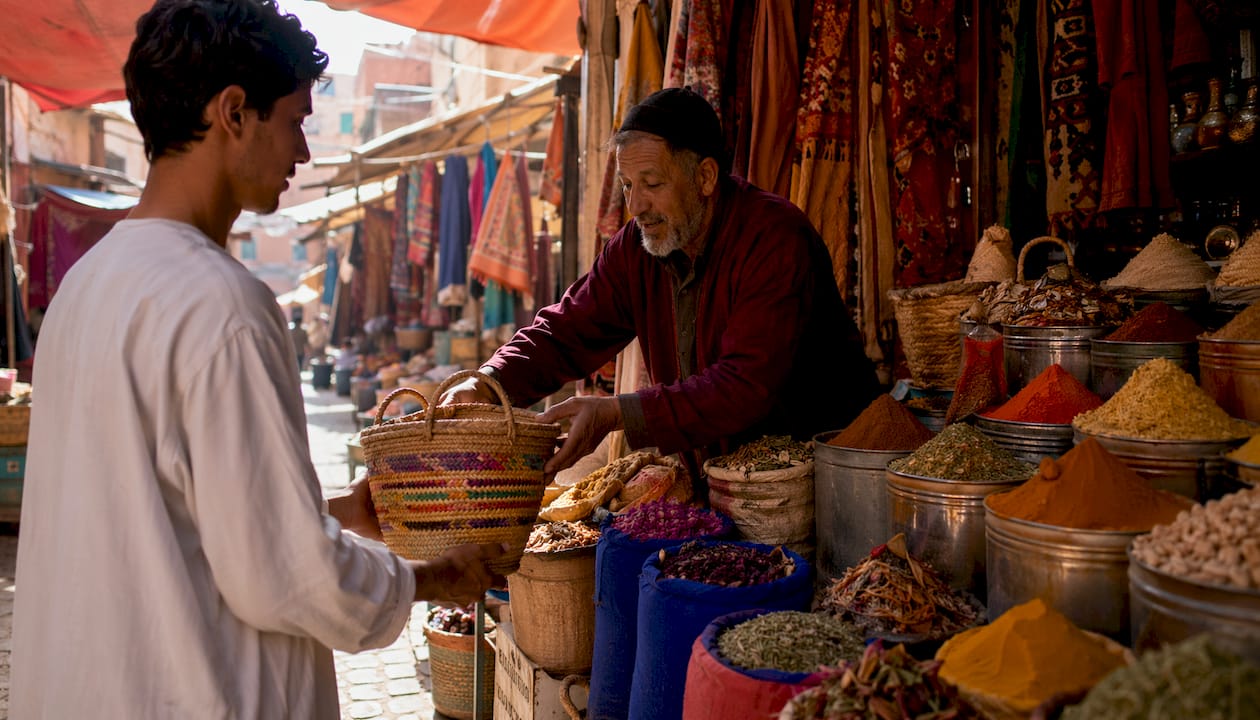
Marrakech is the natural starting point for most couples. The medina pulses with color, scent, and sound during the day, then quiets into candlelit alleyways by night. Private riad dinners, couples hammam rituals, and rooftop dining in the medina rank among the most intimate romantic experiences available anywhere in North Africa. The Jardin Majorelle and the Saadian Tombs give couples a shared sense of discovery without the crowds of peak midday hours.
Fes, Chefchaouen, and Essaouira
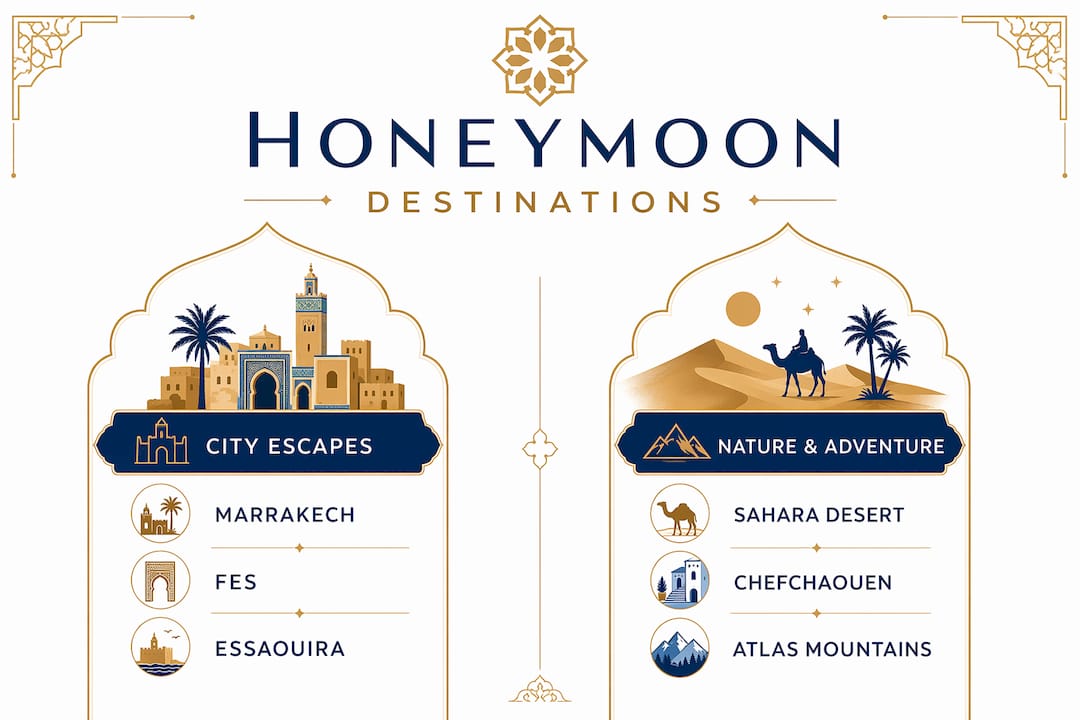
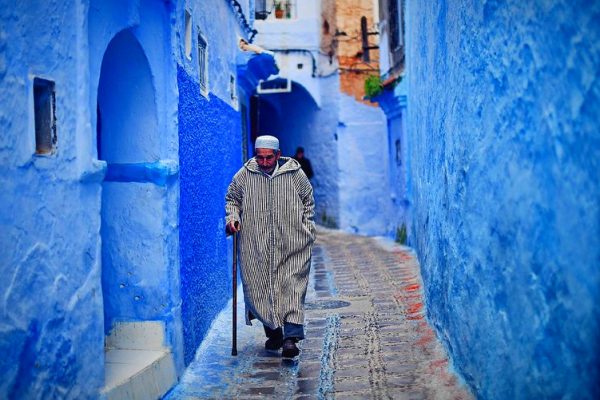
Fes rewards couples who want depth over spectacle. The 9th-century medina is a UNESCO World Heritage Site, and a private guided walk through its tanneries and mosques feels genuinely exclusive. Chefchaouen, the blue-washed mountain town in the Rif Mountains, offers a slower pace and photogenic streets that feel made for two. Essaouira on the Atlantic coast brings sea breezes, whitewashed ramparts, and fresh seafood. It is the ideal wind-down destination after the intensity of the imperial cities.
The Sahara Desert: the centerpiece of any romantic itinerary
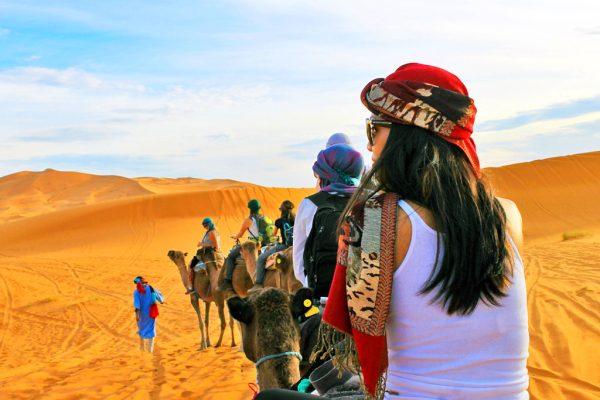
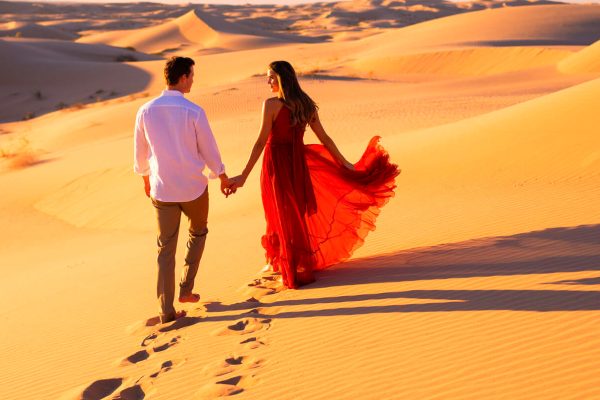
No Morocco honeymoon is complete without at least one night in the Sahara. The Erg Chebbi dunes near Merzouga rise to over 150 meters and glow amber at sunset. Couples who book a private desert camp experience dinner under an unobstructed sky, traditional Gnawa music, and a silence that is genuinely rare. The camel trek to camp at dusk is one of those experiences couples describe for years afterward.
Pro Tip: Book a luxury desert camp with a private tent rather than a shared camp. The price difference is modest, and the privacy is absolute.
Destination comparison for honeymooners
| Destination | Romance factor | Best for |
|---|---|---|
| Marrakech | Very high | City culture, spa, nightlife |
| Fes | High | History, authenticity, medina walks |
| Chefchaouen | High | Slow travel, photography, mountain air |
| Essaouira | Moderate to high | Coastal relaxation, seafood, sunsets |
| Sahara Desert | Exceptional | Stargazing, camel treks, private camps |
| Atlas Mountains | High | Hiking, Berber villages, seclusion |
How to plan your Morocco honeymoon itinerary
A well-paced itinerary is the single biggest factor in whether a honeymoon feels relaxing or exhausting. Morocco rewards couples who resist the urge to see everything.
Choosing the right duration
A typical Morocco honeymoon itinerary runs 7–14 days, depending on how much ground couples want to cover. Seven days works well for Marrakech plus one major excursion, such as the Sahara or the Atlas Mountains. Ten days allow a second city like Fes or Chefchaouen without feeling rushed. Two weeks gives couples the full picture: imperial cities, desert, mountains, and a coastal rest day in Essaouira.
A practical planning sequence
- Set your travel dates first. Spring (March through May) and autumn (September through November) offer the best weather. Avoid July and August in the desert, where midday temperatures exceed 40°C.
- Book accommodations before flights. The best boutique riads in Marrakech and Fes sell out months in advance, especially for peak spring weekends.
- Choose your anchor experiences. Decide whether the Sahara, the Atlas Mountains, or the coast is your priority. Build the rest of the route around that anchor.
- Arrange private transfers between cities. The drive from Marrakech to Merzouga takes roughly 8–9 hours. A private chauffeur with a comfortable vehicle makes that drive part of the experience rather than an ordeal.
- Build in at least two full rest days. Honeymooners who schedule every day with activities consistently report wishing they had slowed down. A full afternoon in a riad courtyard with mint tea is not wasted time.
- Confirm all bookings 4–6 weeks before departure. This applies to desert camps, hammam appointments, and private guided tours, all of which have limited capacity.
Using a bespoke tour service to handle logistics removes the stress of coordinating transfers, guides, and reservations across multiple cities. Private tours also provide cultural context that makes every stop more meaningful.
Pro Tip: Ask your tour operator to arrange a private rooftop dinner on your first night in Marrakech. It sets the tone for the entire trip and costs far less than you would expect.
What are the best luxury accommodations for couples in Morocco?
Accommodation defines the honeymoon experience in Morocco more than in almost any other destination. The right riad or desert camp becomes a memory in itself.
Why riads work for honeymooners
A riad is a traditional Moroccan house built around a central courtyard. The architecture faces inward, which means the street noise disappears the moment you step through the door. Boutique riads with private plunge pools provide intimacy and a romantic atmosphere that large hotels cannot match. Private courtyards, tiled fountains, and rooftop terraces create natural spaces for couples to be alone together. The best riads also offer personalized service, often with a staff-to-guest ratio that rivals the finest hotels in the world.
Notable properties worth knowing
Riad Fes in the Fes medina combines 14th-century architecture with modern amenities, including a hammam, a pool, and a rooftop restaurant. Palais Amani, also in Fes, is a restored palace with just 14 rooms, making it one of the most private luxury stays in Morocco. Kasbah Tamadot in the Atlas Mountains, owned by the Virgin Group, offers mountain views, a heated pool, and Berber-inspired suites. Royal Mansour in Marrakech is the most celebrated luxury address in the country, with private riads for each guest and butler service throughout.
Accommodation types at a glance
| Type | Privacy level | Signature amenity | Best location |
|---|---|---|---|
| Boutique riad | Very high | Private courtyard or plunge pool | Marrakech, Fes |
| Palace hotel | High | Grand architecture, full spa | Marrakech |
| Desert luxury camp | Exceptional | Private tent, stargazing | Merzouga, Zagora |
| Mountain kasbah | High | Views, hiking access, pool | Atlas Mountains |
- Private plunge pools are available in higher-end riads and are worth the premium for honeymooners.
- Rooftop terraces in medina riads offer sunset views that no hotel balcony can replicate.
- Desert camps with private tents include en-suite facilities in the top-tier options.
- Mountain kasbahs often include guided hikes and Berber village visits as part of the stay.
Moroccotours handpicks accommodations for its luxury Morocco honeymoon packages based on privacy, service quality, and romantic atmosphere rather than star ratings alone.
What practical tips should honeymooners know before visiting Morocco?
Morocco is an easy country to travel in when you know what to expect. A few practical details make the difference between a smooth trip and an avoidable frustration.
Best time to visit
Spring and autumn are the best seasons for a Morocco honeymoon. March through May brings wildflowers to the Atlas foothills and comfortable temperatures across all regions. September through November offers warm days, cooler evenings, and significantly fewer tourists than the summer peak. Winter works well for Marrakech and the desert but can be cold in the mountains and on the coast.
Packing and dress code
- Bring lightweight layers. Temperatures swing dramatically between day and night, especially in the desert and mountains.
- Pack modest clothing for medina visits. Shoulders and knees covered is the standard expectation in souks and near mosques.
- Comfortable walking shoes are non-negotiable. Medina streets are uneven and often unpaved.
- A light scarf serves double duty: sun protection during the day and warmth in the evening.
- Sunscreen with SPF 50+ is harder to find locally than in the US, so bring your own supply.
Money, tipping, and connectivity
Tipping in Morocco runs around 10–15% in restaurants and 100–200 MAD per day for private drivers and guides. That translates to roughly $10–$20 per day for a private driver, which is both customary and genuinely appreciated. The local currency is the Moroccan dirham (MAD). ATMs are widely available in cities, though less so in desert areas, so carry cash before heading to Merzouga or the mountains.
For connectivity, an eSIM loaded before departure is the most practical option for US travelers. Mariam and local SIM cards from Maroc Telecom or Orange Morocco are available at the airport for those who prefer a physical card.
Cultural norms for couples
Public displays of affection are uncommon in Morocco outside of tourist-heavy areas. Holding hands is generally fine; more demonstrative affection is better reserved for your riad. Respect for local customs is not just polite. It actively improves how locals interact with you, which enriches the experience for both of you.
Key Takeaways
A Morocco honeymoon delivers the most romance when couples combine boutique riad stays, a Sahara desert night, and at least one slower coastal or mountain day into a single well-paced itinerary.
| Point | Details |
|---|---|
| Best travel seasons | Spring (march–may) and autumn (september–november) offer ideal weather and fewer crowds. |
| Itinerary duration | A 10–14 day trip covers cities, desert, and coast without feeling rushed. |
| Accommodation choice | Boutique riads and private desert camps deliver more intimacy than large hotels. |
| Practical tip | Tip 10–15% in restaurants and 100–200 MAD per day for private drivers and guides. |
| Planning approach | Book riads and desert camps months in advance; use a private tour service for logistics. |
What I have learned planning Morocco honeymoons:
After years of helping couples plan trips to Morocco, the pattern I see most often is this: the couples who enjoy their honeymoon most are the ones who resist the urge to fill every hour.
Morocco has a way of rewarding stillness. A morning spent drinking mint tea in a riad courtyard, watching light move across the tilework, is not a wasted morning. It is often the moment couples describe most vividly when they return. The medinas, the desert, and the mountains all deliver their best experiences slowly, not on a schedule.
The other thing I have noticed is that boutique riads consistently outperform large hotels for honeymoon satisfaction. The seclusion found in boutique riads is something couples value deeply, often more than they expected before arriving. There is something about a private courtyard, a staff that knows your name, and a room that feels genuinely handcrafted that no five-star tower block can replicate.
My honest advice: prioritize one private desert dinner, one couples hammam, and one full day with no agenda. Those three things, more than any landmark or activity, are what make a Morocco honeymoon feel truly extraordinary. And if you are working with a tour operator, tell them exactly what kind of pace you want. The luxury travel options available in Morocco today are genuinely world-class when matched to the right couple.
— MoroccoTours.co
How Moroccotours can help you plan your Morocco honeymoon
MoroccoTours.co specializes in private, customized Morocco travel for couples who want a honeymoon that feels personal rather than packaged. Every itinerary is built around your specific interests, whether that means more time in the Sahara, a focus on Fes’s medieval medina, or a coastal wind-down in Essaouira. The team arranges private chauffeurs, handpicked riads and desert camps, and exclusive experiences like private rooftop dinners and couples’ hammam sessions. For couples who want the full picture, the 14-day Morocco Highlights Tour covers imperial cities, the Sahara, and the Atlas Mountains with all logistics handled. To start building your itinerary, visit the luxury Morocco tours page and connect with a specialist directly.
FAQ
What is the best time of year for a Morocco honeymoon?
Spring (March through May) and autumn (September through November) are the best times to visit. These seasons offer warm days, manageable crowds, and comfortable temperatures across all regions, including the desert.
How long should a Morocco honeymoon itinerary be?
A 7–14 day itinerary covers the main highlights comfortably. Ten days is the most popular duration, allowing couples to visit two cities and the Sahara and including rest days.
Are boutique riads better than hotels for honeymooners?
Boutique riads offer more privacy and a more personal atmosphere than large hotels. Their inward-facing architecture, private courtyards, and small guest counts make them the preferred choice for couples seeking seclusion.
How much should couples budget for tipping in Morocco?
Tipping runs 10–15% in restaurants and 100–200 MAD per day for private drivers and guides. Tipping is customary and appreciated, particularly for personalized private service.
Do couples need a private guide or tour operator in Morocco?
A private guide or tour operator is strongly recommended for first-time visitors. They handle medina navigation, transfers, and cultural context, which reduces stress and significantly improves the overall experience.
Itinerary Expand all Collapse all
Included
Price
Related Tours
Morocco Desert Tour
Northern Morocco Tour
Morocco Family Tour
Morocco Spain Tour
Morocco Trekking Tour
Morocco Highlights Tour
Morocco Group Tour
Morocco Jewish Tour
Morocco Honeymoon Tour
Morocco Food Tour
Morocco Golf Tour
Morocco Photography Tour
Morocco Signature Tour
Morocco Imperial Cities Tour
Morocco Grand Tour

Is Morocco Safe for Solo Women? Your Guide

Morocco Itinerary Guide: 7, 10, and 14 Days
Is Morocco Safe for Tourists? Your Guide
Morocco Travel Tips for First Time Visitors

How Many Days Do You Need in Morocco

What to Know Before Visiting Morocco

10 Mistakes Travelers Make in Morocco

Morocco Travel Agency: Plan Your Luxury Tour

Morocco Visa Guide: Requirements and How to Apply

Morocco for Seniors: A Comfort-First Travel Guide

Luxury Morocco Travel: The Guide for Discerning Travelers

Morocco Train Guide: Routes, Tickets, and Tips

Internet in Morocco: Your Connectivity Guide

Morocco Airport Guide: Arrive and Depart With Confidence

Morocco with Kids: The Family Travel Guide

Morocco Honeymoon Guide: Romantic Trips
