
Morocco Airport Guide: Arrive and Depart With Confidence
Highlights
- A Morocco airport guide helps travelers navigate entry, baggage, and transfer procedures smoothly before landing.
- Knowing airport protocols, booking in advance, and pre-arranging transfers can prevent delays and reduce stress.
- Using the train at Casablanca and booking private transfers at Marrakech ensures efficient travel within Morocco.
A Morocco airport guide is the single most useful document you can read before your flight lands. Morocco offers 90-day visa-free entry for over 70 nationalities, with a passport validity requirement of at least 6 months beyond your entry date. The Office National Des Aéroports, known as ONDA, manages all commercial airports across the country and sets the operational standards travelers experience at every terminal. Knowing what to expect at immigration, baggage claim, and the taxi rank removes the friction that turns a great trip into a stressful one from the first hour.
What does the Morocco Airport Guide cover at arrival?
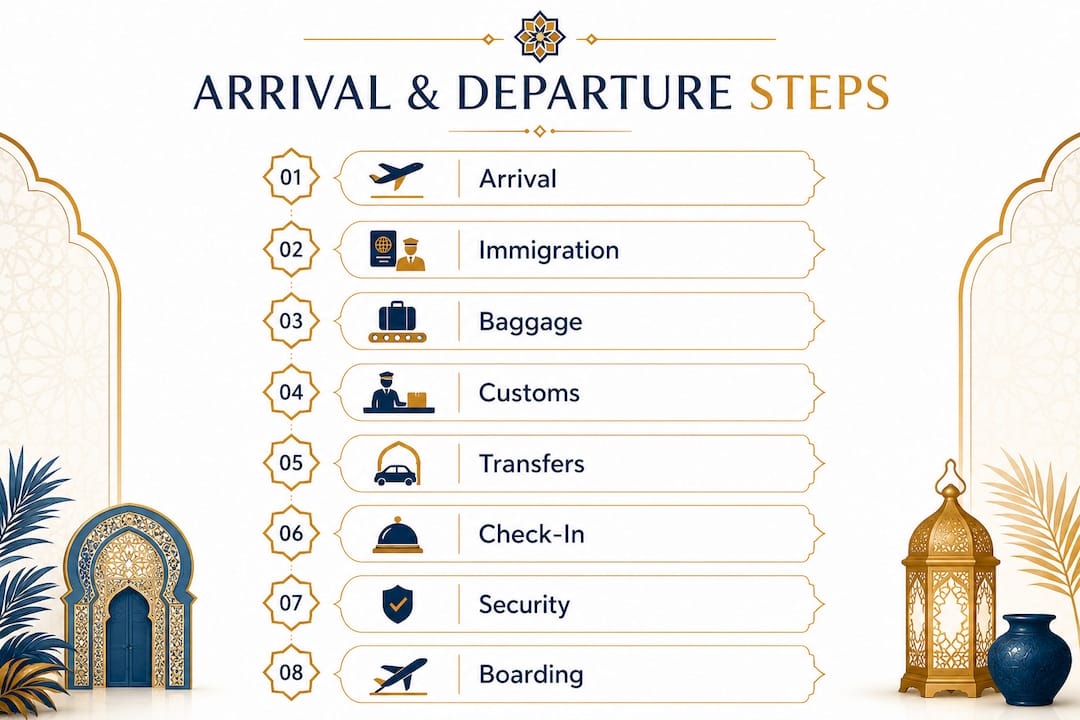
Morocco’s airports follow a consistent arrival sequence: immigration, baggage claim, customs, and then the public arrivals hall. Understanding each step before you land saves time and prevents avoidable mistakes.
Immigration and entry documents
Bring your passport, a return or onward ticket, and proof of accommodation for your first night. Most nationalities do not fill out a paper arrival card anymore, but officers may ask for one at smaller airports, so carry a pen. The officer will stamp your passport and note your 90-day permitted stay. The process moves quickly at off-peak hours but can slow significantly during morning rushes at Casablanca Mohammed V International Airport (CMN) and Marrakech Menara Airport (RAK).
Baggage claim and customs
After immigration, follow the signs to the baggage carousels. Moroccan customs use the standard red and green channel system. The green channel is for travelers with nothing to declare beyond personal effects. The red channel is for anyone carrying goods above the duty-free threshold, large amounts of foreign currency, or commercial items. Customs officers do conduct spot checks in the green channel, so do not carry undeclared electronics or large cash amounts.
Airport amenities and connectivity
ONDA-WiFi is available free at all major terminals, though the speed suits messaging and email rather than video streaming. Currency exchange counters operate in the arrivals hall at CMN and RAK, but airport exchange rates run 2–3% less favorable than city ATMs. Use the airport counter only for enough cash to cover your taxi or transfer, then withdraw more from a city ATM once you reach your hotel.
Key amenities you will find at CMN and RAK:
- Free ONDA-WiFi throughout terminals
- ATMs from major Moroccan banks (Attijariwafa, CIH, BMCE)
- Currency exchange counters in arrivals and departures
- Cafés, pharmacies, and convenience shops
- Prayer rooms and baby care facilities
- Tourist information desks in the arrivals hall
Pro Tip: Withdraw Moroccan dirhams (MAD) from a bank ATM inside the terminal rather than exchanging cash at the counter. You will get a better rate and avoid the queue at peak arrival times.
How do you get from Moroccan airports to city centers?
Transportation from Moroccan airports varies by city, budget, and how much luggage you are carrying. The options range from a train costing less than $5 to a private transfer arranged before you land.

Casablanca Mohammed V Airport (CMN)
CMN is Morocco’s main hub, handling around 10 million passengers annually across two terminals connected by a free shuttle. The ONCF train is the fastest and cheapest option. It costs approximately 45 MAD (about $5) and takes 35–45 minutes to reach Casa-Voyageurs station in the city center. Trains run regularly throughout the day and connect to the national rail network, making CMN the natural choice for travelers heading to Rabat, Fez, or Marrakech by rail.
Private taxis from CMN run 250–500 MAD depending on the vehicle type and time of day. That price gap reflects whether you take a small Petit Taxi or a larger Grand Taxi, and whether you negotiate before getting in. Always confirm the fare before departure.
Marrakech Menara Airport (RAK)
RAK sits just 6 km from the medina, making it one of the most conveniently located airports in North Africa. Regulated official taxi fares run 70–120 MAD during the day and 100–150 MAD after 10:00 PM. The short distance means most travelers reach their riad or hotel within 15 minutes.
| Airport | City center distance | Budget option | Approx. cost | Travel time |
|---|---|---|---|---|
| Casablanca CMN | ~30 km | ONCF train | ~45 MAD | 35–45 min |
| Casablanca CMN | ~30 km | Private taxi | 250–500 MAD | 30–50 min |
| Marrakech RAK | ~6 km | Official taxi | 70–150 MAD | 10–20 min |
| Fez FEZ | ~15 km | Grand Taxi | ~100 MAD | 20–30 min |
| Agadir AGA | ~28 km | Airport bus | ~30 MAD | 40–50 min |
Pro Tip: Book your airport transfer in advance through your hotel or a licensed operator. You avoid fare negotiation entirely, and the driver meets you in the arrivals hall with a name sign. Moroccotours arranges private airport transfers as part of most tour packages, which removes this stress completely.
Unlicensed drivers approach travelers in the arrivals hall at both CMN and RAK. They often quote prices that sound reasonable but climb once you are in the vehicle. Use only taxis with an official meter or a pre-agreed fixed fare confirmed in writing or by your hotel.
What departure tips prevent delays at Moroccan airports?
Departing Morocco requires more attention than most travelers expect. A few specific rules apply here that do not exist at European or American airports.
Arrive early and check in at the counter
Arrive at least 3 hours before your international flight. Moroccan airports run thorough security and passport control, and queues build fast during morning peaks and holiday periods. Marrakech airport sees its heaviest crowds between 7:00 AM and 10:00 AM and on weekend evenings, particularly around Eid holidays.
Even if you checked in online and carry only hand luggage, you must present yourself at the airline check-in counter. This is a mandatory step at Moroccan airports. Officers verify your travel documents in person before issuing a boarding pass stamp. Skipping this step causes delays at the security checkpoint and can result in missing your flight.
Currency and customs at departure
- Exchange all leftover Moroccan dirhams before passing through departure immigration.
- Dirhams are a closed currency and cannot legally be exported beyond small amounts.
- Customs officers at the departure gate check for undeclared currency. Large amounts of MAD without official exchange receipts create exit problems.
- Keep your exchange receipts from any bureau de change transaction during your trip. Officers may ask to see them.
- Foreign currency (euros, dollars, pounds) can be taken out freely up to the amount you declared on entry.
Additional departure checklist:
- Confirm your terminal at CMN (T1 or T2) before arriving at the airport, as the free shuttle adds time.
- Remove liquids, laptops, and belts before the security scanner to avoid secondary screening.
- Boarding at Moroccan airports often involves a bus transfer to the aircraft on the tarmac. Budget extra time after the gate opens.
- Duty-free shops are located after passport control, not before. Do not plan to buy gifts before security.
Which airport should you fly into for your Morocco trip?
Choosing the right airport depends on your final destination, your budget, and how you plan to travel once you land.
Matching airports to destinations
Marrakech Menara Airport suits first-time visitors best. The city is compact, the airport is close, and the medina is walkable from most hotels. Travelers heading to the Atlas Mountains, Ouarzazate, or the Sahara also benefit from flying into RAK, since road connections south are direct. Casablanca Mohammed V Airport works better for travelers who plan to use Morocco’s high-speed rail network (Al Boraq) to reach Rabat or Tangier, or who want to explore multiple imperial cities in one trip.
Fez Saïss Airport (FEZ) is the right choice for travelers focused on the northern medina circuit, including Fez, Meknes, and Chefchaouen. Agadir Al Massira Airport (AGA) serves the Atlantic coast and is the primary gateway for beach-focused itineraries. For best Morocco destinations beyond the main cities, secondary airports like Ouarzazate (OZZ) and Dakhla (VIL) offer direct access to remote regions.
How to book flights at the best price
Booking 2–3 months in advance and flying midweek, especially on Tuesdays, can reduce flight costs by 40–50% compared to last-minute weekend bookings. That is a meaningful saving on transatlantic or long-haul routes. Low-cost carriers serve Morocco well but tend to operate from secondary airports outside city centers, which adds transfer time and cost. Factor in the full door-to-door price, not just the ticket fare, when comparing options.
| Airport | Best for | Key airlines | Rail connection |
|---|---|---|---|
| Casablanca CMN | Multi-city trips, rail travel | Royal Air Maroc, Air France, Iberia | Yes, ONCF direct |
| Marrakech RAK | First-time visitors, southern routes | easyJet, Ryanair, Royal Air Maroc | No |
| Fez FEZ | Northern medina circuit | Ryanair, Transavia | No |
| Agadir AGA | Beach and Atlantic coast | TUI, Ryanair | No |
Pro Tip: Set a price alert on Google Flights for your target route 3 months out. Fares to Morocco fluctuate significantly week to week. A Tuesday departure from a European hub to CMN or RAK consistently prices lower than a Friday or Sunday departure.
For a full breakdown of flight booking strategies specific to Morocco, including airline route maps and seasonal pricing patterns, Moroccotours publishes a regularly updated guide.
Key Takeaways
Arriving in Morocco goes smoothly when you know the rules on entry documents, airport transfers, and departure procedures before you land.
| Point | Details |
|---|---|
| Visa-free entry | Over 70 nationalities get 90 days; the passport must be valid for at least 6 months beyond entry. |
| Airport transfers | The ONCF train from CMN costs ~45 MAD; Marrakech taxis run 70–150 MAD depending on time of day. |
| Mandatory counter check-in | You must visit the airline counter even with online check-in or risk delays at security. |
| Dirham export restriction | Exchange all leftover MAD before departure immigration; the currency cannot legally leave Morocco. |
| Airport choice | Fly into RAK for Marrakech and the south; use CMN for rail connections to northern cities. |
What I’ve learned after years of routing travelers through Moroccan airports
The single most common mistake I see travelers make is treating Moroccan airports like European ones. They check in online, skip the counter, and then stand confused at security when an officer sends them back. That mandatory counter visit is not a formality. It is a document verification step that the airline and Moroccan authorities both require. Missing it costs you 20 minutes at minimum and your flight at worst.
The currency issue catches people off guard too. Travelers arrive, exchange $200 at the airport counter, spend most of it, and then try to take the remaining 300 MAD home as a souvenir. Customs officers at departure are not flexible on this. Exchange your leftover dirhams at the airport bureau de change before you go through passport control. The process takes five minutes and prevents a real problem.
On the transfer question, I always recommend pre-booking for first-time visitors. The arrivals hall at CMN and RAK can feel chaotic after a long flight, especially when unlicensed drivers are calling out to you. A driver holding a sign with your name removes that pressure entirely. The price difference between a pre-booked private transfer and a negotiated taxi is often smaller than people expect, and the comfort difference is significant.
One more thing worth knowing: ONDA-WiFi works fine for sending a message to your hotel or checking your onward train time. Do not rely on it for anything more demanding. Download your maps, boarding passes, and hotel confirmations before you land.
— MoroccoTours.co
Planning your Morocco trip beyond the airport
Arriving at a Moroccan airport is the start, not the finish. Moroccotours specializes in luxury Morocco tours that include private airport transfers, expert local guides, and fully customized itineraries across the imperial cities, the Sahara, and the Atlantic coast. Every package is built around your schedule, your preferred airports, and your travel style. Whether you are flying into Marrakech for a medina experience or landing in Casablanca before heading south by rail, Moroccotours.co handles the logistics so you can focus on the experience. Reach out to the team to build a trip that starts the moment your flight lands.
FAQ
What documents do I need to enter Morocco?
A valid passport with at least 6 months of remaining validity is required. Most nationalities receive a 90-day visa-free stamp on arrival.
Do I need to visit the airline counter if I checked in online?
Yes. Moroccan airports require all passengers to present at the airline check-in counter in person, even with online check-in and hand luggage only, to verify travel documents.
What is the cheapest way to get from Casablanca Airport to the city?
The ONCF train costs approximately 45 MAD (about $5) and takes 35–45 minutes to reach the city center, making it the most affordable and reliable option.
Can I take Moroccan dirhams home after my trip?
No. The Moroccan dirham is a closed currency and cannot legally be exported. Exchange any remaining MAD at the airport bureau de change before passing through departure immigration.
When is the best time to book flights to Morocco?
Booking 2–3 months in advance and choosing midweek departures, particularly Tuesdays, can lower flight costs by up to 50% compared to last-minute weekend bookings.
Itinerary Expand all Collapse all
Included
Price
Related Tours
Morocco Desert Tour
Northern Morocco Tour

Morocco Family Tour

Morocco Spain Tour
Morocco Trekking Tour
Morocco Highlights Tour
Morocco Group Tour
Morocco Jewish Tour

Morocco Honeymoon Tour
Morocco Food Tour

Morocco Golf Tour
Morocco Photography Tour
Morocco Signature Tour
Morocco Imperial Cities Tour
Morocco Grand Tour

Is Morocco Safe for Solo Women? Your Guide

Morocco Itinerary Guide: 7, 10, and 14 Days
Is Morocco Safe for Tourists? Your Guide
Morocco Travel Tips for First Time Visitors

How Many Days Do You Need in Morocco

What to Know Before Visiting Morocco

10 Mistakes Travelers Make in Morocco

Morocco Travel Agency: Plan Your Luxury Tour

Morocco Visa Guide: Requirements and How to Apply

Morocco for Seniors: A Comfort-First Travel Guide

Luxury Morocco Travel: The Guide for Discerning Travelers

Morocco Train Guide: Routes, Tickets, and Tips

Internet in Morocco: Your Connectivity Guide

Morocco Airport Guide: Arrive and Depart With Confidence

Morocco with Kids: The Family Travel Guide
