
Internet in Morocco: Your Connectivity Guide
Highlights
- Morocco has a highly connected population with over 92 percent internet penetration and extensive 4G coverage.
- The country offers mobile broadband, fixed fiber, and wireless options, with fast speeds in cities and limited rural access.
- Travelers should choose between physical SIMs and eSIMs based on trip length and location, especially for rural areas.
Morocco’s internet penetration rate stands at 92.2%, making it one of Africa’s most connected nations. For expats, digital nomads, and tourists, that number translates into real, usable connectivity across most of the country. The internet in Morocco runs on a mix of 4G mobile networks, rapidly expanding 5G, and growing fiber broadband infrastructure. Urban centers like Casablanca, Rabat, and Marrakech offer speeds comparable to Western Europe, while remote areas require more planning. This guide covers every option available, from prepaid SIM cards to fiber plans, so you can stay connected from the moment you land.
What are the main types of internet connections in Morocco?
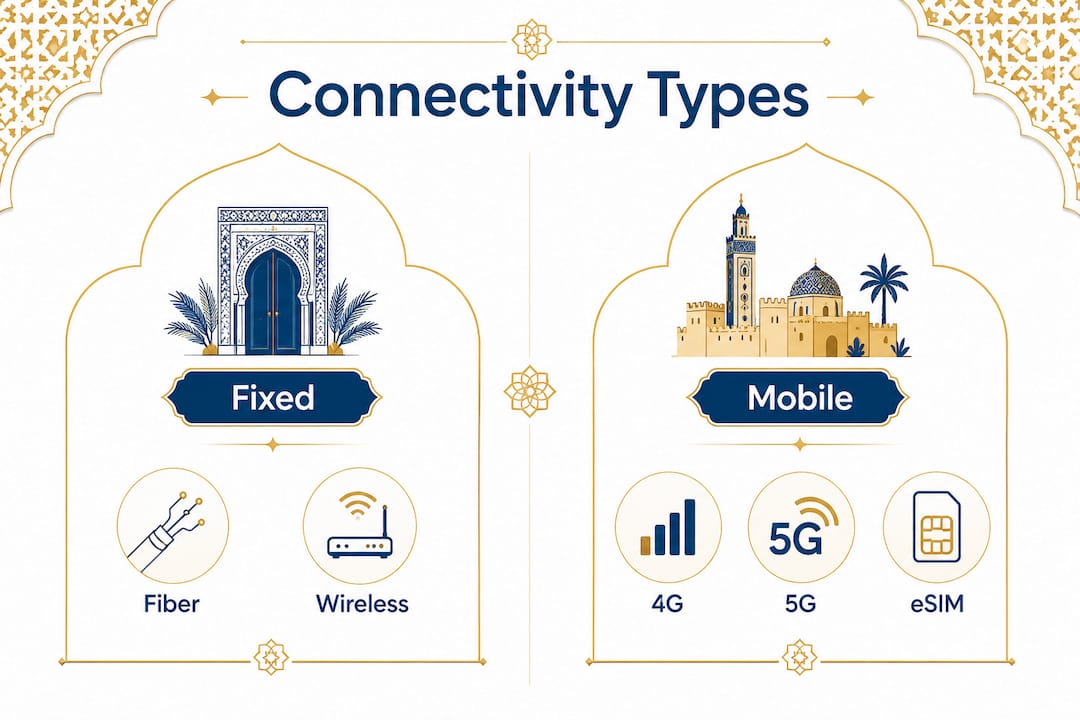
Morocco’s connectivity infrastructure divides into three main categories: mobile broadband, fixed fiber, and fixed wireless access. Each serves a different user profile, and understanding the differences saves you time and money.
Mobile broadband: the dominant option
Mobile internet is the backbone of connectivity in Morocco. The country has over 41 million internet subscriptions, with mobile connections accounting for the vast majority. That scale means competition between carriers is real, which keeps prices reasonable and pushes coverage improvements. 4G coverage reaches 97% of Morocco’s population by landmass, with urban smartphone penetration near 100%. The median mobile internet speed sits at 33.4 Mbps, which handles video calls, streaming, and remote work without issues.
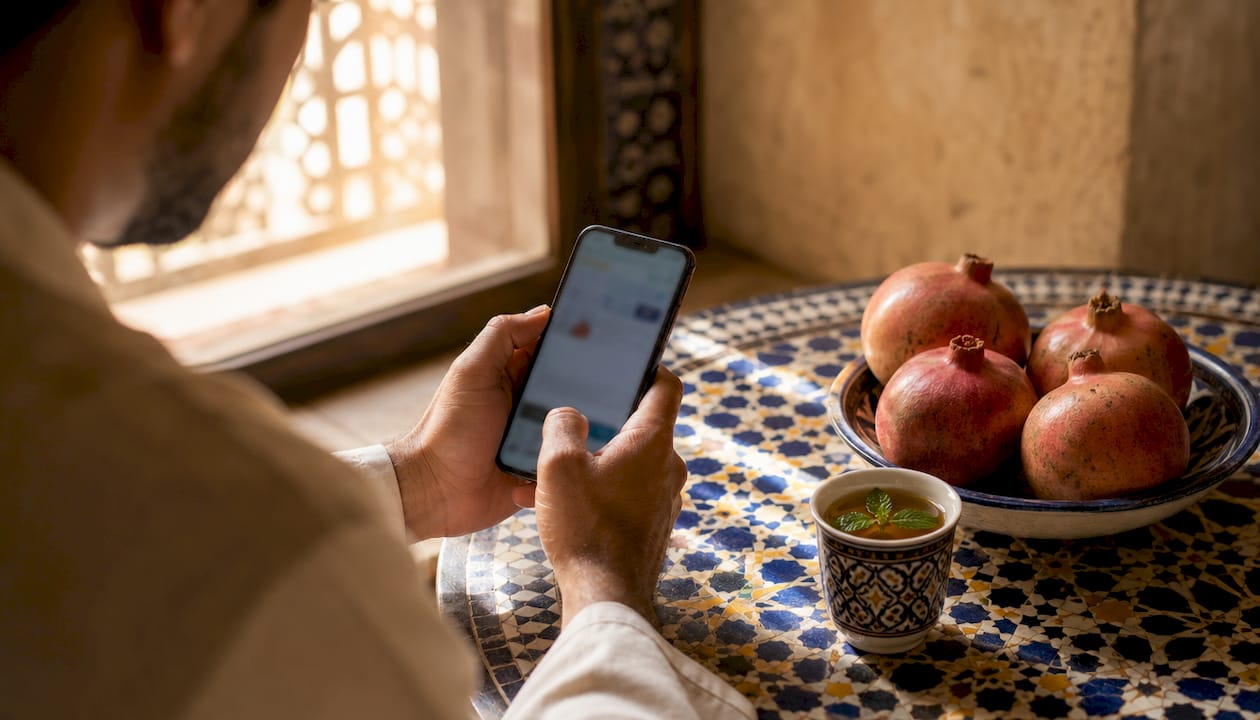
5G is growing fast. Major Moroccan operators ended Q1 2026 with 3.22 million 5G connections across 8,400 cell sites. That represents 8.4% of all mobile internet connections, a share that will climb quickly under the Maroc Digital 2030 strategy, which targets 70–85% 5G population coverage by 2028.
Fixed fiber broadband: fast and growing
Fiber-to-the-home (FTTH) is the standard term for direct fiber connections to residential buildings. Morocco’s median fixed broadband download speed is approximately 78.70 Mbps, and FTTH lines now represent 48% of all fixed broadband connections. Fiber plans range from 199 MAD per month for 30 Mbps entry-level service to 899 MAD for gigabit speeds. Maroc Telecom holds the largest market share at 38%, though its FiberCo partnership with Inwi uses shared infrastructure to reduce deployment costs and accelerate nationwide expansion.
Fixed wireless access: the rural bridge
Fixed wireless access (FWA) uses mobile network signals to deliver home broadband without laying cables. It fills coverage gaps in mountainous and rural zones where fiber installation is not yet economical. FWA is not the fastest option, but it brings usable broadband to areas that would otherwise rely on slow or unreliable connections.
Here is a quick comparison of the three main connection types:
| Connection type | Typical speed | Best for | Approximate cost |
|---|---|---|---|
| 4G mobile | 20–50 Mbps | Travelers, short stays | 50–100 MAD prepaid |
| 5G mobile | 100–300 Mbps | Urban power users | Premium prepaid plans |
| FTTH fiber | 30–1,000 Mbps | Expats, long-term residents | 199–899 MAD per month |
| Fixed wireless | 10–30 Mbps | Rural residents | Varies by provider |
Key features of Morocco’s mobile internet market:
- Three major carriers: Maroc Telecom, Orange Morocco, and Inwi
- Prepaid tourist plans available at airports and city kiosks
- Dual-SIM and eSIM support on most modern smartphones
- Quad-play fiber bundles combining internet, TV, phone, and mobile
How to get connected in Morocco: SIM cards vs. eSIMs
Getting online in Morocco is straightforward once you know which route fits your trip. The two main options are a physical SIM card and an eSIM, and the right choice depends on your trip length, device, and itinerary.
Physical SIM cards: the reliable standard
Physical SIM cards from Maroc Telecom, Orange Morocco, and Inwi are sold at airports, city kiosks, and carrier stores across the country. Traveler SIM cards cost between 50 and 100 MAD, with data packages ranging from 5GB to 20GB priced at roughly 5–20 EUR. Activation takes 10–15 minutes and requires your passport. Moroccan telecommunication law mandates passport registration for all SIM purchases, so bring your document even for a quick airport stop.
Airport kiosks in Marrakech operate from early morning until around 9 PM. Casablanca’s Mohammed V International Airport offers 24-hour service. Maroc Telecom’s kiosks are generally the most staffed and efficient, which matters when you arrive on a late flight and want to get online quickly.
The process for buying a physical SIM follows these steps:
- Locate the carrier kiosk at the arrivals hall (Maroc Telecom, Orange, or Inwi are all present at major airports).
- Present your passport for mandatory registration.
- Choose a prepaid data package that matches your expected usage.
- Wait 10–15 minutes for activation and SIM configuration.
- Insert the SIM, restart your phone, and confirm data connectivity with a speed test.
- Top up online or at any carrier store when your data runs low.
Pro Tip: Buy your SIM before leaving the airport. City center kiosks sometimes run out of tourist-specific packages during peak travel months like july and august.
eSIMs: the modern traveler’s shortcut
An eSIM is a digital SIM built into your phone that you activate remotely. eSIM technology allows you to purchase and activate a data plan before you arrive, so your phone connects the moment you step off the plane. No queues, no kiosk, no waiting. This is the single biggest advantage eSIMs offer over physical cards.
eSIMs work best for trips shorter than three days or for the critical first hours in the country. For longer stays, a physical SIM from a local carrier typically offers better value and more flexible top-up options. Check that your device supports eSIM before departure. Most flagship smartphones released after 2020 do, but budget Android models often do not.
For travelers heading into rural Morocco or the Sahara, Maroc Telecom offers the widest and most reliable coverage in remote areas, including the Atlas Mountains. Orange and Inwi primarily serve urban centers. If your itinerary includes desert excursions or mountain trekking, Maroc Telecom is the correct carrier choice regardless of whether you use a physical SIM or eSIM.
Pro Tip: Keep your home SIM active in a dual-SIM slot or via eSIM while using a local Moroccan SIM for data. This lets you receive banking verification codes and calls on your home number without paying international roaming rates.
What is internet quality like in cities versus remote areas?
The gap between urban and rural connectivity in Morocco is real, but it is narrowing faster than most travelers expect.
Urban centers: fast and reliable
Casablanca, Rabat, Marrakech, Fez, and Tangier all offer strong 4G and growing 5G coverage. Fixed broadband in these cities regularly delivers speeds near the national median of 78.70 Mbps. Most hotels, riads, and cafes provide Wi-Fi, though speeds vary. Checking Wi-Fi availability in Morocco accommodations before booking is worth the extra step, especially if you plan to work remotely. Urban areas also have the densest carrier retail presence, making top-ups and plan changes easy.
Key urban connectivity facts:
- Casablanca and Rabat have the highest concentration of 5G cell sites
- Marrakech’s medina has strong 4G signal despite its dense, historic architecture
- Public Wi-Fi is available in major shopping centers, some cafes, and select public squares
- Most luxury accommodations offer dedicated high-speed connections for guests
Rural and remote areas: plan ahead
Coverage drops noticeably outside major cities. Mountainous terrain in the Atlas range and the Sahara Desert create signal gaps that no carrier fully solves. In Erg Chebbi near Merzouga, signal can drop to 2G or disappear entirely at desert campsites. That is not a minor inconvenience if you rely on navigation apps or need to communicate with family. Download offline maps using Google Maps or Maps.me before leaving your last urban stop. Maroc Telecom consistently outperforms other carriers in rural reach, making it the default recommendation for anyone venturing off the main tourist circuit.
Coastal towns like Essaouira and Agadir have solid 4G coverage. Smaller villages in the Rif Mountains and High Atlas are patchier. The practical rule: the further you are from a paved road, the less you should rely on mobile data.
How to choose the best broadband plan in Morocco for your needs
The right plan depends on three variables: how long you are staying, how much data you use, and what your device supports.
Short trips of one to seven days call for a prepaid eSIM or a small physical SIM package. A 5GB package covers light browsing, maps, and messaging for most short visits. Medium trips of one to four weeks benefit from a larger prepaid package in the 15–20GB range, which costs roughly 15–20 EUR and handles video calls and occasional streaming. Stays longer than a month make a monthly postpaid plan or a fiber subscription worth considering, especially if you are working remotely.
For residents and long-term expats, fiber plans offer the best value per megabit. 40% of new FTTH customers choose quad-play bundles combining internet, TV, phone, and mobile service. That bundling reflects how Moroccan ISPs are competing on total household value, not just raw speed. If you are settling in Casablanca or Rabat for six months or more, a quad-play fiber plan from Maroc Telecom or Inwi delivers the most complete package.
Device compatibility is a non-negotiable check before you buy anything. Confirm your phone is SIM-unlocked. Verify eSIM support in your device settings. Check that your phone supports the frequency bands used by Moroccan carriers, specifically Band 3 and Band 7 for 4G. Most international flagship phones cover these bands, but older or regionally locked devices may not.
The technology shaping how travelers stay connected abroad is evolving fast. Understanding how technology shapes modern travel helps you make smarter decisions about connectivity before you leave home.
Practical tips for staying connected safely and effectively
Getting online in Morocco is easy. Staying connected reliably and securely requires a few deliberate habits.
- Avoid roaming charges entirely. Switch your home SIM to airplane mode and use a local Moroccan SIM or eSIM for all data. Roaming fees from European and American carriers in Morocco can reach several dollars per megabyte.
- Test your SIM immediately after activation. Run a speed test and load a webpage before leaving the airport or kiosk. Problems are far easier to resolve on-site than after you have checked into your accommodation.
- Download offline maps before remote travel. Google Maps and Maps.me both support offline downloads. Download the regions you plan to visit while you still have a strong connection in the city.
- Use a VPN on public Wi-Fi. Cafe and hotel Wi-Fi networks in Morocco are generally safe, but a VPN adds a layer of protection for banking and sensitive accounts.
- Carry a portable power bank. Heavy data use drains batteries faster, especially when your phone is searching for signal in low-coverage areas. A 10,000 mAh power bank covers most day trips.
- Know your kiosk hours. Marrakech airport kiosks close around 9 PM. If you arrive late, plan to use an eSIM or hotel Wi-Fi until morning.
Pro Tip: If you are traveling to Morocco from another country where connectivity planning is a concern, the same principles apply. A guide on staying connected abroad covers the universal framework for managing SIMs, eSIMs, and roaming across international borders.
For first-time visitors, reviewing Morocco travel tips before departure covers connectivity alongside visa requirements, currency, and cultural norms, all in one place.
Key Takeaways
Morocco’s mobile and fiber infrastructure delivers reliable connectivity for most travelers, with Maroc Telecom offering the widest rural coverage and eSIMs providing the fastest path to arrival-day connectivity.
| Point | Details |
|---|---|
| High penetration rate | Morocco’s internet penetration sits at 92.2%, with 4G covering 97% of the population. |
| eSIM for short trips | Activate a data plan before arrival to skip airport queues and connect instantly on landing. |
| Maroc Telecom for rural travel | Choose Maroc Telecom when your itinerary includes the Sahara, Atlas Mountains, or small villages. |
| Fiber for long stays | FTTH plans range from 199 MAD to 899 MAD monthly, with quad-play bundles available for residents. |
| Offline maps are non-negotiable | Download maps before leaving cities, as signal drops to 2G or zero in Erg Chebbi and remote campsites. |
What I have learned about internet in Morocco after years of travel planning
After planning dozens of trips across Morocco for clients ranging from solo digital nomads to large family groups, one pattern holds consistently: travelers overestimate urban coverage and underestimate rural gaps.
Casablanca and Marrakech genuinely rival European cities for mobile speed and reliability. I have run video calls from a riad rooftop in the Marrakech medina without a single drop. The 4G signal there is that good. But the moment a client heads toward Erg Chebbi or a remote Atlas village, the rules change completely. I have seen travelers arrive at a desert camp expecting 4G and find nothing but a faint 2G edge signal, if that.
My personal recommendation for most travelers is to arrive with an eSIM already activated. It removes the single most stressful part of international arrival, which is getting online before you can navigate or communicate. For anyone staying longer than a week, switch to a physical Maroc Telecom SIM. The coverage advantage in rural areas is not marginal. It is the difference between reaching your guide and being unreachable.
The Maroc Digital 2030 strategy is real and moving fast. 5G is already live in major cities, and the infrastructure investment is visible. Morocco is not a connectivity risk destination. It is a destination where a little preparation turns a potential frustration into a non-issue.
— MoroccoTours.co
Planning your Morocco trip with connectivity in mind
Connectivity is one piece of a well-planned Morocco experience. MoroccoTours.co specializes in building private, luxury Morocco tours that account for every practical detail, including accommodation with reliable Wi-Fi, guides who know where signal drops, and itineraries that balance remote adventure with urban comfort. Whether you are planning a Sahara Desert expedition, an imperial cities circuit, or a coastal retreat, MoroccoTours.co handles the logistics so you can focus on the experience. Clients traveling with MoroccoTours.co get expert local knowledge built into every stage of their trip. Explore the full range of guided Morocco tours to find the itinerary that fits your travel style and connectivity needs.
FAQ
What is the internet speed in Morocco?
Morocco’s median mobile internet speed is 33.4 Mbps, while fixed broadband averages approximately 78.70 Mbps. Urban areas with 5G access can exceed 100 Mbps on mobile.
Which SIM card is best for tourists in Morocco?
Maroc Telecom is the best choice for travelers visiting rural or remote areas due to its superior national coverage. Orange and Inwi offer competitive urban plans at slightly lower prices.
Do I need a passport to buy a SIM card in Morocco?
Yes. Moroccan telecommunication law requires passport registration for all SIM card purchases. The process takes 10–15 minutes at any airport kiosk or carrier store.
Is eSIM available in Morocco?
eSIM works in Morocco through international eSIM providers that offer Moroccan data plans. You activate the plan before departure and connect automatically on arrival, bypassing airport kiosks entirely.
Does Morocco have 5G internet?
Morocco had 3.22 million active 5G connections as of Q1 2026, served by 8,400 cell sites. The Maroc Digital 2030 plan targets 70–85% population coverage by 2028.
Itinerary Expand all Collapse all
Included
Price
Related Tours

Morocco Desert Tour
Northern Morocco Tour

Morocco Family Tour

Morocco Spain Tour

Morocco Trekking Tour

Morocco Highlights Tour

Morocco Group Tour
Morocco Jewish Tour

Morocco Honeymoon Tour

Morocco Food Tour

Morocco Golf Tour
Morocco Photography Tour
Morocco Signature Tour
Morocco Imperial Cities Tour
Morocco Grand Tour

Is Morocco Safe for Solo Women? Your Guide

Morocco Itinerary Guide: 7, 10, and 14 Days

Is Morocco Safe for Tourists? Your Guide
Morocco Travel Tips for First Time Visitors

How Many Days Do You Need in Morocco

What to Know Before Visiting Morocco

10 Mistakes Travelers Make in Morocco

Morocco Travel Agency: Plan Your Luxury Tour

Morocco Visa Guide: Requirements and How to Apply

Morocco for Seniors: A Comfort-First Travel Guide

Luxury Morocco Travel: The Guide for Discerning Travelers

Morocco Train Guide: Routes, Tickets, and Tips

Internet in Morocco: Your Connectivity Guide

Morocco Airport Guide: Arrive and Depart With Confidence

Morocco with Kids: The Family Travel Guide
