
Morocco Jewish Heritage Guide: Sites, History & Culture
Highlights
What makes a Jewish heritage tour in Morocco different?
A Jewish heritage tour in Morocco is not a standard sightseeing trip with a few synagogues added to the itinerary. It is a structured journey through 2,500 years of continuous Jewish presence, taking you into mellahs (historic Jewish quarters), working synagogues, ancient cemeteries, and living communities that still observe Moroccan Jewish traditions today. The experience blends religious history, Andalusian architecture, shared Muslim-Jewish mysticism, and a cultural identity that survived mass emigration and continues to evolve.
What sets these tours apart from general Morocco travel?
- Living communities, not just ruins. Casablanca hosts Morocco’s largest active Jewish community, with functioning synagogues and the Museum of Moroccan Judaism, the only Jewish museum in the Arab world.
- Architectural layering. Synagogues like the Moshe Nahon Synagogue in Tangier reflect Andalusian design, while sites in Fez and Marrakech show Amazigh and Arabized Jewish influences.
- Guided interpretation. Specialists like Tzadikim Tours and guide Raphy Elmaleh provide access to private or lesser-known sites that a solo traveler would simply walk past.
- Cultural depth. You encounter Judeo-Spanish music traditions, shared saint pilgrimages with Muslim neighbors, and Mimouna festival customs that have no parallel elsewhere in the world.
The result is a travel experience that rewards curiosity. You are not observing a preserved artifact. You are stepping into a culture that is still being lived.
Which Moroccan cities should you prioritize for Jewish heritage?
Morocco’s Jewish heritage is spread across the country, but certain cities carry more historical and cultural weight than others.
Casablanca is the starting point for most travelers. The city holds Morocco’s largest active Jewish community, the Museum of Moroccan Judaism, and several functioning synagogues. The Alliance Israélite Universelle, founded in 1860 partly in response to the persecution of Moroccan Jews, established schools here that shaped modern Moroccan Jewish identity.
Fez is the oldest and arguably the most layered stop. The mellah of Fez dates to the 15th century, and the city’s Jewish community experienced a golden age from the 9th to 11th centuries before the 1033 Fez massacre, an isolated event tied to political conflict between rival Moroccan tribes. The Jewish cemetery in Fez counts thousands of graves and is part of King Mohammed VI’s ongoing restoration initiative.
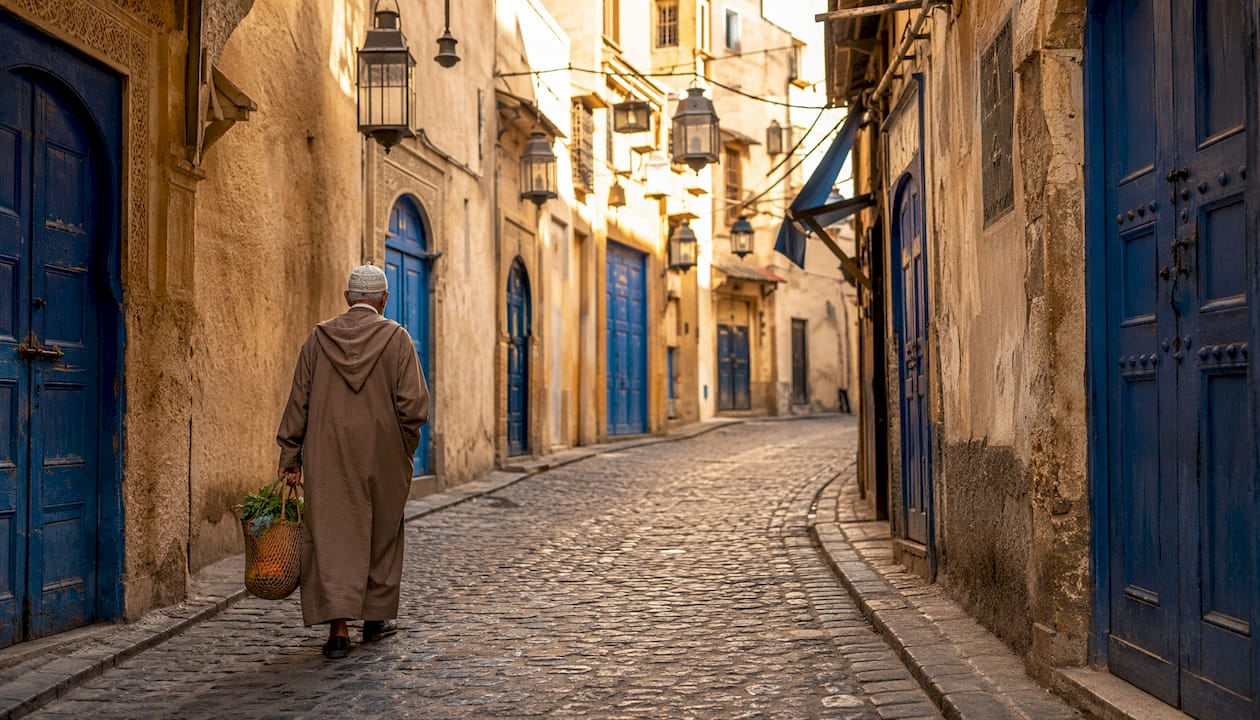
Marrakech holds a well-preserved mellah adjacent to the royal palace, along with the Slat Alfassiyine synagogue, one of the oldest in the city. The Lazama synagogue is another active site worth visiting.
Meknes and Rabat each have historic mellahs and cemeteries. Rabat’s mellah sits near the medina and offers a quieter, less-visited alternative to the larger cities.
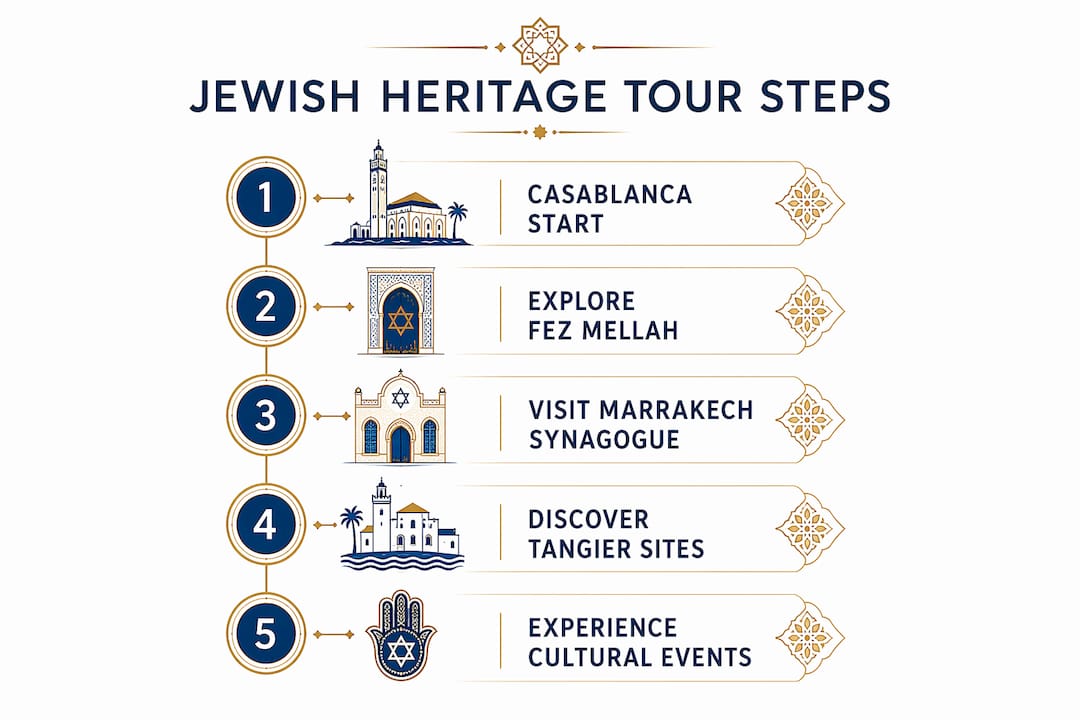
Tangier is home to the Moshe Nahon Synagogue, a restored Andalusian-style building that now doubles as an art museum. The city’s international character through the 20th century made it a hub for Jewish merchants and intellectuals.
Essaouira carries a distinct history. Elite Jewish merchants known as Tujjar as-Sultan handled much of Morocco’s long-distance trade from this port city in the 19th century, and the mellah here reflects that commercial prominence.
Pro Tip: If you are traveling between cities, plan Fez and Meknes together. They are roughly an hour apart by train, and both mellahs are walkable from the medinas.
What are the most important Jewish sites and museums to visit?
Museum of Moroccan Judaism, Casablanca
This is the anchor of any serious visit to Jewish heritage sites in Morocco. Located in the Oasis neighborhood of Casablanca, it is the only Jewish museum in the Arab world and documents more than 2,000 years of Jewish life through religious objects, photographs, manuscripts, and reconstructed domestic spaces. The collection covers everything from Torah scrolls to traditional Moroccan Jewish wedding costumes.
Moshe Nahon Synagogue, Tangier
Restored in the 1990s, the Moshe Nahon Synagogue is one of Morocco’s most visually striking Jewish buildings. Its Andalusian architectural style sets it apart from synagogues elsewhere in the country, and the interior now houses a collection of Jewish art and historical artifacts. Visiting it alongside Tangier’s Grand Socco and the medina gives you a full picture of how Jewish life integrated into this cosmopolitan port city.
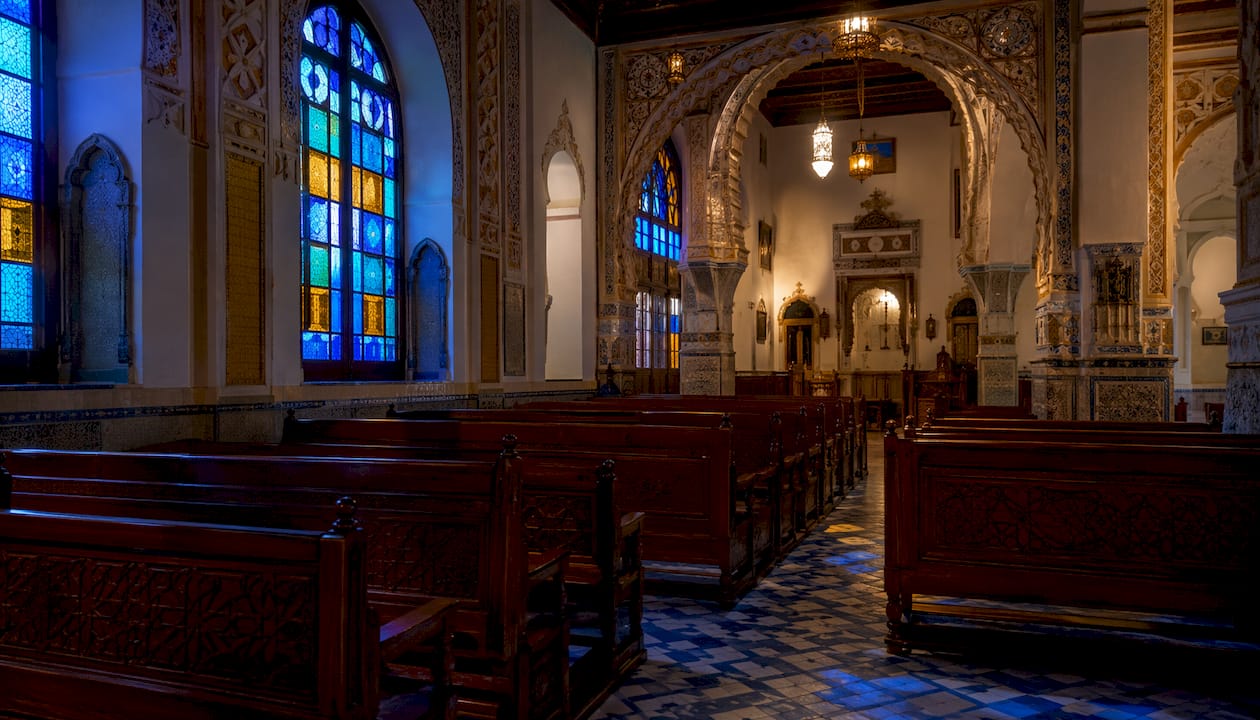
Slat Alfassiyine, Marrakech
One of Marrakech’s oldest synagogues, Slat Alfassiyine sits inside the mellah and remains an active place of worship. The name references the Jews of Fez who settled here after fleeing persecution. The interior is modest but historically rich, and the surrounding mellah streets still carry the layout of a 16th-century Jewish quarter.
Jewish cemeteries
Morocco’s Jewish cemeteries are among the most moving sites on any heritage tour. The cemetery in Fez is the largest, with thousands of graves, including those of revered rabbis whose tombs attract both Jewish and Muslim pilgrims. This shared veneration of saints’ tombs, where both communities pray at the same sites, is one of the most striking expressions of Moroccan Jewish-Muslim coexistence.
Pro Tip: Dress modestly at all religious sites. Women should carry a scarf for synagogue visits, and men may be offered a kippah at the entrance. Photography inside active synagogues requires permission.
Numbered checklist for first-time visitors:
- Museum of Moroccan Judaism (Casablanca) — allocate at least two hours
- Moshe Nahon Synagogue (Tangier) — one hour, combine with medina walk
- Slat Alfassiyine (Marrakech) — thirty minutes, pair with mellah exploration
- Jewish Cemetery of Fez — one hour, ideally with a guide who can identify notable graves
- Essaouira mellah — half day, best explored on foot with a local guide
How do you find a trustworthy guide for Jewish heritage tours?
The difference between a good Jewish heritage tour and a great one almost always comes down to the guide. Morocco’s Jewish sites are not uniformly labeled or explained in English, and many of the most meaningful locations are inside private courtyards, active synagogues, or cemeteries that require a local contact to access.
Tzadikim Tours specializes in Jewish heritage travel across Morocco and offers itineraries that combine historical depth with practical logistics. The name itself references the tzadikim, the righteous saints whose tombs are central to Moroccan Jewish pilgrimage culture.
Raphy Elmaleh is one of Morocco’s most respected Jewish heritage guides, known for his deep knowledge of Moroccan Jewish history and his ability to connect travelers with living community members. Both Tzadikim Tours and Raphy Elmaleh are established resources for travelers seeking authentic access to Jewish cultural sites.
Practical booking advice:
- Book guides at least four to six weeks in advance, especially for spring travel when Mimouna and Passover bring additional visitors.
- Ask specifically whether the guide can arrange access to active synagogues and private community spaces, not just public monuments.
- Confirm language options. English-speaking guides are available in Casablanca, Fez, and Marrakech but less common in smaller cities.
- Check whether the itinerary includes cemetery visits, which require specific timing and local permissions.
- Moroccotours offers private Jewish heritage tours with expert local guides and fully customized itineraries across Morocco’s major heritage cities.
- Social media groups focused on Sephardic genealogy and Moroccan Jewish diaspora communities are a useful secondary resource for connecting with guides and local contacts.
- The Diarna project at diarna.org maintains a geographic database of Jewish heritage sites across North Africa and the Middle East, useful for pre-trip research.
Pro Tip: If your family has Moroccan Jewish roots, tell your guide before the tour. Many guides can arrange visits to specific mellahs, cemeteries, or community archives that are relevant to genealogical research.
Why Moroccan Jewish history is more complex than most guides suggest
Moroccan Jewish-Muslim relations over two millennia resist easy summary. The historical record shows genuine periods of coexistence and cultural exchange alongside episodes of persecution, forced relocation, and legal subordination under the dhimmi system. Both realities are true, and understanding that tension makes the heritage sites you visit far more meaningful.
The diversity within Moroccan Jewry itself surprises many travelers. Three distinct layers shaped the community: the Toshavim, Jews of Amazigh and Arabized origin who predated the Arab conquest; the Megorashim, Sephardic Jews expelled from Spain after 1492 who brought the Ladino language and Andalusian liturgical music; and later waves shaped by French colonial influence and the Alliance Israélite Universelle school network. Each layer left architectural and cultural traces that differ by region.
Moroccan Jewish liturgical music reflects this layered history directly. Unlike Eastern Jewish traditions organized around Middle Eastern maqams, Moroccan Jewish religious music is organized around Noubas, the same modal suites used in Andalusian classical music. This is not nostalgia for pre-expulsion Spain. Scholars who have studied the community’s musical practices from 2007 through 2019 found that Judeo-Spanish repertoires function as active identity markers, protecting the community from cultural assimilation rather than simply memorializing a lost homeland.
The living, evolving nature of Moroccan Jewish culture is what ethnographic researchers consistently emphasize. The Mimouna celebration at the end of Passover, the shared pilgrimages to saints’ tombs, and the distinctive cuisine blending kosher law with Moroccan spices and French influence: these are not museum pieces. They are practiced today by diaspora communities in Israel, France, Canada, and the United States, as well as by the small community that remains in Morocco.
Morocco has restored 110 synagogues and remains the only Arab country with a dedicated Jewish museum. King Mohammed VI launched a further initiative in late 2021 to restore hundreds of additional Jewish heritage sites, including cemeteries and synagogues across multiple cities.
Pro Tip: Read at least one scholarly overview of Moroccan Jewish history before your trip. The Jewish Virtual Library’s Morocco entry and the Wikipedia article on Moroccan Jews are both solid starting points that will sharpen what you notice on the ground.
Suggested itineraries for Jewish heritage tours
5-day focused heritage circuit
This itinerary suits travelers who want depth over breadth.
- Day 1–2, Casablanca: Museum of Moroccan Judaism, Beth-El Synagogue, mellah walk
- Day 3, Rabat: Mellah and Jewish cemetery, optional stop at Chellah ruins
- Day 4–5, Fez: Mellah, Jewish cemetery, Ibn Danan Synagogue, medina context
10-day imperial cities and heritage tour
For travelers who want Jewish heritage woven into a broader Morocco experience, Moroccotours’ 11-day heritage itinerary covers Casablanca, Rabat, Fez, Meknes, Marrakech, and Essaouira with private guides at each stop.
- Days 1–2: Casablanca (museum, synagogues, community visit)
- Days 3–4: Fez (mellah, cemetery, Ibn Danan Synagogue)
- Day 5: Meknes (mellah, Moulay Ismail mausoleum for context)
- Days 6–7: Marrakech (Slat Alfassiyine, mellah, Lazama Synagogue)
- Day 8: Essaouira (mellah, port history)
- Days 9–10: Tangier (Moshe Nahon Synagogue, Grand Socco, medina)
Spring travel (march through may) aligns with Mimouna and Passover, when Moroccan Jewish cultural life is most visible. Avoid major Jewish holidays if you want synagogue access rather than closed doors.
For travelers combining heritage with luxury accommodations and private transport, Moroccotours offers fully customized luxury packages that integrate Jewish heritage stops with riads, private drivers, and curated dining.
Key Takeaways
Morocco’s Jewish heritage spans 2,500 years across active communities, restored synagogues, and living cultural traditions that continue in Morocco and in diaspora communities worldwide.
| Point | Details |
|---|---|
| Only Jewish museum in the Arab world | The Museum of Moroccan Judaism in Casablanca documents over 2,000 years of Jewish life. |
| 110 synagogues restored | Morocco has restored 110 synagogues, more than any other Arab country. |
| Population shift | Morocco’s Jewish population declined significantly during the mid-20th century to a small community remaining in recent decades. |
| Distinct musical tradition | Moroccan Jewish liturgy uses Noubas from Andalusian classical music, unlike any other Jewish tradition. |
| Use a specialist guide | Guides like Raphy Elmaleh and Tzadikim Tours provide access to private sites and living community contacts. |
FAQ
What is the best city to start a Jewish heritage tour in Morocco?
Casablanca is the best starting point. It holds the Museum of Moroccan Judaism, the only Jewish museum in the Arab world, and Morocco’s largest active Jewish community.
Are Jewish heritage sites in Morocco open to non-Jewish visitors?
Yes. Most synagogues, museums, and mellahs welcome all visitors, though modest dress is expected and photography inside active synagogues requires permission from staff or community members.
How long does a thorough Jewish heritage tour of Morocco take?
A focused tour covering Casablanca, Fez, Marrakech, and Tangier takes a minimum of seven to ten days. A shorter five-day circuit can cover Casablanca, Rabat, and Fez with meaningful depth.
Who are the most recommended Jewish heritage guides in Morocco?
Raphy Elmaleh and Tzadikim Tours are the most widely cited specialists for Jewish heritage travel in Morocco, offering historical interpretation and access to private community spaces.
When is the best time to visit for cultural immersion?
Spring, particularly around Passover and the Mimouna celebration that follows it, offers the richest cultural experience, with community events and festivals that are not visible at other times of year.
Itinerary Expand all Collapse all
Included
Price
Related Tours
Morocco Desert Tour
Northern Morocco Tour
Morocco Family Tour
Morocco Spain Tour
Morocco Trekking Tour
Morocco Highlights Tour
Morocco Group Tour
Morocco Jewish Tour
Morocco Honeymoon Tour
Morocco Food Tour

Morocco Golf Tour
Morocco Photography Tour
Morocco Signature Tour
Morocco Imperial Cities Tour
Morocco Grand Tour

Is Morocco Safe for Solo Women? Your Guide
Is Morocco Safe for Tourists? Your Guide
Morocco Travel Tips for First Time Visitors

10 Mistakes Travelers Make in Morocco

Morocco Visa Guide: Requirements and How to Apply

Morocco for Seniors: A Comfort-First Travel Guide

Luxury Morocco Travel: The Guide for Discerning Travelers

Morocco Train Guide: Routes, Tickets, and Tips

Internet in Morocco: Your Connectivity Guide

Morocco Airport Guide: Arrive and Depart With Confidence

Morocco with Kids: The Family Travel Guide

Morocco Honeymoon Guide: Romantic Trips

Morocco Packing List: What to Pack for Every Region

What to Wear in Morocco: A Female Traveler's Guide

Morocco Jewish Heritage Guide: Sites, History & Culture

Morocco Photography Guide: Capture Every Scene Like a Pro
