
Morocco Photography Guide: Capture Every Scene Like a Pro
Highlights
Morocco stops you in your tracks. The light in a Fes medina alley, the silence of Erg Chigaga at dawn, and a blue doorway in Chefchaouen framing a cat mid-stretch—these are images you plan for and then stumble into at the same time. This Morocco photography guide covers the full picture: where to go, when to shoot, what gear to pack, and how to navigate the cultural dynamics that determine whether you leave with authentic portraits or a memory card full of missed moments.
Here is what you need to know before you land:
- Prime locations: Marrakech (Jemaa El Fna, Ben Youssef Madrasa), Fes (Chouara Tannery, Marinid Tombs viewpoint), Chefchaouen’s blue alleys, Sahara Desert dunes at Erg Chebbi and Erg Chigaga, Essaouira’s harbor, Aït Benhaddou, and the Atlas Mountains
- Best shooting windows: Early morning before 10 AM and the hour before sunset; midday light is harsh and flat in most settings
- Best months: March through May and September through November offer mild temperatures and excellent light; July and August push desert temperatures to very high levels
- Gear essentials: A 24-70mm zoom lens as your workhorse, a 16-35mm wide-angle for architecture and dunes, a fast prime (35mm or 50mm f/1.8) for low-light medinas, and a 70-200mm telephoto for candid portraits
- Cultural ground rules: Always ask permission before photographing people. The phrase “Mumkin soura?” (Arabic for “Can I take a photo?”) opens more doors than any lens
- Environmental challenges: Sand and dust are relentless. Weather-sealed bodies, lens hoods, and a rocket blower are not optional in the desert
Table of Contents
- How to photograph Morocco’s medinas and city streets
- Where to find Morocco’s most dramatic landscape photography
- Cultural, market, and lifestyle photography in Morocco
- Photographing Morocco’s architecture and historic sites
- Gear and lens recommendations for Morocco’s environments
- How to photograph people and portraits in Morocco
- Tips for respecting cultural sensitivities and obtaining consent
- How to handle Morocco’s unique lighting challenges
- How to reach remote and less-touristed photography spots
- Post-processing tips for Moroccan photography scenes
- Safety considerations for photographers in busy or sensitive locations
- Key Takeaways
- FAQ
How to photograph Morocco’s medinas and city streets
Morocco’s cities offer some of the richest street photography anywhere in the world, but they require a different mindset than shooting in, say, Tokyo or Lisbon. The medinas of Marrakech and Fes are dense, loud, and visually overwhelming in the best way.
Jemaa El Fna in Marrakech shifts personality by the hour. Morning brings quiet vendors and long shadows across the square. By evening, food stall smoke and warm artificial light create a completely different scene worth a second visit. The Ben Youssef Madrasa nearby rewards patience: the central courtyard’s carved stucco and zellige tilework photograph beautifully when the overhead light is soft, typically mid-morning before direct sun creates harsh contrast on the carved surfaces.
Fes is harder to navigate but more rewarding. The Marinid Tombs viewpoint above the medina is well-known, but the old city wall just below it draws far fewer tourists and delivers an equally strong elevated perspective of the city. The Blue Gate at the western edge of the Fes medina photographs well before sunrise when the area is calm enough to set up a tripod without foot traffic.
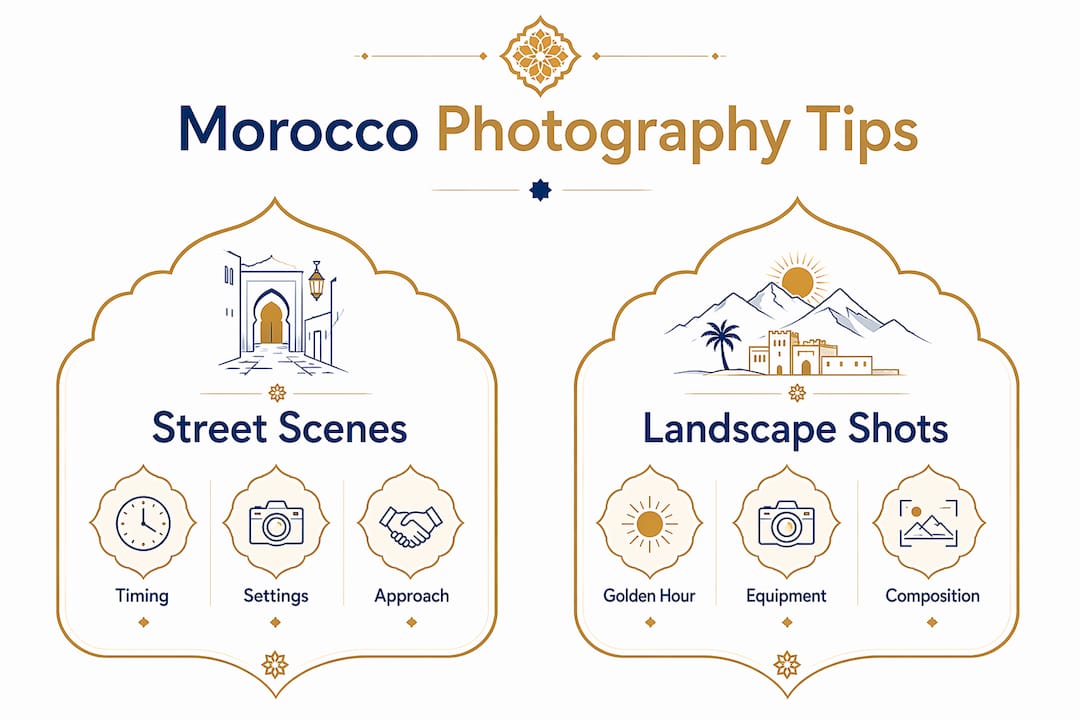
Lighting in narrow medina streets does not follow standard golden hour rules. The sun rarely reaches alley floors when it is low on the horizon, so you often need to shoot later in the morning when the sun is high enough to penetrate the deep corridors. Look for specific alleys where the low morning sun angles directly through the full length of the street—these exist, but you have to scout them.
- Use a 24-70mm zoom for flexibility in tight spaces
- A wide-angle lens (16-35mm) lets you shoot candidly without pointing the camera directly at subjects
- Shoot street scenes at around ISO 320, f/5.6 to f/8, and a shutter speed near 1/400 s to freeze motion
Where to find Morocco’s most dramatic landscape photography
Morocco’s terrain shifts from Atlantic coastline to alpine passes to Saharan dunes within a few hours of driving. Each zone has its own photographic logic.
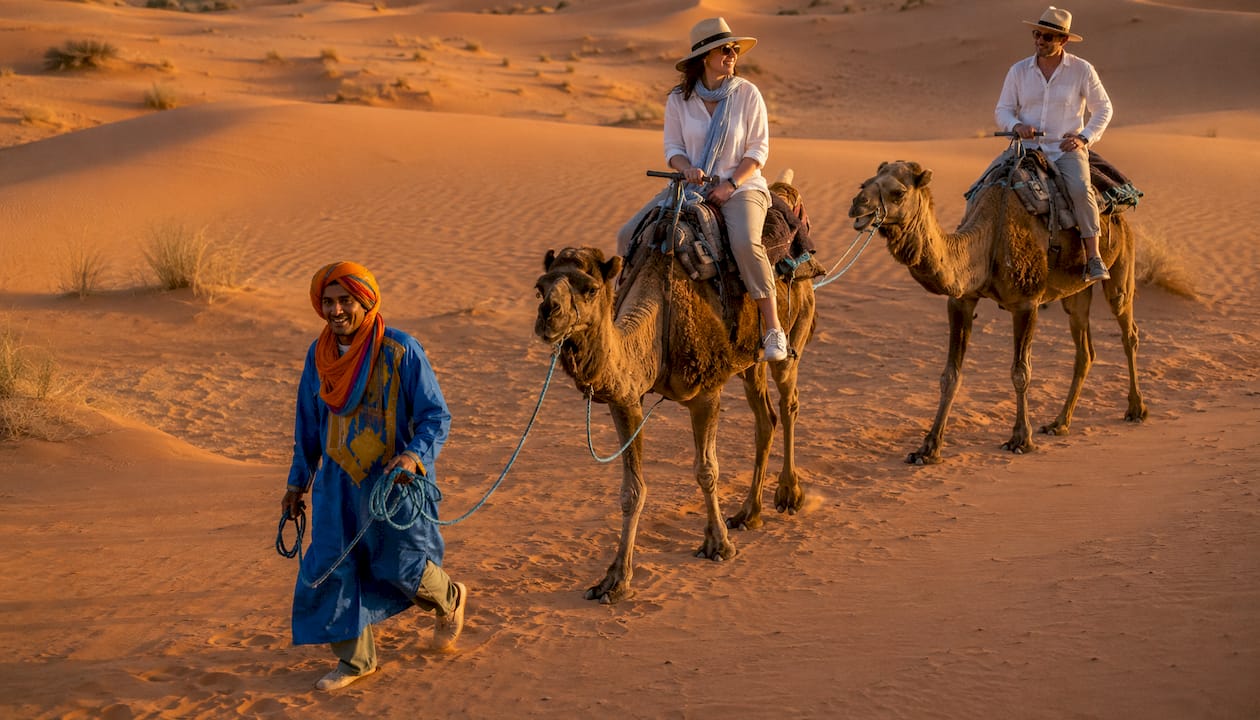
The Sahara Desert is the headline. Erg Chebbi near Merzouga and Erg Chigaga near M’Hamid both deliver classic dune photography: camel caravans at sunrise, long shadow ridgelines at dusk, and near-zero light pollution for astrophotography after dark. Erg Chigaga is the less-visited of the two, which means fewer tourists in your frame. The best light hits the dunes at dawn and the hour before sunset, when warm highlights and deep shadows carve the sand into graphic shapes.
The Atlas Mountains offer a completely different palette. Villages cling to hillsides, terraced fields step down toward river valleys, and the light at altitude is cleaner and cooler than in the lowlands. Imlil, the base village for Mount Toubkal treks, sits surrounded by rivers and mountain faces that photograph well in any season. Snow on the peaks from November through April adds a layer most visitors do not expect from Morocco.
Legzira Beach on the Atlantic coast features dramatic red sandstone arches accessible only at low tide. Sunset turns the cliffs a vivid orange-red. The Ouzoud Waterfalls, the tallest in North Africa, photograph best in the early morning before tour groups arrive. Paradise Valley, a palm-lined oasis in the High Atlas foothills, stays quieter than the major sites and rewards photographers who visit outside peak summer months.
- Shoot desert landscapes at ISO 50, f/11 to f/16 for maximum sharpness and dynamic range
- Use a graduated ND filter to balance bright sky against darker dune foregrounds
- Scout coastal arch locations at low tide the day before your planned shoot
Pro Tip: For Erg Chigaga, arrange a Berber guide with dromedaries for a dedicated sunset shoot around the dunes. The combination of animal silhouettes and raking light creates images that standard tourist camel rides simply cannot replicate.
Cultural, market, and lifestyle photography in Morocco
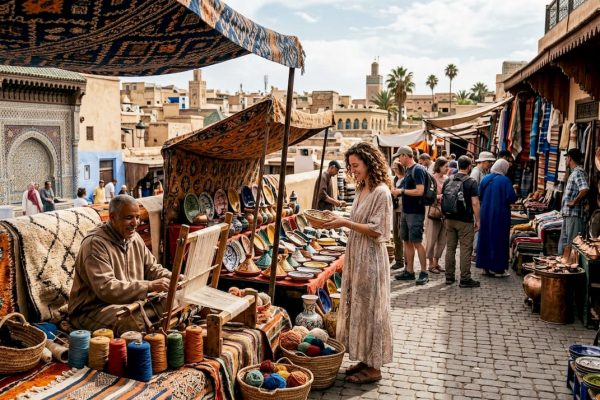
The souks of Marrakech and Fes are visually extraordinary: stacked leather goods, spice pyramids, weavers at wooden looms, and light filtering through reed-covered rooftops. Getting compelling images here is as much about people skills as camera technique.
Building a connection before raising the camera consistently produces better results than shooting from a distance. Showing subjects the photos you have already taken, especially children, creates immediate goodwill. If you carry a Polaroid camera, giving away prints generates genuine smiles and often leads to more relaxed, natural portraits. Learning a few words of Darija, the Moroccan Arabic dialect, signals respect: “Salam” (hello) and “Shukran” (thank you) go a long way before you even ask for a photo.
The Chouara Tannery in Fes is one of the most photographed spots in Morocco. Several leather shops surrounding it offer free rooftop access in exchange for browsing their goods. The best light falls on the tanning vats in the morning. Midday flattens the colors, and the smell intensifies considerably, which shortens most photographers’ visits anyway.
- Ask permission with “Mumkin soura?” before photographing individuals
- Tipping is customary and expected in tourist areas; treat it as a modeling fee
- Avoid photographing women without explicit consent, particularly in more conservative areas
- Traditional festivals and weekly souks in smaller towns offer less-staged cultural scenes than the major medinas
Photographing Morocco’s architecture and historic sites
Morocco’s architectural heritage spans Roman ruins, medieval Islamic monuments, and French colonial buildings. The photographic challenge is usually not finding a beautiful subject — it is managing light, crowds, and scale simultaneously.
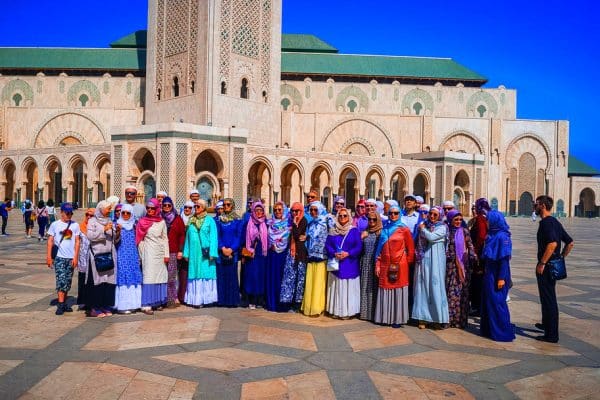
The Hassan II Mosque in Casablanca is one of the largest mosques in the world, with a minaret standing at 210 meters. Its sheer scale means you need to walk several hundred meters away to capture the full structure in a single frame. The Park Marina to the east provides a strong vantage point at sunset, and the tidal pools along the shore offer foreground reflection opportunities at low tide. During blue hour before sunrise, the mosque plaza itself works well for a wide-angle composition, though guards will discourage lingering with a tripod.
Aït Benhaddou is a UNESCO World Heritage Site and one of the most cinematic locations in Morocco. The best light hits the kasbah walls 30–45 minutes before sunset, turning the earthen architecture a deep amber. The riverbank below and the viewpoint just south of the settlement are the two strongest positions. Arrive early to scout before the tour buses appear.
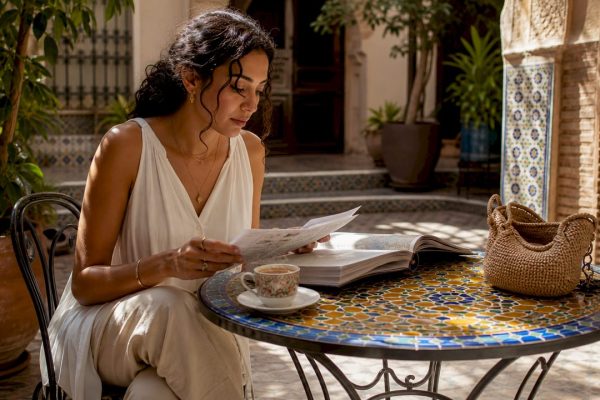
Traditional riads offer a different architectural challenge: intimate courtyards, intricate tilework, and overhead light that shifts dramatically through the day. A stay in a well-chosen riad gives you access to these interiors at dawn and dusk, when the light is softest and the other guests are still asleep.
- Use a 16-35mm wide-angle for interior courtyards and mosque facades
- A fast prime (35mm f/1.8) handles low-light riad interiors without flash
- Shoot Aït Benhaddou from the river at late afternoon for the strongest warm light on the walls
- Always check photography permissions at mosques; non-Muslims cannot enter most Moroccan mosques
Gear and lens recommendations for Morocco’s environments
The right kit for Morocco covers three distinct environments: dense urban medinas, open desert, and coastal or mountain terrain. No single lens handles all three perfectly, but a well-chosen set of three covers everything.
A 24-70mm zoom is the primary workhorse, covering portraits, market scenes, and moderate architecture. Pair it with a 16-35mm wide-angle for desert dunes and mosque interiors, and a 70-200mm telephoto for candid street portraits and compressing dune layers in the Sahara. For low-light medina work, a fast prime at 35mm or 50mm f/1.8 outperforms any zoom.
Sand is the single biggest threat to your gear. Always point the camera body downward during lens changes and use a rocket blower daily. A weather-sealed camera body is worth the investment if you plan to spend time in the desert. Carry a soft paintbrush and lens cleaning tissues for daily maintenance.
- Tripod: Lightweight carbon fiber for desert and coastal long exposures
- ND filters: 6-stop and 10-stop for long exposures at waterfalls and coastal scenes
- Extra batteries: Cold Atlas Mountain mornings drain batteries faster than expected
- Memory cards: High-speed cards are difficult to find in Morocco; bring more than you think you need
- Protective cover: A wet weather cover doubles as a dust shield in sandstorm conditions
Pro Tip: Shoot street and documentary scenes at ISO 320, f/5.6 to f/8, and 1/400s as a starting point. In open shade inside a medina, push ISO to 800 or higher rather than slowing the shutter and losing sharpness to subject movement.
How to photograph people and portraits in Morocco
Portrait photography in Morocco sits at the intersection of technical skill and genuine human connection. The country’s people are visually compelling subjects: weathered faces in mountain villages, blue-robed Berber traders in the desert, craftspeople absorbed in work that has not changed in centuries.
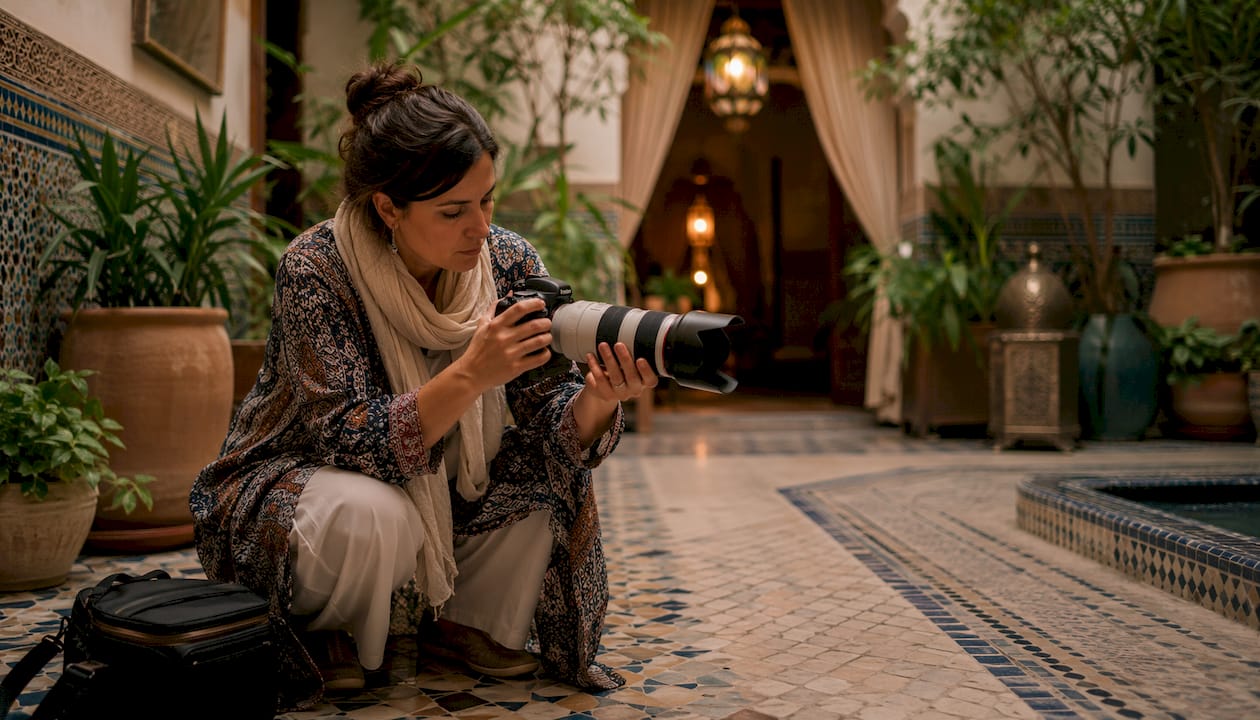
The most effective approach is the direct one. Make eye contact, smile, and ask before raising the camera. When someone agrees, work quickly and show them the result immediately. People who see a flattering image of themselves on your screen often relax and offer a second, more natural pose. Children are almost universally enthusiastic about seeing themselves on camera.
For environmental portraits in markets and workshops, position yourself so the subject’s natural work environment fills the background. A leather worker at the tannery, a spice vendor arranging pyramids of cumin and paprika, and a weaver at a loom in the Fes medina—these subjects are already in their element. Your job is to stay out of the way of that and capture it honestly.
The 70-200mm telephoto is useful for portraits where you want to compress the background and isolate the subject, but it can feel intrusive in tight spaces. In narrow alleys, a 50mm or 85mm prime gives a more natural perspective and lets you stay close enough to maintain the connection you built before shooting.
Tips for respecting cultural sensitivities and obtaining consent
Morocco is a predominantly Muslim country, and photography norms reflect that. Women, particularly in rural and more conservative areas, often prefer not to be photographed. Photographing someone who has declined or who looks uncomfortable is not a gray area — put the camera down.
The phrase “Mumkin soura?” is the standard request for permission and is understood across Morocco. Some people will ask for a small tip in return, which is a reasonable exchange in tourist-heavy areas. Tipping is not a transaction that guarantees a good photo; it is an acknowledgment that you are asking someone to pause their day for you.
Certain subjects are off-limits regardless of permission. Military installations, government buildings, and border areas carry restrictions that are enforced. Morocco also has strict drone regulations, and flying without formal permits can result in confiscation of equipment. Research current drone rules before you travel, as they change.
Religious sites require particular care. Photography inside mosques is generally not permitted for non-Muslim visitors. During prayer times, avoid pointing cameras at worshippers even from outside. The call to prayer is a moment of genuine devotion, not a photo opportunity.
How to handle Morocco’s unique lighting challenges
Morocco’s light is extraordinary and difficult in equal measure. The country sits at a latitude where the sun climbs high and fast, which means the soft golden hour window is shorter than in northern Europe or North America. In the desert, midday light bleaches color from the dunes and creates flat, featureless images. In medina alleys, the opposite problem applies: deep shadow and blown-out patches of direct sun create contrast ratios that challenge any sensor.
The solution in medinas is to expose the highlights. Let the shadows go dark rather than blowing out the bright patches of light. A camera with strong dynamic range gives you more latitude in post-processing, but the exposure decision happens at capture. The “fishing” technique works well here: find a spot where light falls cleanly, set your exposure for that light, and wait for a subject to walk into the frame rather than chasing subjects through the crowd.
In the desert, the best light is at the edges of the day. Dawn in the Sahara is often clearer than dusk, with cooler air and less atmospheric haze. Dusk brings warmer tones but also wind that can kick up fine sand. A UV filter protects the front element without affecting image quality, and a lens hood reduces flare from the intense overhead sun.
White balance in Morocco tends to run warm. Shooting in RAW gives you full control in post. Carry a gray card or a color checker card for reference shots when color accuracy matters, particularly for architectural interiors where mixed light sources create color casts.
How to reach remote and less-touristed photography spots
The most iconic locations in Morocco — Chefchaouen, Jemaa El Fna, Aït Benhaddou — are well-documented and increasingly crowded. Getting off that circuit requires planning, but the rewards are real.
Renting a car is the most practical way to reach places like Legzira Beach, the Draa Valley, Tinerhir Oasis, and the Akchour Waterfalls near Chefchaouen. The Akchour falls sit inside Talassemtane National Park and require a 45-minute hike through a canyon to reach the upper cascade. The payoff is a 100-meter waterfall with a fraction of the visitors that Ouzoud draws. God’s Bridge, a natural rock arch near Akchour, is another location that most photographers skip entirely.
A private guided tour solves the access problem for remote desert locations like Erg Chigaga. The dunes there sit roughly three hours from the nearest paved road, and navigating without a local guide is genuinely difficult. The reward is a landscape that looks nothing like the heavily photographed Erg Chebbi, with fewer tourists and more space to compose.
For urban locations, the timing strategy is simple: arrive before the tour buses. The Marinid Tombs viewpoint above Fes is packed by 9 AM. At 6:30 AM, you may have it to yourself. Chefchaouen’s famous blue streets photograph best in the soft light of early morning, before the day-trippers arrive from Fes and Tetouan.
Pro Tip: Ask your accommodation host or a local guide about weekly souks in smaller towns near your base. These rotating markets draw local traders and buyers rather than tourists, and the photography opportunities are far more authentic than anything in the main medinas.
Post-processing tips for Moroccan photography scenes
Morocco’s color palette is specific: terracotta reds, cobalt blues, saffron yellows, and the warm amber of desert sand. Post-processing that ignores this palette produces images that look generic. Processing that leans into it produces images that are unmistakably Moroccan.
Shoot in RAW format without exception. The dynamic range challenges in medinas and the color complexity of market scenes require the full latitude that RAW provides. In Adobe Lightroom or Capture One, start with highlight recovery in high-contrast medina shots before touching anything else. Pulling highlights down by 40–60 points often reveals detail in blown-out patches of direct sunlight that would otherwise be lost.
For desert images, a slight lift in the orange and red luminance channels brings out the texture of sand without oversaturating. Clarity and texture sliders add definition to dune ridgelines without the artificial look that heavy sharpening creates. For blue-hour city shots, cooling the white balance slightly and lifting the shadows preserves the mood without losing detail in the darker areas.
Chefchaouen’s blue walls tend to shift toward cyan in cameras. In post-processing, pulling the blue hue slider slightly toward purple restores the painted, saturated blue that the eye actually sees on location. This is a small adjustment, but it makes a visible difference in the final image.
Safety considerations for photographers in busy or sensitive locations
Morocco is generally safe for photographers, but situational awareness matters in crowded medinas and at sensitive sites. Jemaa El Fna in Marrakech, particularly in the evening, draws performers who actively seek payment for being photographed. Snake charmers and henna artists will approach tourists with cameras. If you photograph them without agreeing on a price first, expect a demand afterward. Agree on terms before shooting or decline politely and move on.
Keep camera straps short and bags closed in dense market areas. Petty theft is not common, but a camera dangling on a long strap in a crowded souk is an unnecessary risk. A cross-body bag with a secure closure is more practical than a backpack in tight medina streets.
Having a local guide is a genuine advantage beyond navigation. A guide who speaks Arabic and French can de-escalate situations where a local objects to being photographed, explain your intentions, and help you access locations that would otherwise be closed to an unaccompanied foreign photographer. Morocco feels safe, but local knowledge makes it feel easier.
At sensitive locations like military sites, border areas, and government buildings, do not photograph even if no sign prohibits it. If a uniformed official asks you to stop, comply immediately and delete the images if asked. This is not a situation where asserting your rights as a photographer is worth the outcome.
Ready to turn this guide into a real trip? Moroccotours designs private photography tours built around the locations and timing windows that matter most for serious photographers, from Sahara Desert camps to medina access with local guides. For a fully customized itinerary, the Moroccotours travel agency team handles every logistical detail so you can focus on the images.
Key Takeaways
Morocco rewards photographers who prepare for its light, respect its culture, and get off the main tourist circuit to find the scenes that most visitors miss.
| Point | Details |
|---|---|
| Shoot at the edges of the day | Early morning before 10 AM and the hour before sunset deliver the best light across all location types. |
| Medina lighting requires adaptation | Standard golden hour rules don’t apply in narrow alleys; expose for highlights and use the “fishing” technique. |
| Gear for three environments | A 24-70mm zoom, 16-35mm wide-angle, and 70-200mm telephoto cover medinas, architecture, and desert scenes. |
| Always ask permission | “Mumkin soura?” is the standard phrase; tipping is customary and respectful in tourist areas. |
| Protect gear from sand | Point the camera body downward during lens changes and use a rocket blower daily in desert conditions. |
FAQ
What is the best time of year to photograph in Morocco?
March through May and September through November offer the best combination of mild temperatures and quality light. July and August push desert temperatures to very high levels, making extended outdoor shooting physically demanding.
Which lens should you prioritize for Morocco travel photography?
A 24-70mm zoom covers the widest range of situations and is the most practical single lens for Morocco. Add a 16-35mm wide-angle for desert dunes and mosque interiors, and a fast prime like a 50mm f/1.8 for low-light medina work.
How do you ask permission to photograph someone in Morocco?
Use the phrase “Mumkin soura?” which means “Can I take a photo?” in Arabic. A small tip is customary in tourist areas and should be treated as a reasonable modeling fee rather than a nuisance.
Is drone photography allowed in Morocco?
Morocco has strict drone regulations, and flying without formal permits can result in equipment confiscation. Research current rules and apply for the necessary permissions well before your trip.
What are the best less-touristed photography spots in Morocco?
Erg Chigaga in the Sahara, the Akchour Waterfalls near Chefchaouen, Legzira Beach at low tide, and the Draa Valley all offer strong photographic opportunities with far fewer visitors than the headline locations.
Itinerary Expand all Collapse all
Included
Price
Related Tours
Morocco Desert Tour
Northern Morocco Tour
Morocco Family Tour
Morocco Spain Tour
Morocco Trekking Tour
Morocco Highlights Tour
Morocco Group Tour
Morocco Jewish Tour
Morocco Honeymoon Tour
Morocco Food Tour
Morocco Golf Tour
Morocco Photography Tour
Morocco Signature Tour
Morocco Imperial Cities Tour
Morocco Grand Tour

Is Morocco Safe for Solo Women? Your Guide
Is Morocco Safe for Tourists? Your Guide
Morocco Travel Tips for First Time Visitors

How Many Days Do You Need in Morocco

What to Know Before Visiting Morocco

10 Mistakes Travelers Make in Morocco

Morocco Travel Agency: Plan Your Luxury Tour

Morocco Visa Guide: Requirements and How to Apply

Morocco for Seniors: A Comfort-First Travel Guide

Luxury Morocco Travel: The Guide for Discerning Travelers

Morocco Train Guide: Routes, Tickets, and Tips

Internet in Morocco: Your Connectivity Guide

Morocco Airport Guide: Arrive and Depart With Confidence

Morocco with Kids: The Family Travel Guide

Morocco Honeymoon Guide: Romantic Trips

Morocco Packing List: What to Pack for Every Region

What to Wear in Morocco: A Female Traveler's Guide

Morocco Jewish Heritage Guide: Sites, History & Culture

Morocco Photography Guide: Capture Every Scene Like a Pro
