
Morocco Language Guide: Essential Phrases for Travelers
Highlights
Before you land in Morocco, memorize these. They will get you through your first day without a translator:
- Salam (sa-LAM) — casual hello, works everywhere
- Shukran (SHOO-kran) — thank you
- La shukran (la SHOO-kran) — no thank you (your best tool in any souk)
- Afak (ah-FAK) — please
- Labas? (la-BASS) — how are you? (literally “no problems?”)
- Bslama (b-SLA-ma) — goodbye
- Fin…? (FEEN) — where is…?
- Besh’hal? (besh-HAL) — how much?
- Ma fhemtsh (ma FHEMT-sh) — I don’t understand
- Smeh liya (SMEH lee-ya) — excuse me / sorry
These ten phrases alone will open more doors than a phrasebook ever could.
Table of Contents
- What languages will you actually hear in Morocco?
- Basic greetings and everyday expressions in Darija
- Shopping, bargaining, and finding your way around
- Dining, food phrases, and emergency vocabulary
- How to pronounce Darija without losing your mind
- Cultural tips that make your language land better
- How regional dialects affect what you hear across Morocco
- Resources and tools for learning Moroccan Arabic before your trip
- Key Takeaways
- FAQ
What languages will you actually hear in Morocco?
Morocco’s linguistic diversity surprises most first-time visitors. The country officially recognizes Modern Standard Arabic and Amazigh (Berber) as its two official languages. Modern Standard Arabic appears in government documents, news broadcasts, and formal education. Amazigh, written in the ancient Tifinagh script, is the indigenous language of Morocco’s Berber population and was constitutionally recognized in 2011.
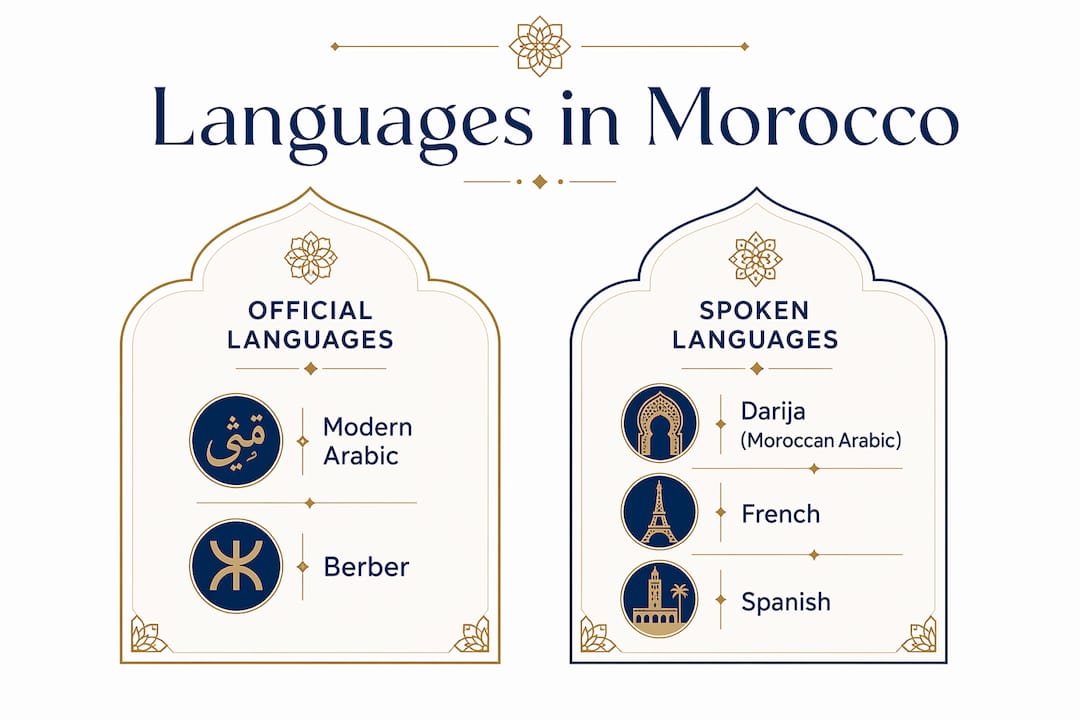
But here’s what matters for your trip: neither of those is what you’ll hear on the street. The everyday spoken language is Darija, Moroccan Arabic. It shares a significant portion of its vocabulary with Modern Standard Arabic but differs so sharply in pronunciation, grammar, and borrowed vocabulary that speakers of standard Arabic from Egypt or Jordan often struggle to follow it. Darija pulls words from Amazigh, French, and Spanish, making it genuinely its own thing.
French is the other language you’ll encounter constantly, especially in Casablanca, Rabat, and tourist-facing businesses. It holds no official status but functions as the language of commerce, higher education, and urban professional life. In northern cities like Tangier and Tetouan, Spanish is still common, a remnant of the Spanish protectorate era. English is growing fast among younger Moroccans and in surf towns and tourist hubs, but don’t count on it outside those pockets.
Basic greetings and everyday expressions in Darija
Greetings carry real social weight in Morocco. Skipping them, even with a shopkeeper you’re just passing, reads as cold or dismissive. The good news: the phrases are short and Moroccans genuinely appreciate any attempt.
- Salam alaykum (sa-LAM ah-LAY-kum) — formal hello; the response is wa alaykum salam
- Salam — informal hello, perfectly acceptable in most settings
- Labas? — how are you? The standard reply is Labas, hamdulillah (fine, praise God)
- Sbah lkhir (SBA-h l-KHEER) — good morning; the reply is Sbah nour
- Bslama — goodbye
- Shukran bzaf — thank you very much
- Makayn mushkil (ma-KAYN moosh-KEEL) — no problem / you’re welcome
- Iyeh / La (ee-YEH / LA) — yes / no
- Inshallah (in-SHA-lah) — God willing; you’ll hear this constantly
Moroccans appreciate any effort to speak Darija, even imperfect attempts. A stumbled “Labas?” with a smile gets you warmer service and more honest prices than perfect silence.
Pro Tip: Don’t overthink the formal versus informal distinction. “Salam” works in nearly every casual setting. Save “Salam alaykum” for entering a shop or greeting an elder, and you’ll always land on the right side of polite.
Shopping, bargaining, and finding your way around
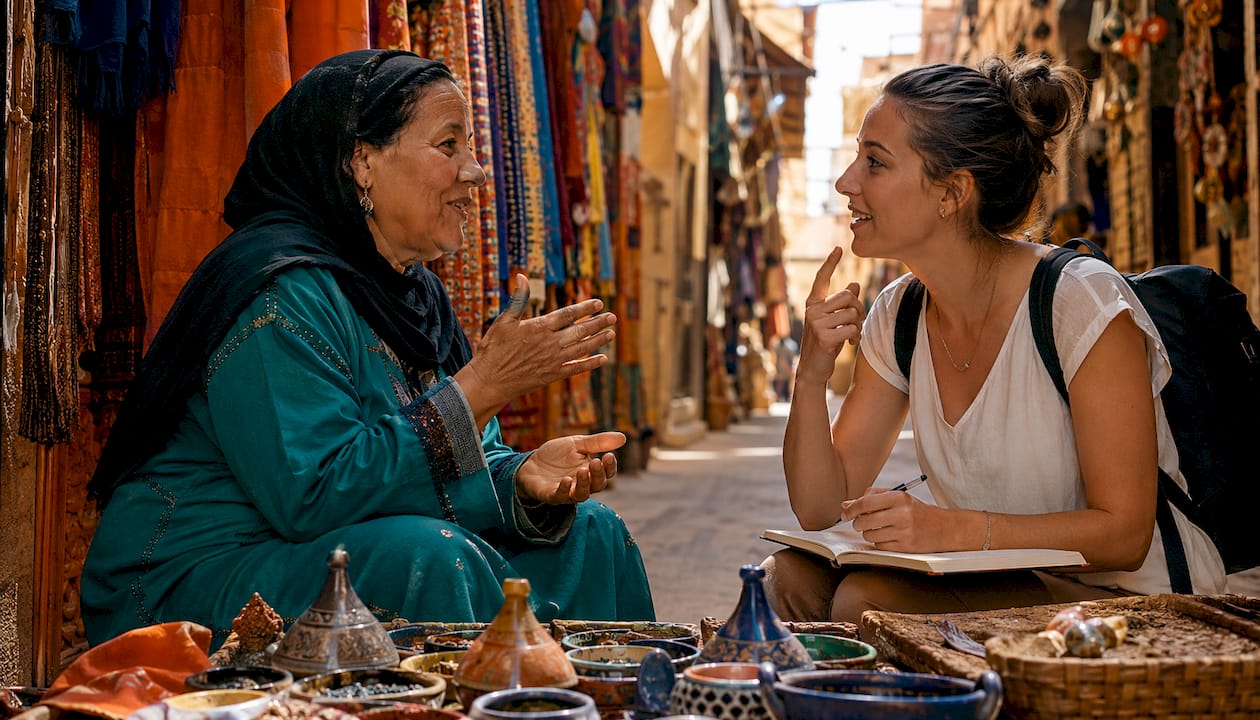
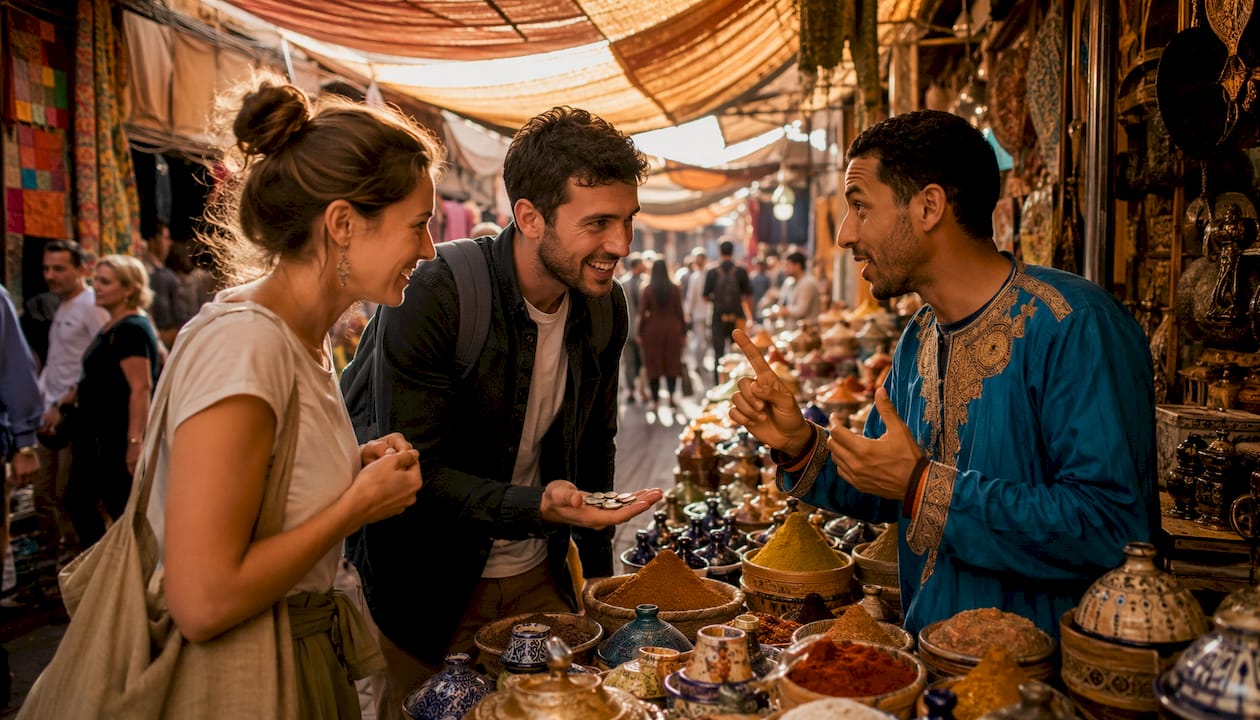
Moroccan markets run on conversation. Knowing a handful of commerce phrases shifts the dynamic entirely, and a polite but firm refusal like “La shukran” ends unwanted negotiations without offense.
For the souk:
- Besh’hal hadi? — how much is this?
- Ghali bzaf! — too expensive!
- Rkhis (r-KHEES) — cheap
- Bghit nshri (b-GHEET n-SHREE) — I want to buy
- La shukran — no thank you (say it once, firmly, and walk)
- Safi (SAH-fee) — okay / enough / done (one word, many meanings)
Numbers for bargaining:
| Number | Darija | Pronunciation |
|---|---|---|
| 1 | Wahed | WAH-hed |
| — | Jouj | JOOJ |
| — | Khamsa | KHAM-sa |
| 10 | Ashra | ASH-ra |
| — | Eshrin | ESH-reen |
| — | Mya | MEE-ya |
For getting around:
- Fin kayn…? — where is…?
- Taxi / Tobis — taxi / bus
- Liser / Limen — left / right
- Neeshan — straight ahead
- Wqef hna — stop here
- Besh’hal le taxi l…? — how much is the taxi to…?
One thing worth knowing: Morocco has two taxi types. The petit taxi (small, colored by city) handles short urban trips; the grand taxi covers intercity routes. Knowing the difference saves you from negotiating the wrong fare entirely. You can read more about navigating Morocco’s transport options before you go.
Dining, food phrases, and emergency vocabulary
Moroccan food culture is generous and social. A few words go a long way at any restaurant or street stall. And knowing emergency phrases before you need them is just smart travel.
At the table:
- Lma (l-MA) — water
- Khobz (KHOBZ) — bread
- Atay b’naanaa — mint tea
- Qahwa — coffee
- Lhem / Djaj / Hoot — meat / chicken / fish
- Jiaan — I’m hungry
- Bghit ntleb — I want to order
- L-hsab afak — the bill, please
- Ldid — delicious
- Ma kanakol lhem — I don’t eat meat
Pair these with your knowledge of Moroccan cuisine and you’ll navigate any menu with confidence.
Emergency phrases:
- Awni! (OW-nee) — help!
- Bghit tbib — I need a doctor
- Sbitar — hospital
- Farmasiya — pharmacy
- Bolis — police
- Ana tleft — I am lost
- Iyed ambulance — call an ambulance
- Tsraq l-portmoni dyali — my wallet was stolen
Save these in your phone before you travel. You won’t need most of them, but the one time you do, you’ll be glad they’re there.
How to pronounce Darija without losing your mind
Darija is primarily an oral language with no standardized written form. That’s actually good news for travelers: there’s no “correct” spelling to memorize, and locals judge you on sound, not script.
A few sounds will trip up English speakers:
- Kh — a guttural sound from the back of the throat, like the “ch” in the Scottish “loch.” Found in khobz (bread) and khayr (good).
- Gh — similar but voiced, like a soft gargle. Appears in ghali (expensive).
- 3 — in digital Darija writing, the number 3 represents the Arabic letter ayn, a deep throat constriction with no English equivalent. You’ll see it in transliterations like 3afak (please).
- 7 — represents ha, a breathy “h” sound. Appears Alhamdulillah.
- 9 — represents qaf, a deep “k” sound from the back of the throat.
Moroccan Arabic uses these numerals in informal digital writing because Latin letters simply can’t capture those sounds. When you see them in texts or online, they’re phonetic stand-ins, not typos.
Pronunciation also shifts by region. Casablanca Darija sounds noticeably different from Marrakech Darija, and the north has its own rhythm influenced by Spanish. Don’t let that discourage you. Core vocabulary stays consistent enough that your phrases will land anywhere.
Pro Tip: Skip the written phrasebook as your primary tool. Find a short Darija audio clip on YouTube, listen to it ten times, then repeat. Ten minutes of audio exposure beats an hour of reading transliterations.
Cultural tips that make your language land better
Language in Morocco is inseparable from social ritual. A few cultural notes will stop you from accidentally offending someone while trying to be friendly.
Greetings are non-negotiable. Entering a shop, sitting down at a café, or starting any transaction without a greeting first reads as rude. Even a quick “Salam” before asking your question changes the entire tone of the interaction.
“Habibi” needs context. The word means “my dear” or “my love” in Arabic, and while it’s used casually between close friends in some Arab cultures, in Morocco it carries a more intimate weight. Using it with strangers, especially across genders, can come across as flirtatious or overly familiar. Save it for people you actually know.
Try one word of Amazigh. Saying Azul (ah-ZOOL, hello in Tachelhit Berber) to someone in a rural area or the Atlas Mountains creates instant warmth. It signals that you see them as more than a transaction. Even a single Amazigh word can shift the entire dynamic of an encounter.
Code-switching is normal. Moroccans routinely mix Darija, French, and Amazigh within a single conversation. Don’t be thrown off when someone answers your Darija phrase in French. It’s not a correction; it’s just how the language works here. Avoiding common traveler mistakes often comes down to reading these social cues correctly.
How regional dialects affect what you hear across Morocco
Morocco is not linguistically uniform, and the differences are real enough to affect comprehension.
In Casablanca and Rabat, you’ll hear the most “standard” Darija, heavily influenced by French and familiar to most Moroccans from TV and media. This is the dialect most learning resources teach.
Marrakech Darija has a distinct rhythm and some vocabulary differences, particularly around the medina and souks. Vendors there also tend to switch to English or French quickly with tourists.
The northern regions around Tangier, Tetouan, and Chefchaouen carry strong Spanish influence. You’ll hear Spanish words woven into everyday speech, and some older residents speak Spanish more fluently than French.
Rural and mountain communities in the Atlas and Souss regions often speak Tachelhit or Central Atlas Tamazight as their primary language, with Darija as a second. French may be limited. This is where knowing even a few Amazigh phrases pays off most.
The practical takeaway: learn core Darija, and you’ll be understood everywhere. But adjust your expectations for comprehension speed. A fast-talking Fez medina vendor sounds very different from a Marrakech café owner, even when they’re technically speaking the same dialect.
Resources and tools for learning Moroccan Arabic before your trip
The good news is that Darija learning resources have improved dramatically in recent years.
Apps and online courses:
- Loecsen offers a free structured Darija course built around real spoken phrases and audio, targeting the CEFR A1 level. It’s one of the few platforms that treats Darija as its own language rather than a footnote to standard Arabic.
- SpeakMoroccan.com organizes lessons by real-life scenario: markets, taxis, hotels, and family visits. The unit structure is practical, and the audio is clear.
- YouTube has a growing number of native Darija teachers. Search for slow speech. Darija lessons specifically: fast native-speed content is useful for ear training but rough for beginners.
Books:
- An Introduction to Moroccan Arabic by Ernest T. Abdel-Massih (University of Michigan) is the most academically rigorous option and is available open-access through HathiTrust.
- The Wikivoyage Moroccan Arabic phrasebook is a solid free reference with transliterations and audio links for common travel phrases.
In Morocco:
Local language schools in Marrakech, Fez, and Rabat offer short-term Darija immersion courses, often one to two weeks. These are worth considering if you plan an extended stay. The combination of classroom instruction and immediate street practice accelerates learning faster than any app.
The single most effective preparation, though, is ten minutes of Darija audio daily for the month before your trip. By the time you land, the rhythm of the language will feel familiar even if the words don’t all click yet.
Key Takeaways
Darija is the language that actually runs daily life in Morocco, and even basic phrases dramatically improve your travel experience.
| Point | Details |
|---|---|
| Darija is the key dialect | Moroccan Arabic (Darija) shares 70–75% vocabulary with Modern Standard Arabic but sounds and functions very differently. |
| French is your backup | French is widely understood in cities and tourism settings, even without official status. |
| Greetings come first | Always open any interaction with a greeting; skipping it reads as rude in Moroccan culture. |
| “La shukran” is essential | This polite refusal ends souk negotiations respectfully without confrontation. |
| Audio beats text | Darija has no standardized written form; learning through listening is more effective than memorizing transliterations. |
FAQ
How do you say “hi” in Moroccan?
The most common casual greeting is Salam (sa-LAM). For a more formal hello, use Salam alaykum, to which the standard reply is wa alaykum salam.
Do Moroccans speak Arabic or Spanish?
Most Moroccans speak Darija (Moroccan Arabic) as their everyday language, with French widely used in cities and business. Spanish is common in northern Morocco, particularly around Tangier and Tetouan, due to historical Spanish influence in the region.
Can you say “habibi” to a Moroccan?
Use it carefully. In Morocco, “habibi” carries a more intimate connotation than in some other Arab cultures, and using it with strangers, especially across genders, can come across as overly familiar or flirtatious. It’s best reserved for people you already know well.
How do I say “please” in Moroccan?
Afak (ah-FAK) is the standard word for “please” in Darija. You’ll also hear 3afak, which is the same word written with the numeral representing the Arabic letter ayn.
Itinerary Expand all Collapse all
Included
Price
Related Tours
Morocco Desert Tour
Northern Morocco Tour
Morocco Family Tour
Morocco Spain Tour
Morocco Trekking Tour
Morocco Highlights Tour
Morocco Group Tour
Morocco Jewish Tour
Morocco Honeymoon Tour
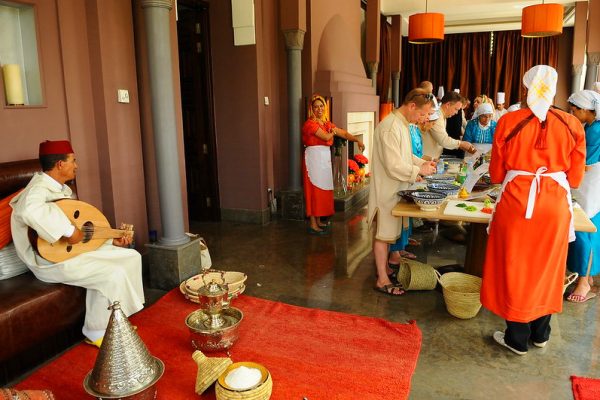
Morocco Food Tour
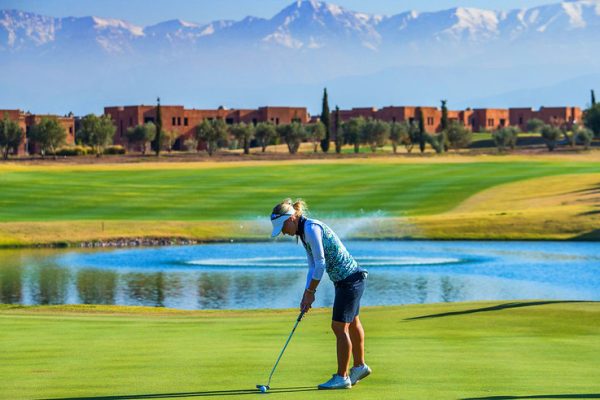
Morocco Golf Tour
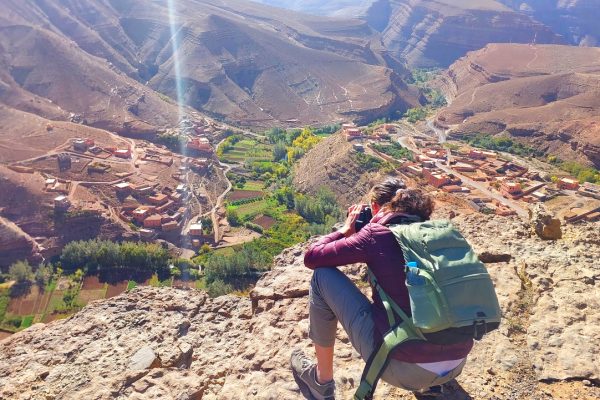
Morocco Photography Tour
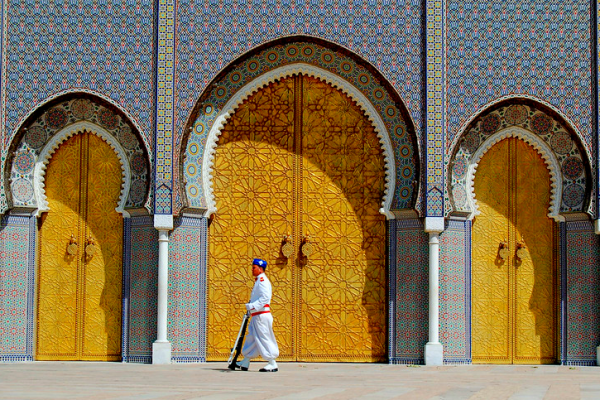
Morocco Signature Tour
Morocco Imperial Cities Tour
Morocco Grand Tour

Is Morocco Safe for Solo Women? Your Guide
Is Morocco Safe for Tourists? Your Guide
Morocco Travel Tips for First Time Visitors

How Many Days Do You Need in Morocco

What to Know Before Visiting Morocco

10 Mistakes Travelers Make in Morocco

Morocco Travel Agency: Plan Your Luxury Tour

Morocco Visa Guide: Requirements and How to Apply

Morocco for Seniors: A Comfort-First Travel Guide

Luxury Morocco Travel: The Guide for Discerning Travelers

Morocco Train Guide: Routes, Tickets, and Tips

Internet in Morocco: Your Connectivity Guide

Morocco Airport Guide: Arrive and Depart With Confidence

Morocco with Kids: The Family Travel Guide

Morocco Honeymoon Guide: Romantic Trips

Morocco Packing List: What to Pack for Every Region

What to Wear in Morocco: A Female Traveler's Guide

Morocco Jewish Heritage Guide: Sites, History & Culture

Morocco Photography Guide: Capture Every Scene Like a Pro
